About.......Contact.......Society.....................
Showing posts with label Health. Show all posts

Sunday, December 4, 2016

Three (Godly) Reasons to Get Some Sleep

Three Reasons to Get Some Sleep
By Jonathan Parnell
Pastor, Minneapolis, Minnesota

[Full article below]

----------------------------------------------------------

Life is short. Stay awake for it.

So goes the tagline for the second largest coffee franchise in America. It’s catchy and practical. Drink our coffee, it suggests, not merely for its taste, but for its benefits, that is, to be awake to life. And the reason being — here comes the resonating connection — life is short. The clock is ticking. Our days are numbered. And we Christians agree (Psalm 90:10; 103:15–16; James 4:14).

Life is too short to sleep all the time.

But life is also too short not to sleep a large part of the time.

The fact is humans need sleep, between 7–8 hours a day. But most of us aren’t getting it. According to studies from the Centers for Disease Control and Prevention, sleep deprivation is epidemic. In the last week articles and infographs have been circulating the web with convincing evidence that this is the real deal.

In addition to that content, here are three reasons why you should get some sleep.

1. God created you to require sleep for a healthy life

In a sense, this highlights the most intuitive reason why we need sleep: to survive. Most of us (not all of us) know from experience that going without ample sleep has drastic effects on us physically and emotionally. The latest study claims that going just one night with less than six hours of sleep may alter our genes and cause several side effects — from a higher chance of catching a cold to the loss of brain tissue.

But perhaps the most shared result is that without enough sleep we’re “more likely to get emotional.” Now we know how to fill in that generic term. Without enough sleep, we are more easily stressed and frustrated. Our capacity for patience dissipates. Lack of sleep is a sucker-punch to our ability to listen and think creatively, and therefore be productive.

Personally, one of the toughest things during my time in seminary was sleeplessness (and I think I got more than most guys). David Mathis and I don’t mention sleep in our little book How to Stay Christian in Seminary, but it could easily merit its own chapter. Days that followed only a few hours of shut-eye often meant the Hebrew was harder and our home was unhappy. But a good night of sleep was like its own mini-vacation, and it still is.

God created us this way. Just like oxygen and food, we need sleep to work right. It won’t look the same for everyone, and some are in situations where their care for others inhibits a solid snooze, but know for sure that we need sleep. It was God’s idea.

2. Sleep is the midwife of humility

Humility is a heart-virtue that gestates. It matures over time, born by truth and practice. We believe facts about reality (we’re needy creatures, not autonomous beings), and we act in step with those facts.

Next to prayer, sleep may be the most central practice that lines up with the truth of who we are. Sleep is that necessary moment that comes every single day when our bodies go slow and our minds start dragging. They witness to our fragility. And eventually, we will surrender. Our problem, as the studies suggest, is that we don’t surrender soon enough. Oftentimes we push back. The invitation gets handed to us with generous terms, but we resist until we’re wrestled down.

To be sure, some people have trouble falling asleep. One report says 40 million Americans suffer from 70 different sleep disorders. It’s serious, and deserves treatment, which could be simply adopting new habits. But the concern here is the heart of the matter. Whether we fall asleep quickly or not, we can welcome sleep for what it is. We can choose to bow out of the action, to know that the world will be fine without us for a while. We can welcome that segment of the day when we make ourselves most vulnerable, when we exit consciousness and are forced to, in the right sense, “let go, and let God.” Whether we actually say it or not, going to bed prays, at least in practice: “Now I lay me down to sleep. Lord, I pray my soul to keep. If I should die before I wake, Lord, I pray my soul to take.”

Sleep is intrinsically a humble thing to do.

3. Sleep is distinctively Christian

Really, there is something remarkably Christian about sleep. We see this first in the Psalms and then fulfilled in the life of Jesus.

We read in Psalm 3:5–6, “I lay down a slept and woke again, for the Lᴏʀᴅ sustained me. I will not be afraid of many thousands of people who have set themselves against me all around.” Then we read in Psalm 4:8, “In peace I will both lie down and sleep; for you alone, O Lᴏʀᴅ, make me dwell in safety.”

It’s Saying Something

Two things are happening here. First, David is making sleep an act of faith in the Lord’s protection. Enemies surround him, and they want to destroy him. But he sleeps. He knows the Lord sustains him and guards him. But why? How does he know this? Here’s the second thing to see: David trusts in God’s protection because of what God says in Psalm 2.

In Psalm 2 we see that the Lord’s King — who is also a Son — will reign. He will have the nations as his heritage and the ends of the earth his possession (Psalm 2:7–8). The Lord exalts him and issues the warning of his supremacy: “Kiss the Son, lest he be angry and you perish in the way. Blessed are all who take refuge in him.” (Psalm 2:12). This is an endorsement that carries throughout the entire Psalter. The Lord is committed to his King, his Son, his Anointed — and David knows it.

David is God’s anointed king, but he mirrors the true and better Anointed King that will descend from his lineage (2 Samuel 7:16). David’s faith in God’s protection, displayed by his sleep, points us to the Son of David who also knew how to sleep — which we see in Mark 4.

Why Jesus Slept

This scene of Mark 4 shows us Jesus and his disciples out at sea when a windstorm arises. The waves are so intense that they’re breaking into the boat, filling it with water (Mark 4:37). The disciples are terrified. This is a shipwreck in the works. But where is Jesus? He is in the stern of the boat asleep on a cushion (verse 38). He wakes up to stop the storm by his word and the disciples are awed. But we as readers — disciples with a canonical conscience — see him sleeping and we’re awed.

Jesus slept for the same reason David did. He knew that his Father would protect him. Based upon what God had promised to his King, to David, to Moses, to Abraham, to Adam — Jesus knew God would keep his Anointed. Sleep was the symbol of faith in that promise. It was for Jesus and for David and for us.

The Same Spirit of Faith

When we sleep we are saying — in that same spirit of faith — that God will protect his Anointed and all those anointed in him (2 Corinthians 1:21). We are saying that no matter how many thousand enemies surround our soul, because of the Father’s commitment to his Son, we will not be destroyed. We will not be condemned. Nothing will ever be able to snatch us out of his hand (John 10:28). Nothing will ever separate us from his love (Romans 8:38–39). When we go to bed, we are saying that.

Christian, life is short. You should get some sleep.
Jonathan Parnell (@jonathanparnell) is the lead pastor of Cities Church in Minneapolis/St. Paul, where he lives with his wife, Melissa, and their five children. He is co-editor of Designed for Joy: How the Gospel Impacts Men and Women, Identity and Practice.

Saturday, February 7, 2015

Jack


Jack, on watch (poor mailman)
[Photo from Google Maps]


I was greeted by two rambunctious dogs, a large pale-furred golden retriever and a black labrador retriever, at the front door of my physiotherapist's office which I was attending for the first time.

I wasn't intimidated, and peered through the glass door and said "Are you going to let me in?"

They retreated, and I opened the door.

The black labrador went downstairs, but the golden retriever edged close to me as I sat on the bench after I signed in at the reception.

" What's his name?"

"Jack."

"Perfect. Hey, Jack!"

Then Jack wouldn't leave me alone, having been formally introduced to me. He would put his big head on my knee, stroke me with his giant paws, lean his lumbering body against my leg. And just stay by me.

I stroked his head, pulled his ears, and talked to him in some form of human-dog speech.

Then suddenly, he left my side and started pawing at the door, with a couple of deep, gruff barks.

"Should I let him out?"

"Yes, he just wants to be out when the school kids walk by"

He has an internal clock!

Jack goes out, and sits on the sidewalk. And sure enough, small clusters of chattering school kids, about eight and nine-year-olds, start walking by. They don't pay any attention to the large canine sitting on the cold pavement, watching them pass by. They must be used to him. But how can they not want to stroke his big, sympathethic head? Poor, faithful Jack!

Jack would keep glancing back, even as he sits patiently on the sidewalk. He clearly misses his warm perch on top of what looks like part of a rowing fitness machine. He should be back inside! He has a room to survey!


Prince
Watercolor by Kimberly Kaminski


"It's cold out there, in fact, it's freezing!" say I, having braved through ice, snow, and blisteringly cold temperatures to make it to my early morning appointment.

"Yes," says the woman, who seems to be the owner of both the practice and the dog.

Jack paws at the door. I let him in, but his leash gets stuck outside, pulling him a little back.

"Should I take it off his neck?"

"Yes, thanks."

Jack sits patiently, and even raises his head a little, to let me get at the hook.

"There you go."

He then resumes his place against my knee.

With a friend like that, who needs anyone else?

----------------------------------------------------------------------

Below is a Jack look-alike on the left, which this dog site describes as "a slightly undershot jaw characteristic of light-furred retrievers."

This was Jack's expression. He wasn't just playing, he was very serious about his friendliness!


----------------------------------------------------------------------
Posted By: Kidist P. Asrat

Monday, June 23, 2014

What Are Li Ka-Shing's Intentions For His Multi-Million Dollars to St. Michael's Hospital?


Left: Statue of goddess Gaun Yin in Macau, China, which Wikipedia describes as:
"...a blend between the traditional images of the bodhisattva Guanyin and Holy Mary."

Center: Statue of Guan Yin at the Ka-Shing Tsz Shan Monastery (under construction)

This statue is to be completed in 2014, and will be "The world's tallest bronze Guan Yin Statue."

Ka-Shing, I think, used the Macau statue as his model, and it suits his "cosmopoliatan" opportunism, where Mary might figure in his design, but his thoughts and beliefs are quite certainly Buddhist and Asian.

More on the goddess Guan Yin:
Guanyin (...previous transliterations Quan Yin, Kwan Yin, or Kuanyin) is the bodhisattva associated with compassion as venerated by East Asian Buddhists, usually as a female. The name Guanyin is short for Guanshiyin, which means "Observing the Sounds (or Cries) of the World". She is also sometimes referred to as Guanyin Pusa (...literally: "Bodhisattva Guanyin"). Some Buddhists believe that when one of their adherents departs from this world, they are placed by Guanyin in the heart of a lotus, and then sent to the western pure land of Sukhāvatī.
[Collage by KPA]

-------------------------------------------------------------------------------------------------------------------------------------------------------------

I wrote recently that the disappearance of Saint Michael, the patron saint of St. Michael's hospital and its legacy, is due to Christianity and Western culture being subtly but persistently swept aside in Toronto. I alluded to the $25 million donation from Hong Kong businessman Li Ka-Shing to establish the Li Ka-Shing Knowledge Institute as being influential in this process. This was a premonition (or an educated deduction), based on other posts I had written over an eight-year period.

My post was too long for me to search more on the religious practices of Li Ka-Shing, this Hong Kong billionaire.

I tried to find Ka-Shing's religion. Is he Catholic? Is he Buddhist? Is he an atheist? What is he?

The information wasn't forthcoming, but Ka-Shing is no Catholic, let alone some kind of a Christian, and instead has close affiliations with Buddhism.

From Wikipedia:
Tsz Shan Monastery is a large Buddhist temple currently under construction in Tung Tsz, Tai Po District, Hong Kong. Much of the monastery building funds were funded entirely by local business magnate Li Ka-shing.

[This] includes the construction of Tsz Shan Monastery, a large monastery and a height of 76 meters and is the second highest in the world outdoor bronze Guanyin statue. Tsz Temple is expected to be completed in 2014, led by the Venerable Kok Kwong HHCKLA open, the public will then be able to make an appointment and visit Tsz Shan Monastery.
Perhaps this lack of information is because of the yet-to-be-completed Buddhist monastery, but surely there are other instances where Ka-Shing reveals his religious sentiments?

China Times provided more information about the monastery-in-contruction in an August 2013 article Li Ka-shing builds bulletproof private compound in monastery:
Property tycoon Li Ka-shing has allegedly had a private safe house and meditation room built at the Tsz Shan Monastery, a Buddhist temple in Hong Kong that is under construction. Li's Cheung Kong Holdings has also been sued by the building contractors for HK$335 million (US$43 million) in outstanding payments, according to Duowei News, a media outlet operated by overseas Chinese.

Li donated over HK$1 billion (US$128 million) for the construction of the monastery, which includes the world's second tallest Buddhist statue. Li and his eldest son Victor established a private company to oversee the work.
My conclusion for this lack of ready information on Ka-Shing's religious affiliations is that if Ka-Shing publicizes his beliefs, he then has to be held in some way accountable to the many Christian organizations in which he participates. Another reason could be that Buddhists don't view their belief as a religion, as Christians do, but classify it more as a guide for living well. Either way, his affiliation with a historically Catholic hospital is odd. But perhaps it's not so odd.

In search of money, organizations, and even whole countries, are going to the biggest bidder. Ka-Shing is delivering. But, he has his loyalties, and he will make sure that they are met.

And by funding a world-renonwed Western hospital like St. Michael's, he is providing a facility which can cater to his own people, both family and countrymen.

The author at Wikipedia on the Tzs Shan monastery provides this title with a link at the bottom of the article:
Hong Kong billionaire denies report 249-foot goddess statue will be his tomb. I think this is just another instance of Ka-Shing's obfuscation and secrecy.

Everyone has to think about his death at some time. People's loyalties can be ascertained by how they approach their death. Ka-Shing has given us plenty of information with his choice of burial place.
-------------------------------------------------------------------------------------------------------------------------------------------------------------
Posted By: Kidist P. Asrat
-------------------------------------------------------------------------------------------------------------------------------------------------------------

Friday, June 20, 2014

St. Michael's: A Disappearing Legacy

I have been posting about my visits to St. Michael's Hospital, in Toronto, where I have been a regular patient for the past year or so. I now won't have to make another visit for another two months. My doctor diagnosed my treatment as successful at my visit last week, and that I just need to return for a follow-up. That is good news. I have said that it is St. Michael who is protecting me, and I carry with me a key chain of the hospital's sculpture.

I briefly mention this in Reclaiming The Beauty of St. Michael's Hospital, where I also write about the hospital.

I didn't know then, in February 26, 2014, four months ago, how appropriate that heading was.

On my last visit, I went again into the gift shop to buy something else - a poster, a replica of the sculpture, a mug even - as a conclusion and my small gift (although I have made a donation already, which can be made here) to my visits to the hospital.

The saleswoman had told me at my list visit that the hospital was changing its logo, and would be bringing in new items in a couple of months.

So I asked her what was new.

She showed me a couple of t-shirts with just the words "St. Michael's, Inspired Care, Inspiring Science" in bold, plain white print against a navy blue background.

"How about the sculpture?" I asked.

"Well, this is the new logo," she replied.

"That doesn't make sense. How is it St. Michael's without that famous sculpture as its logo? The older signs all had it."

"I don't know. We have no say,' she answered, clearly not very happy.

I got a little emotional, and said that if he wasn't going to be around to watch out for us, then who was?

Well, it is the trend now, in our contemporary world, where anything to do with God and Christianity, and more specifically Western Christianity and culture, are subtly being eradicated. The hospital hasn't change its name yet, although I don't doubt that can happen very soon. There are too many forces in multicultural Toronto which want Christianity, the Christian God, and Western culture out of the way.

I wrote here in my February 2014 post (linking to a 2012 post I did on my criticism of the hospital's funding source and new building):
I have criticized the hospital's latest wing, completed in 2011, and its funding source here. But, the St. Michael's Hospital legacy is long and sustained. There is Saint Michael's Cathedral, and St. Michael's Choir School for boys, both in the vicinity of the hospital (more here), giving it moral support.
I wrote in February 2012:
Art is a testament of God. The new hospital addition discards God through the bland, expressionless, spiritless flat glass panes. Since God is not important, then man takes on a different dimension, whose importance is gauged not by his spirituality and his goodness, but by his acquisitions and his power. And money is rootless, so it can come from the highest bidder, from any corner of the world. Shing won this time around, but it could have been anyone. Anyone, that is, who could come up with extra zeros on the donation check.
Even before that physical removal of the presence of God, or God's archangel, I had a premonition that the whole idea was to remove God altogether.

I figured this out two years before St. Michael was officially removed as the hospital's logo.

One of the hospital's new wing that is part of the hospital's "state-of-the-art" medical facility was funded by a Hong Kong businessman, Li Ka-Shing. His inroads into Canada include:
...the single largest shareholder of Canadian Imperial Bank of Commerce (CIBC), the fifth largest bank in Canada until the sale of his share in 2005 (with all proceedings donated, see below). He is also the majority shareholder of a major energy company, Husky Energy, based in Alberta, Canada.

In January 2005, Li announced plans to sell his $1.2 billion CAD stake in the Canadian Imperial Bank of Commerce, with all proceeds going to private charitable foundations established by Li including the Li Ka Shing Foundation in Hong Kong and the Li Ka Shing (Canada) Foundation based in Toronto.

Li has some real estate interest in Vancouver, specifically in connection with Concord Pacific Developments that developed the old Expo '86 lands in Yaletown[citation needed], as well as Concord Park Place and CityPlace, Toronto in Toronto.
His two sons, who work with him, are Canadian citizens:
His two sons, Victor Li and Richard Li, are also prominent figures in the Hong Kong business scene. Victor Li works directly with his father as managing director and vice-chairman of Cheung Kong (Holdings) Limited, while Richard Li is the head of PCCW, the largest telecom company in Hong Kong. They are both Canadian citizens.
[Source: Wikipedia]
There is already some dramatic background regarding his son Victor Li who was kidnapped by "crime king "Big Spender" Cheung Tze-keung 17 years ago [in 1996]." Ka-Shing paid a ransom to have his son released, who is now a Canadian citizen (and from what I can find out, Ka-Shing, father, has dual Canadian and Chinese citizenship).

And here is a Canadian intelligence investigation on Li Ka-Shing:
Victor Li, the Chinese-Canadian businessman who wants to take control of much of Air Canada, has a family name that is well known to investigators in the Canadian Security and Information Service (CSIS) and the RCMP, who were very interested in his father, Li Ka-shing, in the late 1990s.

Li Ka-shing was the focus of a special joint CSIS (Canadian Security Intelligence Services) and RCMP (The Royal Canadian Mounted Police) probe, called Project Sidewinder. The report, called "Chinese Intelligence Services and Triads Financial Links in Canada," which was not widely distributed here, shows that Li Ka-shing is closely associated with the Chinese government.

"The companies belonging to Mr. Li (one of the 10 richest men in the world) are not simply businesses that performed better than our own companies in a particular sector," explained one of the main authors of the report, Michel Juneau-Katsuya, during an interview yesterday.

For years, Mr. Juneau-Katsuya headed the strategic investigation office for CSIS in the Asia-Pacific area. He retired in 2000 and now directs an international intelligence organization, the Northgate Group, in Ottawa. "No American company has links with the political centres in Washington that are as close as the ones the Li family has with Beijing," he said. "At the time of the investigations, Mr. Li was increasing his holdings in Canada. This raised a national security issue: to what extent can foreign companies be allowed to own important economic entities in Canada?"

[...]

Seven years ago, according to information that has never been confirmed, Li Ka-shing apparently handed over $125 million to men who kidnapped his son, Victor Li, in Hong Kong. According to reports, Mr. Ka-shing asked then Chinese President Jiang Zemin for assistance directly (when Hong Kong was still separate from China). [Source: Prime Time Crime: November 11, 2003]
This is the name that a hospital wishes to associate itself with. So, it is no surprise that St. Michael's has to go.

And even sadder, and more uncanny, is something which I just found out while trying to link to the hospital's benefactor, Patrick Keenan:
Patrick J. Keenan, 1932-2014
It is with great sadness that we announce the passing of one of St. Michael’s best friends and most generous benefactors, Patrick (Pat) J. Keenan. His affiliation with the hospital spans nearly 30 years, including important roles as hospital board chair, dedicated volunteer and advocate, philanthropist and friend.
Here is more from the St. Michael's website, with an announcement written on Friday May 2, 2014:
St. Michael’s Hospital was today mourning the loss of Patrick (Pat) J. Keenan, a longtime supporter, board member, benefactor and friend. Keenan, 82, died Thursday night.
I was in the hospital, being given a clean bill of health on that very day, Thursday May 1, that Mr. Keenan died.

It is no surprose that I am getting all kinds of premonitions. We, those who get these because of our attention to our cultural changes, need to keep a vigilant eye, and are responsible for conveying our knowledge. I will continue to do so.


Pat and Barbara Keenan stand outside
the former Annex buildings, now the
site of the Keenan Research Centre, in 2005

-------------------------------------------------------------------------------------------------------------------------------------------------------------
Posted By: Kidist P. Asrat
-------------------------------------------------------------------------------------------------------------------------------------------------------------

Wednesday, February 26, 2014

Reclaiming The Beauty of St. Michael's Hospital


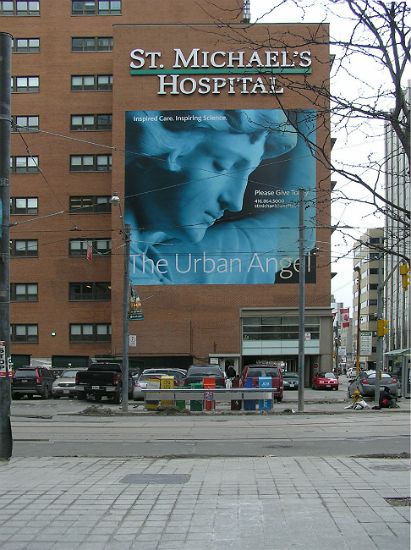
Mural of St. Michael's profile on the front wall
of St. Michael's Hospital in Toronto


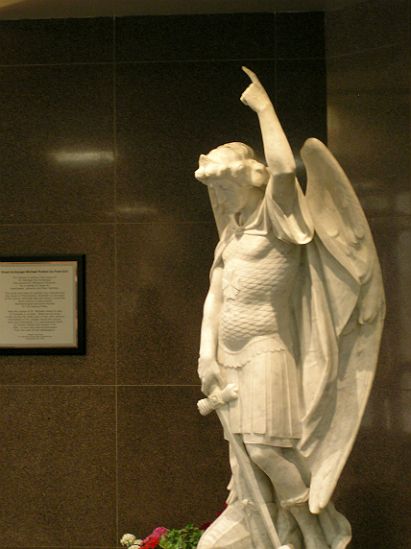
Sculpture of St. Michael
in the front lobby of St. Michael's Hospital.
St. Michael is slaying Satan,
with his finger pointed up at God.


[Above photos by KPA: 2014]

Above are photos I took of St. Michael's hospital, and more specifically, the mural of the angel's profile, and the sculpture in the lobby.

Here is the background to the sculpture:
For almost a century the statue of Saint Michael the Archangel has graced St. Michael's as a symbol of hope for employees, patients and their families. The artist and date of creation of the statue are unknown, but the name of 'Pietrasanta' chiselled on the back of the statue indicates the stone is from the same quarry in Italy where Michelangelo procured the marble for his famous 'Pieta'.

How the statue made its way to Canada is unclear, but what we do know is that during the latter part of the 19th century the Sisters of St. Joseph found this statue, dirty and blackened, in a second-hand store on Queen Street. Recognizing its value, they wisely bought it for the sum of $49 - money they had accumulated from the sale of old newspapers.

The statue now stands in our Cardinal Carter lobby, meticulously restored, a symbol of hope and healing for all who visit. It is why St. Michael's is affectionately known as Toronto's Urban Angel.
[Source: St. Michael Hospital's website]

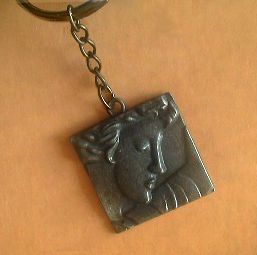
Key chain I received from the St. Michael's foundation,
after I gave a very modest contribution.
(Here is the foundation's webpage for online contributions)
.

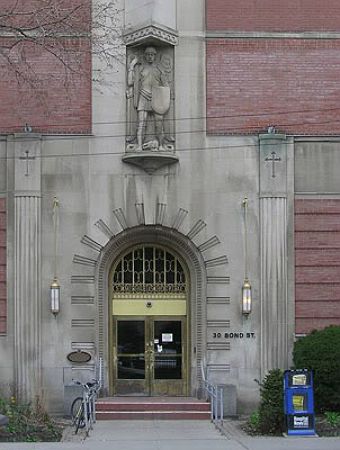
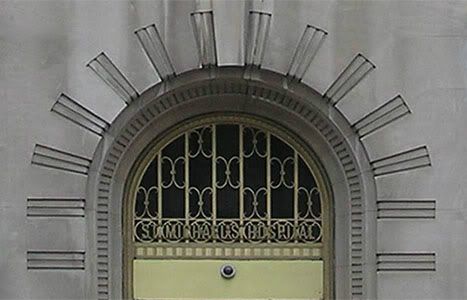
I had taken photographs of a side street entrance to the hospital at Bond Street several years ago. St. Michael is the sculpture above the entrance door. The sculpture was designed by Frances Loring.


St. Michael's entrance on Bond Street
The sculpture above the doorway is stiffer
than the life-like sculpture in the lobby


Archway above Bond Street entrance
[Above photos by KPA: 2012]


Here's the hospital's history at its website:
In 1892, in an old Baptist church on Bond Street, the Sisters of St. Joseph operated Notre Dame des Anges, a boarding house for working women. Responding to the need to care for their own and the poor population in the south end of Toronto, the Sisters founded St. Michael's Hospital.

The hospital opened its doors with a bed capacity of 26 and a staff of six doctors and four graduate nurses. Within a year, accommodation was increased to include two large wards and an emergency department. By 1912, bed capacity reached 300, and a five-room operating suite was added.

As early as 1894, St. Michael's Hospital received medical students and, in 1920, negotiated a formal agreement with the faculty of medicine at the University of Toronto that continues to this day.

Between 1892 and 1974, St. Michael's school of nursing graduated 81 classes, totalling 5,177 graduates. The school was closed in 1974 when nursing education was moved into the province's community college system. Later, the hospital opened a school for medical record librarians, the first in Canada, and also participated in the preparation of dietitians and X-ray and laboratory technologists.

As Toronto grew and expanded, so did the hospital. Ongoing physical expansion, most prominent in the 1960s, increased the original 26 bed facility to a high of 900 beds.
I have criticized the hospital's latest wing, completed in 2011, and its funding source here. But, the St. Michael's Hospital legacy is long and sustained. There is Saint Michael's Cathedral, and St. Michael's Choir School for boys, both in the vicinity of the hospital (more here), giving it moral support.


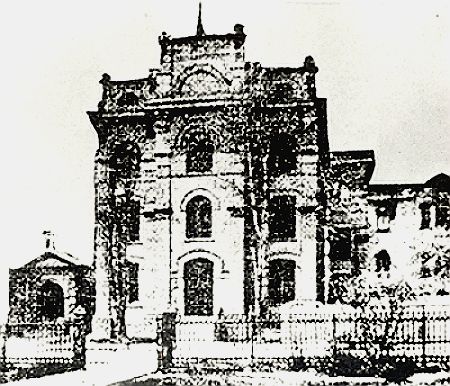
St. Michael's as it appeared in 1892 - the year of its founding.
[Image Source: St. Michael's Hospital Archives]


The plaque at the Bond Street entrance:


[Image Source:Toronto's Historical Plaques]

There were three architects involved in the original design of the hospital (more detailed biographies here - pdf file):

- Albert Asa Post (1850-1926):
Albert Post was born in Pickering, Ontario, and attended St. Michael's College in Toronto before entering an apprenticeship with Henry Langley...In 1879, Post opened his own practice in Whitby, Ont. before joining A. W. Holmes to form Post & Holmes in Toronto.

- James Patrick Hynes (1868-1953)
James Hynes was a Toronto-born architect...He was president of the Royal Architectural Institute of Canada, The Ontario Association of Architects, The Architectural League of America, and The Town Planning Association of Ontario. He was a fellow of the Royal Architectural Institute of Canada, president of the Ontario Association of Architects, and writer for the Canadian Homes and Gardens magazine.

- William Lyon Somerville (1886- 1965)
Willima Somerville, born in Hamilton, and responsible for designing McMaster University, practiced in New York before opening an office on Bay Street in 1919.

These architects continued to expand and renovate the hospital into the late 1960s. The original design and aesthetics of the building were never compromised, and the new additions fitted seamlessly with the original building.

The addition of the newest wing, completed in 2011, is an eye-sore. Glass, the preferred style of post-modernist architects, is the main material. Carefully patterned brick and delicately carved stone are substituted by relentless sheets of blank glass. Glass doesn't leave much for ornament, and instead exposes messy interiors, or to avoid that, empty interiors:


Li Ka Shing Knowlege Institute's empty interior, exposed by the sheets of glass.
Rather than fill the area with objects, both ornamental and functional,
it is left empty. This is a deliberate strategy, both for safety reasons
(exposing antique cabinets for all to see?), and for aesthetic reasons,
since the over-exposing glass will accentuate and magnify any object,
thus visually confusing the space.

With this new addition, the hospital's original aesthetic and design is destroyed.

[Image source: Diamond Schmitt Architects
]

The stark contrast of this post-modern structure with the rest of the building might alert people, patients, doctors, donors and other city folk, that this new addition is a mistake. And since the hospital is still undergoing renovations, future projects can still reclaim the beauty and dignity of the original ideas.


St. Michael's Foundation webpage for online contributions.

------------------------------------------------------------------------------------------------------------------------------------------------------------
Posted By: Kidist P. Asrat
------------------------------------------------------------------------------------------------------------------------------------------------------------

Tuesday, January 14, 2014

Update


I had put a health alert in my New Year's post where I said:
- I went through a couple of health scares, and so far, they have been resolved.
This didn't sound definitive, and it wasn't. My great team of (Canadian) doctors gave me a clean bill of health last week at my appointment, where I went after I received an "alert" call to see my family doctor. I don't want to get into details, but I have had family members with colon cancer, and pre-colon cancer diagnoses. I was in the "pre" category. Now, that is no longer a problem.

This is the best news of the New Year for me, and I can now resume, without anything hindering my thoughts, my various projects. As my family doctor said, when I asked her if I could travel to New York for Christmas, that my "super-active" personality would not follow her recommendations of "rest" anyway, and there's no reason for me not to travel.
-------------------------------------------------------------------------------------------------------------------------------------------------------------
Posted By: Kidist P. Asrat
-------------------------------------------------------------------------------------------------------------------------------------------------------------

Thursday, June 13, 2013

McDonalds' Aesthetics


The Golden Arches of McDonalds
Rt.1, Saugus, Massachusetts USA
Photo taken on November 4, 2012


A reader at Laura Wood's site, under her posting Ugly Toronto where she quotes from my post "Stay Classy, Toronto" has this to say about McDonalds:
Jay from Goshen writes:
If a municipality wants to take the trouble, it can pass ordinances that even McDonald’s has to follow. That is why in some locales, McDonald’s restaurants look not only inconspicuous, but attractive. My family and I drove a long distance once in a very isolated part of the southwest. We finally found a McDonald’s. Normally I hate the place, but in that instance, it was comforting and reassuring. It was constructed of local materials and that normally garish golden arch was small, and attractive, under the circumstances.
There was a time in recent years when McDonalds was really an awful place, dirty and with dubious characters taking up the seats. Now they are gone, having been chased out, and the clientel is clean and proper. There is also a new and ambitious addition to the original McDonalds: the McCafé, which features good, strong coffee which is on a par with Starbucks. The
"é" at the end of cafe is not snobishness. It fits with McDonalds' new image of being cultured, and gets away from its grimy past.

McDonalds goes back to the America of the 1950s, with the hamburger joints, the car culture of teenagers, juke boxes, and waitresses on roller blades. There was an American architecture of burger buildings (there no longer is), and McDonalds was part of that. The burger, and the culture around it, is an American tradition.


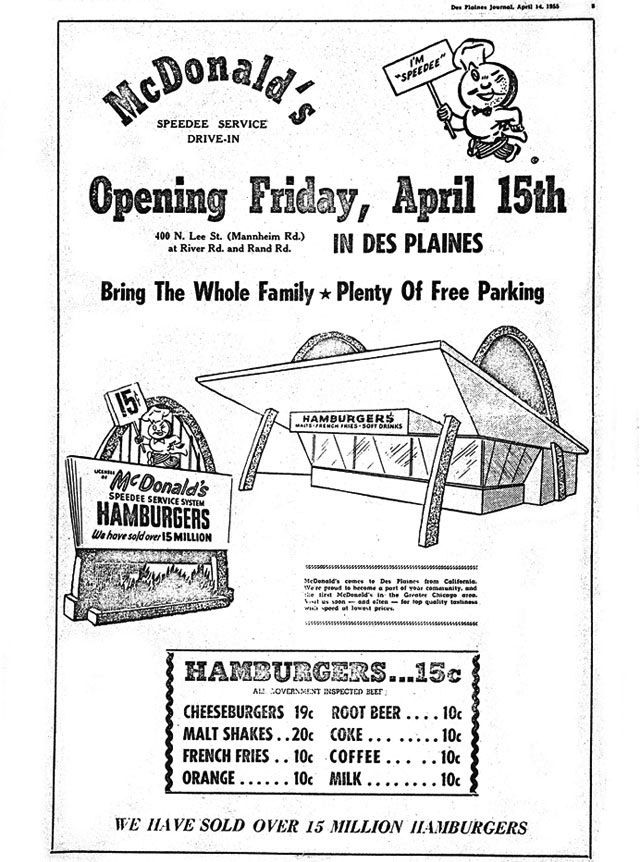
A 1950s McDonalds
Ray Kroc opened the first McDonald's franchise...on April 15, 1955, in Des Plaines, Illinois. Though it was the ninth McDonald's restaurant overall, it was Kroc's first franchise...The first day's sales were $366.12.

Just four years later, McDonald's notched its 100th restaurant with the opening of an outpost in Fond du Lac, Wisconsin [More inforamtion here].

A hamburger for 15c, made from "Government inspected meat"
[Larger menu version here]


A contemporary McCafé


Peppermint Mocha for $2.39, in Toronto


Apple Slices. They may not be fresh, but they follow
McDonads' new philosophy of eating healthy without sacrificing taste.


There would really not be a McDonalds without kids. What better way for a kid to have a snack than with sliced apples? It's not much, but this is the enlightened direction that successful institutions take.

Even McDonalds follows the concerns of its customers. But more than mere reaction to customers, the contemporary McDonalds is trying to make eating an aesthetic, pleasant, healthy and fulfilling experience.
-------------------------------------------------------------------------------------------------------------------------------------------------------------
Posted By: Kidist P. Asrat
-------------------------------------------------------------------------------------------------------------------------------------------------------------

Tuesday, May 7, 2013

Book Project: The Neglected Beauty of the Dandelion

This will probably go under a new chapter I will call Neglected Beauty.


Dandelion

Pierre-Joseph Redoute (1759 - 1840)
Pissenlit Dent-De-Lion.
10 1/2 by 14 1/2 inches
This plate is by Redoute from the first illustrated edition of Jean Jacques Rousseau's "La Botanique de J.J. Rousseau, ornee de soixante-cinq planches, imprimes en couleurs d' apres les peintures de P.J. Redoute." Published in Paris in 1805, the plates are Stipple-engraved , printed in color and finished by hand. [Todd Cooper Antique Maps & Prints]
-------------------------------------------------------------------------------------------------------------------------------------------------------------

The Neglected Beauty of the Dandelion

Lawns and grassy patches are now covered with dandelions. The dark, mustard yellow flower brightens up the outdoors, and shows us that we are in the full swing of spring. The name dandelion comes from the French dent de lion (lion's tooth), which became the anglicized dandelion we call it. The name refers to the jagged leaves. But I think the petals also look like the long, sharp canine teeth of a wild animal.

The dandelion is a bright, but ungainly flower. Perhaps that is why no-one has written an ode to this plant (unlike the daffodil, which competes for space and attention with this neglected weed in the over-crowded lawns of spring).

Walt Whitman wrote The First Dandelion, but it is a mere four lines compared to the four verses of William Wordsworth's Daffodils.
The First Dandelion
By Walt Whitman

Simple and fresh and fair from winter's close emerging,
As if no artifice of fashion, business, politics, had ever been,
Forth from its sunny nook of shelter'd grass--innocent, golden, calm as the dawn,
The spring's first dandelion shows its trustful face.
[Source: The Walt Whitman Archive]
William Wordsworth does mention the dandelion (and not even its flower but its seed) in his poem A Narrow Girdle of Rough Stones and Crags
Not seldom did we stop to watch some tuft
Of dandelion seed or thistle's beard,
That skimmed the surface of the dead calm lake,
Suddenly halting now--a lifeless stand!
Emily Dickenson wrote two verses, more a loud proclamation of the coming spring rather than a subtle ode to its beauty:
The Dandelion's pallid tube
By: Emily Dickenson

The Dandelion's Pallid Ttube
Astonishes the Grass,
And Winter instantly becomes
An infinite Alas --

The tube uplifts a signal Bud
And then a shouting Flower, --
The Proclamation of the Suns
That sepulture is o'er.
[Source: American Poems]
The dandelion's crowning glory is its seed head, ready to be dispersed by a small gust of wind, or the puff of a child ever enchanted by this unexpected surprise.

Dandelions are considered weeds, yet they have numerous positive qualities.

The University of Maryland Medical Center has the following on the dandelion:
Overview:

While many people think of the dandelion (Taraxacum officinale) as a pesky weed, herbalists consider it a valuable herb that can be used as a food and medicine. Dandelion is a rich source of vitamins A, B complex, C, and D, as well as minerals such as iron, potassium, and zinc. Dandelion leaves are used to add flavor to salads, sandwiches, and teas. The roots are used in some coffee substitutes, and the flowers are used to make wines.

Traditionally, dandelion roots and leaves were used to treat liver problems. Native Americans also boiled dandelion in water and took it to treat kidney disease, swelling, skin problems, heartburn, and upset stomach. In traditional Chinese medicine, dandelion has been used to treat stomach problems, appendicitis, and breast problems, such as inflammation or lack of milk flow. In Europe, it was used in remedies for fever, boils, eye problems, diabetes, and diarrhea.

So far, there have not been any good quality scientific studies on dandelion. Today, the roots are mainly used as an appetite stimulant, and for liver and gallbladder problems. Dandelion leaves are used as a diuretic to help the body get rid of excess fluid.

Plant Description:

Hundreds of species of dandelion grow in the temperate regions of Europe, Asia, and North America. Dandelion is a hardy perennial that can grow to a height of nearly 12 inches. Dandelions have deeply notched, toothy, spatula-like leaves that are shiny and hairless. Dandelion stems are capped by bright yellow flowers. The grooved leaves funnel rain to the root.

Dandelion flowers open with the sun in the morning and close in the evening or during gloomy weather. The dark brown roots are fleshy and brittle and are filled with a white milky substance that is bitter and slightly smelly.

Parts Used:

Dandelion leaves act as a diuretic, increasing the amount of urine the body produces. The leaves are used to stimulate the appetite and help digestion. Dandelion flower has antioxidant properties. Dandelion may also help improve the immune system.

Herbalists use dandelion root to detoxify the liver and gallbladder, and dandelion leaves to support kidney function.

Medicinal Uses and Indications:

Traditionally, dandelion has been used a diuretic, to increase the amount of urine the body produces in order to get rid of excess fluid. It has been used for many conditions where a diuretic might help, such as liver problems and high blood pressure. However, there is no good research on using dandelion as a diuretic in people.

Fresh or dried dandelion herb is also used as a mild appetite stimulant and to improve upset stomach. The root of the dandelion plant may act as a mild laxative and has been used to improve digestion. There is some very preliminary research that suggests dandelion may help improve liver and gallbladder function, but the study was not well designed.

Some preliminary animal studies also suggest that dandelion may help normalize blood sugar levels and lower total cholesterol and triglycerides while raising HDL, "good," cholesterol in diabetic mice. But not all the animal studies have found a positive effect on blood sugar. Human studies are needed to see if dandelion would work in people.

A few animal studies also suggest that dandelion might help fight inflammation.

Alternative Names:

Lion's tooth; Priest's crown; Swine's snout; Taraxacum officinale. [More information at the University of Marylyand's website]
Lions, priests and crowns. This small flower does keep good company.
-------------------------------------------------------------------------------------------------------------------------------------------------------------
Posted By: Kidist P. Asrat
-------------------------------------------------------------------------------------------------------------------------------------------------------------