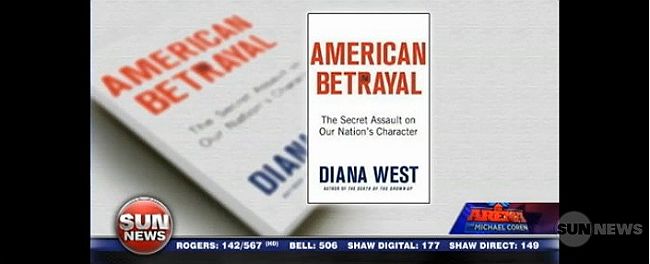
Diana West's American Betrayal on Michael Coren's The Arena, Tuesday May 22, 2013
I berated Michael Coren
recently on his
contradictory stance on the death penalty and abortion, and Diana West on her
appearance during a television interview (I do not recant either posts), but I do admire both of them, and here is the truth that their formidable minds is disclosing to our world.
West was on Coren's
The Arena yesterday evening, and she talked about her new book
American Betrayal. The video is not yet on Coren's
The Arena web page, but
Vlad Tapes has somehow acuqired it a few hours after the program, and here it is:
West talks about the the fundamental change in American attitudes and beliefs starting from World War II, with Soviet penetration into the American government, and the continued betrayal of the American government towards the American people after WWII with the cover-up of this betrayal, or as West puts it "this treason."
Says West:
We have never reckoned with it since, and it has changed us.
West continues, drawing parallels between the government elites' apologetics for Communism in the 1950s with our current elites' apologetics for Islam by calling Islam the "Religion of Peace":
This notion that people loyal to the Kremlin trying to overthrow the United States government are seen as the free thinking liberals, whereas on the right you had people like Senator Joseph McCarthy trying to expose this treason by Communists in the American government, they are seen as the totalitarians. It doesn't make sense. People trying to preserve liberty in the great Red Hunters of that post-war period vs. people trying to subvert it and indeed overthrow it. Who did their P.R.? I mean, it is the most amazing flim-flam scheme I concluded that we've ever seen. And I think the parallel would be Islam. Islam is the religion of peace is the modern iteration of this incredible flim-flam scheme that once again elites are putting over on us, and that is indeed one of the parallels I draw in the conclusion.
West also brings up Obama's socialized medicine, and his leftist beliefes:
I believe that that excusing of Soviet crime that we have throughout our past comes from the penetration, the subversion, the apologetics that were injected into our systems and indeed the advance of Marx itself to this day. I mean, you look at the Cold War and everyone says America won. Well, 100 million dead at the end of this communist century we just finished, and America cannot muster the votes to repeal socialized medicine. What happened?
I have reprinted chapter one of
American Betrayal below.
-------------------------------------------------------------------------------------------------------------------------------------------------------------
American Betrayal: The Secret Assault on Our Nation's CharacterDiana West
St. Martin's Press, 2013
Chapter One
Having lamented “the death of the grown-up” in a previous book, it may seem odd to begin here with a paean to “the child”—a perfectly guileless but curious and also innately logical child. This is the very young person in Hans Christian Andersen’s “The Emperor’s New Clothes,” who entered posterity by speaking out, free and heedless of consensus, careerism, peer pressure, personal safety, legal repercussions, and even, freest and most heedless of all, “giving offense.”
If you recall, the procession of the naked emperor, arrayed in what was put over, flimflam style, as rich and sumptuous attire, was a great success so long as the crowd played along and participated in the charade. “Nobody would let on that he couldn’t see anything,” Andersen writes, “because then he would have been unfit for his job or very stupid.” It was at this point that the little child—boy or girl, we never know which—said its famous line:
“But he hasn’t got anything on!” … And it was whispered from man to man what the child had said …
“Why, but he hasn’t got anything on!” they all shouted at last.
And the emperor winced, for he felt they were right. But he thought to himself: “I must go through with the procession now.” And he drew himself up more proudly than ever, while the chamberlains walked behind him, bearing the train that wasn’t there.2
So ends one of the great cliff-hangers. Will the emperor and his chamberlains brazen it out, cowing the people into acquiescence and thus maintaining their power? Or will the people have the courage to trust their own eyes and, relying on the evidence before them, call the emperor and his men to account? In considering these possibilities, never underestimate the influence of those invisible-train-bearing chamberlains, each one of whom has everything to lose if the empire of lies goes down.
There is hope, at least, in the open question. There is inspiration, too, in the example of the child who tells the truth. However, the forces of illusion and self-delusion are formidable foes against such outbursts of reality. The odds are against any public reckoning. More likely than not, the free-speaking child will be hushed up or badly shunned until it, too, either learns “better” or loses heart in the reeducation process. After all, it’s not easy to continue shouting out what is in plain sight when surrounding society is determined to ignore, overlook, or even hide it. When “everyone” agrees there is nothing there, what is there becomes invisible by consensus, and the Big Lie lives. At some point, even this child may buy into it.
Not a chance.
This child, too, is a force in history, as the following chronicle of Big Lies will tell us, its voice calling out the nation’s betrayal in a desperate struggle to pass on dangerous knowledge that is too often suppressed. We must listen for these voices. You will hear them time and again in the following pages. Sometimes the child has bad teeth and mumbles. Sometimes he pierces the echo chamber of lies with a funny accent. Sometimes he sports a yachting cap and hails from the Social Register. Sometimes she—for, yes, there were such women, too—is careworn, eyes seared by unimaginable hell on earth. Sometimes she is quirky. But the child is always true, always real. It is the rest, the emperors and chamberlains all around, who are as false and hollow as the historical narrative they create, assuming we will follow along. As, in fact, we do. That is our problem today. Heirs to a false and hollow history, we become unwitting participants, perpetuating and entrenching many, many lies as we take our places in a secretly subverted pageant—and never know it.
That’s partly because this subversion of our history, this assault on our nation’s character, has no visible markers or specific constituencies. From the inner rings of the Pentagon to the principal’s office in a local grammar school, we see nothing amiss. Our people still look, speak, and comport themselves just as they should, snapping salutes and schooling the young. What’s changed here is on the inside. Forced to reckonings that require gathering facts and drawing conclusions about ourselves or others, we do not fall back on a vital store of survival instinct and moral code; we fall back on a perversion of both. It is in this moment of free fall when we must look more closely to understand what has happened to us.
Let me illustrate with a true story about a real-life U.S. Navy admiral that first crystallized the syndrome for me several years ago. You know the type: steel-gray hair, clipped; military ribbons, bristling; dutiful, loyal, the works. One day in this long-drawn-out post-9/11 era, this admiral received a lengthy, extensively documented briefing on the Islamic doctrine of jihad (Islamic war) from Maj. Stephen C. Coughlin, U.S. Army Reserves. Coughlin is an expert on the legal-religious doctrine that Islamic terrorists claim as the justification for campaigns of violence against infidels and rival Muslims.3 His briefings, which I’ve attended multiple times, are legendary in security circles in Washington and elsewhere for their comprehensive, if not overwhelming, compilation of factual, Islamic-sourced evidence, which demonstrates, for example, that Islamic terrorists are not “hijacking” Islamic law (sharia) when they engage in jihad. On the contrary, they are executing it. Nor are they “twisting” the foundational principles of Islam as codified in each and every authoritative Islamic source. They are exemplifying them.
For reasons that should become clearer over the following pages, this briefing on these basic facts of jihad doctrine is typically our top military leaders’ first exposure to what is known in Pentagon parlance as the “enemy threat doctrine.” I am not exaggerating. Years of battle—even worse, years of battle planning—have passed without our leadership having studied, or even having become acquainted with, the principles and historic facts of Islamic war doctrine. Four years into the so-called war on terror, then–Joint Chiefs Chairman Peter Pace even pointed this out in a speech at the National Defense University on December 1, 2005.
Notwithstanding Pace’s concern, the study and analysis of Islam and jihad remained de facto forbidden in policy-making circles inside the Bush White House, which even codified a lexicon in 2008 to help government officials discuss Islamic jihad without mentioning “Islam” or “jihad.”5 The Obama administration would carry this same see-no-Islam policy to its zealous limit, finally mounting a two-front assault on the few trainers and fact-based training materials that were sometimes (sparingly) used by law enforcement agencies and the military to educate personnel about Islam and jihad. What history should remember as the Great Jihad Purges of 2012 began at the Justice Department, affecting domestic law enforcement agencies, and spread to the Pentagon, affecting the entire U.S. military.
First, the FBI eliminated hundreds of pages of “anti-Islam” educational material from its own training programs and those of other law enforcement agencies. Several Muslim advocacy groups applauded these purge results at the briefing at the bureau on February 15, 2012, “unexpectedly” attended by FBI Director Robert Mueller himself.6 Next, on April 24, 2012, Joint Chiefs Chairman Gen. Martin E. Dempsey ordered a similar scrub, calling on the entire U.S. military to “review” its educational and training classes, files, and rosters of instructors to ensure that no members of the armed services were studying material “disrespectful of the Islamic religion.”
What exactly does the U.S. government and its Muslim advisers consider “anti-Islam” or “disrespectful,” or, as a Pentagon spokesman put it on Al Jazeera TV, “warped views”? One trophy of this so-called Islamophobia that made it into Wired.com (whose reportage seems to have energized if not triggered these government purges) was a PowerPoint slide created by Stephen C. Coughlin about the “permanent command in Islam for Muslims to hate and despise Jews and Christians and not take them as friends.”
Pretty disrespectful and warped for sure—but only if Coughlin’s premise and supporting documentation were untrue. The statement and the documentation, however, are incontrovertible. There is a permanent command in Islam for Muslims to hate and despise Jews and Christians and not take them as friends. The slide in question includes citations of the most authoritative Islamic texts, the Koran and the hadiths (the sayings and deeds of Mohammed, which Muslims hold sacred) to document its veracity.
Veracity is not the issue here, though. Evidence is not the issue here. Reality is not the issue here, either. The issue is a commandment from on high in government—“Islam is a religion of peace.” It is the Big Lie that is the basis of the prevailing ideology, and, above all, the Big Lie must live. No one in the leadership contradicts it “because then,” as Hans Christian Andersen tells us, he would be “unfit for his job or very stupid.”
Admiral X certainly didn’t want anyone to think that. So what did he make of his Coughlin briefing, an introduction to the central Islamic doctrine of jihad and its role in driving global jihad? How did he react to the spectacular if not shattering array of information contained in the authoritative Islamic texts and books of authentic, mainstream Islamic jurisprudence before him, which shattered the Islam-is-peace mantra?
He said, and I quote, “I’ll have to check with my imam on that.”
I was staggered when I first heard this story, and, in a way, I still am. Was the admiral kidding? Did he not have the wit to make up his own mind based on the ample, annotated, inconvenient evidence before him? Witlessness, however, wasn’t the admiral’s problem, just as witlessness wasn’t the problem in the Justice and Defense Departments. If the admiral was announcing that he would be deferring to “his imam”—in other words, to an Islamic interpreter of things Islamic—on the matter of Islamic war-making doctrine, there was a reason for this, and it had nothing to do with IQ. Similarly, if FBI Director Mueller and Joint Chiefs Chairman General Dempsey were deferring to the wishes of an array of Muslim advocacy groups—including groups designated by the U.S. government as Muslim Brotherhood front groups11—regarding education about Islam, something else had rendered them, and countless others like them in military, security, and civilian leadership, incapable of assessing facts and passing judgment.
What was it?
This is the leading question that guided the research going into this book. What, in a nutshell, throughout eight years of George W. Bush and four years of Barack Obama, caused our leadership to deny and eliminate categorically the teachings of Islam from all official analysis of the global jihad that has wracked the world for decades (for centuries), and particularly since the 9/11 attacks in 2001? This omission has created a scrupulously de-Islamized, and thus truly “warped,” record for future historians to puzzle over. What will they make, for example, of a 2007 ninety-slide briefing on “the surge” in Iraq presented by counterinsurgency guru David Kilcullen that failed to mention Islam (let alone jihad war doctrine) once? Instead, the militarily, politically, and academically elite audiences for whom the presentation was created were asked to “think of the [Iraqi] environment as a sort of ‘conflict ecosystem.’”12 How will they explain Gen. Stanley McChrystal’s 2009 “assessment” of the war against Islamic jihadists in Afghanistan, which, in sixty-six pages, contained not one discussion of Islam, jihad, or how they fit into both the Taliban struggle and the Afghan people’s antipathy for Western forces? How will they explain why “everyone” agreed to fight blind?
To be fair, there is one passing reference to Islam in the McChrystal assessment. Calling for an improved communications approach, the commander demanded that insurgents and jihadist militias be “exposed continually” for their “anti-Islamic” use of violence and terror. The report elaborates, “These include their causing of the majority of civilian casualties, attacks on education, development projects, and government institutions, and flagrant contravention of the principles of the Koran” (emphasis added).
It would be easy to toss off a derisive quip at this point and move on, but it’s well worth mulling over how it could be that eight years after 9/11, a West Point–trained, battle-hardened, and by all accounts capable commander fighting jihad forces in the Islamic Republic of Afghanistan could assume the role of an apologist for Islam rather than an expert analyst of holy war as waged against his own forces. Flagrant contravention of the Koranic principles of jihad? Au contraire. Between the Koran’s teachings against befriending Christians and Jews (noted above) and its teachings that it is a “grave sin for a Muslim to shirk the battle against the unbelievers,” as the scholar and critic Ibn Warraq explains (“those who do will roast in hell”), it is also perfectly Islamic to wage jihad against any and all infidel “education, development projects,” not to mention against Muslims not actively fighting or supporting jihad.
Don’t just take my word for it. Back in 2003, the man who used to be described as Osama bin Laden’s “spiritual guide” castigated President Bush along similar lines, and rightly so. In response to Bush’s repeated slander of the religion of jihad as the “religion of peace,” Abu Qatada said, “I am astonished by President Bush when he claims there is nothing in the Koran that justifies jihad or violence in the name of Islam. Is he some kind of Islamic scholar? Has he ever actually read the Koran?”
If Bush, or McChrystal for that matter, ever did crack the book, he read only the “good parts”—the 124 verses of tolerance—that are rendered meaningless according to the rule of “abrogation.” The rule of abrogation is the key that Islamic scholars use to resolve contradictions within the Koran. By means of this doctrine, Koranic passages are “abrogated,” or canceled, by any subsequently “revealed” verses that convey a different meaning. In other words, when there is a contradiction (e.g., don’t kill the infidel vs. yes, kill the infidel), whatever was “revealed” to Islam’s prophet, Mohammed, more recently trumps whatever was “revealed” before it. This technique comes from Mohammed himself at the Koran’s sura 2:105: “Whatever verses we [i.e., Allah] cancel or cause you to forget, we bring a better or its like.”
It’s a simple concept, unforgettable once taught—but our elected officials, our military and other security providers, our pundits and other public voices seem never to have learned it, much less explained it to the rest of us. Or worse, they are ignoring it on purpose. In this ignorant morass, then, We, the People are left on our own to make sense of misinformation and disinformation. Why? Why haven’t they sought and told the truth?
There are reasons. In his book What the Koran Really Says, Ibn Warraq explains that while abrogation resolves the abundant contradictions to be found in the Koran, it “does pose problems for apologists of Islam, since all the passages preaching tolerance are found in Meccan (i.e., early) suras, and all the passages recommending killing, decapitating and maiming, the so-called Sword Verses, are Medinan (i.e., later).” His conclusion: “‘Tolerance’ has been abrogated by ‘intolerance.’”16 Just to be clear: Islamic tolerance in the Koran has been canceled by Islamic intolerance in the Koran.
Like Coughlin’s slides and presentations, this fact contradicts the Big Lie at the root of the prevailing ideology: “Islam is a religion of peace.” Therefore, our leaders don’t want us to know it. They also don’t want to know it themselves. So they don’t, as the Kilcullen “surge” presentation and the McChrystal Afghanistan “assessment” demonstrate. Such knowledge would collapse their deceitful balloon of “universal” values, which rises on the hot air of “Kum-bay-a”-interchangeable sameness. Such a collapse would, in turn, doom the relativism, moral and cultural, that currently drives these same utopian fantasists to undermine liberty in their quest to order or even rule our world and beyond.
Suppression of the facts, then, becomes the only way to keep this enterprise of lies buoyant, something for which there is ample precedent in our past, as the pages ahead will show. Under both the Bush and Obama administrations, then, any fact-driven discussion of Islamic religious, legal, and historical imperatives to make holy war until the world is governed by Islam threatened this same enterprise and had to be, in effect, outlawed and later officially forbidden. “Cultural sensitivity” had to become the name of the game. Thus, as Joint Chiefs Chairman Gen. Martin Dempsey wrote in April 2012, U.S. military programs must “exhibit the cultural sensitivity, respect for religion and intellectual balance that we should expect of our academic institutions.”17 In plain English: Whitewash Islam or else.
Why? And how did the whitewashing of Islam become the business of the United States government? This is another question that inspired this book. It is also a question which, true confession, has driven me to distraction for more than a decade. Sometimes I despair. Sometimes I play it for laughs, or at least revel a little in the absurdity. You have to. Imagine the following scenario coming across your desk: Kifah Mustapha, a known Hamas operative and unindicted coconspirator in the landmark Holy Land Foundation trial, gets invited into the top secret National Counterterrorism Center (NCTC) and then to the FBI’s training center at Quantico.18 The auspices were a six-week “Citizens’ Academy” hosted by the FBI in 2010 as part of the agency’s “outreach” to the Muslim community.
You look at the story and rub your eyes. A Hamas operative? An unindicted coconspirator? Must they “reach out” quite so far? Here we see the U.S. officials charged with fending off the jihad that Mustapha’s activities supported (as laid out in court documents filed by federal investigators) flinging open the doors to this man on their own terror watch lists. How could this even be happening?
“The plugs had to be pulled” on the watch system just to get Mustapha in the NCTC door, Patrick Poole wrote online at PJ Media, quoting a Department of Homeland Security official. After all, “the NCTC has Kifah Mustapha on the highest watch list we have.”
Unbelievable. So who pulled those plugs? Wouldn’t it be great to get a bunch of national security pooh-bahs into one room and ask them?
It would be—and so it was. In September 2010, at a Washington conference on domestic intelligence, I took the opportunity to ask as many of these officials as possible this very question. First up was James Clapper, director of national intelligence, who would later make history, or, rather, antihistory, by proclaiming the Muslim Brotherhood to be a “largely secular organization.”20 During a question-and-answer session, I asked him about FBI “outreach” to Mustapha. “I think the FBI will be here later,” Clapper boldly punted (laughter in the room). Meanwhile, he continued, there is “great merit in outreach, to engage as much as possible with the Muslim community.” Subtext: Bringing a Hamas op into a top secret security installation is no big deal.
Between panels, I buttonholed panelist Sean Joyce, a senior official with the FBI. What did the FBI executive assistant director for national security think about the Mustapha incident?
“We don’t comment on individuals,” he told me.
OK. How about commenting on a blanket policy regarding FBI tours of sensitive installations for unindicted coconspirators and terrorist group operatives?
“Again, we don’t comment on individuals.”
It’s not every day that you notice a former director of the Central Intelligence Agency standing around, so I asked Michael Hayden for his overall opinion of the speak-no-Islam policy that let jihadists through the door. “People I trust”—uh-oh—”say to be careful not to use the term ‘jihadist’ because it does have a broader use across the Islamic world,” he said, referencing the definition of jihad as “inner struggle.”
Oh, please. This is another Grand Pulling of Wool over Infidel Eyes. Why? There is precisely one explicit reference in the Koran to jihad (“ja-ha-da”) “as an inner, spiritual phenomenon, not as an outwardly (usually military) phenomenon.” So writes Tina Magaard, a Sorbonne-trained linguist specializing in textual analysis. “But,” she continues, “this sole reference does not carry much weight against the more than 50 references to actual armed struggle in the Koran (and even more in the Hadith).”
Unfortunately, I didn’t have a Magaard cheat sheet with me when I happened on the former CIA director, so I just erupted, politely: So what? That doesn’t affect the accuracy of “jihadist” as a description of the enemy!
Then again, not using the word “Islamic,” he continued, “obfuscates the issue (and) neuters our understanding” of Islamic terrorism “however perverted it might be.” Hayden continued, meaningfully: “This is in no way a comment on the Islamic faith.”
Heaven forfend. The Islamic faith can inflict censorship, death for leaving Islam, marital rape, polygamy, and slavery on the world, but please, none of the above is in any way a comment on the Islamic faith. Or so the American “intelligence” community has determined. What we inadequately label “political correctness” has obfuscated and neutered fact-gathering and conclusion-drawing powers to the point where the “political correctness,” too, is obfuscated. To wit: NCTC Director Michael Leiter next took the podium to address the conference and declared “there was no PC-ness” on his watch. “If someone is inspired by Islamic ideology—” he began, then stopped. “Let me rephrase that: al Qaeda ideology…”
Poor baby.
Later, I had an opportunity to ask Leiter what he thought about the FBI bringing Mustapha into NCTC. “Ask the FBI,” he suggested helpfully.
Isn’t NCTC your shop? I asked.
“Actually,” he explained, “the building isn’t owned by us. Three organizations have offices there.”
When I picked myself up off the floor, he was still talking. “It’s more complicated—talk to the FBI. They’ve got a lot more information than I do.”
The FBI better be good, right? They should be prepared, anyway. Indeed, on taking my Mustapha question, FBI Director Robert Mueller, the conference’s final speaker, said he’d been briefed to expect it. His response? “I’m not sure I agree with the predicate of your question, and we’re not going to debate it here.”
He continued discussing the Citizens’ Academy program, which he described as “exposing the FBI to a variety of communities.”
“Exposing” is right.
He, too, wouldn’t discuss individuals, he said, but added, “We do look into the individuals that we invite into the Citizens’ Academies.” The man who pulled the plugs had spoken, but he explained nothing. Soon, the FBI director would make his way out of the conference hall, his security detail in tow. And he drew himself up more proudly than ever, while the chamberlains walked behind him, bearing the train that wasn’t there.
* * *
Imagine a World War II Allied military staff briefing on the Shintoism that animated Imperial Japan. (Shinto war doctrine and Islamic war doctrine are similar in many ways.22) Would a WWII-era commander have deferred to the judgment of “his Shinto priest” to assess the validity of a briefing on the expansionist ideology of Imperial Japan?
No.
Would he, alternately, have invited a German American Bund leader into sensitive security installations as a matter of “fascist outreach”?
No again.
Would he have suspended judgment on a briefing on the principles of Marxism-Leninism pending consultation with “his commissar”?
Pause.
Not exactly. However, there were always Communist agents and apologists steering the U.S.-Soviet relationship away from the inevitable rocks of incompatibility, just as today there is an all-encompassing force field blocking the realization that freedom and Islam are similarly incompatible.
-------The many parallels between America’s struggle with Communism and with Islam are striking. Once upon a time, Washington was penetrated by Communist networks and agents to the point of occupation, as I will argue in the chapters ahead. In 1938, five or six or twenty years into this complex underground assault directed by Moscow, the indomitable Rep. Martin Dies (D-TX) took it upon himself to crank up the House Un-American Activities Committee to investigate totalitarian infiltration, whether Communist or fascist. Pressured by FDR himself from day one to halt investigations into Communist infiltration—“Several of the best friends I have are Communists,” FDR told Dies23—the Dies Committee finally ran into a brick wall a few years later when the outbreak of World War II and the Western alliance with Stalin kicked off a newly intensive period of “Communist outreach,” to be discussed ahead. Only in the late 1940s, after the war had ended and Soviet intentions to communize as much of Europe and Asia as possible became bitter reality, and as the great witnesses, ex-Communists Elizabeth Bentley and Whittaker Chambers, defected to the FBI, did a willing and quite able Congress begin to get its arms around at least some of the extensive Soviet-directed operations against this country, which had by then been going on for nearly two decades. Thus began a short-lived heyday of House and Senate investigations into Communist penetration that come down to us as an enduring historical record we would not otherwise have.--------
Today, we are again allies with adherents of a totalitarian ideology whose agents and apologists have penetrated Western institutions, both overtly and covertly. Just as simultaneous Communist alliance and penetration once disabled our defenses, today, simultaneous Islamic alliance and penetration do so again. Once upon a time, our forebears came to a breaking point with Communism with the advent of what we call the Cold War. There is no comparable breaking point with Islam in sight. In fact, simply pointing out the incompatibility of a civilization based on individual liberty (the West) and a civilization based on collectivism (Islam), for instance, can get a body fired and, even worse, branded a dread “Islamophobe.” To date, we have not seen the emergence of investigators among our elected officials to fill the shoes of Reps. Martin Dies and Carroll Reece, Senator Patrick McCarran, and others including, yes, above all, Senator Joseph McCarthy. For writing a letter to the State Department inspector general that hoisted a red flag over the close, dense, demonstrable, ongoing family ties to Muslim Brotherhood organizations of Huma Abedin, a top aide to Secretary of State Hillary Clinton, Rep. Michele Bachmann (R-MN) was crucified in the summer of 2012 by the media and political Establishment, Right and Left, as the second coming of Joe McCarthy, Antichrist—a smear campaign as unfair to McCarthy, who, as we will see, has been vindicated by the historical record, as it was to Bachmann, who was entirely correct and measured in merely asking an inspector general to examine the alarming connections of someone so highly placed.24 Meanwhile, the jihadist penetration of our institutions continues apace.
Don’t believe me? Guess who said the following. “The earliest defenders of Islam would defend their more numerous and better-equipped oppressors because the early Muslims loved death—dying for the sake of almighty Allah—more than the oppressors of Muslims loved life. This must be the case when we are fighting life’s other battles.”
I know I haven’t asked a fair question. As former federal prosecutor Andrew C. McCarthy has put it, “That leitmotif—We love death more than you love life—has been a staple of every jihadist from bin Laden through Maj. Nidal Hasan, the Fort Hood killer.”
McCarthy, who successfully prosecuted Omar Abdel Rahman, the “Blind Sheikh” behind the 1993 attack on the World Trade Center, elaborated: The “Supreme Guide” of the Muslim Brotherhood, Muhammad Mahdi Akef, while praising Osama bin Laden, urged teaching young people “the principles of jihad so as to create mujahideen who love to die as much as others love to live.”26 In 2004, the 3/11 bombers in Madrid left behind a tape saying, “You love life and we love death.”27 Jihad expert Andrew Bostom points out that the noted Muslim historian and Koranic commentator al-Tabari recorded this statement, circa 634, from the Muslim commander to Hurmuz, the Persian leader in Iraq: “Now then. Embrace Islam so that you may be safe, or else make a treaty of protection for yourself and your people, for I have brought you a people who love death as you love life.”
Just to be sporting, here’s more of the same mystery quotation. “What are our oppressors going to do with a people like us? We are prepared to give our lives for the cause of Islam.” Chilling, but not helpful, right? Similar death-cult code could come from any jihadist, from Mohammed Atta, in his night-before-9/11 instructions (oddly not included in the 9/11 Commission report), to the late and unlamented Anwar al-Awlaki, in his e-mails “ministering” to the underpants bomber, Umar F. Abdulmutallab.
Could it also come from a former Bush administration appointee? A member of the board of directors of the American Conservative Union (ACU), sponsor of the well-known CPAC convention in Washington, D.C., where every single GOP presidential hopeful comes to speech-o-flex before thousands of grassroots activists?
The surprising answer is yes. The former Bush official and ACU board member I am quoting above is Suhail Khan, a close associate of the extremely influential antitax activist Grover Norquist. Khan’s shocking quotation—shocking, that is, for a classical conservative, but not for a classical jihadist—comes from a 1999 speech he gave at another convention, that of the Islamic Society of North America (ISNA).
As Suhail Khan has said himself, his father, Mahboob Khan, helped found and was very active in ISNA. He said so in that same 1999 speech, further pledging as his “life’s work, inspired by my dear father’s shining legacy … to work for the umma,” or transnational Islam. According to a key internal 1991 document of the Muslim Brotherhood entered into evidence at the 2008 Holy Land Foundation trial, ISNA is a Muslim Brotherhood front, the largest one in America. Which means that Khan’s father was a founding member of the Muslim Brotherhood in America.
That’s right, America. The Brotherhood isn’t merely a Tunisian or Libyan or Egyptian or Syrian movement committed to Islamic world government (caliphate) and sharia (Islamic law); the Brothers are here. According to government evidence in the Holy Land Foundation trial, the Muslim Brotherhood claims twenty-nine front and “friendly” organizations in North America, all of which remain unindicted coconspirators. The Council on American-Islamic Relations (CAIR)—which was founded by members of Hamas, which is the Palestinian wing of the Muslim Brotherhood—also remains an unindicted coconspirator in this landmark trial.
What do our elites do with such information?
I’ll have to check with my imam on that … in spades. They ask members of these same front groups for advice about homeland security. They bring sympathizers of such radical groups into the Pentagon to help formulate policy. They tap them to organize Muslim chaplains for the military and to help set up a mini-sharia-state at Guantánamo Bay. They invite them onto Fox’s O’Reilly Factor to comment on the affairs of the day. What we’re watching begins to look like an influence operation to rival that of the old days of the Communist Kremlin, only this time around the hostiles proceed much of the time in plain sight. So how does it all go unnoticed, unremarked upon?
To look for the answer, let’s return to Admiral X—not to mention FBI Agent Y and Congressman Z—and the way in which they all are prone, primed, and conditioned to withhold judgment. Despite their sworn duty to preserve and protect the Constitution of the United States of America, such leaders find nothing amiss in outsourcing their understanding of the enemy threat doctrine to a likely agent, proponent, or sympathizer of that same enemy threat doctrine (and then inviting them into sensitive security installations). Mastering the objective facts of the matter and drawing their own conclusions never seems to enter their minds. Why? The short answer is that they don’t have it in them to make up their own minds. The longer answer will lead us back through nearly a century’s worth of Big Lies to a place where their corrosive source should become clear.
For the moment, though, let’s turn from paralysis in the capital over jihad to paralysis in a small California school district over what historian Robert Conquest might call the “residual muck” of Marxism-Leninism—another enemy doctrine targeting Western beliefs.
In the run-up to Thanksgiving 2008, a small-town elementary school in Southern California received a letter. It was from a parent whose daughter was enrolled in the school’s kindergarten. This parent, later described as a university English professor “specializing in Native American literature,” wrote in to say she had just learned that, according to local custom some forty years old, the school’s kindergartners would be joining kindergartners from another local school for a Thanksgiving feast, with one class dressed up as Indians and the other class dressed up as Pilgrims.
Costuming the children this way was “demeaning,” she wrote, adding, “I’m sure you can appreciate the inappropriateness of asking children to dress up like slaves (and kind slave masters), or Jews (and friendly Nazis), or members of any other racial minority group who has struggled in our nation’s history.” The first Thanksgiving thus equated with mealtime at Buchenwald served up by Simon Legree, the parent demanded the schools abolish the celebration, which meant up to and including the macaroni Indian necklaces and the black paper Pilgrim hats.
Before considering the official response of the schools, it’s worth recalling that in the case of the Plymouth Colony harvest feast of 1621 that Americans have commemorated as a day of national thanksgiving since the nineteenth century, the “minority group” who “struggled” was in fact the group of Pilgrims and other passengers who had made the arduous Atlantic crossing in 1620. Half of these English Separatists had died since setting sail from Plymouth, England, mostly during that first Massachusetts winter, and it was largely due to the aid of two English-speaking Indians, Squanto and Samoset, that the 53 (out of 102) who survived were able to bring in a good harvest the following fall. It was then, according to a contemporaneous account by Edward Winslow, “amongst other Recreations, we exercised our Armes, many of the Indians coming amongst us, and amongst the rest their greatest king Massasoyt, with some ninetie men, whom for three dayes we entertained and feasted.”31 Here lies the basis of our foundational act of thanksgiving to God and comity among men—not to mention bona fide cultural duality, if not technical diversity.
One politically correct push, however, and those charged with passing on this legacy gave way. Just as our admiral above was unable to draw on reason and knowledge at his core to render judgment on the threatening doctrine of Islamic jihad, the administrations of both elementary schools were similarly incapacitated when it came to rendering judgment on this Marx-inspired, “multicultural” assault on American legitimacy. The educators couldn’t muster the most elementary defense of themselves or their tradition based on what was once a bedrock, intuitive, and practically atavistic understanding that, at the very least, the Indian-Pilgrim relationship at Plymouth Rock bore no resemblance to either the slave-master relationship or the Jew-Nazi relationship.
How hard would it have been to explain to the parent that the costume party tradition was an age-appropriate way both to illustrate the historic unity of peoples, purpose, and thankfulness that we rightly celebrate to this day and to connect these young schoolchildren to founding mythology that happens to be true? Instead, the schools surrendered their judgment without hesitation, let alone a fight. They subordinated not only their understanding of history but also their understanding of themselves—namely, their ability to differentiate between right and wrong—to an interpretation specifically engineered to eradicate and replace their own. They then trumpeted their surrender in a letter they sent home with the kids.
“Dear Kindergarten Parents,” the principal of one of the two schools wrote. “This year we continue the wonderful tradition of sharing a feast with the students…”
But.
She continued, obviously without proofreading, “It has been brought to our attention that by dressing the students in an Indian costume may be perceived as a negative caricature of Native Americans. In order to be sensitive to the Native American culture, we will not celebrate our feast together in costume. We will instead dress in Mountain View and Condit t-shirts.”
Goodbye, “Pilgrim” hats and “Indian” necklaces; hello, Happy T-Shirt Day. In yielding our nation’s historical symbols, in depriving the students of their cultural heritage, the educators exposed their own subverted core. There, facts are no match for the magnetic draw of ideology, which causes our culture to collapse in on itself. Over the black hole that remains, the last standard flying is a pair of stupid T-shirts.
What—who—brought us here?
This is the mystery. The clues lie scattered behind us, somewhere along the rocky course of a voyage of transformation, which, I find, has never been completely tracked, sounded, and mapped. Along this still uncharted way are the familiar landmarks of World War II and what we think of as the Cold War, the era of hostilities that gave way to, or, at least, was superseded by, a war with Islam that goes on officially unacknowledged. As enemies of the West, godless Communism and godcentric Islam are strangely, eerily similar, in their collectivist, totalitarian natures, in their dysfunctional ideological reliance on the Eternal Foe for forward thrust, and, above all, in our blindness to all related and resulting implications of our struggle against them. In the following quotation, Robert Conquest, circa 2005, is retrospectively considering the animus of Soviet Communism, but what he describes sounds much like the timeless drive of Islamic jihad:
The confrontation with the West was, like the ruin of the [Soviet] economy, a product of the mental distortions of the Soviet order. The ‘insane militarization’ Gorbachev spoke of was a symptom of the mind-set that prevailed, which required an unceasing struggle with all other cultures [emphasis added].
One salient difference is that the Soviets only had “rope” to sell the West; Islam has oil.
While there is reasonable consensus on the link between the Soviets’ “unceasing struggle” with others (climaxing in the Reagan-driven arms race) and the ultimate ruin of the Soviet economy, we hardly consider the impact that this same “unceasing struggle” had on ourselves. The fact is, wars change combatants, and we, the West, did not emerge unscathed from the better part of a century of accommodating, appeasing, enabling, opposing, fighting, tolerating, accepting, and assisting the influence and power of the Soviet regime. Indeed, the changes wrought by this continuous entanglement of Communist Russia and the Free World are deep, if also grossly and dangerously unappreciated.
Take the reputation in the West of Communism itself. It may not be trumpeted as the coming thing—not specifically by name, anyway—but, in the burn pit for catastrophic ideologies, its aura today is not blackened to the same crisp as Nazism and fascism. Not even close. Despite Soviet “defeat” in 1991, the ideas associated with Communism remain shockingly reputable throughout what we still know as the Free World.
Consider class warfare. This basic tenet of Marx 101 has been a staple of President Barack Obama’s rhetoric—only, again, not by name. Euphemism here, as always, is key. Meanwhile, to have served, nonrepentant, as an identified Communist or fellow traveler during the MAD-fraught years of the Cold War is no bar to continuing public service in the supposedly anti-Communist, or, at least, non-Communist West. In fact, it often seems to be an asset.
We see this all over the European Union, once the central battlefield of the Cold War. With a new constitution known as the Lisbon Treaty, the EU has become a supranational federal state led by an unelected president and foreign minister, exerting concrete control over the rights of over five hundred million citizens. With its rigid centralization, unelected ruling body, flagrant corruption, and, recently, colossal states of bankruptcy, the governing structure the EU most closely resembles is the old USSR—“though admittedly only a pale copy,” as onetime Soviet dissident Vladimir Bukovsky is quick to explain. Still, Bukovsky, a self-described “ex-convict,” sees chilling parallels, for example, in the police powers of Europol, particularly in the force’s diplomatic immunity. Bukovsky writes, “A policeman with diplomatic immunity can come in, take whatever he likes, beat you up, and you can’t even sue him. EuroPol will police us on 32 criminal counts, 2 of which are particularly interesting because they don’t exist in the penal codes of any other country. One is ‘racism’ and the other is ‘xenophobia.’”
Bukovsky further notes that “the authorities”—the unelected commissioners (commissars?) who run the EU—have already indicated that opposition to EU immigration policy, for example, may count as “racism,” while opposing further integration of Europe may trigger a “xenophobia” alert. With Europol up and running—and did I mention that the EU has also streamlined country-to-country extradition?—who needs to go to the trouble of setting up a Gulag?
After all, one thing the rise and fall of the Soviet Union demonstrates is that the Gulag is a cumbersome means of social control—in the end, more trouble than it was worth to the dictatorship. (Then again, as a source of slave labor, the Gulag remains unsurpassed.) Today, turning one individual into an example seems to be all that’s necessary to keep the citizenry in line. We’ve already seen a series of recent precision prosecutions for speech “violations” in the Netherlands (Geert Wilders), Denmark (Lars Hedegaard), Austria (Elisabeth Sabaditsch-Wolff), and elsewhere. Even when these trials end in acquittal, the time, expense, and wear and tear on the spirit do wonders to check the voice of the people, any people. On these relatively narrow shoulders of repression, then, central state power rises.
According to the Soviet-era archive Bukovsky amassed by copying thousands of classified Kremlin documents in 1992, these Soviet-lite developments in Europe are not accidental. Rather, as Bukovsky discovered in the minutes of secret meetings that would continue until shortly before the December 1991 collapse of the Soviet Union, we are seeing the results of “convergency” planning by Mikhail Gorbachev in 1987 to create an EU-USSR “counterbalance” to the United States. In an extraordinary Moscow meeting in January 1989 between Gorbachev and members of the Trilateral Commission—David Rockefeller, Henry Kissinger, Yasuhiro Nakasone, and Valery Giscard d’Estaing—recreating Europe from “the Atlantic to the Urals,” as Kissinger sweepingly put it, was discussed there before the treaties to make such a European superstate were drafted.35 Twenty years later, after the Lisbon Treaty was finally ratified—after being rejected in three separate referenda—English-language Pravda, of all publications, published a column highlighting similarities between the EU government and the USSR government, in particular their powers to check individual rights. The headline was an attention grabber: TWENTY YEARS AFTER THE FALL OF THE BERLIN WALL, THE EU IS A REINCARNATION OF THE FORMER SOVIET UNION.
Given that Europe was the primary theater of the Cold War—a war that was plenty “hot” at times37—this is quite a mind-boggling concept. Then there’s the leadership. The EU’s first foreign minister—appointed in Politburo-style secrecy by its governing body, the European Commission—is Baroness Catherine Ashton. Not even the baronial crest awarded her by Tony Blair’s Labor government in 1999 hides the fact that Ashton is the former treasurer of the British organization Campaign for Nuclear Disarmament (CND), a Marxist-infiltrated, Communist-led organization deemed “communist and subversive” by MI5 for its Cold War–era efforts to disarm Britain, force U.S. cruise missiles off British bases, and decouple Europe generally from the U.S.-led NATO alliance—the latter a point of Soviet strategy documented in Bukovsky’s blessedly purloined archive.38 Ashton’s tenure coincided with the final, covert Soviet drive of the Cold War, the Moscow-orchestrated and Soviet-bloc-funded “peace movement” to strip the West of its tactical superiority in nuclear weaponry. In other words, in answer to the question, “What did you do in the Cold War, Mummy?” the baroness would have to include the fact that she advanced the cause of the Other Side. Then again, has “convergency” reached a stage where we still recognize there was one?
Gerard Batten, member of the European Parliament for the United Kingdom Independence Party, laid out the case against Ashton’s appointment publicly, concluding, “CND was, knowingly or unknowingly, the Soviet Union’s Fifth Column, and its senior members were either traitors or what Lenin called ‘useful idiots.’” As for Baroness Ashton, he wrote, “She, who would have unilaterally removed Britain’s nuclear defenses, will now direct the foreign and defense policies of Europe’s nuclear powers: Britain and France.”39 Not only did Batten’s plaint not stir outrage, it failed even to lift an eyebrow.
Meanwhile, if Ashton denies she was herself ever a Communist, not so seven of twenty-seven members of the European Commission, the unelected supercouncil Bukovsky likens to the old Soviet Politburo.40 Among the commission’s recycled revolutionaries is its president, José Barroso, who, while Baroness Ashton was a top official of the CND in Britain, was himself a leader of an underground Maoist revolutionary party in Portugal in the 1970s. This was a period, Batten notes, “when such parties were directed from Beijing in the same way as the Communist Parties were controlled by Moscow.” Another commissioner, Joaquín Almunia, who currently belongs to the Marxist wing of the Socialist Workers Party in Spain, was a minister (1986–91) in the “fanatically pro-Kremlin” government of Felipe González. Batten writes that this Spanish government “enthusiastically supported the Soviet project of the creation of a ‘common European home,’ [and] also opposed the independence of the Baltic states.” The should-be shocking litany goes on, as Batten elaborates on six more EU commissioners with notable Communist associations.
The European Parliament, to say the least, was unmoved by Batten’s tocsin, validating Bukovsky’s comparison of that body to the old USSR’s moribund, rubber-stamp Supreme Soviet.42 Indeed, the empowerment of longtime Communists and Soviet sympathizers in Europe’s new superstate is nonnews everywhere. Maybe the apathy is itself another consequence of our struggle-cum-encounter with Communism: The West has been down-to-the-nub exhausted, bored, or to-its-very marrow co-opted by the whole experience.
Such ennui, if that’s the right term, is no match for the persistent animus toward capitalism, individualism, and “bourgeois” culture that, again, seemingly paradoxically, has long outlasted the rotted Soviet superstructure. Indeed, in the person of President Barack Hussein Obama, two decades after the disintegration of the USSR, such animus pulses through his administration.
Of course, here I am talking about Barroso the Maoist, and Ashton the fellow traveler, and Almunia the Marxist, and assorted apparatchiks running Megastate Europe, and I imagine readers nodding along, not registering any upset at all over the terminology I’ve chosen. In other words, the ideological labels I have affixed to these European figures have violated no intense, doctrinal taboos.
On the other hand, even now, if I were to critique Obama as a “Marxist,” a “socialist,” or a “fellow traveler,” something quite different would be likely to happen. Even if I offered quotations from Obama himself about “spreading the wealth” and income redistribution, like Pavlov’s dog, most readers would be instantly overtaken by the conditioned reflex of rejection, becoming instantly derisive and scoffing in disbelief. I would be automatically discredited for attempting to affix descriptive labels on the man or even on his Marxist, socialist, or fellow-traveling policies—including his plan for socialized medicine, that definitively Marxist program applauded by Bolsheviks, “progressives,” statists, socialists, and fellow travelers alike. I would hear either that I don’t understand Marxism, that I am imprecisely characterizing socialism, or that it is historically out of context to invoke “fellow traveling.” What is being rejected is definition itself, labeling, even with a factual basis. The preference for imprecision, for “nuance,” has the effect of denying us the clearest understanding of reality possible, and thus becomes more dangerous than Marxism itself. It is bad enough to consider the fact that two decades after the fall of the Berlin Wall, the forty-fourth president of the United States of America could be accurately thumbnailed by the term “Marxist” (or “socialist” or “fellow traveler”); it is somehow worse when one can’t broach the topic without triggering an avalanche of opprobrium.
Even beyond the question of how Americans elected a man incubated in a radical comfort zone peopled by Stalinists, Maoists, card-carrying Communists, socialists, and postmodern revolutionaries unhelpfully obscured as “Alinskyites,” and who first ran for elected office as both a Democrat and socialist (New Party) “fusion” candidate, how did this topic of crucial public interest became a conversation ender, something to wave off, frantically, like a bad smell? Or, alternately, how did a topic so important to the future of the nation become a laugh-track prompt? There was something unnatural about the taboo from the start.
Jonah Goldberg noted the phenomenon as a matter of fact in a 2010 Commentary magazine essay called “What Kind of Socialist Is Obama?” He wrote, “Republicans believed they had hit a rhetorical mother lode with this line of argument, but their efforts to make hay of Obama’s putative socialism proved unedifying, if not outright comic” (emphasis added).
To be sure, back in 2008 many conservatives believed that simply unmasking Obama’s inner Marxist, really laying it out in plain sight for voters to see, would inevitably trigger a dramatic shift in support away from Obama and toward a GOP ticket that was at least a marginally safer bet than the anti-American abyss Obama beckoned toward. Surely, the facts would lead Americans to conclude that a candidate who embraced Frantz Fanon, the “Marx of the Third World,” and assorted anti-American revolutionists rather than philosophers of free enterprise and liberty was wholly unsuitable for the presidency. I know I felt that way even over noxious revelations about Obama’s close, twenty-year-long association with the Rev. Jeremiah “God damn America” Wright. Funny to say “even.” I actually thought it was all over for Obama. (I even predicted it on national television.) It was hard to let the notion go. In the waning days of the campaign, The New Criterion’s Roger Kimball gallantly argued that an abiding belief that ideology—Obama’s—mattered. The occasion was the late-breaking emergence online (never in the mainstream media) of a 2001 radio interview with Obama on WBEZ in Chicago. In a real tour-de-Marx performance, Obama is heard bemoaning constitutional restraints on state powers and the fact that the Civil Rights–era Warren Court “never ventured into the issues of redistribution of wealth.” He also plugs “community organizing activities on the ground” that create “coalitions of power through which you bring about redistributive change.”
Got that? Not hope and change—redistributive change.
Referencing some of the exemplars of extremism associated with Obama (Bill Ayers, Rev. Wright), along with his alarmingly sealed past (e.g., Obama’s refusal to release his college and law school transcripts), Kimball wrote, “For reasons that I find difficult to comprehend, such elements in Obama’s political DNA so far seem to have made little impression on the public at large. People cannot seem to get their minds around the implications of these alliances.” (emphasis added).
Or maybe, Kimball continued, people couldn’t get their hearts around the implications, so emotionally committed were they to the “hope and change” candidate. “All that, I suspect, is about to change, and change fast,” he wrote. “Credulity is a wonderful thing. So long as you maintain the illusion of benevolence, all is well. Once that begins to crack, the façade shatters and disillusionment rushes in like a tempest-driven tide.”
He was so certain, adding, “Here at last you witness the real Barack Obama. The sound you hear in the background is the cracking of Obama’s nimbus of benevolent moderation. This is not ‘change we can believe in.’ It is left-wing radicalism aimed at the foundations of the American system of government.”
Kimball really cared. Well, so did I and some insufficient number of our fellow Americans. The majority of us did not. As Goldberg would later note, the political impact of revelations about Obama’s radical ideology (so far as they went, sans mainstream media coverage) was “unedifying if not outright comic.”
Why not “edifying” and “outright alarming”?
I have come to believe the apathy and especially the laughter are conditioned responses, trained responses designed to short-circuit the thinking process and other natural reflexes. Who or what did the conditioning? Who or what taught us to yawn at or mock overtly anti-American subversion? Did I just say “anti-American subversion”? That’s another howler for most of us postmoderns. So howl at this: Barack Hussein Obama, by associations, by actions, by stated beliefs—by rights—should not have been given a government security clearance, let alone the highest government security clearance. Short of having been elected president, the shocking paradox is, it is extremely unlikely he would ever have received it. Of course, is it a paradox if it doesn’t even rate a newspaper story? Meanwhile, it’s difficult to be shocked if you’ve been conditioned never to widen your eyes and gasp. Ever.
Frankly, we were lucky to get as close as we did to the whole socialism issue. It was only the unexpected and electrifying emergence of “Joe the Plumber” about three weeks before Election Day 2008 that put Obama’s belief in economic redistribution on display, briefly, for the wider public. “I think when you spread the wealth around, it’s good for everybody,” Obama famously told Joe Wurzelbacher, during a televised campaign stop in Ohio on October 12, 2008. Obama’s “postpartisan” mask had slipped. Did it reveal the Marxist underneath? Did this would-be emperor wear antidemocratic clothes?
If so, no one wanted to look too closely, John McCain’s fainthearted jabs and Sarah Palin’s full-throated sloganeering aside. The MSM, clutching their candidate’s invisible train, decided that what American voters wanted to know—or, rather, should have wanted to know—was not whether the next president was a Marxist but rather whether Joe was a licensed plumber. Stranger still, significant conservative voices downplayed the socialism issue, too.
The timing was critical. Recall that in the 2000 presidential election, a late-breaking wavelet of outrage crested over carefully leaked “news” that George W. Bush had been DUI in 1976, likely causing him to lose the popular vote, and very nearly the election. The socialist issue (Marxist, collectivist, statist, Communist), had it caught fire, might well have frightened some measurable percentage of Obama voters, particularly among his more conservative or independent voters. The MSM seemed to hold its breath. On October 24, 2008, however, with less than two weeks before Election Day, Fox News’s Special Report with Brit Hume took up the issue in a panel discussion featuring Mara Liasson, Fred Barnes, and the quasi-oracular Charles Krauthammer.
The conversation kicked off promisingly enough with a question from Hume as to whether Obama’s recent comment to Joe the Plumber had “raised legitimate questions about whether he has a socialist or socialistic policy.” Conversation stalled with Barnes, who seemed more intent on fending off similarly justifiable questions regarding the socialist underpinnings of both John McCain’s and George W. Bush’s taxation and banking policies, ignoring the Obama story altogether. As a legitimate line of inquiry, however, the topic dead-ended when it got to Charles Krauthammer. “Since the word ‘socialism’ has reared its ugly head,” he began, “let’s dispose of it.”
Think of it. The presidential front-runner—the supposedly “postpartisan” presidential front-runner—says, “When you spread the wealth around, it’s good for everybody,” and the leading pundit of what passes for conservatism knocks the issue down on the first go-round. On the contrary, he wants to explain why socialism could not possibly be at issue. His reasoning? Socialism just isn’t “socialism,” Krauthammer explained, unless the government owns the means of production. So, presumably, because Obama didn’t tell Joe that it’s good for everybody when you spread the wealth around and as President, he would take over two of the Big Three automakers, one-sixth of the economy (health care), and much of the student loan and home mortgage industries, there was no reason to wonder what type or even whether a Socialist was about to be elected president. (Meanwhile, the extent to which the social engineer and megaregulator George W. “I’ve abandoned free-market principles to save the free market” Bush had already “pre-socialized” the economy, to use Michelle Malkin’s term, shouldn’t be forgotten, and he was hardly the first, as we will see.)
Rather than consider “spreading the wealth around” in the context of Obama’s lifelong ties to card-carrying Communists, Marxists, Maoists, and socialists, Krauthammer introduced an irrelevant and distracting historical context. He said, “What Obama is talking about is what we have had for a long time, progressive taxation.” Progressive taxation “for a long time” should present a conservative with a problem, not the Adam Smith stamp of approval.
But back to Krauthammer: “Now, he wants to raise the marginal income tax rate from about 36 percent today to about 39.5 … But let’s remember, under Eisenhower, the marginal income tax rate was 91 percent … [Such tax rates] are not the Supreme Soviet, it’s not Sweden, and it isn’t even Eisenhower’s America.”
A sound bite is sometimes just a sound bite, but this one still reverberates. In pairing these late-breaking glimpses of Obama’s redistributionist beliefs with “Eisenhower’s America,” Krauthammer invoked the worn Rorschach prompt for plain vanilla conservatism, which could hardly be more inaccurate. Eisenhower may have been elected on his solemn pledge to roll back the New Deal and war-inflated spending and taxes, but he did neither. That doesn’t change Ike’s chiseled-in-stone reputation for “conservative” stability, however. By referencing Eisenhower’s America, Krauthammer was promoting a sense of politics as usual. Quite possibly, it reflected his own desire to believe in politics as usual. Joe the Plumber aside, this emperor does wear clothes. Nothing subversive here. The center can hold.
The electorate, of course, was similarly undisturbed. Just as revelations about Obama’s lifelong involvement with anti-American radicals failed to resonate beyond remote outposts of the Right, Obama’s breaking-news espousal of Marxist theory fell completely flat. The possibility that the next president of the USA might be a not-so-crypto Marxist didn’t alarm or distress many voters. Why not?
One plausible explanation put forward by author and professor Paul Kengor is this simple fact: “The history and truth about communism are not taught by our educators.”48 Americans are not equipped, not prepared, to regard anything resembling Communism—Marxism, socialism, statism, collectivism, and other such terms that are much more interchangeable than we are taught to think—as an existential threat to liberty. Ignorant of Communism’s history of blood and terror, we are susceptible to its false promises. In fact, we are continually conditioned to embrace Communistic principles, all serving to expand the power and authority of the state over the individual—and it all started long before Barack Hussein Obama came on the scene.
Again, which side was it that won the “ideological” battle of the century?
It was one thing for the liberal likes of The New York Times to wait until two months after Obama was inaugurated to get around to asking him “whether his domestic policies suggested he was a socialist, as some conservatives have implied.”49 It was another for Fox’s flagship pundits, in essence, to stow the subject, pre–Election Day, before it could be even partly aired. We knew from Stanley Kurtz, writing as early as June 2, 2008, at the mainstream conservative Web site National Review Online, that on the eve of Obama’s first election in 1995 (he won an Illinois State Senate seat), Obama said the following:
In America, we have this strong bias toward individual action. You know, we idolize the John Wayne hero who comes in to correct things with both guns blazing. But individual actions, individual dreams, are not sufficient. We must unite in collective action, build collective institutions and organizations.
Obama could not have been clearer about his intentions to replace what he denigrated as the old “right-wing,” “individualistic bootstrap myth” with a collectivist order—pure Marx. Such sentiments were underscored by other statements from his career, including that “redistributionist” radio interview unearthed by bloggers and mentioned above. Media on the left and most media on the right just let these choice scoops lie, flopping on the Internet, denying them the mainstream oxygen that would have turned them into living, breathing campaign issues. This same blanket of silence lay heavily on those of us who judged the evidence as it lay there, untrumpeted, unheralded, almost entirely unreported, subtly pressuring us not to break ranks. If a story broke in the forest and no one reported it … It was as if the s-word (socialist) came with a gag. I remember feeling that way at CNN. I remember thinking extra long and hard before one of my regular appearances on the political roundtable of the old Lou Dobbs show about whether to use the word “socialist” on the air (I’d already used it in my column), triple-checking already double-checked facts, reevaluating the evidence, almost as though I didn’t trust myself. If no one else was talking about it, could it be true? If no one else was bringing it up, did it matter? Such questions are unavoidable in the silence of a sound booth. What I was responding to, however, was the force of taboo—the unspoken vow of silence. No one in the mainstream media, liberal or conservative, wanted to talk about it. Finally, I overcame the ultrasensitivity and wondered aloud on CNN whether as president “Obama will lead the country in a socialist direction” and was instantly accused of “Red-baiting” by the next panelist. Coincidentally or not, I never resumed regular appearances on Dobbs after that, and my contract was not renewed. Even National Review’s Kurtz, with his clear-cut and groundbreaking reportage, at that time danced around directly calling Obama or his New Party affiliation “socialist,” arguing that what was important here was not the label, but rather the fact that Obama and the New Party were clearly far to the left of mainstream liberalism.
I disagree. The label, the clarity, is always of paramount importance. Of course, with Krauthammer at Fox summarily disposing of the label that set off the cry of “Red-baiting” at CNN, little wonder mum remained the word. It still does. As long as Obama, or anyone else, isn’t correctly identified and discussed as being “socialist” or “Marxist,” his place and that of others like him in the continuum of American liberalism is secure; the same goes for the socialist tenets of American liberalism in general. (In 1933, the Democratic Party should have changed its name to the Democratic Socialist Party. The Republican remnant would have done well to take the name Constitutionalist Party.) This is the identical argument I frequently make about our failure to speak freely about Islam—and yes, absolutely, our deferential attitudes toward the two ideologies are deeply and tragically related.
I much appreciated the counsel of a British writer named Adam Shaw. Describing the wide range of socialists, so labeled, in British and European politics, and commenting on the contortions of the American media, particularly conservatives in the media, to avoid the “obvious fact [that] President Obama is quite clearly a socialist,” he tried to shine a little wisdom across the water: “To call someone a socialist is not conspiratorial, and it is not fear-mongering; it is simply the truth, and it is time for some in the conservative media to take a deep breath and admit it—America has a socialist leading the country. Welcome to the club: It stinks!”
Why our neo-Victorian recoil at such frankness? The answer has something to do with what Andrew C. McCarthy has described as “fog from the vaporous arsenal to which Alinskyites resort when they know clarity would betray their radicalism.”53 This is key: the use of confusion, obfuscation, deception … when they know clarity would betray their radicalism. Of course, I would argue that the use of the term “Alinskyite,” in reference to community organizer Saul Alinsky, is itself a shot of fog. All of these weapons of semantic confusion from the “vaporous arsenal” go straight back, past Alinsky, to Lenin and Marx.
From The New York Times, March 7, 2009, Exhibit A: “Obama has always sought to avoid being defined by labels, presenting himself as open to ideas from the left and the right … Asked to describe his philosophy in a word, he said, ‘No, I’m not going to engage in that.’”
Of course not. “Engaging in that” might burn off the fog, which, in this same story, Obama actually tries to sink more deeply into. On Air Force One earlier in the day, the Times reporter had asked the new president whether his domestic policies could be described as socialist. “‘The answer would be no,’ he said, laughing for a moment … As the interview progressed, Mr. Obama never returned to the question.” About ninety minutes after the plane landed, though, he called the reporter from the Oval Office and said he had been thinking about it. “It was hard for me to believe you were entirely serious about that socialist question,” the president said.
Notice the implication of ridicule, the suggestion that such a question was so unworthy as to be a punch line.
He then dismissed the criticism, saying that large-scale government intervention in the markets and the expansion of social welfare programs had begun under his Republican predecessor, George W. Bush.
As Charles Krauthammer told us, large-scale government was part of “Eisenhower’s America.”
“It wasn’t under me that we started buying a bunch of shares of banks,” Mr. Obama said. “And it wasn’t on my watch that we passed a massive new entitlement, the prescription drug plan, without a source of funding.”
He added, “We’ve actually been operating in a way that has been entirely consistent with free-market principles, and some of the same folks who are throwing the word socialist around can’t say the same.”
Aside from that parting whopper about his own administration operating on “free-market principles,” Obama never spoke truer words. George W. Bush did indeed ramp up the socialization of the U.S. economy with colossal government bailouts in the banking, auto, and insurance industries. Further, the Bush administration’s intervention into the home loan industry capped one of the great, bipartisan social engineering disasters of all time. His reputation as a conservative, however, seems secure—if only, as Jonah Goldberg has noted, as a foil for the Left and, I would add, a talisman of the Right, a Buddha to rub for reassurance and corroboration. The thinking goes: Since I’m a conservative and supported Bush, Bush must be a conservative, too. Or: Since Obama’s planned tax increases are more modest than Eisenhower’s, Obama must not be a socialist. Call it innocence—conservatism—by association.
Obama’s socialism did become a topic on conservative talk radio for a time, notably driven by Mark Levin, while Glenn Beck on Fox News explored what amounts to a century-old “progressive” assault on the nation’s founding principles. Such antisocialist rhetoric reached a crescendo during the Obamacare debate, which probably explains why Obama himself entered the fray. During a televised January 2010 meeting with House Republicans, out of the blue, he made the following point: “The component parts of this thing [Obamacare] are pretty similar to what Howard Baker, Bob Dole, and Tom Daschle proposed at the beginning of this debate last year. Now, you may not agree with Bob Dole and Howard Baker, and, certainly, you don’t agree with Tom Daschle on much, but that’s not a radical bunch.”
Another declaration of innocence by association. Then this: “But if you were to listen to the debate and, frankly, how some of you went after this bill, you’d think that this thing was some Bolshevik plot” (emphasis added).
Here we see an epic act of self-vaccination, a public declaration designed to ward off any political harm caused by mounting discussion of whether nationalized health deserves to be called socialist or Marxist. (Yes.) We never heard the term “Bolshevik” invoked during the health care debate, but I think the president chose the label for being the most antique and, to the twenty-first-century-ear, most outlandish, and thus the most likely to cue reflexive laughter.
To wit: A smattering of applause arose from the Republican ranks at the mention of “Bolshevik plot,” as though some Republicans actually believed Obama had delivered a witty zinger. On the contrary, the president had put them on notice as to what was politically incorrect and thus diss-able, which is quite different. Suggesting that nationalized health care had “Bolshevik” origins was ridiculous, he was saying, while arguing that it was a “plot” was crazy. Further, such talk was only one step away from conspiracy theory (total looney tunes!). Bolshevik plot? Bob Dole? Are you crazy? Yuk, yuk, yuk.
Would that some Republican, any Republican, had replied, Not necessarily a “plot,” sir, but a program that is indeed “Bolshevik” in conception, design, and purpose nonetheless. Government control of private sector activity, as the American people well know, is aptly described as Bolshevik—or Marxist, socialist, collectivist, statist, and, for that matter, fascist, too. Indeed, nationalized health care was one of the first programs enacted by the Bolsheviks after they seized power in 1917. (Banks, insurance companies and means of communications were also taken over by Soviet authorities immediately.) Further, it is worth noting that one of the most prominent early champions of nationalized health insurance and socialized medicine in this country, Henry Sigerist, was a notorious apologist for Stalin, including his state-engineered famine in the Ukraine. According to historian John F. Hutchinson, Sigerist “shared with the architects of Soviet health policy under Stalin an outlook best described as medical totalitarianism. He really believed that humanity would be better off if every individual were under the medical supervision of the state from the cradle to the grave … Sigerist’s belief in the necessity for state control over all aspects of medicine ultimately made him an apologist for state control over most aspects of human life.”
But no.
It’s always no. Such rejoinders, such logical deductions from the conservative side, the side left to defend the republic as founded, come few and far between. At almost every challenge, the bastions of tradition run up a white flag. It’s almost as if they’ve been neutralized, neutered even, as though there were nothing left on the inside. Could it be that emptiness, reluctance to stand on and defend tradition and its institutions, a shaky hold on principle, a failure to draw conclusions and make judgments, are the real legacy of the “American Century”?
If so, who really won all of those wars?
Copyright © 2013 by Diana West
-------------------------------------------------------------------------------------------------------------------------------------------------------------
Posted By: Kidist P. Asrat
-------------------------------------------------------------------------------------------------------------------------------------------------------------