About.......Contact.......Society.....................
Showing posts with label Literature. Show all posts

Wednesday, May 31, 2017

How Multiculturalism Took Over...


Excerpt from a February 2017 article:
'I am American, not Asian-American.' Writer Bharati Mukherjee (1940-2017) never wanted a label:

She did say “I am American, not Asian-American. My rejection of hyphenation has been called race treachery, but it is really a demand that America deliver the promises of its dream to all its citizens equally.” But her rejection of the hyphen was not a rejection of her roots at all. She loved going to Durga Puja celebrations.
About the article source Scroll.in:
Scroll.in is an independent news, information, and entertainment venture. We bring into sharp focus the most important political and cultural stories that are shaping contemporary India. Our goal is to add critical perspectives to these stories through rigorous reporting, objective analyses, and expert commentary.
----------------------------------------------------------------------------------------------------

I recently wrote this brief (unpublished) commentary on "Third World" writers in their "First World spaces:"
Oppositional Aesthetics: Readings from a Hyphenated Space
By: Arun Prabha Mukherjee

Although this collection of essays...demonstrate the topics that the majority of Third World writers and essayists broach. Mukherjee presents a harsh and racially negative view of the Euro-Canadian arts and literary world.
Here is an excerpt from Larry Auster's more extensive commentary from his article in Frontpage Magazine:
How Multiculturalism Took Over America from July 2004.
Moderate Myth [Number Five]: The Pro-Western Multiculturalist

Another soothing fiction that has helped advance multiculturalism is a personality type rather than an idea. It is the friendly Third-World immigrant, who warmly professes his or her love for America, yet who, on closer examination, reveals a desire to do away with America as an historically distinct country. Such a moderate is the novelist Bharati Mukherjee, an immigrant to the U.S. by way of Canada, who had this to say in a public television interview with Bill Moyers in 1990:
What I like to think, Bill, is that you and I are both now without rules, because of the large influx of non-Europeans in the '70s and '80s, and more to come in the '90s. That it's not a melting pot situation anymore, and I don't like to use the phrase melting pot if I can help it, because of the 19th century associations with mimicry; that one was expected to scrub down one's cultural eccentricities and remake oneself in the Anglo-Saxon image. If I can replace melting pot with a phrase like fusion vat, or fusion chamber, in which you and I are both changed radically by the presence of new immigrants, I would be much happier. So that you are having to change your rules, I like to think, and I am certainly have to change my Old World rules.… [Emphasis added].

There are no comforts, no old mythologies to cling to. We have to invent new American mythologies. Letting go of the old notions of what America was shouldn't be seen as a loss.… I hope that as we all mongrelize, or as we all fuse, that we will build a better and more hopeful nation.(16)
Underneath Mukherjee's confiding and civilized tone, she was informing her American audience that they must "mongrelize" themselves in order to accommodate non-Europeans. In this new dispensation (unchallenged by her supremely passive and "open" interviewer, Bill Moyers, who piously hung on her every word), the preservation of America as a historic nation and people was not even an issue any more. To grasp how unnatural this situation was, imagine an immigrant in some relatively sane country—say Japan or Italy or the pre-1965 America—who, shortly after his arrival, announces to his new countrymen: "Oh, by the way, you people must—in order to make me comfortable—give up everything that has constituted your culture and identity. But don't worry! You shouldn't see this as a loss!" He would be thrown out on his ear. Yet by the 1990s America had become the sort of decadent place where a smooth-talking "moderate" could make a career saying exactly that.

Like most imperialists, Mukherjee seemed complacently oblivious to the culture and people she wished to dominate. At one point in the Moyers interview, she predicted an increase in ethnic violence, "because there's a kind of disinvestment in America.… [P]eople have not invested in the country. There's been a 'What part of the pie is for me?' kind of an attitude …" It didn't seem to occur to her that the disinvestment in America that she regretted may have had something to do with the devaluing of America's historic identity that she applauded. Indeed, if anyone was wondering, "what part of the pie is for me," it would seem to be Mukherjee herself and her fellow immigrants, whom she spoke of as "we, the new pioneers, who are thinking of America as still a frontier country."

I think that the original American pioneers had to have been in many ways, hustlers, and capable of a great deal of violence in order to wrest the country from the original inhabitants. And to make a new life, new country, for themselves. So that vigor of possessing the land, I like to think, my characters have.

16. 16. Bill Moyers interview with Bharati Mukherjee, PBS, 1990.
Full transcript of the interview is here

----------------------------------------------------------------------------------------------------
Addendum


Grandparents Muharjee and her husband Clark Blaise (who is also an author)

Clark Blaise:
...has been married since 1963 to writer Bharati Mukherjee. They met as students at the Iowa Writers' Workshop at the University of Iowa and have two sons. In 1978, Blaise and Mukherjee moved to Toronto. However, Mukherjee felt excluded in Canada, attributing it to racism and publishing an essay in Saturday Night.In 1980, the couple decided to return to the United States, moving to San Francisco.
[Source: Wikipedia]

The perfect multicultural grandchild:
Mukherjee's son Bart Anand, of Indian and Canadian heritage, married Kim, who is half Irish and half German American and they have just adopted a baby girl from China. Says Mukherjee, "So it's a very poly-national American family that we represent. What I want to get across is that I hope this will be the way American society goes, that we are all going to be embracing so many different ethnic and racial groups within our families that this whole anxiety about ethnic origin - what does it mean to be a hyphenated American - I hope will disappear."
[Source: Little India Half And Half: Just how authentic an American are you?]

Tuesday, June 2, 2015

Positively 44th Street


I first came upon West 44th street between 5th and 6th Avenues in 2009 when I went to New York and Princeton to participate in my first anti-Jihad event. I met the (now dormant) International Free Press Society's Bjorn Larsen outside the Harvard Club, where there was a private luncheon for Muhammad Cartoonist Kurt Westergaard. A small group of us, including Bjorn, Lars Hedegaard (who was at one time after this event confined to his house in his native Holland to protect him from Muslim antagonists for his negative commentary on Muslim immigrants), Paul Belien of the Brussels Journal, and Westergaard traveled to Princeton University for a presentations by Westergaard, and later that evening, to attend a private reception for Westergaard at a mid-town New York apartment. The day after the event in Princeton, I met Larry Auster for the first time, at The Red Flame Diner in New York on 44th Street. I had been communicating with Larry for a few years as a commentator on his website The View From the Right.

Below is an interesting article about this one-block strip, with its various intellectual and literary clubs. One is the Alogonquin Hotel, where the infamous Round Table met. I went inside the restaurant on another trip, to see the menu, and realized that I could afford one item (say the shrimp cocktail for $20). I also mentioned the prestigious Harvard Club after visit in that block in 2012.

It is amazing that so much happened (and happens) in such a tiny, hidden, part of New York.

---------------------------------------------------------------------------------------------------


Waiting on The Algonquin
[Photo By: KPA]


Positively 44th Street
By: Alex Shoumatoff
Vanity Fair
June 12, 2014

Room 2806, the presidential suite in the Sofitel at 45 West 44th Street, goes for $3,000 a night, which is not out of line for a suite in Midtown Manhattan. The Mandarin Oriental on Columbus Circle has one for $18,000. But three grand is a lot more than the seedy Hotel Seymour, which occupied the Sofitel site until being demolished in 1983, used to charge for a room. The Seymour was one of the three welfare or S.R.O. (single-room occupancy) hotels, as they were also called, on the block—44th between Fifth and Sixth—where retired theater people had been living for years at reduced rates. In the 70s, I remember, I met one Broadway widow—a heavily rouged woman in her 80s who smoked cigarettes through a long black holder and called me “Dahling,” à la Tallulah Bankhead—at the Teheran, the bar down the block from the Seymour that everybody went to after work; it, too, is gone. The two other residential hotels were the Royalton, at 44 West 44th, and the Mansfield, at 12 West 44th, which were both renovated in the late 80s and 90s when the Times Square district was “Disneyfied,” as critics called the process. They are both now boutique hotels, though not as luxurious or pricey as the haute Euro Sofitel.

The Royalton was resurrected in 1988 by the hotelier Ian Schrager. In 1992 he brought in the downtown restaurateur Brian McNally, who had opened a string of hot spots the previous decade, including Indochine, the Odeon, and Canal Bar, to run its restaurant. McNally made the restaurant—called Forty Four—and the Royalton’s Philippe Starck-designed lobby the place to eat and meet and be seen, particularly for the literati, as the Algonquin Hotel across the street had been 60 years before, when the roués of the Round Table had their famous drunken luncheons there.

On May 14 of last year, between 12:07 and 12:13 p.m., Room 2806 in the Sofitel acquired a place in the annals of tawdriness and in the rich social history of the block, when Dominique Strauss-Kahn, the managing director of the International Monetary Fund, who was leading the polls for France’s forthcoming presidential election, had a hurried sexual encounter with the Guinean housemaid Nafissatou Diallo as he was preparing to vacate the suite. The circumstances—whether it was consensual or an assault—are disputed, but after Strauss-Kahn was taken off a plane to Paris later that day and imprisoned on Rikers Island on charges that were later dropped because of issues with Ms. Diallo’s credibility, a female journalist in France came forth with a similar account of having been attacked by D.S.K. eight years earlier. His career at the I.M.F. and his French presidential aspirations were finished.

If anyone on the block was scandalized by this bit of Euro-loucheness, it would have been farther down toward Fifth Avenue, in the stately neo-Georgian Harvard Club, at 35 West 44th, and next door in the beguiling Beaux Arts New York Yacht Club, at 37, whose windows look like they were plucked from a galleon. But it would be a bit of a stretch for these bastions of the old East Coast Wasp imperium, or what is left of it, to feel like their escutcheons had been besmirched. They probably don’t bear much scrutiny themselves these days, the noblesse oblige and ethos of service and stewardship of the old blueblood ruling class having been hemorrhaging since the presidency of Nixon and being, at this point, pretty much gone. Plus, this block has seen it all. The illicit trysts that have taken place on it would be impossible to chronicle. Back in the 20s, the playwright George Kaufman, who was a member of the Round Table and one of the progenitors of situation comedy, ran into an old flame in the elevator of the Algonquin Hotel, on the arm of a new beau, whom she introduced as being “in cotton,” and he came out with a memorable one-liner: “And them that plants ’em is soon forgotten.”


Inside the Algonquin, 1986
By Peter Freed/The New York Times

(From the online slideshow on Vanity Fair's June 2012 article Positively 44th Street)

Many completely different worlds, many different cultures, networks, and scenes coexist on this one block of West 44th Street. You could spend your life trying to find out what happened and what is happening along this 250-yard stretch of pavement and not begin to scratch the surface. Its baseline component is the local Midtown culture, which is New York melting pot flavored with the flimflam of Tin Pan Alley and Times Square, both within spitting distance. In fact, the Hippodrome, the largest and most successful theater in New York in the first part of the 20th century, was right on the southeast corner of 44th and Sixth Avenue. Before that it was a carriage house and stable for the trotting horses of wealthy sportsmen of the Vanderbilt-Rockefeller set. Houdini made a five-ton elephant disappear before a crowd of more than 5,000 at the Hippodrome. The site today is occupied by a nondescript glass office tower.

But the indigenous Midtown culture is still alive and well, I was glad to find, in the arcade of the old New Yorker building, which runs from 28 West 44th Street to 25 West 43rd Street. From 1935 until 1991, The New Yorker magazine had its “Dickensian” offices, as they were invariably called, on the 18th, 19th, and 20th floors of this building (which was then known as the National Association Building). I had one of them when I was a staff writer at the magazine, from 1978 to 1990. It was tiny and spartan, with just enough room for a table and a chair, a bookshelf, and an ancient black Royal typewriter probably used by its previous tenant, a revered “fact” editor and reporter named St. Clair McKelway, whose demise had made it available. (A tall man who mumbled in his mustache and was given to bouts of paranoia, McKelway, who served as a public-relations officer for the military on Guam in 1944, is most remembered for firing off a telegram to the Pentagon accusing Admiral Chester Nimitz, the commander of the Pacific Fleet in World War II, of high treason.) “Fact” was the quirky New Yorker term for journalism, as opposed to fiction. It avoided being defined by what it wasn’t: nonfiction.

The arcade of the National Association Building was like a little self-contained global village where your basic necessities were taken care of. There was a barber, a tailor, a coffee shop, a newsstand, a watch-repair shop, even a post office. To me this arcade is the very omphalos—the navel—of Gotham. The guy at the Arcade Hair Styling Salon for Men and Women who cut my hair 30 years ago is still there, I noticed when I was passing through at the beginning of last December. His name is Aldo Nestico and he’s 67 now. Half a dozen old-timers, longtime customers from the neighborhood, were sitting in the salon’s waiting section in Miami Beach leisure suits. One of them was wearing a loud plaid golf cap. None of them looked like they particularly needed a haircut. But I did, my last cut being a three-dollar job in Borneo three months earlier. I booked a cut with Aldo for the following afternoon.

Aldo came over from Calabria in 1955 on the Andrea Doria, a year before it went down, “or I wouldn’t be here,” as he points out. He has cut a lot of famous people’s hair, including the Beatles’. But the guy with the stories, with the gift of gab, is snipping away at the next chair—Andreas Pavlou, who has been cutting hair in the neighborhood since 1964 and is originally from Cyprus. Having a captive audience who is all ears, he uncorks the following classic New York yarn.

‘It was around this time of year many years ago, a few weeks before Christmas. I am finishing a haircut at the shop across the street and suddenly the guy starts sweating and it’s cold outside and I says to him, ‘You don’t look so good. Maybe we should call an ambulance,’ and he says, ‘I’m O.K. I’m just coming down with a cold. I’m going to go home and kill my wife for giving me this virus.’ But when he gets up he starts staggering and asks if he can sit on the couch for a minute, and while he is lying there on his side he has a heart attack. I call an ambulance and by the time it arrives the guy is dead. The paramedic gives him CPR, but it’s no use. It’s 11 in the morning and everybody is starting to come. The paramedic says, ‘I have to leave him here so the police can come and make sure you didn’t do it.’ I says, ‘You can’t do that. It’ll be the end of my business.’ So we sit him up on the couch and cross his legs and put a New York Times in his hands and spread it out so nobody can see he’s dead. All day long customers come and sit right next to him and nobody notices. At five o’clock a huge guy comes and sits on the couch, and the corpse slumps over onto him, and I says to the corpse, ‘Look, if you want to take a nap, why don’t you get a hotel room,’ and I prop him back up and everything is still fine. Finally at 7:30 the cops come and one of them asks, ‘O.K., where’s the stiff?,’ and I says, ‘Over there on the couch,’ and he asks, ‘Well, did he pay you?,’ and I says ‘No,’ and the cop shakes his head and says, ‘The things people will do to get out of paying. But this is a new one,’ and I says to him, ‘Well, there’s a first time for everything.’ ”


The New York Yacht Club
Photograph By: Jonathan Becker

(From the online slideshow on Vanity Fair's June 2012 article Positively 44th Street)

--------------------------------------------------------------------------------------------------
Posted By: Kidist P. Asrat

Saturday, February 21, 2015

Obama Is Not Caulfield


Here is the new breed of Obama critic. This wouldn't have happened a year ago, but now suddenly, everyone has seen the light when it comes to Obama:
There is a personality type common among the Left’s partisans, and it has a name: Holden Caulfield. He is adolescent, perpetually disappointed, and ever on the lookout for phoniness and hypocrisy...He believes with Barack Obama that the only reason (e.g.) Staples does not pay its part-time associates more or schedule them for more hours is so that it can pad its executive pay and protect its “billions” in annual profits.

[...]

Barack Obama has a great, big, heaping dose of Holden Caulfield in him.[Source: National Review Online article by Kevin D. Williamson]

I have read The Catcher in the Rye, and I liked it. I thought Caulfield was intelligent, but that he was dealt a difficult life by his rich but inattentive parents who let him wonder through expensive private schools. I especially liked his spunky little sister with that strange name Phoebe (strange for me when I was reading the book for the first time at age thirteen), and how Caulfield decides to change (somewhat) if only to take care of her.

But in this moment of critic proliferation, almost everyone who writes critically about Obama resorts to explaining his behavior as someone who really doesn't know better: a foolish adolescent.

That in itself is racist, as though a black leader should be excused for his behavior and mistakes with a reference to his immaturity of one form or another: emotional, intellectual, ethical, spiritual, aesthetic.

But Obama is not immature, in any sense.

He is smart. He may have fudged some of his academic papers, but he persistently fought in politics, and won his way through.

He has a strong personality, and can battle through tough competitions.

He is an eloquent speaker. I don't have to agree with what he says, but he says what he has to say very well indeed.

He has a sense of humor, making people laugh during those dour State of the Union events, and at more relaxed moments in front of the press. He teases people around him with confidence, including Michelle Obama, who seems oblivious to his humor. His latest fracas with Buzzfeed was an attempt at humor to get a point across, and it was cleverly done.

The argument can be made about his ethical and spiritual authenticity, but that is nothing to do with immaturity, but in fact a sophistication to convince people, the American public, of the worthiness of some unworthy ideas.

And he may have to deal with Michelle Obama's inferior aesthetics, but he has never made a false move with his presentations.

So, we should take him at face value: An American President.

But we should take him as an American President with a leftist, and even a far left, world view. This causes him to say stupid things. But, it isn't his stupidity, rather his ideology, which does that.

So, instead of getting all twisted up giving him all kinds of excuses, let's drop the screen and reveal the emperor.

Our inability, or more precisely, our resistance, in identifying Obama for who and what he is will have dangerous, and far-reaching, consequences: Jihadi bombs in American and Western cities; illegal immigrants competing for scarce jobs; welfare criminals; race warfare; class divisions; and so on, and so on.

Obama is no adolescent Caulfield. He has his vision and agenda for the world, which the listless Caulfield could not muster even for the next day.
----------------------------------------------------------------------------
Posted By: Kidist P. Asrat

Wednesday, January 28, 2015

The contradiction (hypocrisy?) of a Socialist Atheist Demanding the Subsidy of a Place of Worship to Maintain its Artistic Merit

I received the following article from a correspondent, who suggested that I might wish to discuss it.

The text is an English translation of a paper by the French writer Marcel Proust, written in 1904, and titled The Death of the Cathedral.

I have analyzed sections of the text below.

I should add that this I am suited to discuss this text, not only because I do write about the loss of culture, in my thesis Reclaiming Beauty, but I have closely studied a cathedral here in Toronto, which I eventually abandoned visiting because what it had become was just too painful to witness.

I went to this cathedral, St. James Cathedral, only a few days ago, with my camera, to see how "far gone" it was, and it still stands, nor does it have a "soon to be demolished" sign by it, nor is there any mosque nearby.

But, its degeneration is more subtle. It is standing, but what is is it being used for?

The most telling sign was this big, turquoise "Welcome" banner, draping the full vertical of the cathedral.

Welcome to whom? I doubt it is a welcome to new parish members, or to those who decided to return, or for those visiting on the occasional Sunday.

I think it is a "welcome" to all those who want to enter this culturally and "spiritually" open establishment, to stand and basque in the great quietness of it all. Our God, I don't think, comes into the picture at all.

There are still Sunday services, a standing choir with a first class repertoire, clergy who give sermons quoting from the Bible? But on what, about what?

I left, having been a regular Sunday goer (I went to the evening services), since the message I heard was so un-Biblical, that even the beauty of the place could no longer keep me there.

Here, in 2011 is where I write of one of the last times I went there, and when I started to seriously consider no longer attending the services and how I decided not to attend any more, in 2011:
Some dioceses from the Anglican Church of Canada have joined the recently formed Anglican Church of North America, protesting the loss of traditionalism in the original church, including its stance on homosexual marriage and the ordination of homosexual priests.

St. James Cathedral is not part of that protest, and continues to maintain those non-Christian beliefs.
So, a beautiful building still stands, but it is so far gone from its original purpose, of worship, that even that memory is too painful to contemplate.

Better, I would say, start all over. Build another Saint James, and with careful, and repeated, requests that God bless it.

Below are the photographs of Saint James, I took yesterday. Below that is my discussion of the text The Death of the Cathedral.

---------------------------------------------------------------------------------------------

THE DEATH OF CATHEDRALS - and the Rites for which they were built
By Marcel Proust
Le Figaro
August 16, 1904


Saint James Cathedral, rising high in downtown Toronto


Welcome! in bright blue


Welcome close-up


Tiles at the entrance


Cross in a side chapel, St. George's Chapel
Formerly the east entrance to the Cathedral, this area was converted into
the present chapel by the Cawthra family in 1935
to commemorate the silver Jubilee of King George V.
The south window depicts members of the Royal Family
and representatives of the Empire. The window above the altar
depicts Christ the King reigning from the cross. [Source]


Stained glass of what looks like a falling dove


View from the entrance looking towards the alter


The organ pipes, above the entrance


Stained glass above the alter

[Photos By: KPA, 2015]

Below is discussion of the text Death of the Cathedral, by Marcel Proust. The full text, is here in English is here, here in French.

---------------------------------------------------------------------------------------------

1. Text:
Suppose for a moment that Catholicism had been dead for centuries, that the traditions of its worship had been lost. Only the unspeaking and forlorn cathedrals remain; they have become unintelligible yet remain admirable.

KPA: Admirable, as any grand object is admirable. Unintelligible because no-one uses them as they were designed to be used, and therefore we can no longer relate to their message, meaning, and signs.


2. Text: When the government underwrites this resurrection, [of the Cathedrals] it is more in the right than when it underwrites the performances in the theaters of Orange, of the Opéra-Comique, and of the Opéra, for Catholic ceremonies have an historical, social, artistic, and musical interest whose beauty alone surpasses all that any artist has ever dreamed, and which Wagner alone was ever able to come close to, in Parsifal—and that by imitation.

KPA: More to explain this below, but the argument is that French culture has more in relation than with its religious-artistic culture than with its secular artistic one.

3. Text: “Alas! How much more beautiful these feasts must have been when priests celebrated the liturgy not in order to give some idea of these ceremonies to an educated audience, but because they set the same faith in their efficacy as did the artists who sculpted the Last Judgment in the west porch tympanum or who painted the stained-glass lives of the saints in the apse. How much more deeply and truly expressive the entire work must have been when a whole people responded to the priest’s voice and fell to its knees as the bell rang at the elevation, not as cold and stylized extras in historical reconstructions, but because they too, like the priest, like the sculptor, believed. But alas, such things are as far from us as the pious enthusiasm of the Greeks at their theater performances, and our ‘reconstitutions’ cannot give a faithful idea of them.”

KPA: How beautiful these ceremonies must have been when done in true adherence to their purpose, even though they still retain that beauty from these historical origins.

4. Text: That is what one would say if the Catholic religion no longer existed and if scholars had been able to rediscover its rites...But the point is that it still does exist and has not changed, as it were, since the great century when the cathedrals were built. For us to imagine what a living and sublimely functioning thirteenth-century cathedral was like, we need not do with it as we do with the theater of Orange and turn it into a venue for exact yet frozen reconstitutions and retrospectives. All we need to do is to go into it at any hour of the day when a liturgical office is being celebrated. Here mimicry, psalmody, and chant are not entrusted to artists without “conviction.” It is the ministers of worship themselves who celebrate, not with an aesthetic outlook, but by faith—and thus all the more aesthetically.

KPA: Still, even with the distance of time and purpose, if one goes into a cathedral, and listen to the services conducted, one gets the true beauty of the place. It is the worship that makes the beauty, not the physical environment, the building, even in our alienated, areligious era.

5. Text: One could not hope for livelier and more sincere extras, since it is the faithful that take the trouble of unwittingly playing their role for us. One may say that thanks to the persistence of the same rites in the Catholic Church and also of Catholic belief in French hearts, cathedrals are not only the most beautiful monuments of our art, but also the only ones that still live their life fully and have remained true to the purpose for which they were built.

KPA: And it is the persistence of the few, innocent, faithful, who allow this beauty to continue, despite the threat from great men and institutions.

I think this shows the hope that faith, true faith, can possibly turn the tides.

6. Text: Now because of the French government’s break with Rome debates on Mr. Briand’s bill and its probable passing are imminent. Its provisions indicate that after five years churches may, and often will, be shut down; not only will the government no longer underwrite the celebration of ritual ceremonies in the churches, but will also be enabled to transform them into whatever it wishes: museums; conference centers, or casinos.

KPA: And now mosques. There is a current tide where abandoned churches and cathedrals are being converted into mosques, or rented out to Muslims who could use them for their own worship.

7. Text: Your clever zeal has often been effective; surely you will not let all the churches of France die in one fell swoop. Today there is not one socialist endowed with taste who doesn’t deplore the mutilations the Revolution visited upon our cathedrals: so many shattered statues and stained-glass windows! Well: better to ransack a church than to decommission it. As mutilated as a church may be, so long as the Mass is celebrated there, it retains at least some life. Once a church is decommissioned it dies, and though as an historical monument it may be protected from scandalous uses, it is no more than a museum.

KPA: Here the author is saying that a "decommissioned" church, or a church which is no longer used for its liturgy is worse than a mutilated church. A broken down church which conducts its services is better than a church which just stands as a bare building.

It is in these "decommissioned" churches where museums, theaters, condominiums and mosques become replacements.

8. Text: When the sacrifice of Christ’s flesh and blood, the sacrifice of the Mass, is no longer celebrated in our churches, they will have no life left in them. Catholic liturgy and the architecture and sculpture of our cathedrals form a whole, for they stem from the same symbolism.

9. Text: It is a matter of common knowledge that in the cathedrals there is no sculpture, however secondary it may seem, that does not have its own symbolic value. If the statue of Christ at the Western entrance of the cathedral of Amiens rests on a pedestal of roses, lilies, and vines, it is because Christ said: “I am the rose of Saron”; “I am the lily of the valley”; “I am the true vine”.

If the asp and the basilisk, the lion and the dragon and sculpted beneath His feet it is because of the verse in Ps 90: Inculcabis super aspidem et leonem. To his left, in a small relief, a man is represented dropping his sword at the sight of an animal while a bird continues to sing beside him. This is because “the coward hasn’t the courage of a thrush”: indeed the mission of this bas-relief is to symbolize cowardice, as opposed to courage, because it is set under the statue that is always (at least in earliest times) to the right of the statue of Christ, that is, under the statue of St. Peter, the Apostle of courage.


Historical Archive: Genoels-Elderen ivories.
Rheno-Mosan Insular Bavarian late 8th or early 9th century

[Christ trampling on the adder and the lion]


And so it goes for the thousands of statues that adorn the cathedral.

KPA: Psalm 90: Inculcatis super aspidem et leonem.
Psalm 91:13 Thou shalt tread upon the lion and adder

God will give you strength to vanquish your enemies.

10. Text: Here is the interpretation of a daily ceremony: the Mass. You will see that it is no less symbolic.

The deep and sorrowful chant of the Introit opens the ceremony: it proclaims the expectation of the patriarchs and prophets. The clergy are in choir, the choir of the saints of the old Law who yearn for the coming of the Messias and do not see Him. Then the bishop enters and appears as the living image of Jesus Christ. His arrival symbolizes the Advent of the Lord that the nations await. On great feast days, seven torches are born before him to recall that, as the prophet says, the seven gifts of the Holy Ghost rest upon the head of the Son of God. He processes under a triumphant canopy whose four bearers may be likened to the four Evangelists. Two acolytes walk to this right and left and represent Moses and Elias, who appeared at Mount Tabor on either side of Christ. They teach that Jesus held the authority of the Law and of the Prophets.

KPA: The symbolism in music, sculpture, art and architecture to show through beauty to word of God.

11. Text: The very clothing the priest wears to the altar” and the objects used in worship amount to so many symbols, M. Male adds. “The chasuble, worn on top of the other garments, is charity, which is above all the commandments of the Law and is itself the supreme law. The stole, which the priest puts over his neck, is the light yoke of the Lord, and since it is written that every Christian must cherish this yoke, the priest kisses this yoke when he puts it on or takes it off. The bishop’s two-pointed miter symbolizes the knowledge he must have of each of the Testaments; two ribbons are attached to it to recall that Holy Scripture is to be interpreted both literally and spiritually. The bell is the voice of the preachers and the timber from which it hangs is a figure of the Cross. Its rope, woven from three twisted threads, points to the threefold understanding of scripture, which must be interpreted according to the threefold sense, i.e., historically, allegorically, and morally. When one takes the rope in hand to set the bell ringing, one symbolically expresses the fundamental truth that the knowledge of Scripture must lead to acts.”

KPA: The objects in the liturgy, the clothing, the ribbons, the interaction with these objects, all convey the symbolic, ritualistic significance of the church ceremony. And these objects are designed and constructed with aesthetics in mind.

12. Text: And in this way everything down to the least of the priest’s gestures, down the stole he wears, comes together to symbolize Him with the deep sentiment that gives life to the whole cathedral and which is, as M. Male puts it so well, the genius of the Middle Ages itself.

KPA: Not only the objects, but the gestures, and the interactions with these objects, are carefully and aesthetically conducted.

13. Text: Doubtless only those who have studied the religious art of the Middle Ages are able to analyze the beauty of such a spectacle fully. That alone would suffice for the State to have to see to its preservation.

KPA: I think this is the discussion that always centers around "are the experts the only ones to know....?" Experts are essential, but they have to be:
a. Experts, and not ideologues who may (will) direct the public in the wrong direction (e.g., feminists, etc.)
b. That they can properly translate the information so that it doesn't stay in some ivory tower of elites, and cannot influence the world around them.

14. Text: But let us hasten to add that the people who can read medieval symbolism fluently are not the only ones for whom the living cathedral, that is to say the sculpted, painted, singing cathedral is the greatest of spectacles, as one can feel music without knowing harmony.

KPA: Analyzing music without the emotional attachments, coldly and detachedly is good for a theoretical thesis, but even then, if the student of that piece of music has no attachment to it, he will relegate it to some file "for further reference" and remove its essential quality: that it be listened and enjoyed.

15. Text: I am well aware that Ruskin, when he was demonstrating what spiritual reasons explain the arrangement of chapels in cathedral apses, declared: “Never will you be able to delight in architectural forms unless you are in sympathy with the thinking from which they arose.”

KPA: Ruskin has already said more eloquently what I have demonstrated above.

But to add my take, I think this is a very important point, and it adds the importance of the human element in art. It is not only the form that "delights," but the purpose of the form. A beautifully shaped stone cannot delight as would a beautifully carved stone, which cannot delight as would a beautifully carved sculpture, which cannot delight as would a beautifully carved sculpture of Christ, or Mary, or one of the disciples.

It is evident even in mundane pieces. A brooch which is of pure abstract shape might delight for a while, but think of a finely crafted brooch of a leaf or a flower, or a heart.

And even better, a diamond which has all its symbolism of love and eternity, given as an engagement ring.

The context behind the work of art makes the work more valuable and meaningful, at least to the owner. And the "owner" becomes collectively a family, a culture, and then a nation.

16. Text:: Still, we all know the ignorant man, the simple dreamer, who walks into a cathedral without any effort at understanding yet is overwhelmed by his emotions and receives an impression which, though perhaps less precise, is certainly just as strong.

KPA: Here, the symbiotic and osmotic influence of a culture informs even the most illiterate of laymen, who understand intuitively the importance and significance of certain cultural symbols, and even more so symbols that represent their religious beliefs. The rich, the poor, the erudite and the less intellectually versed, everyone, can in common agreement say "This is mine." The religion and its symbols become keepsakes to protect, cherish, and use.

17. Text: As a literary witness to this state of mind, admittedly quite different to that of the learned person of whom we were speaking a moment ago and who walks in a cathedral “as in a forest of symbols who gaze on him with familiar glances,” yet which allows for a vague but powerful emotion in a cathedral during the liturgy, I shall quote Renan’s beautiful text The Double Prayer:
“One of the most beautiful religious spectacles one can still contemplate today (and which one may soon no longer be able to contemplate, if the House of Representatives passes the Briand bill) is that which the ancient cathedral of Quimper presents at dusk. Once darkness has filled the vast building’s side aisles, the faithful of both sexes gather in the nave and sing evensong in the Breton language with a simple and moving rhythm. The cathedral is lit only by two or three lamps. In the nave, the men are on one side, standing; on the other side, the kneeling women form a motionless sea of white headdresses. The two halves sing in alternation, and the phrase that one of the choirs begins is finished by the other. What they sing is quite beautiful. As I heard it, I felt that with a few changes it might be fitted to every state of humanity. Above all it made me dream of a prayer which, with a few variations, might suit men and women equally.”
KPA: Once again, it is the human emotion which is the conveyer of the meaning. Without feeling, there is no spirituality.

18. Text: There are many gradations between between this reverie, which is not without its charm, and the religious art “connoisseur’s” more conscious joys. Let us bear and keep in mind the case of Gustave Flaubert, who studied—albeit with a view to interpreting it within a modern outlook—one of the most beautiful parts of the Catholic liturgy:
“The priest dipped his thumb in the holy oil and began to anoint his eyes first . . . then his nostrils, so fond of warm breezes and of the scents of love, his hands that had found their delight in sweet caresses . . . lastly his feet, which had been so swift in running to satisfy his desires, and which now would walk no more.”
KPA: Proust then quotes another writer, Gustave Flaubert, describing the simple, symbolic and profoundly significant part of a ritual:

19. Text: There is therefore more than one way of dreaming before this artistic realization - the most complete ever, since all of the arts collaborated in it—of the greatest dream to which humanity ever rose; this mansion is grand enough for us all to find our place in.

KPA: Proust continues with his theme that the church is "grand enough," big enough, for everyone.

20. Text: The cathedral, which shelters so many saints, patriarchs, prophets, apostles, kings, confessors, and martyrs that whole generations huddle in supplication and anxiety all the way to the porch entrances and, trembling, raise the edifice as a long groan under heaven while the angels smilingly lean over from the top of the galleries which, in the evening’s blue and rose incense and the morning’s blinding gold do seem to be “heaven’s balconies” - the cathedral, in its vastness, can grant asylum both to the man of letters and to the man of faith, to the vague dreamer as well as to the archeologist.

KPA: The cathedral is a repository for the grand representatives of God, who can give respite to the most humble of his children. But the humble are seen also in their behavior, and not just in their materials.

21. Text: All that matters is that it remain alive...

KPA: And this is the condition, that it be a vibrant place.

22. Text: ...and that France should not find herself transformed overnight into a dried-up shore on which giant chiseled shells seem marooned, emptied of the life that once lived in them and no longer able even to give to an ear leaning in on them a distant rumor from long ago, mere museum pieces and icy museums themselves.

KPA: I can only repeat Proust's poetic words, the modern-day landscape where "giant chiseled shells seem marooned, emptied of the life that once lived in them...

23. Text: They wanted the church of Vézelay to be decommissioned. Such is the silliness that anticlericalism inspires. Decommissioning that basilica amounts to taking away what little soul it has left. Once the little lamp that shines deep in the sanctuary has been snuffed out, Vézelay will become no more than an archeological curiosity.

KPA: Vezelay has in fact now become a UNESCO World Heritage Centre. What Proust predicted has happened. Cathedrals are now simply museums, places of curiousity, where people go to gape at what once was.

24. Text: Things keep their beauty and their life only by continuously carrying out the task for which they were intended, even should they slowly die at it. Does anyone believe that, in museums of comparative sculpture, the plaster casts of the famous sculpted wooden choir stalls of the Cathedral of Amiens can give an idea of the stalls themselves in their august yet still functional antiquity?

KPA: A church, and a cathedral, still has more life than a museum, since at least its original function was not to store sacred objects, but to include them in the liturgy and ritual.

25. Text: Whereas a museum guard keeps us from getting too close to their plaster casts, the pricelessly precious stalls, which are so old, so illustrious, and so beautiful, continue to carry out their humble task in the cathedral of Amiens which they have been doing for centuries to the great satisfaction of the citizens of Amiens, just as those artists who, while having become famous, yet still keep up a small job or give lessons. This task consists in bearing bodies even before they instruct souls.

KPA And Proust compares cathedrals with those artists who still keep contact with the common man, despite having become famous. These cathedrals still have a place for the humble worshiper.

And the "task" of these stalls in these cathedrals is first to hold the bodies of the kneeling worshipers, so that they may receive instructions on their souls. All worshipers are equal, when kneeling before God.

26. Text: and that is what, folded down and showing their upper side, they humbly do during the offices. More than this: these stalls’ perpetually worn wood has slowly acquired, or rather let seep through, that dark purple that is so to speak its heart and which the eye that has once fallen prey to its charm prefers to everything else, to the point of being unable even to look at the colors of the paintings which, after this, seem rough and plain. Then one experiences something like ebriety as one savors, in the wood’s ever more blazing ardor, what is so to speak the tree’s sap overflowing in time. The naïf figures sculpted in it receive something like a twofold nature from the material in which they live. And generations have variously polished all of these Amiens-born fruits, flowers, leaves, and vegetation that the Amiens sculptor sculpted in Amiens wood, thus bringing out those wonderful contrasting tones in which the differently colored leaf stands out from the twig; this brings to mind the noble accents that Mr. Gallé has been able to draw out of the oak’s harmonious heart.

KPA: The beauty of these stalls, their carvings, their worn wood, is more precious to the worshiper, who kneels on them in prayer, than even the paintings on the catherdral's walls, since they hold him while he prays.

Mr. Gallé, I assume, is the sculptor.

27. Text: The cathedral, if Mr. Briand’s bill were passed, would not find itself closed and unable to provide the Mass and prayers just for the canons who perform the services in those stalls whose armrests, misericords, and banister tell of the Old and New Testaments, nor only for the people filling up the immense nave. We were just saying that nearly every image in a cathedral is a symbol. Yet some are not. Such are the painted or sculpted pictures of those who, having contributed their pennies to the decoration of the cathedral, wished to keep a place in it forever, so that they might silently follow the services and noiselessly participate in prayer from a niche’s balustrade or the recess of a stained glass window, in saecula saeculorum. we know that since the oxen of Laon had christianly drawn the construction materials for the cathedral up the hill from which it rises, the architect rewarded them by setting up their statues at the feet of the towers. You can see them to this day as, in the din of the bells and the pooling sunlight, they raise their horned heads above the colossal holy arch towards the horizon of the French plains—their “inner dream.” That was the best that could be done for beasts: for men, better was granted.

KPA: The cathedral is not just for the living, but for those who have contributed to have a space in the cathedral at their death, so that "they might silently follow the services and noiselessly participate in prayer."

Mr. Briand was a socialist politician, who briefly became Prime Minister of France, who worked towards the separation of Church and State. The Bill Proust is talking about is probably that which became law in 1905: Loi du 9 décembre 1905 concernant la séparation des Églises et de l'État.

28. Text: They went into the church. There they took their place, which would be theirs after death and from which, just as during their lifetime, they could go on following the divine sacrifice. In some cases, leaning out of their marble tomb, they turn their heads slightly to the Gospel or to the Epistle side and are able to glimpse and feel around them, as they can in Brou, the tight and tireless interlacing of crest flowers and initials; sometimes, as in Dijon, they keep even in their tombs the bright colors of life. In other cases, from the recess of a stained glass window, in their crimson, ultramarine, or azure cloaks that catch the sun and blaze up with it, they fill its transparent rays with color and suddenly let them loose, multicolored and aimlessly wandering in the nave, which they tinge with their wild and lazy splendor, with their palpable unreality. Thus they remain donors, who, for this very reason, have deserved perpetual prayers. And all of them want the Holy Ghost, when He will come down from the Church, really to recognize his own.

KPA: Such donors took their place in their lifetime, so that they may follow the cathedral during their death.

29. Text: It is not just the queen and the princes who wear their insignia, their crown, or their collar of the Golden fleece: money changers are portrayed proving the title of coins; furriers sell their furs (see [Emile] Male for reproductions of those windows); butchers slaughter cows; knights wear their coat of arms; sculptors cut capitals. Oh! all of you in your stained glass windows in Chartres, in Tours, in Bourges, in Sens, in Auxerre, in Troyes, in Clermont-Ferrand, in Toulouse, ye coopers, furriers, grocers, pilgrims, laborers, armorers, weavers, stonemasons, butchers, basket makers, cobblers, money changers, o ye, great silent democracy, ye faithful obstinately wanting to hear the office, who are not dematerialized but more beautiful than in your living days now in the glory of heaven and blood that is your precious glass: no longer will you hear the Mass you had guaranteed for yourselves by donating the best part of your pennies to building this church. As the profound saying goes, the dead no longer govern the living. And the forgetful living stop fulfilling the wishes of the dead.

KPA: Money-lenders, laborers, butchers and cobblers are equally present with queens and princes.

30. Text: But let the ruby coopers and the rose and silver basket makers inscribe the backdrop of their stained glass with the “silent protest” that Mr. Jaurès could so eloquently give us and which we beg him to bring to the ears of the representatives.

KPA: Mr. Jaurès was a socialist leader who spoke at one of the Dreyfus rallies, which Proust attended. The plea is to have Jaures speak as eloquently on behalf of the cathedrals as he did for the falsely accused Jewish Dreyfus.

31. Text: Leaving aside that innumerable and silent people, the ancestors of the electors for whom the House has such little concern, let us at last summarize:

KPA: And here are the recommendations Proust makes:

1. Text: First: safeguarding the most beautiful works of French architecture and sculpture, which will die on the day that they no longer serve the worship for which they were born, which is their function just as they are its organs, which explains them because it is their soul, makes it the government’s duty to demand that worship be offered in the cathedrals in perpetuity, while the Briand bill authorizes it to turn the cathedrals into whatever museums or conference halls (in the best of cases) it pleases after a few years, and even if the government does not undertake to do so, it authorizes the clergy (and, since it will no longer be subsidized, compels it) no longer to celebrate the offices in them if it finds the rent too high.

KPA: Proust's message is that if these places of worship are not used for worship, they "will die on the day that they no longer serve the worship for which they were born."

2. Text: Second: the preservation of the greatest historic yet living artistic production imaginable, for the reconstruction of which, if it did not already exist, no one would shrink from spending millions, namely the cathedral Mass, makes it the government’s duty to subsidize the Catholic Church for the upkeep of a worship that is far more relevant to the conservation of the noblest French art (to continue our strictly worldly perspective) than the conservatories, theaters, concert-halls, ancient tragedy reconstitutions at the theater of Orange, etc. etc., all of which enterprises have doubtful artistic aims and which keep up many weak works (how do Le Jour, L’Aventurière, or Le Gendre de M. Poirier stand up to the choir of Beauvais or the statues of Rheims?), whereas the masterpiece that is the medieval cathedral, with its thousands of painted or sculpted figures, its chants, its services, is the noblest of all the works to which the genius of France has ever risen.

KPA: But, like a true socialist atheist, Proust demands that the government subsidize these cathedrals as "the greatest historic yet living artistic production imaginable," relegating religion, and Christianity, to a work of art, but still superior to:

3. Text: ...the conservatories, theaters, concert-halls, ancient tragedy reconstitutions at the theater of Orange, etc. etc., all of which enterprises have doubtful artistic aims and which keep up many weak works (how do Le Jour, L’Aventurière, or Le Gendre de M. Poirier stand up to the choir of Beauvais or the statues of Rheims?), whereas the masterpiece that is the medieval cathedral, with its thousands of painted or sculpted figures, its chants, its services, is the noblest of all the works to which the genius of France has ever risen.

KPA: It is not enough that even if such a committed socialist declare the importance of cathedrals. His point is that their loss is a loss for artistic legacy, rather than religious presence. As Proust eloquently writes, without worship, the cathedral will be diminished, and eventually disappear. In fact, we are seeing this slowly and surely. Our cathedrals, and their more humble variations, our churches, are not simply transforming into "giant chiseled shells [which] seem marooned, emptied of the life that once lived in them..." but are becoming repositories for the biggest take-over of our century: their conversion into mosques.


St. James Cathedral, Toronto
View from the entrance looking towards the alter


Proust may have been prescient in his clarion call about the church, but he was deficient in his fight.

He was insufficiently religious. He was insufficiently Christian.

---------------------------------------------------------------------------------------------

[Photo By: KPA, 2015]

Posted By: Kidist P. Asrat

Sunday, August 24, 2014

Malebolge: The Eighth Circle of Hell

Early in Canto XXIV, Dante clarifies the geographical structure of Malebolge (the Eighth Circle): it slopes continuously downward, so that, after the Tenth Pouch, it runs right into Hell’s central pit. Virgil and Dante have thus not been simply progressing around the underworld’s circumference but descending deeper and deeper into the Earth’s core. [Source]

In Dante's Inferno, Hell is described as having 9 different levels, or circles, each lower than the last. As one descends into the depths of hell, he comes closer to the 9th circle where Satan himself resides. Each level of hell is reserved for different types of sinners, and different punishments are inflicted on the damned depending on the nature and severity of their sin. The greater their sin, the lower the level to which they are condemned to spend eternity.[Source]
The Eighth circle:
Panderers and seducers, flatterers, sorcerers and false prophets, liars, thieves, and Ulysses and Diomedes. [Source]
More on the Eighth Circle:
In Dante Alighieri's Inferno, part of the Divine Comedy, Malebolge is the eighth circle of Hell.

[...]

As the eighth of nine circles, Malebolge is one of the worst places in hell to be. In it, sinners guilty of "simple" fraud are punished (that is, fraud that is committed without particularly malicious intent, whereas Malicious or "compound" fraud — fraud that goes against bond of love, blood, honor, or the bond of hospitality — would be punished in the ninth circle). Sinners of this category include counterfeiters, hypocrites, grafters, seducers, sorcerers and simonists. [Source]

William Blake
British (London, England 1757 - 1827 London, England)
The Circle of the Thieves
Buoso Donati Attacked by the Serpent , from Dante's Inferno, Canto XXV
Date: ca. 1825–27
Medium: Engraving
Dimensions: plate: 9 5/16 x 13 1/4 in.
Metropolitan Museum of Art, New York
About the print:
This print illustrates lines from Canto 25 of Dante’s Inferno. It shows a thief named Cavalcanti in the guise of a serpent ‘all on fire’. He is preparing to attack another thief, Buoso de’ Donati. The serpent and Donati eye each other while ‘One from the wound, the other from the mouth Breath’d a thick smoke, whose vap'ry columns join’d’.

In the next scene, which Blake also illustrated, Donati is transformed into a serpent and Cavalcanti into a man. Their punishment is to suffer this transformation from man to snake and back again for eternity. [Source]

William Blake
British (London, England 1757 - 1827 London, England)
Donati Transformed into a Serpent; Francesco de'Cavalcanti Retransformed into a Man (from Dante's "Divine Comedy"), 1824-1827
Alternate Title: Buoso Donati Transformed into a Serpent; Francesco de' Cavalcanti Retrans...
Series/Book Title: Dante, "The Divine Comedy"
Drawing
British, 19th century
Watercolor, black ink, graphite, and black chalk on off-white antique laid paper
37 x 52.3 cm (14 9/16 x 20 9/16 in.)
Harvard Art Museums/Fogg Museum, Bequest of Grenville L. Winthrop, 1943.434
Department of Drawings, Division of European and American Art
Cambridge, MA
-------------------------------------------------------------------------------


Surveillance video of Ferguson Market and Liquor,
which was recorded on August 9, 2014

-------------------------------------------------------------------------------------------------------------------------------------------------------------
Posted By: Kidist P. Asrat
-------------------------------------------------------------------------------------------------------------------------------------------------------------

Friday, August 22, 2014

A Good Day for Drying Clothes


A Good Day for Drying Clothes
Near St. John, New Bruswick, Canada.
[Photo By: KPA]


From a recent post:
I provided my own image of a close up of water from a fountain to Edith Wharton's short story A Cup of Cold Water in my previous post, Summer Air. I got the idea from this line: White skirts wavered across the floor like thistle-down on summer air... But the same short story (in fact, the same line) gave me an idea for another image: that of sailboats on Lake Ontario. The white skirts wavering could be white sails billowing.
I remembered this photograph filed away, and thought it suited the excerpt even better than the "billowing sails" or the frothy water droplets in "Summer Air."
-------------------------------------------------------------------------------------------------------------------------------------------------------------
Posted By: Kidist P. Asrat
-------------------------------------------------------------------------------------------------------------------------------------------------------------

Friday, August 15, 2014

New York Stories by the Fountains


#whereandwheniliketoread
[Photo By: KPA]


In a recent post, I put up a photograph of C Cafe, in Celebration Square, Mississauga, where I go to have coffee, and sometimes breakfast.

The cafe is quiet in the early mornings (around 8am-10am), an ideal time for me to go and read. The spray of the fountains masks other noises, and it also adds a peaceful background for reading.

My photograph was not as I had wished it to be. The rain storm the night before had flooded the cafe, and the staff had piled the seats towards the back, leaving a messy cluster. I moved a couple of tables and some chairs to the front, but I couldn't rearrange the whole patio, leaving awkward spaces where tables or chairs should be.

I have always liked the pleasant rhythm of the chairs and the round tables, as they are normally arranged. I took photographs a second time yesterday morning, and I am pleased with one result, which I've posted above.

The New York Public Library is asking its members to contribute photographs of where they like to read to its twitter page #ireadeverywhere. This is actually incorrect. I think people have specific places where they like to read, and they are often particular about the time of day too. I would have called the hashtag #whereandwheniliketoread.

Mine, for now, is the quiet C Cafe, early in the morning, with a cup of coffee. I don't like to eat while reading, because eating requires some concentration to enjoy the food, to use the utensils, to keep food from getting on the book, and so on. And I associate coffee with reading, some kind of Pavlovian reflex. And the coffee should be Starbucks.

I think I will submit the photo above.

I have placed my paper cup with the coffee (they don't have ceramic mugs), my book New York Stories, and the rope sling of my bag in the frame, to have my presence in the photograph.
-------------------------------------------------------------------------------------------------------------------------------------------------------------
Posted By: Kidist P. Asrat
-------------------------------------------------------------------------------------------------------------------------------------------------------------

Tuesday, August 12, 2014

New York Stories in Mississauga


"C Cafe captures the essence of Civic Centre. Cuisine. Celebration."
[Photo By KPA - "After the Storm with a Starbucks and New York Stories"]

I frequently go to the small cafe photographed above, the C Cafe, in Mississauga's Celebration Square, where I have my daily doses of coffee (two cups, Starbucks) and a sandwich. I've posted on Celebration Square before, where I've described outgoing mayor Hazel McCallion's contributions to this city, which includes this Square.

I go to the C Cafe to read, and currently it is to read my book of short stories, New York Stories.

The last story I read from that collection is O. Henry's The Making of a New Yorker. Without giving too much away, it is about a man, Raggles.
Besides many things, Raggles was a poet. He was called a tramp; but that was only an elliptical way of saying that he was a philosopher, an artist, a traveler, a naturalist, and a discoverer. But most of all he was a poet.
Raggles finally succumbs to the unique charms of this great big city. He's seen them all: Chicago, Pittsburgh, Boston, New Orleans, and was won over by all of them (or won them all over). But with New York:
He was defeated puzzled, discomfited, frightened. Other cities had been to him as long primers to read; as country maidens quickly to fathom; as send-price-of-subscription-with-answer rebuses to solve; as oyster cocktails to swallow; but her was one as cold, glittering, serene, impossible as a four-carat diamond in a window to a lover outside fingering damply in his pocket his ribbon-counter salary.
Here is the full (short) short story, online.


Out-going Mayor Hazel McCallion, with members of the City Council
At the opening of C Cafe, in October 2012


I took the top photo early in the morning. There had been a storm the night before, and the cafe's staff had moved the chairs and tables to the far end by the wall to allow the floor and chairs to dry down. The awning was also rolled up. By the time I got there, the sun was peaking through the clouds. I asked the waitress to roll down the awning (all by remote control). The chairs were still stacked close together. I arranged my chair and table near the front. I was the only one there for a while, peacefully reading The Making of a New Yorker.
-------------------------------------------------------------------------------------------------------------------------------------------------------------
Posted By: Kidist P. Asrat
-------------------------------------------------------------------------------------------------------------------------------------------------------------

Sunday, August 10, 2014

White Sails Billowing...

I provided my own image of a close up of water from a fountain to Edith Wharton's short story A Cup of Cold Water in my previous post, Summer Air. I got the idea from this line: White skirts wavered across the floor like thistle-down on summer air...But the same short story (in fact, the same line) gave me an idea for another image: that of sailboats on Lake Ontario. The white skirts wavering could be white sails billowing.


Harbourfront Sailboats

[Photos By: KPA]

-------------------------------------------------------------------------------------------------------------------------------------------------------------
Posted By: Kidist P. Asrat
-------------------------------------------------------------------------------------------------------------------------------------------------------------

Saturday, August 9, 2014

Summer Air


[Photo By: KPA]

Excerpt from A Cup of Cold Water
From the collection of short stories New York Stories
By Edith Wharton
P. 140
White skirts wavered across the floor like thistle-down on summer air...
Full story online.
-------------------------------------------------------------------------------------------------------------------------------------------------------------
Posted By: Kidist P. Asrat
-------------------------------------------------------------------------------------------------------------------------------------------------------------

Friday, August 1, 2014

Round Tables


Waiting On The Algonquin
[Photo By: KPA]


There are many lovely photos of the Algonquin Hotel in New York, including this one from the hotel's website, where there is action in the flutter of the flags.

But, how many can say they managed to get this staff carrying (where is he going?) a package (looks like delivery), just outside the hotel, with his reflection in the door of the hotel? And I do manage to get some motion in the flags too.

I went in to ask about the menu, and about the history of the Round Table, and where the group sat. The receptionist did show me the table, and told me that there was some kind of guided tour. I asked to see the menu.

Well, from the dinner menu in the restaurant, a shrimp cocktail costs $20, and "parmesan crusted chicken breast" is $36. But, a Pre-theater Dinner (three course) costs $35, which is reasonable enough.

Or one could have a drink and snacks at the Lounge, as the recpetionist suggested, where "home made Algonquin potato chips with old fashioned onion dip" is $9, and the Hemingway cocktail is $21. The bar has graciously written the drinks' ingredients on the menu, where the Hemingway includes: stolichnaya, fresh grapefruit and simple syrup, with a sugar rim on the glass. Matilda the Cat has her own cocktail as the Matilda, which at $21 contains: tangerine vodka, cointreau, fresh lemon & orange juices and korbel brut. Champagne and sweet liqueurs for this cat. The menu assures us that their "cocktails are made with depth, complexity and a dexterous hand."

But what is stolichnaya? I suppose it is Hemingway's communist connection which graced this vodka in the cocktail:
As in Europe, in the 1920s and 1930s numerous American intellectuals sympathized or joined the Communist Party in the United States as young activists. Columnist Max Lerner included the term in his 1936 article for The Nation called "Mr. Roosevelt and His Fellow Travelers." Future HUAC chief investigator J. B. Matthews would use the term in the title of his last book, Odyssey of a Fellow Traveler (1938). Other famous writers who traveled included Ernest Hemingway, and Theodore Dreiser. [Source]
I would have thought the acerbic Dorothy Parker would have been a better candidate after whom to name a cocktail.

I managed to see the mural of the Round Table group on the far wall of the Algonquin Restaurant, which would have been the room where they met.


A Vicious Circle
2002
Illustration by Natalie Ascencios
[Source: NPR
]

------------------------------------------------------------

Identifying members of the Round Table
[Source]


1. Dorothy Parker writer and literary and drama critic

2. Robert Benchley humorist and writer, managing editor at Vanity Fair and drama critic for Life and The New Yorker.

3. Matildais the Algonquin’s steadfast cat

4. Franklin Pierce Adams, best known for his column, “Conning Tower,” which appeared in three New York newspapers, The World, The Herald Tribune and the New York Post.

5. Robert Sherwood, playwright, drama editor of Vanity Fair, and wrote movie reviews for Life.

6. Harpo Marx, part of the Marx Brothers team

7. Alexander Woollcott, essayist and literary and drama critic, wrote for the New York Times, McCalls, The Saturday Evening Post, and Vanity Fair, had a weekly radio show, “Town Crier" in New York City.

8. Harold Ross, created The New Yorker magazine in 1925, Round Tablers Benchley, Parker and Woollcott contributed regularly

9. George S. Kaufman, playwright who wrote several Broadway hits, and collaborated on many works with fellow Round Tabler Marc Connelly

10. Heywood Broun, drama critic and sports writer for the New York Herald Tribune, wrote the column “Seems to Me” for 20 years covering New York nightlife

11. Marc Connelly, playwright, journalist for The Morning Telegraph

12. Edna Ferber, novelist and playwright
And next time I might be able to meet the Hotel's current, VIP: Matilda the cat.


I wrote on the Alonguin here, On Round Tables.

-------------------------------------------------------------------------------------------------------------------------------------------------------------
Posted By: Kidist P. Asrat
-------------------------------------------------------------------------------------------------------------------------------------------------------------

Thursday, January 2, 2014

On Round Tables


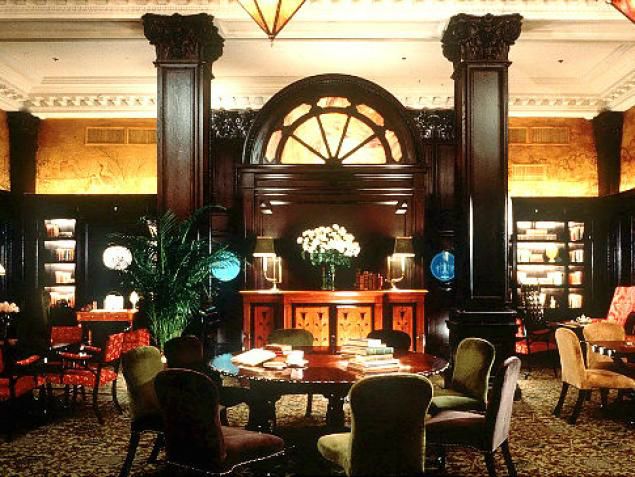
In the Algonquin where the Round Table met
[Image Source]


I am part of a group that meets in New York (hence one of my reasons for traveling to New York this past holiday season), to have a meal together, and to discuss the latest political/social/cultural developments. I compared this group to the Knights of the Round Table, or the more current Algonquin Round Table, in my email to the host of this group:
I am working on being a permanent presence in New York! But until then, I will make it as often as I can to your "Knights of the Round Table," (although the Algonquin Round Table fits well too!).
In our last meeting, we prepared to "discuss and criticize" the following:
Politics today wants to convert the world into a sort of machine for equal production and distribution of satisfactions. The goal is inhuman, since man is not a machine. It is also unworkable, and the attempt means public institutions that don't function as intended. To some extent that's a feature and not a bug: incompetence is good when the goal is bad.

At some point people will lose faith in the project. Today there are still many true believers but people are becoming more cynical, and liberalism in particular is becoming soaked in hatred and snobbery. That tendency seems likely eventually to reach some sort of tipping point in spite of the enduring idealism, or perhaps sentimentality and literal-mindedness, of much of the American public. Also, at some point it will no longer be possible to make up for malfunction by payoffs. The money will run out or lose purchasing power.

The end result is likely to be something like a third-world dictatorship: a semi-socialist ideology no one takes very seriously, the cult of personality, crony capitalism, corrupt officials, methods of control that rely on the stick more than the carrot, and social and economic life that's mostly off the books.

Such a situation could stagger on for quite a while. It's not at all inspirational, though, and people want to believe they're in a world that makes sense and is going somewhere, so it's likely to be a seedbed for the growth or regrowth of religious communities.

Any thoughts on how these things, to the extent I'm talking about something real, are likely to play out?
I wrote in my previous post, The Fruits of the New Year:
I continued to challenge the destructive elements of our society and culture at my blog and tried to bring in contributors, with the aim of taking this small idea into a larger movement of Reclaiming Beauty.
It is well and good to have a blog, where I write independently on current (and at times historical) topics, and to have a "blog" group. But at some point, these words have to be transformed into some kind of action, and the ephemeral "blog" group has to assemble in some real place, in real time.

That is why think my New York group is so important. As I wrote in The Fruits of the New Year:
I will battle on with persistence and perseverance, and hope to accomplish some of my goals for this year.
Our table is indeed a round table of knights, where we are battling the destructive elements of our society and culture.

My idea of a round table idea was also influenced by my passing by several times the original meeting place in New York of the Algonquin group.

During my trips to New York, I go to a small diner on 44th between 5th and 6th, for a quick and inexpensive meal. It is only a few blocks away from the 42nd Street New York Public Library. Next to this diner is the Algonquin Hotel, where:
After World War I, Vanity Fair writers and Algonquin regulars Dorothy Parker, Robert Benchley, and Robert E. Sherwood began lunching at The Algonquin. In 1919, they gathered in the Rose Room with some literary friends to welcome back acerbic critic Alexander Woollcott from his service as a war correspondent. It proved so enjoyable that someone suggested it become a daily event. This led to a daily exchange of ideas, opinions, and often-savage wit that has enriched the world's literary life. George S. Kaufman, Heywood Broun, and Edna Ferber were also in this August assembly, which strongly influenced writers like F. Scott Fitzgerald and Ernest Hemingway. Perhaps their greatest contribution was the founding of The New Yorker magazine, which today is free to guests of the hotel...The group expanded to a core membership that included Edna Ferber, Franklin P. Adams, George S. Kaufman, Heywood Broun, and Marc Connelly.

Though society columns referred to them as The Algonquin Round Table, they called themselves the Vicious Circle. "By force of character," observed drama critic Brooks Atkinson, "they changed the nature of American comedy and established the tastes of a new period in the arts and theatre."
Although my idea of exchanging ideas specifically around beauty might seem tame, it is surprising how strongly people feel when confronted about their definition of beauty, especially in our liberalized society, where everything is gradually being diminished to the same level of ugliness, all in the name of equality. Bringing up beauty as something with standards of excellence seems to ignite a viciousness in people, as though I'm suggesting that we eliminate all those who don't fit with this view.

The idea for specifically battling against ugliness, and fighting for beauty, is I think much more difficult than for fighting for our culture and society. Of course, the first problem is the definition of beauty, although I think there are good enough definitions of beauty. I think another problem will arise when we question people's (most people in our modern society) acceptance of ugliness, and allowing the usurpation of beauty by ugliness. No-one wants to be identified as a nurturer of ugliness, and each will thus defend "to death" his concept of beauty as we criticize and label it as ugliness (or the antithesis of beauty).

Also, I'm saying that beauty is hierarchical (some things that are more beautiful than others), and it is better to be upfront about it than to be subversive (and liberal). The idea of hierarchy in anything, let alone appearances, is not a popular one in our modern, liberal era, and will probably be attacked as viciously as the definition of beauty. And as I've written elsewhere (I'll find the sources), beauty is transmitted to various levels of society, which is another form of hierarchy. Those who have the capacity to see beauty, or to live in beauty (artists for example, or the wealthy) can set the example for others. A beautiful piece of jewelry, in gold and other precious stones, can be imitated in less expensive material, but can still hold some kind of magical attractiveness.

This concept of elitism and societal hierarchy is not popular in the new world (America and Canada), and it speaks of the aristocracy that was left behind in the old world. Although, I have to say that both Canada and America foster a hypocritical and subversive liberal elite, while the "elitist" Knights of the Round Table was actually designed (to be round) in order to remove a "head" of table, and allow discussions to proceed with equal voice (and strength) for all the table's members.

The Round Table is:
...King Arthur's famed table in the Arthurian legend, around which he and his Knights congregate. As its name suggests, it has no head, implying that everyone who sits there has equal status. The table was first described in 1155 by Wace, who relied on previous depictions of Arthur's fabulous retinue. The symbolism of the Round Table developed over time; by the close of the 12th century it had come to represent the chivalric order associated with Arthur's court, the Knights of the Round Table. [Source: Wikipedia]
The Knights' round table was designed to diminish hierarchy, in an age when hierarchy was the way of life. Yet, this group of leaders decided to meet in this "democratic" fashion, in order to have a better method for completing its goals.

This meeting of like-minded, and elite groups, in a democratic and equal fashion, shows that true elitism isn't rooted in demagoguery, and dictatorship. It is just an efficient way of ruling. And that in many ways, Godly and conscientious elites can be democratic, whereas equal opportunity seeking liberals can be demagogues. But, the balance falls against liberals, who have repeatedly shown us that their demagoguery is much more vicious than the elitism (if it is vicious at all) of traditional elites.

Below is the Charge Given to the Knights by King Arthur.

The first line is:
God make you a good man and fail not of beauty.
It is interesting to note that this confidence in ruling is rooted in a Godly humility. And that beauty (I think here it means order)
The next lines continue with the message of goodliness and of protecting and defending the weak:
Thou must keep thy word to all and not be feeble of good believeth and faith. Right must be defended against might and distress must be protected. Thou must know good from evil and the vain glory of the world, because great pride and bobauce maketh great sorrow. Should anyone require ye of any quest so that it is not to thy shame, thou shouldst fulfil the desire.
And chivalry towards women:
Thou shouldst be for all ladies and fight for their quarrels, and ever be courteous...
It is interesting that the Knights, along with their humility and adherence to good, are there to battle the world of its evil tendencies:
Right must be defended against might and distress must be protected. Thou must know good from evil and the vain glory of the world
.
The Algonquin Round Table was also called "The Vicious Circle." It may have been vindictive and cruel at times, but I think its real purpose was to set some kind of standard for art, culture and literature. Like the Knights of the Round Table, the Algonquin group must have had its standards which it felt it had to uphold, in culture and specifically in literature. Its label as vicious must have come from its confrontational stance.
-----------------------------------------------------------------------------------------------------------------------------------------------------------
Posted By: Kidist P. Asrat
-----------------------------------------------------------------------------------------------------------------------------------------------------------