About.......Contact.......Society.....................
Showing posts with label Perfume. Show all posts

Thursday, December 18, 2014

Yellow Diamond for the Holidays


Versace's Yellow Diamond Eau de Toilette is a subtle fruity-floral (more on the floral) scent, with solid base notes, which I think makes a perfect perfume for these winter holidays.

Here are the notes:
Top: Neroli, Bergamot, Lemon, Pear
Middle: Orange blossom, Water Lily, Freesia, Mimosa
Base: Musk, Guaiac Wood, Amber

Here is more detail on the notes:

Guaiac Wood:
[T]he heartwood of a palo santo (Bulnesia sarmienti) that yields an oil having an odor of tea or violets and used especially as a fixative in perfumery.
From Merriam-Webster
Mimosa:
"Mimosa has a fresh, floral, slightly powdery, almost honeyed aspect, which blends with the green scent of the stems," says Sebastien Plan of the perfume supplieers, Robertet.
Freesia:
"The fragrance is fresh but with depth to it, like a delicious Alsatian wine," explains flower expert Sarah Raven.
Comparing Neroli with Bergamot:
[Neroli] is sweet, honeyed and somewhat metallic, whereas bergamot, being rich in linalool (which is the main component in lavender), has more of an aromatic, soft floralcy. From Wikipedia
Amber:
Amber is also made with natural ingredients. It is often a combination of woods, resins, incense notes, patchouli and vanilla. It can be light and fresh (heavy on the frankinscence), or dark, thick and sweet (lots of patchouli and vanilla), Writes "lookingglass" at an online forum on perfumes.
A 30ml bottle (1fl) is about $60 Canadian (about $55 US). A little steep, but the scent lasts the whole day, and beyond. And the bottle's stopper which looks like a cut diamond will sit elegantly on any table.
-------------------------------------------------------------------------------------------------------------------------------------------------------------
Posted By: Kidist P. Asrat
-------------------------------------------------------------------------------------------------------------------------------------------------------------

Thursday, June 19, 2014

Tresor


The beautiful Isabella Rossellini (the daughter of the even more beautiful Ingrid Bergman) was the "face" of Lancome's signiature perfume Tresor from 1982-1996.

I've had Tresor for years, and have gone through some bottles (I think three).

This last bottle is at its last stretches, so I went to the mall (The Bay) to find out about prices. A 30ml bottle is around $70. I told the salesman that it was my all time favorite perfume, and that I have about a month's worth left (I showed him my bottle). He got quite emotional, and said his mother used to wear it also. He then went into the back, and brought me a tiny sample bottle, usually given as gifts for other Lancome purchases. "You made my day!" I said, thanking him.

None of the subsequent models for Tresor have Rossellini's beauty.

Tresor has a combination scent of floral/fruity, which I think is perfect for summer.

Here are Tresor's notes:
Top: Pineapple, Lilac, Peach, Apricot Blossom, Lilly-if-the-Valley, Bergamot, Rose
Middle: Iris, Jasmine, Heliotrope, Rose
Base: Apricot, Sandalwood, Amber, Musk, Vanilla, Peach


------------------------------------------------------------------------------------------------------------------------------------------------------------
Posted By: Kidist P. Asrat
------------------------------------------------------------------------------------------------------------------------------------------------------------

Saturday, April 12, 2014

Poppy Blossom


Coach, which started out as a luggage store, is now selling perfume (and handbags, purses, wallets and other leather paraphernalia - minus shoes). So far, I think it's become quite successful. I bought several years ago the Coach signature scent, but I found it too sweet. I remember finding Coach Poppy Blossom, but for some reason, I remained unimpressed.

Recently, I went to my favorite perfume store Sephora (where they give samples of scents for the undecided, or the searching), and got a tiny flask (worth about ten sprays) to test. It usually takes several minutes for the scent to release its notes, and even longer for the middle and base notes to come out. Many current perfumes lose their scent within a few hours, but the good ones persist for days.

I asked a shop assistant (a man, unusual for stores these days) what he thought of the perfume. He started a conversation by saying that he recognized the New York Public Library's pin I was wearing on my coat lapel (a logo of the library's lion head). "I worked there for a while last year," he said. "Oh really, what section?" "In the Judaica section, in the Dorot." "Yes, I'm aware of it, but I haven't visited that section... Are you Israeli?"

I asked him his national origin because he had a peculiar name (to me), and a clear Israeli accent.

"No, I'm Moroccan. But I speak fluent Hebrew." he answered.

This didn't ring true (or honest). He did not have an Arab accent. I figured then that he must be one of the many ethnic Arabs who live (or lived) in Israel.

"Do you speak Arabic?" I asked him.

"Yes."

"Are you Muslim?" I finally asked.

"Yes."

Then I thanked him and left.

In any case, he had no idea about the perfume I was asking him, as is the case with most of the staff I ask for assistance at Sephora. What do these people have to do all day but stand around? A smart manager would have them go through all the perfumes, section by section, and study all the basic information about them. And the smart employees would go home online and read up more on the collections.

Which is what I did.

Poppy Blossom was disconnected from the Coach line for a while, but it is back as a limited edition in some of its stores, and Fragrantica and the Bay also carry the line. It is a modest $45 for 30ml.

I have to add, though, there is no poppy flower notes in the perfume, despite the name. It seems like a branding strategy, where the collection's bottles come with cloth poppy flowers for hair or dress decoration: Orange/red flower for the original Poppy Blossom), green for the Poppy Citrine Blossom, and violet/red for the Poppy Freesia Blossom.

The "Poppy" seems to be the name of the woman this perfume was designed for. But what kind of woman is called "Poppy?"

Here are the notes for the Poppy Blossom:
Top: Lychee, Strawberry, Orange, Freesia
Middle: Lily-of-the-valley, Rose, Tubrose, Gardenia, Jasmine
Base: Pralin, Vanilla, Musk, Woody notes

It has the lily-of-the-valley that I wrote about here.
The scent does last several days. Its final notes are a light combination of the floral and fruit, with the floral dominating slightly.

It is the perfect scent for late spring and summer.

Osmoz says this about the perfume:
Description: Poppy Blossom by Coach begins with fruity notes of mandarin, strawberry and lychee. The heart is a bunch of muguet, centifolia rose, tuberose, jasmine and gardenia. The warm and gourmand dry-down mixes praline, vanilla, blond woods and white musks.
At a glance: A playful and optimistic scent
History: After Poppy, and Poppy Flower, a citrusy and sparkling fragrance, Coach introduces Poppy Blossom, a more floral and fruity scent. According to the brand, the perfume combines the vivacious energy of Coach Poppy and the floral femininity of Poppy Flower. The fragrance embodies a whimsical, modern and sophisticated woman with an exhilarating personality.
Bottle: Poppy’s signature flacon is reinterpreted with a red poppy-like ribbon and a golden juice.
The era of the individual perfumer is over. Although Karyn Khoury is attributed as Poppy Blossom's creator, she worked with a large team of perfumers to make the scent. She says about the process:
...We spent many hours with Reed Krakoff (Coach’s executive creative director) and his team, listening to their vision of the brand and customer.

[...]

The result is a beautifully blended fragrance with great presence, signature and diffusion, which represents modern beauty, elegance and charm.
But, the "nose" of the original Poppy is Celine Barel, who has a modest collection of perfumes, including one nice one she designed for Jessica Simpson (modern pop star).

This original bottle has no corresponding flower, and is a darker bottle with a chocolate brown ribbon, perhaps referencing that "modern woman," with notes which include light and stronger elements, such as cucumber, gardenia, jasmine, and "decadent" marshmallow.

This site describes this dichotomy best with:
Poppy Blossom combines the vivacious energy of Poppy with the floral femininity of Poppy Flower. This luminous and warm fragrance is inspired by the modern beauty of the Poppy Woman.
But, as I said earlier, if left to its own qualities, Poppy Blossom is light, fresh, fruity and floral, and is perfect for spring and summer.
-------------------------------------------------------------------------------------------------------------------------------------------------------------
Posted By: Kidist P. Asrat
-------------------------------------------------------------------------------------------------------------------------------------------------------------

Sunday, February 2, 2014

February Month Of The Violet


Eduard Manet (1832-1883)
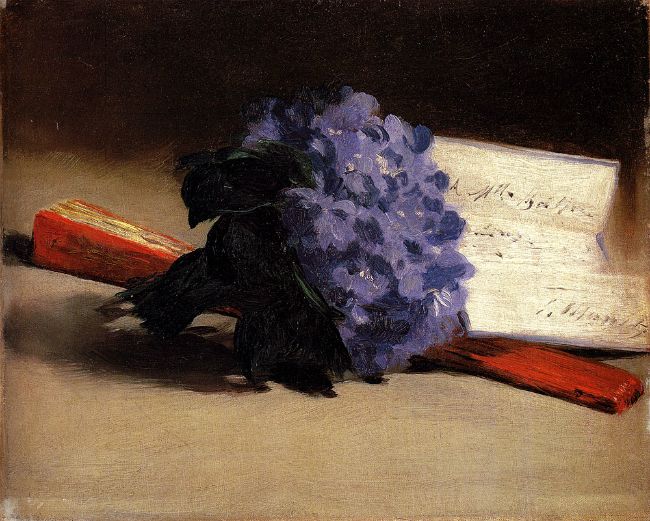
Bouquet Of Violets
Oil on canvas
1872
8.66" x 10.63"
Private collection


Rather than find flowers and gems related to a horoscope sign, I thought it would be interesting to find them as they relate to a month.

February is the month for violets. According to Wikipedia, February's:
- Birth flower is the violet (Viola) and the common primrose (Primula vulgaris).
- Birthstone is the amethyst
- Symbols are piety, humility, spiritual wisdom, and sincerity.
- Zodiac signs are Aquarius (until February 18) and Pisces (February 19 onwards)
This month, which is in deep winter, already has four things that I like:
- The violet flower is part of a perfume that I find delicately pleasant: Elizabeth Taylor's Violet Eyes has the essence of the violet flower (below is my review I wrote in 2011)
- The deep purple amethyst is my second favorite stone
- I am Capricorn, but as I read Aquarius astrology notes signs, I find that I have a lot in common with that sign, including getting on well with the creative, imaginative and often visionary Aquarians. Perhaps it is to do with the moon, sun and planets?
- Humility, spiritual wisdom and sincerity? I think I do have a certain sincerity in what I do. That is probably why I decided to be a blogger.
- I did a post on Elizabeth Taylor only a month ago. It was mostly about her perfumes, where I wrote:
...[I]n Taylor's time, celebrities didn't run around in embarrassing outfits confessing all kinds of unmentionable things to callous magazine interviewers who have to take things (gossip and ugliness) up a notch in order to sell their stories. Despite their clearly difficult lives (Elizabeth Taylor was married eight times), there still was an aura of mystique and mystery around these celebrities. This provided them with the shelter to continue with their creative energies. And it gave Taylor room to create her perfumes.

She had been in the news mostly about her readmission into hospital because of her heart. Even for such a trip, she put on her best face and best clothes.

She still had energy to compose one final perfume, Violet Eyes, in 2010, perhaps her most personal...
Here is perfumer Carlos Benaim describing the perfume, and Elizabeth Taylor:
At first, you perceive the brightness of her gaze. Then she looks straight at you, and there you are, staring into the most famous eyes in the world. And they are indeed violet, absolutely unique and truly beautiful.

Both the bottle and the outer package were carefully designed to my specifications. The contrast of both shiny and matte surface and watercolour violets combine to make this an exquisite design.
And here are the notes for Violet Eyes:
Top: White Peach
Middle: Purple Rose, Jasmine
Base: Violet, Cedar Wood, Amber
I took the photograph below of a field of violets sometime in spring. I'm not sure what violets have to do with February, but I have noticed this small, unassuming flower, which gives a purple carpet on fields where it is allowed to grow.


Violet Garden (2011)
[Photo By: KPA]

-------------------------------------------------------------------------------------------------------------------------------------------------------------
Posted By: Kidist P. Asrat
-------------------------------------------------------------------------------------------------------------------------------------------------------------

Thursday, January 23, 2014

Well-Perfumed


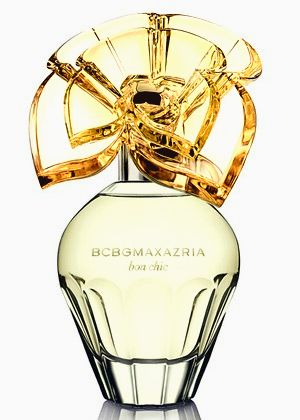
Bon Chic Bottle. The Max Azria signiature logo is the two Bs in mirror image.
The bottle's lid is designed with the logo in mind, but looking like the open petals of a flower
.

Bon Chic Bon Genre, or BCBG (Bé Cé Bé Gé) is a French term for "preppy." But it doesn't have the sophomoric, college student, connotations behind its name. It really just means well styled, and well mannered.

The fashion designer Max Azria, of BCBG Max Azria, has been releasing a series of BCBG perfumes, created by perfumer Stephen Nilsen. The first of the BCBGs was called BCBG (initials only), and came in a pretty pink bottle with a rose-like lid. He then broke down the BCBG, and released a yellow-bottled Bon Chic in 2012, and a purple Bon Genre in 2013.

I've tried all three (through the generous "sample" bottles provided at Sephora), and I find Bon Chic the most successful (although all three are good).

Here are the notes for Bon Chic:
Top: Mango, Pear, Rasberry
Middle: Violet, Pink Peony, Orange Blossom
Base: Vanilla, Musk
A tiny Eau de Parfum bottle (0.25 fl. oz) is $20. The Sephora shop assistant told me that this was as long as quantities last. These small bottles were initially designed as promotional bottles at department stores during the holidays.

There is nothing overwhelming about this perfume. I think putting in the delicate raspberry scent, rather than the stronger strawberry, was a clever move by the designer to maintain the lightness of the scent.

I don't smell any strong "woodsy" scent either, although I think it is masked by the vanilla and the musk, which I think give a warm and unobtrusive dry down. The top "fruity" scents are take over by the floral middle notes. This gives the perfume an initial burst of cheery fruits, which then give way to the sweet and floral middle notes supported by the delicate base notes.

All the perfume sites I found gave copied and pasted versions of some original (and I'm not sure where its origins are). But here is one cheerful reviewer who writes:
This is feminine and summery -in a really good way! I was pleasantly surprised by the complex sweetness of this. My first thoughts on this were apple and mimosa with a touch of powder. Then there's a smokey quality to this perfume that balances the sweetness ( I'm not the best at detecting notes.. albeit this is my humble description :). It is sweet but not unsophisticated.

The dry down is very pleasant, soft, and sensual. Unfortunately, it doesn't stick around for a very long time :(. Maybe several hours, which isn't terrible, but at the end of the day it's barely there. But, all in all I was very pleased with this scent and I think it's the best of the BCBG Fragrances. Would repurchase!
I don't agree with her about the short scent span of the perfume.I sprayed mine on a scarf to test its longevity, and I still detect a light, sweet, floral scent even after about a week.
-------------------------------------------------------------------------------------------------------------------------------------------------------------
Posted By: Kidist P. Asrat
-------------------------------------------------------------------------------------------------------------------------------------------------------------

Wednesday, December 11, 2013

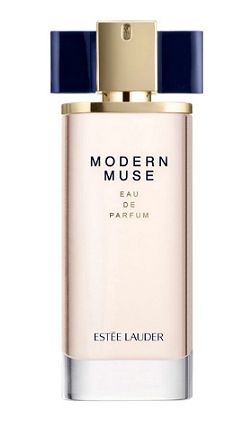
Modern Muse: A Jasminy-Musky-Vanilla Grand Finale


What is a modern muse?

Estee Lauder created the new perfume Modern Muse inspired by:
...the complexity of a modern woman, with the same dynamic contrasts as her life and her personality. Her creative energy and magnetic femininity are captured by its multi-faceted, sparkling floralcy. Her sleek style, strength and sensuality by its sleek woods.
She asks:
"Who is a Modern Muse?"
And answers:
A chic new vision of today's woman.

She's confident and independent, soft and strong, feminine yet dynamic.

Stylish and original, she inspires everyone she meets--without saying a word.
It looks like the modern muse is everything.

Irrespective of this "dual" definition, Modern Muse is a soft and flowery perfume. It has none of the "strength" and "dynamism" that Lauder describes.

And I think it is a good thing.

Here are the notes for Modern Muse:

Top Notes: Mandarine Orange
Middle Notes: Lily, Honeysuckle, Jasmine, Tuberose, "Flower Petals"
Base Notes: Patchouli, Amber, Musk, Vanilla, "Woody Notes"

The perfume is lovely. It does start off a little strong. Could it be the tuberose middle note? I've never liked tuberose in perfumes as it gives them a harsh scent. Or the citrusy orange top note? Citrus notes are my least favorite. But fortunately this doesn't stay long, and a delicate flowery scent - possibly the lily or honeysuckle - takes over for a while. Then we're left with a jasminy-musky-vanilla finale.

I think it can work both for a day and a night perfume. I think it is best as a winter/fall perfume, and is a little too strong for spring and summer. It is just strong enough to give a "dressed-up" feel for an evening, but light enough to wear on a winter's coat.

The bottle is also well-designed, in a modernist sort of way. The long, rectangular bottle resembles the tall modern skyscrapers (very masculine), but the dark bow on top gives it that feminine touch (women shopping in big city department stores?). I like the contrast of the very pale pink of the bottle, which is not the color of the liquid, but rather the enameled bottle, with the stiff navy blue bow. This is not a bottle that men would be attracted to.

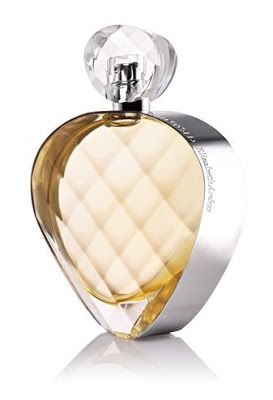
The nice shop girl at Sephora's gave me a sample, although I went looking for Elizabeth Arden's "Untold," which is being advertized in magazines and on TV commercials. Again, it is the "multi-faceted modern woman" who is being featured in Arden's new perfume. But the jeweled facets of the bottle more creatively allude to this modern woman. The notes for Untold, though, are very similar to Modern Muse, although Untold doesn't have the vanilla and jasmine base notes which soften it and make it very feminine.


I thought perhaps the perfume designers were the same for Modern Muse and Untold. But it is Karyn Khoury (who sounds like she has Lebanese origins) for Modern Muse, who worked as an assistant to Estee Lauder for thirty-five years, and the French Clement Gavarry, with several generations of perfumers in his family, for Untold.

I will do a review of Untold in the near future.

Karen Khoury, Senior Vice President at Estee Lauder says about creating Modern Muse:
We built Modern Muse by carefully selecting every ingredient to reflect the personality, style and distinctive femininity of today’s woman.

The “dual-impression” creative approach offers each woman the opportunity to connect with the fragrance in her own way. Some will focus on the sparkling floral elements of the fragrance, while others will view the warm, rich woodiness as the defining facet.
The "we" in Khoury's team consists of the French Master Perfumer Harry Fremont:
Parfumer; born in Cannes, France, graduated from the ISIPCA or "Institute Superieur de la Parfumerie" located in Versailles in 1981, he received two consecutive awards for his olfactive creation by the prestigious "Societe Technique Des Parfumeurs de France" in both 1984 and 1985. In 1987, joined the Firmenich International Fragrance Center in New York after spending three years at the Corporate Headquarters in Geneva; has created fragrances in partnership with Ralph Lauren Fragrances, Calvin Klein Cosmetics, Intimate Beauty, Bath & Body Works, Cacharel, Nino Cerruti, Valentino and Lancome


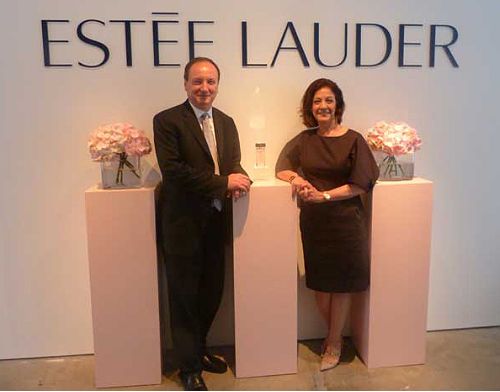
Harry Fremont and Karyn Khoury showcasing Modern Muse

--------------------------------------------------------------------------------------------------------------------------------------------
Posted By: Kidist P. Asrat

Friday, October 25, 2013

Marchesa's D'Extase


The couture clothing line Marchesa, run by the sisters Georgina Chapman and Keren Craig, released its first perfume last year, called D'Extase. I've been to Sephora to try it, and as usual, they gave me a small sample to test. Often with perfume the initial spurt is not enough to release the middle and base notes. A small sample helps me test the perfume through the day, as it changes and reaches its final scent.

Here are the notes:
Top Notes: Iris, Freesia, Black Current, Violet Leaves
Middle Notes: Jasmine, Bulgarian Rose, Orange Blossom
Base Notes: Iris, Musk
I forgot about this perfume until recently, when I saw the lovely bottle again during a recent trip to Sephora's. My original sample had evaporated by then, so I asked the shop girl to give me another.

The perfume has a light beginning, but it then blossoms into a sweet florals and a warm musk. The jasmine gives it a powdery softness. It lasts for several hours, and stays on sprayed fabric for days.

The ad below has one of the sisters rambling on about the perfume making a woman feel powerful, special, intoxicating, beautiful, sensual, confident, strong, ethereal. Is there any adjective missing for this woman who wants it all?


Still, these woman have designed a good perfume. It's no Chanel or Dior, but it is a warm welcome to to the cold days ahead.

The perfume bottle is crystal-encrusted, after the evening clutches designed by Marchesa.


Below is an evening clutch from the Marchesa collection, which I particularly like:


-------------------------------------------------------------------------------------------------------------------------------------------------------------
Posted By: Kidist P. Asrat
-------------------------------------------------------------------------------------------------------------------------------------------------------------

Friday, September 6, 2013

Scents for Summer


Guerlain is indeed the perfume house of greatness, although it had a small blimp with its variation on La Petite Robe Noire - Eau de Toilette (I wrote here a few days ago praising the LPRN Eau de Parfum, but disappointed with the new Eau de Toilette which came out just a few months ago).

I went back to Sephora's to look for more Guerlain scents. I remember a series of tall, rounded bottles, which looked ominously large (and expensive). These are the Allegoria series of about ten Eau de Toilettes.

A few were on display. There was nothing smaller than 75 ml (or 2.5floz) which goes for $65. The sales girl gave me a tiny sample each of Herba Fresca and Nerolia Bianca. I wanted to analyze the dry-downs ("The final phase - or bottom note - of a fragrance, which emerges several hours after application. Perfumers evaluate the base notes and the tenacity of the fragrance during this stage.")

Here are the notes for Herba Fresca:
Top: Lemon, Clover
Middle: Green Tea, Mint
Base: Cylamen, Lily of the Valley, Pear Blossom
The Cyclamen scent:
...is light floral. A little like lily of the valley, but sweeter and lighter. It isn't obvious ...but if you pick a few flowers they can fill a room with scent for a few hours.[By Commenter Chris Bartlett at Basenotes]
The mint is overpowering at first, but about fifteen minutes later, it subsides and adds a pleasant freshness. A little longer, and a flowery scent (cyclamen?) starts to dominate. But the general fragrance is fresh and leafy. I think Herba Fresca is a perfect scent for late summer: fresh and nostalgic.

I would have liked a smaller bottle, and of course, consequently, a lower price. But, as I've experienced, Guerlain is eternal, and this bottle can go through many summers.

Herba Fresca was created in 1999.

The much newer Nerolia Bianca (created in 2013) is stronger. It starts out soft, then builds up to a heavy scent. It seems suited for a hot midsummer's day. The base notes are a strong medley of musk, white amber and cedarwood, and combined with the the neroli flower, I think give it the heavy sweetness.

About the Neroli:
Neroli is the name given to the oil extracted by steam-distillation from the fragrant white flower blossoms of bitter orange trees...

Neroli has a light sweet-floral fragrance with an element of citrus. It is said to have a refreshing, honeyed floral aroma. It is commonly used as a top note in modern fragrances.
-------------------------------------------------------------------------------------------------------------------------------------------------------------
Posted By: Kidist P. Asrat
-------------------------------------------------------------------------------------------------------------------------------------------------------------

Wednesday, September 4, 2013

Heavenly Dream Angels


My mall has a large Victoria's Secret store. I had read somewhere that Victoria's Secret also has a perfume line (or lines). I was curious, and went in.

I happened to be there when they were selling a smaller bottle from the advertised original: 2.5floz vs. 8.4floz, and at about the same percentage reduction in price. It came in a package with an eye-shadow set.


The slate, brown and gold are a nice combination, and the "Get the Look" guide has directions for night and day application.

Here are the notes for Heavenly Dream Angels (Angel Mist):
Top: Quince, Cardamom, Orange, Ivy
Middle: Lotus, Peony, Freesia, Iris, Violet
Base: Orchid, Vanilla, Musk, Sandalwood
[Source: Fragrantica]
I find it initially a little to sweet, but it softens over time and the vanilla and musk base notes start to take over. I think it is the quince which gives it this exaggeratedly sweet scent. "...deep and honey-sweet with a strong citrus or pineapple note and a rather exotic spiciness all in one," is how this blogger describes the scent. I think that is a good description. The bottle is pretty too. Long and sheer, with a gold top.
-------------------------------------------------------------------------------------------------------------------------------------------------------------
Posted By: Kidist P. Asrat
-------------------------------------------------------------------------------------------------------------------------------------------------------------

Tuesday, September 3, 2013

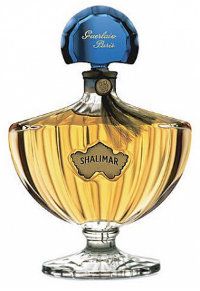
Shalimar: Senses in a Bottle

Below is an unpublished, short article: Shalimar: Senses in a Bottle which I wrote around 2008. (Retrieved from Camera Lucida and Kidist P. Asrat Articles.)

-------------------------------------------------------------------------------------------------------------------


Shalimar: Senses in a Bottle

Sight, sound, touch, taste, and of course smell combine together to make Shalimar.

Guerlain, one of the oldest fragrance companies in the world, introduced its famously exotic perfume Shalimar in 1925. A combination of flavorful spices, aromatic woods and smooth, powdery florals gives this perfume a distinctive fragrance. A secret ingredient called Guerlinade, which goes into all the Guerlain perfumes, was added to seal the final product.

As perfumeries (and individuals) were gathering their favorite scents over the centuries, spices, florals, woods, roots and animal scents were combined in non-discriminate manners, with their scents being the decisive factors. Spices for food and perfumes were only recently separated from serving the two distinct senses of smell and taste. Vanilla, cinnamon, nutmeg and even cloves have always been part of perfumes. Shalimar, true to this ancient practice in perfume making, includes the versatile vanilla as one of its ingredients.

The ancient Greek botanist Theophrastus considered these compounded scents to be the most sophisticated and successful fragrances, and even suggested that perfumes be considered along musical terms. Modern-day structuring of the various scents considers the whole product in terms of a musical chord. Top notes are the most short-lived of the odorants, followed by the more enduring middle notes, or corps odors, and finally the clinging bottom notes, or the fonds. All this in an effort to balance out the real substance of the perfume which are the bottom notes. Left on their own, these bottom notes can be initially overpowering, and rely on the two other higher ‘chords’ to gradually introduce their heavier scents, and soften them over time.

According to its compositional notes Shalimar’s ‘notes’ are:
Top notes: bergamot, lemon, hesperidies

Middle notes: rose, jasmine, iris, patchouli, vetiver

Base notes: vanilla, incense, opoanax, sandalwood, musk, civet, ambergris, leather
Guerlain realized that a visually styled flask would elevate its perfume to the status of art. By collaborating with Baccarat crystal to form the now famous Shalimar flask, Guerlin displayed its perfume to the public for the first time, in its perfect bottle, at the famous Exhibition of Decorative Arts in Paris, in 1925. Shalimar and Art Deco were thus inaugurated. But as always, in the history of perfume, Shalimar was only following an ancient tradition where the flask is just as important as the fragrance.

Scents and fragrances have always been a mixture of pomades, oils, waters, and creams. Shalimar is no exception. In addition to the exclusive perfumes and sprays, lotions and creams promise to deliver smooth powdery textures imbued with the famous Shalimar scent.

Shalimar the perfume has come full circle. Not only as a fragrance but as a visual, aural, tactile and even flavourful concoction. As with most artistic attempts to appeal to the feminine, Shalimar has diverged into as many senses as possible to make the apparently simple experience of a perfume a rich and complex one.

References:
1. Barille, Elizabeth. Guerlin. New York : Assouline, 2000
2. Kennett, Frances. History of Perfume. London : Harrap, 1975.
-------------------------------------------------------------------------------------------------------------------------------------------------------------
Posted By: Kidist P. Asrat
-------------------------------------------------------------------------------------------------------------------------------------------------------------

L'Heure Bleue


The Seine at L'Heure Bleue

From Camera Lucida, September 1, 2012:
I posted in my previous post an image of the Seine at "L'Heure Bleue" without explaining the meaning of the term.

From Wikipedia:
The blue hour comes from the French expression l'heure bleue, which refers to the period of twilight each morning and evening where there is neither full daylight nor complete darkness. The time is considered special because of the quality of the light at this time of day.

Wikipedia continues with a more metaphoric meaning:
The phrase is also used to refer to Paris immediately prior to World War I, which was considered to be a time of relative innocence.
The Wikipedia site has other interesting pieces of information, including art, books, films and music which use l'heure bleue.

It is a hard moment to catch. It is not quite light, not quite dark, with a strange sense of stillness. A little like the moment of a full solar eclipse, when the earth seems momentarily to be at a standstill (I have seen a full one in 1991 in Mexico City, of course through safety glasses. One thing that struck me was the birds stopped chirping - I was near a wood - for those brief seconds).
-------------------------------------------------------------------------------------------------------------------------------------------------------------
Posted By: Kidist P. Asrat
-------------------------------------------------------------------------------------------------------------------------------------------------------------

All Things French (a.k.a. Perfume)


Even the Eau de Toilette's bottle (left) is a diluted version of the Parfum (right)

I haven't done a perfume review in a while.

I recently went to The Bay to see what new scents are on the perfume stands. I saw La Petite Robe Noire, Eau de Toilette, and asked the saleswoman if I could smell it.

"It smells nothing like the original," I said.

"They're completely different scents," she said. "They don't make lighter versions of the EDP with the EDT. The add completely new ingredients."

That was news to me! Toilettes have always been a lower concentration of Parfums.

"If the EDP and the EDT are different, it just looks like a strategy to get women to buy the scent in its different forms." I replied.

She had no comment on that, possibly out of ignorance.

Here are the notes of the "new" La Petite Robe Noire, Eau de Toilette:

Top: Jasmine, Rose, "Green Notes"
Middle: Sour Cherry, Orange Blossom, Apple
Base: Patchouli, Amber, White Musk

In comparison, these are the notes for the original, Eau de Parfum:

Top Notes: Bergamot, Almond, Sour Cherry, Red Berries
Middle Notes: Rose, Licorice
Base Notes: Anise, Vanilla, Patchouli, Iris

The perfume blog Pop Sugar Beauty (formerly Bella Sugar, which I consider a reliable perfume review site) writes:
All the fragrance terms...are actually just designators for different dilutions of perfume oil.

Eau de parfum/millésime/parfum de toilette

This is what most people consider "perfume," and it's the standard dilution level for women's fragrances, clocking in at between 10 and 20 percent oil (although almost always less than 15). EDPs tend to be the scents that are most noticeable to others, making them great for dates but not always optimal if you work in close quarters or spend a lot of time in the heat, which makes the smell even stronger.

Eau de toilette

These are your go-tos for warm weather or inoffensive everyday wear. They're usually less than 10 percent oil, although they can be anywhere from five to15, and they provide a lighter, slightly less complex scent than an EDP does. Fragrance counter people often position EDTs as "inferior" to EDPs, because they're lower priced, but that's simply not the case. They both have a function, and lots of scents are actually preferable in their EDT form. Don't let a sales pitch keep you from trying both, because the less expensive EDT could very well be a nicer fragrance. They're also a great "entry" to a scent; if you're not sure you'll adore a fragrance or it's a big investment, buy the EDT.
The Bay's shop woman is right. Guerlain has come up with different notes for its EDT and EDP for La Petite Robe Noire.

The EDT is an unattractive, bland scent. It is completely different from the original EDT. As I said to the saleswoman, this is just a marketing strategy from Guerlain. They can now sell two La Petite Robe Noire variations as two different perfumes. EDP and EDT owners will now want to own both.

Not me.

---------------------------------------------------------------------------------------

Here is what I wrote on La Petite Robe Noire (Eau De Parfum) in Camera Lucida on September 1, 2012:

Guerlain's bottles for L'Heure Bleue
and La Petite Robe Noire


Guerlain, which houses my favorite perfume Shalimar (here's an article I wrote on Shalimar - Shalimar: Senses in a Bottle) has a perfume cutely titled La Petite Robe Noire, or LPRN, as the unromantic perfume saleswoman told me is the best way to remember it. What happened to knowing a little bit of French? Petite, robe, noire. Is that so hard to remember?

Of course La Petite Robe Noire is in reference to that cocktail dress which all fashionable women should have in their wardrobe.

Notes the Guerlain's La Petite Robe Noire, Eau de Parfum:
Top Notes: Bergamot, Almond, Sour Cherry, Red Berries
Middle Notes: Rose, Licorice
Base Notes: Anise, Vanilla, Patchouli, Iris

It sounds like it should smell like candy, but it has the famous Guerlinade that is present in Shalimar. It is in fact a lighter version of Shalimar, and not at all juvenile fruity as the name suggests but a good blend of floral and fruity.

The bottle for La Petite Robe Noire is exactly the same as the 1912 L'Heure Bleue (re-instated in 2012 at its 100 year anniversary). La Petite Robe Noire's bottle, which comes in a deeper purple, could have done without the cute dress illustration and the scribbly script.


The Seine at L'Heure Bleue
-----------------------------------------------------------------------------------------------------------------------------------------------------------
Posted By: Kidist P. Asrat
-----------------------------------------------------------------------------------------------------------------------------------------------------------
Friday, August 2, 2013

Fifth Avenue: The Structure of a Perfume


[Photo by KPA]
I put together my two Fifth Avenue bottles, and a fridge magnet with a dusk shot of New York, for the collage above.


This is actually not a new post, but a re-posting of my 2011 post The Structure of a Perfume: 5th Avenue by Elizabeth Arden.

Summer is the season for perfumes, both store-bought and on the many fragrant flowers blooming everywhere.

While I was looking for scents with linden blossom scents (here is my post), I also thought I would try to find Elizabeth Arden's Fifth Avenue in the various department stores.

Her Fifth Avenue, and Fifth Avenue After Five are still on the shelves. I have both (courtesy of the discount perfume counter at Winners!). Both are now priced around CAN$55, which is relatively low-priced for a designer perfume.

I was explaining to the salesgirl at the Bay about the perfume structure:

- That it is both a horizontal and vertical allusion to the beautiful avenue: Vertical like the skyscrapers, and horizontal like the grid-like, long and straight avenue.

- The bottle has now become iconic, and the shape takes on the many variations of Fifth Avenue.

From her reaction, I thought she had been to New York. But, she said she never had, but knew of these places through the movies! Such is the cultural education of twenty-somethings of our era. How hard is it it grab a bus to New York, and to find a Y with decent but cheap accommodations?

Elizabeth Arden produced a series of Fifth Avenue perfumes.

Fifth Avenue NYC is for cocktail evenings, not After Five, but after dark.

Fifth Avenue Nights, with the sparkling dots, shows the glittering lights of the skyscrapers.

Fifth Avenue Style evokes the fashion on the avenue.

Fifth Avenue Gold, the wealth and luxe in the avenue.


Elizabeth Arden's New York Quartet
Clockwise:
- Fifth Avenue Gold
- Fifth Avenue Nights
- Fifth Avenue NYC
- Fifth Avenue Style

------------------------------------------------------------------------------------------------------------------------------------------------------------
Posted By: Kidist P. Asrat
------------------------------------------------------------------------------------------------------------------------------------------------------------
Hermes


Minerva, Mercury and Hercules (Greek equivalents: Athena, Hermes and Heracles)
Grand Central Terminal, New York City


Sculptures designed by Jules Coutan:
...a symmetrical massing of figurative scluptures titled "The Glory of Commerce." This colossal 48-ft (14.6m)-high sculptural trio depicts Mercury (the personification of travel and speed) flanked by Hercules and Minerva and was designed by French scholar and Ecole Des Beaux-Arts professor Jules-Alexis Coutan (1848-1849).

At its base is an ornamental cornice that frames a typographic frieze of all-capacity serif letters identifying the edifice in a ceremonial and formal manner reminiscent of early Roman triumph arches.

[From: Graphic Design and Architecture, A 20th Century History: A Guide to Type, Image, Symbol, and Visual Storytelling in the Modern World, P 558 Richard Poulin]
----------------------------------------------------------------------------------------------


Hermes luggage, ca. 1930, designed for Karen Blixen, author of "Out of Africa."
I'm not sure if these are the original suitcases, which were made of crocodile skin

Zeus was [Hermes's] father and Maia, daughter of Atlas, his mother. Because of a very popular statue his appearance is more familiar to us than that of any other god. He was graceful and swift of motion. On his feet were winged sandals; wings were on his low-crowned hat, too, and on his magic wand, the Caduceus. He was Zeus's Messenger, who "flies as fleet as thought to do his bidding."

Of all the gods he was the shrewdest and most cunning; in fact he was the Master Thief, who started upon his career before he was a day old.
The babe was born at the breakof the day,
And ere the night fell he had stolen away
Apollo's herds.
Zeus made him give them back, and he won Apollo's forgiveness by presenting him with they lyre which he had just invented, making it out of a tortoise's shell. Perhaps there was some connection between that very early story of him and the fact that he was God of Commerce and the Market, protector of traders.

In odd contrast to this idea of him, he was also the solemn guide of the dead, the Divine Herald who led the souls down to their last home.

He appears oftener in the tales of mythology than any other god. [From: Mythology, By Edith Hamilton. Pp34-35].
One note, to contradict the great Edith Hamilton: I don't think Pan's guide for the dead is an odd contrast to "this idea of him." Death is also a journey, albeit our last journey that leads our soul to our last home.

This book was suggested to me by Lawrence Auster, to familiarize me with ancient mythologies, and to provide me with a better understanding of the roots of Western civilization. It is a pleasure to read, like a story of the gods rather than a dry, scholarly book. But, as I research more on the book, Hamilton hasn't short-changed any of the gods - or else those mischievous ones, like Hermes's son Pan, might make her a visit.

It is fitting that Hermes should choose this mischievious god as its label, who is also the protector for commerce, market and trade.

Before Hermes became such a prestigious design label, his family's origins were as harness makers (speed and travel, again). They naturally evolved to saddlery, then designed bags to carry the saddles (see below for more information). to

What is fortuitous, though, is that Hermes is the actual family name of this design label. It is as though the decision for them to lead in travel accessories was written in their name!


Orion, a contemporary Hermes suitcase
In aluminium with handles,
straps and interior in natural cowhide.
Going for a mere $10,300.00

After Orion the hunter, the giant in
Greek mythology
?

----------------------------------------------------------------------------------------------

I tried to find some scents with the linden flower. Hermes makes one which I had identified as Aroma D'Orange Verte. I went to Holts Renfrew (the high-priced Hermes perfumes are not available in Sears or the Bay) to look for it. It has a pleasant, slightly citrusy, slightly floral scent. I can identify the sweet linden flower. The perfume (it is an eau de toilette) stays all day - I sprayed it on a test card, and the scent stayed for more than twelve hours, becoming gentler and sweeter with time. It retains a very mild cologne scent. It is a pleasant surprise. The knowledgeable sales man (I think they put former male models in perfume counters. And all the helpful and knowledgeable ones are men) immediately understood that I was looking for a linden flower scent, which he specified as "Linden blossom."

It's normal fare at $72 Canadian (no tax) for 50ml selling at Holt's. Hermes perfumes are usually expensive. But this is an Eau de Toilette (no "parfum" version, as the salesman informed me). There is nothing smaller than 50ml. I find 30ml more than adequate.

The bottle is an unattractive elongated shape, and the perfume is described as "unisex." Perhaps they are trying to attract the male customers, since with Hermes' signature, I don't think women would be so picky about the bottle. I am though. A pretty bottle and a pretty scent go together. Imagine pulling this cumbersome flask out from one's purse. Even Hermes' latest perfume for women, Jour D'Hermes, is an odd, simplistic square, with an empty base, which seems like a waste of bottle space. But, I will admit that it looks good juxtaposed with the men's fragrance Terre D'Hermes.


Hermes was made famous through the sturdy, leather luggage. Strong bottles travel well, and these contemporary bottle designers may be alluding to the travel and luggage origins of Hermes.
Beginnings in the 19th century
Thierry Hermès, founder of Hermès.
Born in Krefeld (Germany), Thierry Hermès was the son of a French man and a German woman. The family moved to France in 1828. In 1837, Thierry Hermès (1801–1878) first established Hermès as a harness workshop on the Grands Boulevards quarter of Paris, dedicated to serving European noblemen. He created some of the finest wrought harnesses and bridles for the carriage trade. Monsieur Hermès's earned citations included the first prize in its class in 1855 and the first-class medal in 1867 at the Expositions Universelles in Paris.

Hermès's son, Charles-Émile Hermès (1835–1919), took over management from his father and moved the shop in 1880 to 24 rue du Faubourg Saint-Honoré, where it remains today and where the new leader introduced saddlery and began retail sales. With the aid of sons Adolphe and Émile-Maurice Hermès, the company catered to the élite of Europe, North Africa, Russia, Asia, and the Americas. In 1900, the firm offered the Haut à Courroies bag, specially designed for riders to carry their saddles with them.
Here are the notes to Aroma D'Orange Verte:
Created in 1979 it's like citrus fruit in a bottle: oranges, lemons with their stimulating freshness, cheering mandarins . A minty and fruity accord (papaya and mango) enhances the slightly acid character of the fragrance. A patchouli and oakmoss end note lifts up these light notes and gives more character to the perfume.
It is sold as a men's cologne, but it has such a delicate drydown that it might be better for women.

The bottle is nothing special. Perhaps the designers were trying not to alienate too many men and women by making it neutral.


Here is Hermes' classic, which I carried around with me to the last drop. I acquired it when it was know as Parfum d’Hermes, and couldn't find it for a long time. It still has a whiff of the lovely, powdery scent. In 2000, it was re-interpreted as Rouge Hermes, and is available in a slightly elongated version of the round, compact design, as well as the clumsy, long bottle (signature for contemporary Hermes!).


Parfum D'Hermes, the 1984 classic (the basic notes):
Top: Hyacinth
Middle: Iris, Rose, Jasmine
Base: Sandalwood, Vanilla

Rouge Hermes, the 2000 version:
Top: Rose, Iris,
Middle: Rose, Vanilla Cedar, Sandalwood, Amber
Base: Amber, Cedar, Spices, Myrtle

The vanilla is the base note in the original, while there is rose in both the top and middle notes in the original.

I suspect the latest version is just a little prettier, with its rose emphasis, and less of the heavier jasmine. But, "diluted" classics is the trend for contemporary trend for perfumes (like everything else?).
------------------------------------------------------------------------------------------------------------------------------------------------------------
Posted By: Kidist P. Asrat
------------------------------------------------------------------------------------------------------------------------------------------------------------

Thursday, July 11, 2013

The Linden Tree Flower and its Fragrance


The small clusters of flowers and the heart-shaped leaves of the linden tree


Younger flowers are pale yellow


The flowers turns a deeper yellow as they mature


[Photos By: KPA]


Albrecht Durer (1471-1528)
Linden Tree on a Bastion
Painted: 1494


The flowers are barely discernible from a distance. But once up close, their scent tells us that we're under the linden tree.

-------------------------------------------------------------------------------------------------------------------------------------------------------------

These flowers were blooming on a nearby tree. It is a strangely inconspicuous tree. Its flowers are barely distinguishable in the thick foliage. But once underneath, they have a pungent, sweet smell. I thought it was a honeysuckle tree.

I picked a short stalk (I didn't have my camera to take a picture).

I arranged the flowers in a small bowl, and took a photo. And thanks to "google image" I was able to identify it as a linden flower, from the linden tree.

Here is information about the linden tree and its flower:
This tree will grow to 130 feet in height and when in bloom perfumes its whole neighbourhood. The leaves are obliquely heart-shaped, dark green above, paler below, from 2 1\2 to 4 inches long and sharply toothed. The yellowish-white flowers hang from slender stalks in flattened clusters. They have five petals and five sepals. The original five stamens have each developed a cluster, and there is a spoon-shaped false petal opposite each true one.

Linden tea is much used on the Continent, especially in France, where stocks of dried lime-flowers are kept in most households for making 'Tilleul.'

The honey from the flowers is regarded as the best flavoured and the most valuable in the world. It is used exclusively in medicine and in liqueurs.

The wood is useful for small articles not requiring strength or durability, and where ease in working is wanted: it is specially valuable for carving, being white, close-grained, smooth and tractable in working, and admits of the greatest sharpness in minute details. Grinley Gibbons did most of his flower and figure carvings for St. Paul's Cathedral, Windsor Castle, and Chatsworth in Lime wood.

It is the lightest wood produced by any of the broad-leaved European trees, and is suitable for many other purposes, as it never becomes worm-eaten. On the Continent it is much used for turnery, sounding boards for pianos, in organ manufacture, as the framework of veneers for furniture, for packingcases, and also for artists' charcoal making and for the fabrication of wood-pulp.

The inner bark or bast when detached from the outer bark in strands or ribands makes excellent fibres and coarse matting, chiefly used by gardeners, being light, but strong and elastic. Fancy baskets are often made of it. In Sweden, the inner bark, separated by maceration so as to form a kind of flax, has been employed to make fishing-nets.

The sap, drawn off in the spring, affords a considerable quantity of sugar.

The foliage is eaten by cattle, either fresh or dry. The leaves and shoots are mucilaginous and may be employed in poultices and fomentations. [Source: Botanical.com]

Tilia L. Var. Americana
Illustration By: David Nathanael Friederich Dietrich
Family Tiliaceae
Tilia americana L. var. americana
American basswood, American linden, basswood
Status: Native
Plant: Perennial tree to 130' tall
Flower: Inflorescence a stalked cluster of fragrant, yellowish flowers
Fruit: Nutlike, hairy, roundish
Leaf: Oval to round, heart-shaped to flat unequal base, edges sharply toothed
Habitat: Rich woods
[Source: Robert W. Freckmann Herbarium]
Here are some well-known perfumers who have used the pungent, sweet linden blossom scent:
- 5th Avenue, Elizabeth Arden
- Paris, Yves St. Laurent
- PanAme, Jean Patou
- Aroma d'Orange Verte, Hermes
- Central Park, Bond No. 9
- Central Park West, Bond No. 9
- Eau de Cologne du 68, Guerlain
- DKNY Women Summer 2012, Donna Karan
- Beatiful Sheer, Estee Lauder
[Source: Fragrantica]


Franz Schubert
"Der Lindenbaum" (Winterreise, 5)
Gerald Seminatore, Tenor and Michael Schütze, piano
Meng Concert Hall, Orange County, CA (live performance)

DER LINDENBAUM
Am Brunnen vor dem Tore
Da steht ein Lindenbaum;
Ich träumt in seinem Schatten
So manchen süßen Traum.

Ich schnitt in seine Rinde
So manches liebe Wort;
Es zog in Freud' und Leide
Zu ihm mich immer fort.

Ich mußt' auch heute wandern
Vorbei in tiefer Nacht,
Da hab' ich noch im Dunkel
Die Augen zugemacht.

Und seine Zweige rauschten,
Als riefen sie mir zu:
Komm her zu mir, Geselle,
Hier find'st du deine Ruh'!

Die kalten Winde bliesen
Mir grad ins Angesicht;
Der Hut flog mir vom Kopfe,
Ich wendete mich nicht.

Nun bin ich manche Stunde
Entfernt von jenem Ort,
Und immer hör' ich's rauschen:
Du fändest Ruhe dort!
THE LINDEN TREE
Near the well before the gate,
a linden tree stands.
I dreamed in its shade
many beautiful dreams.

And in its bark I carved
many words of love;
My pleasures and my sorrows
were drawn into the tree itself.

Today I had to pass it,
in the depths of night -
and still, in all the darkness,
my eyes closed.

Its branches bent and rustled,
as if they called to me:
Come here, companion,
here you will find peace!

The icy winds were blowing,
straight in my face they ground.
My hat flew off my head, yet
I did not turn back.

Now I many hours away
from where the linden tree stands,
and still I hear it whisp'ring:
"Here you will find peace!"


Johann Strauss III (1866-1939)
Unter Den Linden, waltz for orchestra
(Under the Linden Trees), Op. 30


Berlin, Unter den Linden

In the nineteenth century, Unter den Linden was "the best-known and grandest street in Berlin."
-------------------------------------------------------------------------------------------------------------------------------------------------------------
Posted By: Kidist P. Asrat
-------------------------------------------------------------------------------------------------------------------------------------------------------------

Thursday, June 27, 2013

The Scent of the Marigold


I recently posted photos I took of marigolds here, in my post Marigolds: A Welcome Patch of Gold. They are a welcome patch of gold.

Botanical.com has some information on the marigold:
The Common Marigold is familiar to everyone, with its pale-green leaves and golden orange flowers. It is said to be in bloom on the calends of every month, hence its Latin name [Calendula officinalis]... It was not named after the Virgin, its name being a corruption of the Anglo-Saxon merso-meargealla, the Marsh Marigold. Old English authors called it Golds or Ruddes. It was, however, later associated with the Virgin Mary, and in the seventeenth century with Queen Mary.[More at the site]
I picked a flower, to look closely, and to smell its scent. As Wikipedia describes it, "Marigold foliage has a musky, pungent scent." Yes, it is strong, but not unpleasant. A kind of fresh, leafy scent, with a muskiness.

I then wondered if any perfumes use this scent. So I went to Fragrantica, the online perfume site, and searched under "marigold."

I got a long list! I wasn't wrong.

Estee Lauder uses it as a Top Note in Beautiful Spring Veil

Elizabeth Arden has it as a Top Note in Fifth Avenue Style

Ralph Lauren uses it as a Top Note in Safari

Givenchy's Extravagance D'Amarige puts it up there again with the Top Notes.

Ralph Lauren complex Escape gives it Top Note importance.

So, it is not hidden in the middle notes, or used as a supporting base note, but is right there at the top. I didn't expect that.
-------------------------------------------------------------------------------------------------------------------------------------------------------------
Posted By: Kidist P. Asrat
-------------------------------------------------------------------------------------------------------------------------------------------------------------

Sunday, June 23, 2013

A Blush of Rose


Perfume bottle for D'Extase
I have photoshopped the image to give the bottle a rose hue.
Otherwise, it looks a bland colorless crystal.


It's time I posted on a perfume.

Marchesa has a perfume out. It is their first one. About time!

I went to Sephora's to look around for what's new, and I found D'Extase sitting on the shelf. I had seen it before, had smelt it, and wasn't overly impressed by it. I decided to give it another try.

The salesgirl was pleasant. She said she's "In love with the perfume." I'm now used to the word "love" being thrown around for all kinds of things: "I loved the movie!" "I love how you do your hair!" "I love [fill in the actress/celebrity of the month here]!"

"I'm in love with [fill in some fashion item like a dress, shoes, lipstick, nail polish color, perfume]!"

I simply went off and sprayed the perfume on those sample strips of paper they have provided for us. Again, nothing impressive.

I went to the Sephora data base, and looked it up.

These are the notes for D'Extase:
Iris Flower, Freesia, Black Current, Young Violet Leaves, Lotus Flower, Night Blooming Jasmine, Bulgarian Rose Water, Orange Blossom, Iris Root, Ambrox, Captive Musks.
Rose water, jasmine and musk? These are my favorite ("I LOVE jasmine and rose together!").

Then I thought I should give it some time to settle and for the notes to combine together.

Sure enough, after about five minutes, it became something very different. After about fifteen, it had reached its peak and stayed that way for several hours.

The scent is floral, but not insipid. Musky, but not overwhelming. Slightly sweet from the jasmine but not clingy.

These Marchesa ladies are smart.

I asked the salesgirl to give me a sample. At $72 for 30ml, it will not be a purchase I will make any time soon, but I will keep the scent alive with the tiny (5ml) sample I have.

The perfumer (the nose, in perfume technical language) is Annie Buzantian, who has created a long list of perfumes with well-known designers.

I wonder if she chose perfume composition because of her long nose?


Annie Buzantian

The designer of the bottle is Malin Ericson, who appears to work for Calvin Klein and Nina Ricci. The bottle isn't that special. They could have added a blush of pink to it, or lavender, and designed the crystals around that. Here is the beautiful bottle for Violet Eyes by the aesthete Elizabeth Taylor:


Violet Eyes
by Elizabeth Taylor


I've reviewed Violet Eyes here. It has that combination of rose and violet. The cedar gives it a lighter quality, which while musk would have made it too heavy. Elizabeth Taylor's choices
are perfect.


The beautiful Georgina Chapman, of Marchesa,
with her multi-millionaire husband film mogul Harvey Weinstein

-------------------------------------------------------------------------------------------------------------------------------------------------------------
Posted By: Kidist P. Asrat
-------------------------------------------------------------------------------------------------------------------------------------------------------------

Thursday, May 30, 2013

A Girl, a Maze, a White Owl, and a Red Apple: A Clever Little Film About Evil


Red For Apple; Red for Heart; Red for Eve; Red for Blood

I go around my usual perfume testing activity when I'm in big department stores (or in Sephora's), and I recently came across Nina Ricci's latest.

It is called Nina L'Eau, and although the bottle is shaped like an apple, it is a pale, frosted pink color. It is a newer version of her 2006 Nina, which came in a red, apple-shaped bottle.

Below is my shot analysis of the video. It is sometimes interesting to see a written description of visuals. This little film, only fifty-one seconds long, is a sophisticated ensemble packed with symbolic, visual and filmic content. It is a superior piece.

You can start by watching the video (51 seconds), and then follow my shot analyses of sequences.

This "shot analysis" technique is something I learnt while studying film. It helps to pull apart a piece, to understand the director's process of image sequencing, which gives meaning to his ideas. This technique is often used in very short films. In any case, if that is too complicated, you can read the "shot analyses" as some kind of written "story" of the film.

My whole point is that this is a clever little film about evil, which packed so many elements in its fifty-one seconds, that it looks like an innocuous video portrait of a young woman. But within the first five seconds of the video, an ominous mood is set.

A Clever Little Video About Evil.


Video Commerical Spot for Nina Ricci's L'Eau

Sequence of Shots:
1. 0:00 - 0:04
We hear running footsteps, then we see the reflection of a young, chic woman running in two floor-length mirrors. She runs into a room. She drops her coat and runs towards mirror closer to her.

2. 0:04 - 0:07
A close-up of the woman moving towards the mirror. she touches the mirror which dissolves momentarily into liquid.

3. 0:08 - 0:10
A head shot of the woman looking down. A sharp noises jolts her to raise her eyes, then her head. She gasps and turns around. She looks up. The music crescendos.

4. 0:11 - 0:12
A white owl flies into the frame.

5. 0:12 - 0:13
Aerial view of the woman and a mirror-image double in the middle of a compound, with the owl flying toward her (them). The owls land on their outstretched arms. The owl in the foreground is white, the one behind it is dark. We hear the shriek of an owl. The woman is wearing a long, flowing, sleeveless chiffon dress.

6. 0:14 - 0:15
Head shot of the woman with the owl's head beside her, as though it is sitting on her shoulder.
They both look up as she whispers: "Dites-moi."

7. 0:16 - 0:17
The woman releases the owl, which flies out of the frame.

8, 9, 10. 0:18 - 0:20
One frame each of the woman in various parts of the maze, as though running away from something or trying to get out.

11. 0:21 - 22
The owl swoops in from the top right hand corner to the bottom of the maze.

12. 0:23 - 0:23
The woman looks like she's avoiding something (which she cannot see), and turns a corner in the maze, out of our view.

13. 0:24 - 0:25
Aerial shot of the woman running forward in the maze.

14. 0::25 - 0:27
Closer shot of the woman as she turns around. She momentarily stops, looks, smiles faintly, then runs on forward. The camera follows her running on until it loses her as she turns another curve.

15. 0:27 - 0:28
The owl flies up from the ground, going in the same direction as the woman.

16. 0:28 - 0:30
The woman appears from the leafy hedge of the maze and looks up. She moves slightly forward with a happy expression.

17. 0:31 - 0:32
Aerial view of the woman looking up at a tree in front of the maze exit. She walks toward it.

18. 0:33 - 0:35
Aerial view of the tree, being blown around by heavy wind. There is the sound of gusts of wind.

19. 0:36 - 0:37
Shot of the tree from below, looking up at its upper trunk and branches. The glare of the sun is partially hid by the tree. The camera is slowly moving towards the tree. There is a reddish round object hanging between the top branches of the tree.

20. 0:38 - 0:39
The woman is walking forward, engulfed in a reddish light, which looks like it is emanating from behind the tree. She is looking up.

21. 0:31 - 0:39
We see a shadow on the white ground, which is also glowing a pale red. It has the form of the woman. Next to it is the shadow of the top of the tree and its branches. The glowing round object is also reflected on the white ground. The woman's shadow reaches up the round glowing object on the tree.

22. 0:40 - 0:41
Close-up of the woman reaching out towards an object (the same round one?) whose glow has expanded. As she reaches forward, the glow recedes, and dies out.

23. 0:42 - 0:44
A shot of the woman looking back at the camera, with the red object clutched at her breast It looks like a heart. She moves slightly back, and away from us (the camera) as though enticing us to follow her. The red object is the bottle of Nina Ricci's perfume L'Eau.

24. 0:45 - 0:46
Aerial view of the maze. The camera pulls out. There is an explosion in the middle of the maze. The image fades out.

25. 0:47 - 0:51
The graphics: "Nina L'Eau. Nina Ricci. Mon Secret" fades in with a voice-over "Nina L'Eau. Le nouveau parfum secret. De Nina Ricci."

The video ends.
The following are the elements I will analyze in a further post. The film has taken on a fairy tale with aspects of horror.
The maze, the giant tree, the glow in the tree which turns into an apple, the apple which turns into a reddish heart, the foreboding owl which becomes a pet, the maze, the glow from the sun which becomes a halo, the shadows on the snow, the swirling tree and maze, the exploding maze, the moving sun, the disappearing red glow that surrounded the girl, the secret, wonderland.
The music is by Bruno Coulais & The Children’s Choir Of Nice.

Below is the closest I can come up with the lyrics in the ad. Most of what's below is in the video, although I seem to hear the words "Nina Ricci" somewhere in the ad. The words are gibberish. They sound like a small child made them up.
Creaking Van Iddli Fla Lu Va
Pretty Sah? Lu Feh Iddli Twu Ki Padi
Trelly Goilly Doilly Seli Pretty Chedi
Emi Swalin Gwoh
Seri Ferin Dorin Greh
Fairy Seiry Don
Sweedes Machin Twinky Doo
Fweeden Soreti
The music was originally for the end credits of a stop-animation film Coraline, for which Bruno Coulais composed the music. Several critics describe the film as a horror/fantasy film.

Below are Wikipedia's descriptions of the film and the music:

Wikipedia describes the book Coraline thus:
Coraline is a horror/fantasy novella by British author Neil Gaiman, published in 2002 by Bloomsbury and Harper Collins. It was awarded the 2003 Hugo Award for Best Novella, the 2003 Nebula Award for Best Novella, and the 2002 Bram Stoker Award for Best Work for Young Readers. It has been compared to Lewis Carroll's Alice's Adventures in Wonderland and has been adapted into a 2009 stop-motion film directed by Henry Selick.
And the film by the same title - Coraline - thus:
Coraline is a 2009 British-American stop-motion 3D horror/fantasy film based on Neil Gaiman's 2002 novel of the same name. It was produced by Laika and distributed by Focus Features. Written and directed by Henry Selick, it was released widely in United States theaters on February 6, 2009, after a world premiere at the Portland International Film Festival.
Wikipedia continues:
Other Mother's severed hand enters Coraline's world and tries to drag Coraline back to the Other World.


On the production set for the ad. A Big Production for a 51-second film

The model, Frida Gustavsson, who acts in this commercial says this about her role (here is the link to the video):
Model: When I first heard about this project, I was really excited. Nina [the girl in the video] is young, and she's playful, and she's going out on different adventures, and she's doing all these things. She's very strong. And I feel in a way that I'm kind of connected to her as a person. And I really like the concept and the idea of "Nina."
Question: If I told you that you were Frida in WOnderland [I don't know where "Frida" came from, I don't think there's a parallel to Alice in French fairy tales], what would you say?
Model: I guess that's kind of my life in a way...So I guess Frida in Wonderland is kind of me. It's kind of what's happening."
(And later on)
Question: Are you Passion Fruit or the Forbidden Fruit?
Model: Both?


"Forbidden or Passion Fruit?"
"Both?"

----------------------------------------------------------------------------------------------------------------------------------------------------
Posted By: Kidist P. Asrat
----------------------------------------------------------------------------------------------------------------------------------------------------

Monday, February 18, 2013

The Structure of a Perfume: 5th Avenue by Elizabeth Arden


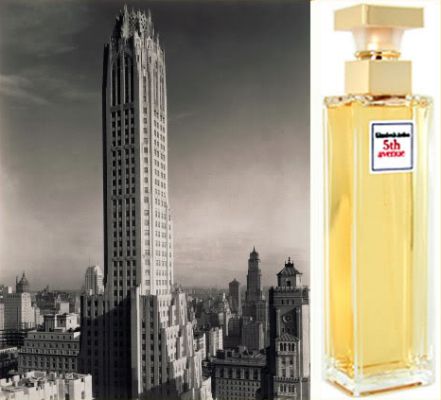
5th Avenue's bottle delicately conjures the sleek, elongated structures of New York City's sky scrapers. I tried to find a building that might fit its structure, and while looking at turn-of-the-century photographs of New York by Alfred Stieglitz, I came up with the RCA tower posted above.

Its scent is a whirlwind of florals; eleven according to the perfume website Fragrantica, which are interspersed in all three of its notes. The perfume, like the sky scraper, is an ambitious creation.

5th Avenue is clearly a reference to Chanel No. 5. The symmetrical, unadorned, modernist bottle from Chanel No. 5 has been elongated into the 5th Avenue flask. The bottle stoppers are also very similar. Chanel named her perfume after the laboratory vial labeled No. 5, which contained the scent that she chose for her perfume.


The five in 5th Avenue is also a systematic way of labeling, this time the long streets in New York City. 5th Avenue is where Arden opened her first store. It is also the center of fashion in the fashion center, New York City. It is thus an apt name for a perfume that references a famous fashion predecessor.

Yet despite the restraint in the bottles' adornments, and even names, the scents of both Chanel No. 5 and 5th Avenue are complex and unrestrained. 5th Avenue, on a conservative count, has eleven ingredients. The original No. 5 had 31 .
-----------------------------------------------------------------------------------------------------------------------------------------------------
By: Kidist P. Asrat

Thursday, February 7, 2013

Shalimar: Senses in a Bottle


Kidist P. Asrat
Unpublished

Sight, sound, touch, taste, and of course smell combine together to make Shalimar.

Guerlain, one of the oldest fragrance companies in the world, introduced its famously exotic perfume ‘Shalimar’ in 1925. A combination of flavorful spices, aromatic woods and smooth, powdery florals gives this perfume a distinctive fragrance. A secret ingredient called Guerlinade, which goes into all the Guerlain perfumes, was added to seal the final product.

As perfumeries (and individuals) were gathering their favorite scents over the centuries, spices, florals, woods, roots and animal scents were combined in non-discriminate manners, with their scents being the decisive factors. Spices (for food) and perfumes were only recently separated as serving the two distinct senses. Vanilla, cinnamon, nutmeg and even cloves have always been part of perfumes, and continue so today. Some perfume manufacturers even bring in whole foods such as ‘pumpkin pie’ to add to the ever-enlarging perfume vocabulary. Shalimar, true to this ancient practice in perfume making, includes the versatile vanilla as one of its ingredients.

The ancient Greek botanist Theophrastus considered these compounded scents to be the most sophisticated and successful fragrances, and even suggested that perfumes be considered along musical terms. Modern-day structuring of the various scents considers the whole product in terms of a musical chord. Top notes are the most short-lived of the odorants, followed by the more enduring middle notes, or corps odors, and finally the clinging bottom notes, or the fonds. All this in an effort to balance out the real substance of the perfume which are the bottom notes. Left on their own, these bottom notes can be initially overpowering, and rely on the two other higher ‘chords’ to gradually introduce their heavier scents, and soften them over time.

According to its compositional notes Shalimar’s ‘notes’ are: Top notes: Bergamot, lemon, hesperidies. Middle notes: Rose, Jasmine, Iris, Patchouli, Vetiver. And base notes: Vanilla, incense, opoanax, sandalwood, musk, civet, ambergris, leather.

Guerlin realized that a visually styled flask would elevate their perfume to the status of art. By collaborating with Baccarat crystal to form the now famous Shalimar flask, Guerlin displayed its perfume to the public for the first time, in its perfect bottle, at the famous Exhibition of Decorative Arts in Paris in 1925. Shalimar and Art Deco were thus inaugurated. But as always, in the history of perfume, Shalimar was only following an ancient tradition where the flask is just as important as the fragrance.

Scents and fragrances have always been a mixture of pomades, oils, waters, and creams. Shalimar is no exception. In addition to the exclusive perfumes and sprays, lotions and creams promise to deliver smooth powdery textures which are imbued with the famous Shalimar scent.

Shalimar the perfume has come full circle. Not only as a fragrance but as a visual, aural, tactile and even flavourful concoction. As with most artistic attempts to appeal to the feminine, Shalimar has diverged into as many senses as possible to make the apparently simple experience of a perfume into a rich and complex one.

Refrences:
- Barille, Elizabeth. Guerlin. New York : Assouline, 2000
- Kennett, Frances. History of Perfume. London : Harrap, 1975.
-----------------------------------------------------------------------------------------------------------------------------------------------------
Post By: Kidist P. Asrat