About.......Contact.......Society.....................
Showing posts with label Ethnicity. Show all posts

Wednesday, June 28, 2017

Identity


Blue Nile Falls

This is an email I sent to a correspondent:
My cousin...was here the other day with her children as well as her brother and his wife.

It is interesting. She stopped her memoir as she entered Canada. I was right about her reticence to write about her Canadian "experience."

[...]

She told me she is [now] writing a "fiction.

[...]

She brought up "identity" as part of her concern in her book...

I told her that "identity" in Canada was always going to be an issue for her (and people like her, although didn't say that).

"Ethiopia is going through some kind of renaissance. Why don't you and your family figure out a way to return? To go 'back home?' You came here through the most difficult way possible (they crossed deserts and countries before reaching Djibouti and finally coming to Canada as "refugees.")

Don't worry about culture and language. Both, especially for Ethiopians who live the culture daily, are easy to regain. Your children (they don't speak Amharic but understand it) will easily pick it up.

A country is a big thing. Everyone needs one."

She (and her brother) were listening to me intently.

I am glad I attended the dinner. I was curious to see what she would do after her "memoir."

[...]

I also said that in general that people like my father, important people ("big people" in the Amharic literal translation) could set an example and make the exodus back home. My parents have bought two houses from the inheritance house (which they sold at a fantastic price to high-rise developers) in Addis Abeba. They go back now every few months. They have invited me again in November but I have declined the invitation.

They could set an example for all these destitute, culturally bereft Ethiopians by returning (to Ethiopia). A courageous exodus.

Ethiopia is undergoing a "renaissance," I told them at the dinner. "After famines, revolutions, communist governments, ethnic wars, it still stands. Ethiopia, and Ethiopians and specially the Amhara, is resilient. It has withstood incursions and invasions through the centuries. The Amhara are still Amhara. Ethiopia is still Ethiopia. You could be part of this renaissance."

My father was quiet but I could see that he was stunned. He didn't expect me to say these things openly, although he knows my views.

I didn't plan this either. It was as though I HAD to do this. And I'm glad I followed this direction.

My cousins left without rancor or ill-feelings. I have told the truth, and they know it.
Interestingly, the last part I said, "Ethiopia, and Ethiopians and specially the Amhara, is resilient," is almost a direct quote from what her father said to them as they started their journey across the desert, which she discusses in her interview with the CBC. I hadn't listened to this part of the interview until today.

She says about her father (my father's now deceased brother):
He grew up hearing about Ethiopians defeating a common enemy and keeping Ethiopia independent for centuries. Ethiopians were very proud people then and I'm sure they still are. So he has that in him. This desert wasn't going to defeat him. He's done it. His ancestors have done it before. And that kept us very strong, because he was 100 per cent sure we would make it.
I am simply telling her to make that journey in reverse, so much easier now that they have so much more than those clothes on their backs when they crossed that desert.

Then they can be Ethiopians once again.

Tuesday, June 27, 2017

Re post: Indians Will Be Indians


Bad Eagle, ancestor of David Yeagley

(Original post: My Time with the Indians, December, 16 2016)

Below is a forum discussion on the late David Yeagley's Bad Eagle website. Yeagley would write articles or commentaries and leave it up to a registered group of commentators (many of whom became friends) to "trash out" their arguments. I was part of that group. Yeagley was lenient, but he would occasionally ban hecklers. More often than not, we all came out a little wiser.

The comments section is especially entertaining - and serious - which is a good combination to keep discussions lively. Again this was thanks to Yeagley's vision. But he never convinced me of his vision of the "question of Indians," American or Canadian.

-----------------------------------------------------------------------------------------------------------------------------------

From: The Best on Bad Eagle
By: David Yeagley
August 31 2009

BadEagle.com was recently noted by an Ethiopian artist on her website, Camera Lucinda [sic]. Her remarks about BadEagle.com are a milestone, and deserve serious consideration. Why?

Kidist Paulos Asrat, known as “She Designs,” is a highly educated and elegant woman, who expresses herself beautifully in words, as well as in textiles, graphic arts, film, and photography.


Kidist Paulos Asrat,
woman of the world.
[My reaction later in the discussion:
I am a Canadian citizen, not a “woman of the world.”]


Asrat is a native of Ethiopia, but was educated in Canada, and has lived most of her life there. She studied textile design at the Ontario College of Art and Design, and also studied drawing and painting under Toronto artist Michael Jenzen and botanical artist Leslie Staple. She studied film and photography at Ryerson University under two of Canada’s most renowned artists, Bruce Elder, an experimental filmmaker, and Don Snyder, a photographer.

Asrat’s films and photographs have been exhibited in Toronto, Montreal, Prague and Lille (France). She has served on the Board of Directors for Trinity Square Video, a non-profit video art organization.

As a young child, Asrat was trained in ballet and piano. More recently, she has been a performing member in several dance groups, including a modern dance ensemble. She has also given many public piano performances.

Kidist Asrat was attracted to BadEagle.com.

That in itself bespeaks her sense of adventure, experimentation, and creativity. Not that every conversation on BadEagle.com was something worthy of her interest, but Asrat’s view of the American Indian patriot website is most worthy of our interest.

She says, in “Indians Will Be Indians,” that BadEagle.com has failed to work the magic it professes. She admits that, in her fascination with the scope of the site, she often forgot that it was in fact an “Indian” site. When considering the purpose of BadEagle.com, American Patriotism, she reflects:
“Is there really an Indian who is at peace with America and willing to swallow the bitter pills of defeat? I thought so for a while at Bad Eagle, but I think I was asking for a superhuman feat.”

“Despite a professed love for America, I think David, naturally, loves Indians first—and best. So he has to find ways to incorporate the defeat of his people with their uncomfortable and humiliating lives in modern America. Hence, his strange and constant discussions of the subliminal effects of Indians on America, and even the world.”

Asrat, as indeed the world, sees Indians as a defeated people. However, she is not a liberal, so she doesn’t see Indians as victims. Rather, she sees in Indians the failure to respond to the modern world. She sees my attempts at reinterpreting these present circumstances as a failure to address the problem. BadEagle.com works no ‘medicine’ for Indian people, therefore.

Asrat, as indeed the world, sees Indians as a defeated people. However, she is not a liberal, so she doesn’t see Indians as victims. Rather, she sees in Indians the failure to respond to the modern world. She sees my attempts at reinterpreting these present circumstances as a failure to address the problem. BadEagle.com works no ‘medicine’ for Indian people, therefore.
“I’m afraid that David, cleverly and sincerely, is using psychological tactics to give Indians the importance they don’t have. We have some magical properties, we can heal your ills, he says.”

Yet, BadEagle.com doesn’t spend time addressing the obvious problems Indians have.
“Unfortunately, David seems more interested in giving Indians a false sense of their position in the world based on feelings and emotions rather than provide recourse for actual achievements. He is acting like any other (leftist) Indian in this case, who professes magical, spiritual qualities, which unfortunately have not been proven yet.”

Unfortunately, perhaps, Asrat does not understand the value of being Indian, to an Indian. Indians chose to be Indian, rather than adapt to a new culture they did not value. In a sense, Indians are the one people whom America has never and will never defeat, psychologically. To make this Indian mind set applicable to the modern world is the point of BadEagle.com. Ethnicity and nationhood are one, in the Indian. Indians cherish our nationhood. The problem in much of the world today is the fact that ethnicities do not value their nations.

The leftist craze for immigration, integration, and intermarriage is precisely what Indians eschewed, historically, and why Indians still exist as Indians today—beleaguered as we are by white leftists and leftist-trained Indians. I am ever the opposite of a leftist.

Now, the issue of the treaties is related, but only as the historical foundation of the blood-bought right to be separate, or, to be Indian, forever.

But I can’t really expect any non-Indian to understand this. The only thing that really singes me about Kidist is the fact that she trashes Ilana Mercer! Ilana was the first noted writer to take the Bad Eagle Interview. But Kidist sees things I don’t see. Therefore, I take note when she “sees” BadEagle.com.

--------------------------------------------------

The comments, lively and insightful, start here.

-----------------------------------------------------------------------------------------------------------------------------------

Friday, June 16, 2017

Culture Watch: Burning Down Western Culture

I have started a new topic I've titled "Culture Watch."


Nafiseh Emadmostofi
Do it Yourself: Coffins II, 81cm x 101cm
Oil on Canvass


Art is one of the first ways that we get indications of the directions a culture is taking. That is because it is hard to lie with art. Your authenticity is revealed firstly through your technical dexterity. And having invested so much time learning the techniques and processes, what you present becomes a labor of love. You do the very best that you can do.

And images are more primal than words. One can mask meanings and intentions with words, but pictures are more direct.

We have now in Canada (and specifically in Mississauga) artists who have gone through - so far - the exemplary schools that the region have to offer. Even in this era of postmodernism, there are first class traditional schools of painting and drawing available to anyone who wants to attend. Many are at very low cost or even free. Public secondary and post secondary school systems in Ontario have them in their curricula, with skilled art teachers on their staff.

Many times these artists are second generation immigrants who may have been born in Canada or came to the country as very young children. They maneuver through "Canadian" culture with expertise, speak fluent English, and often also their own languages.

They go through the usual rigorous screening systems, first for admissions into these post secondary schools and even secondary schools. For example The Etobcoke School of the Arts is highly selective in admitting its high school students.

Then, as they complete their studies, these artists start their rounds of galleries and museums to submit their works for exhibitions. Some venture out into the commercial world, but that comes much later.

The fascinating thing is the themes they chose to represent. Without fail (view work by students and alumni of Chinese or other ethnic backgrounds at the Ontario College of Art and Design here, or here at the University of Toronto ), their works reference their own cultures. Often there is a sense of alienation in their works. And where these works intersect with other cultures, and specifically with white, western culture, there is an amorphous sense of doom. This may be representative of the postmodern era of doom and gloom in art, but this doom and gloom is specifically Chinese, or Indian, or some other ethnic group's where the artists pull from their own cultural vocabularies to represent such worlds through their art.

Multiculturalism has really brought out their unique demons.

But there is another interesting layer. While each culture represents its imagery, in its own way, with unapologetic references to its "identity," whites are not allowed to do so. For if they do, then they are channeling into their "oppressor" history, their legacy of "racism" where they prevented the ancestors of these non-whites (some only as far back as 1/2 a generation ago) from participating and fully living in this land. Whites cannot be genuine artists because of the crimes that have been allocated to them. They will only make more of the same art, "alienating" and "oppressive."

What could be further from the truth!

But all these "ethnics" cannot be true artists either, for their inauthentic methods of "copying" their oppressors.

So where does that leave us in the world of art?

We get to watch the burning of the Western tradition, painted in the immaculate tradition of Western art.

Nafiseh Emadmostofi channels back to this tradition, having nothing else to emulate. Yet her deepest desire is to see it go up in flames, to vanish, so that she can once again return to her true, authentic self, her true authentic art.

The Art Gallery of Mississauga will exhibit Emadmostofi's works in the XIT-RM from June 29-August 27 2017 under the title Burning Desire. She will also participate in an "Artist Talk" on June 29, the opening night.

What is Emadmostofi's burning desire? I have answered that question above: "...her deepest desire is to see [this Western culture] go up in flames, to vanish, so that she can once again return to her true, authentic self, her true authentic art."

The gallery's communication describes Emadmostofi's work thus:
Nafiseh Emadmostofi’s bold figural paintings offer up representative and allegorical examinations of ideological conflict, and the power of art to inspire protest, incite censure, and yet also speak to a collective (and contested) desire to envision a better world.
And we get this "better world" after we get rid of the "old" and "corrupt" one.

There is nothing more exhilarating than utopian visions.

Wednesday, June 14, 2017

"I am grateful to live in a country where diversity is welcomed and celebrated."
But...


Amira Elghawaby
Journalist and human rights advocate in Ottawa
"I am grateful to live in a country where diversity is welcomed and celebrated. Canada is a country which provides me with opportunities to be an active and caring citizen, open to others, and committed to social justice, fairness and human rights for all."
Above is a quote from "Egyptian-Canadian" Amira Elghawaby, who is presenting her case alongside the Multicultural Act of Canada, as an unapologetic, non-multicultural, non-hyphenated Muslim.

But she is being authentic. Non-Multiculturalism now applies to Hindus, Blacks, Hispanics, Muslims and every single ethnic and racial group, except for Whites.

The future is with "Non-Multiculturalism." Groups will be authentic to their races and ethnicities. But if Whites do so it will be called "racism."

Elghawaby is only following the cultural trend, and her "true self."

She is telling the truth.

Thursday, June 8, 2017

The Lesbian Vs. God and Other Stories


Hernandez (middle) performing Future Folk with her
Sulong Theatre Collective, which is a play based on:
"The experiences of Filipino women who come to Canada to work as nannies.
They send their wages back home, and hope after 24 months of employment
to become citizens and bring their own families to Canada."
[Source]
------------------------------------------------------------------------------------------------------------------------------------------

Our Neighborhood Filipina Story Teller portrayed in my recent post Catch Them When They're Young has quite a resume writing for "minors":
Kilt Pins
In a Catholic high school in Scarborough, Ontario, amidst low-income housing, difficult race relations, and poverty, a young woman struggles to find her sexual identity. In this sincere portrayal of high-school kids pitting the voice of God and thousands of years of scripture against the voice of their own bodies, Kilt Pins cheekily asks “Is your kilt pin up or down?”
Scarborough
Scarborough is a low-income, culturally diverse neighbourhood east of Toronto, the fourth largest city in North America; like many inner-city communities, it suffers under the weight of poverty, drugs, crime, and urban blight. Scarborough the novel employs a multitude of voices to tell the story of a tight-knit neighbourhood under fire: among them, Victor, a black artist harassed by the police; Winsum, a West Indian restaurant owner struggling to keep it together; and Hina, a Muslim school worker who witnesses first-hand the impact of poverty on education.

And then there are the three kids who work to rise above a system that consistently fails them: Bing, a gay Filipino boy who lives under the shadow of his father’s mental illness; Sylvie, Bing’s best friend, a Native girl whose family struggles to find a permanent home to live in; and Laura, whose history of neglect by her mother is destined to repeat itself with her father.
And more on Arsenal Press
Arsenal Pulp Press is a book publisher in Vancouver, Canada with over 300 titles currently in print, which include literary fiction and nonfiction; cultural and gender studies; LGBT and multicultural literature; cookbooks, including vegan; alternative crafts; graphic novels; visual arts; and books in translation. We are interested in literature that engages and challenges readers, and which asks probing questions about the world around us.
Of course these welfare artists insist that they get their financial sources from tax payers money courtesy of the Canadian Government (don't let the meek word "suggests" deceive you):
Catherine Hernandez suggests several strategies to redress...deep-seated inequities: hiring more diverse teaching staff; educating teaching staff in anti-oppressive values; implementing a “much more aggressive diverse application process to ensure the student body is multicultural”; and diversifying the curriculum beyond the canonical (white) narratives that dominate it [Source].
Here is one such publisher which has produced Hernandez's children's book, that petitioned successfully to get LGBQT children's books into the school curriculum through the Toronto District School Board:
"Flamingo Rampant is a micro-press with a mission – to produce feminist, racially-diverse, LGBTQ positive children’s books. This is an effort to bring visibility and positivity to the reading landscape of children everywhere. We make books kids love that love them right back, bedtime stories for beautiful dreams, and books that make kids of all kinds say with pride : that kid’s just like me!" tells us the publisher
Hernandez has had a lot of practice with her own daughter who is now around thirteen years old. Hernandez appears to have been married to a male from whom she separated soon after her daughter's birth. She writes: "I parented Arden with little to no help from friends, family and my spouse at the time." She says that her children's book M is for Mustache: A Pride ABC Book was inspired by her daughter.
"Based on my many marches with my own child during what she called “Rainbow Time”, the book will follow in an ABC format, a small child as she gets ready to march alongside her mama at Pride.“


Previously-married-to-a-male Hernandez has a daughter now thirteen
Just shy of Arden’s 12th birthday, she approaches my partner, Nazbah, in the kitchen. “I’m so glad you’re my stepparent,” she says. Nazbah considers spearing a fork into their own heart in order to stop the tears of joy.[Source]

Monday, June 5, 2017

Catch Them While They're Young


M is for Mustache: A Pride ABC Book
Written by Catherine Hernandez
Illustrated By Marisa Firebaugh


The Friendly Neighborhood Lesbian Storyteller is coming to a gallery near you!

The Art Gallery of Mississauga hosts regular "story telling" session for toddlers.

Here is information on the upcoming session at the gallery's website:
AGM TOT SPOT!
with Guest Storyteller Catherine Hernandez
NEXT SESSION: FRIDAY, JUNE 16, 10 - 11 AM

Art Gallery of Mississauga | 300 City Centre Drive | FREE & Open to the Public

Monthly on Fridays, 10 - 11 AM, join us at the gallery for an hour of stories, movement and imagination!

Catherine Hernandez is a proud queer woman of colour, radical mother, activist, theatre practitioner and the Artistic Director of b current performing arts. Her one-woman show, The Femme Playlist, premiered at Buddies in Bad Times Theatre as part of the afterRock Play Series, co-produced by b current, Eventual Ashes and Sulong Theatre. Her children’s book, M is for Mustache: A Pride ABC Book was published by Flamingo Rampant in 2015.
The AGM recommends 1 parent for every 2 children at Tot Spot!
Below is the accompanying image:


Listen to the animated lesbian-Filipna-Canadian story-teller Catherine Hernandez tell the tale of the girl with the 'stache.


From Hernandez' website:
Catherine Hernandez is a proud queer woman of colour, radical mother, activist, theatre practitioner, burlesque performer, writer, the Artistic Director of Sulong Theatre Company and the owner of Out and About Home Daycare.
Yes: the owner of Out and About Home Daycare.

Below is Hernandez at her daycare with a hijacked audience (image from her twitter page) reading a fellow Canadian multicultural transsexual's children's book (catch them while they're young) The Boy and the Bindi.


And here she is in her pretty pink dress protesting Charlottetown Junior Public School's last minute cancellation of her book reading for preschoolers. This was her daughter's former school in Scarborough, a suburb of Toronto.


But your friendly neighborhood daycare story-teller isn't as pleasant as she looks.


Catherine Hernandez: Ethnic Lesbian
Twitter prole photo

Nor as Canadian as she seems

Dancing at the Kapisanan Philippine Centre for Arts & Culture

#marriedanamerican should really be #marriedanamercanindian


Saturday, June 3, 2017

Thirteen Provinces and Multiculturalism?


These were the alternate designs submitted to a focus group.

But why wasn't the simple 13 maple leaves design, representing the thirteen provinces, within two thin blue circles, chosen?

But then, where would they put all that multiculturalism?

How Multiculturalism Infantilizes design


2017 1967
The winning design for Canada's Sesquicentennial anniversary is a rip off from the winning design for the Centennial Anniversary.

Both represent the Maple Leaf, although the 150th designer does so somewhat reluctantly.

And both are stuck on "multiculturalism."

I've said many times that "multiculturalism" makes for bad design.

Here is an article I posted at Camera Lucida in 2008:

--------------------------------------------------------------------------------------------------------

July 19, 2008
How Multiculturalism Infantilizes design

I haven't yet read Diana West's book The Death of the Grown-up, but here is an interesting insight she makes while answering questions on an interview on National Review Online:
Kathryn Jean Lopez: How are “dhimmi life under Islam” and “PC life in a multicultural world” similar?

Diana West: For me, this pairing was something of a “eureka” moment in the writing of the book.

I would describe PC life in a multiculti world as being marked in part by self-censorship based in fear — fear of professional failure, opprobrium or social ostracism. I would also describe this same self-censorship as a form of childishness. During one lecture on The Death of the Grown-Up, I took a question from a man who wondered, in a rather agitated way, if I were actually saying that multiculturalism is juvenile. I hadn’t phrased things that way, but, on quick reflection, I told him that, yes, that was indeed what I was saying. The fact is, buying into multiculturalism — the outlook that sees all cultures as being of equal value (except the West, which is essentially vile) — requires us to repress our faculties of logic, and this in itself is an infantilizing act. I mean, it’s patently illogical to accept and teach our children the notion that a culture that has brought liberty and penicillin to the masses is of no greater value than others that haven’t. In accepting the multicultural worldview, we deceive ourselves into inhabiting a world of pretend where certain truths are out of bounds and remain unspoken — even verboten.
I remember looking at logos of institutions who stressed diversity either in their title, or in their mission statements, and found this very same infantilizing going on at the design level.

Since there are no standards, that everyone and everything is equal, logo designs stress the equality of all these elements to the detriment of their design.

I've already talked about the COSTI Immigrant Services logo, which went from a lovely clear red line, as though traveling into to the horizon, to me signifying the release of the new immigrant into the bigger and greater society, into a disheveled, hardly stable umbrella which is trying hard to shade all those diverse elements under its inadequate roof. By forfeiting their strong message of "you can make it," they turned it into a half-hearted, insincere, "we'll protect you."

The same with the Ontario logo design which had a solid, identifiable trillium and withstood all the elements for several decades, until diversity entered the vocabulary. The logo devolved into three stick-figure like objects, hardly resembling the strong structure of the original.

Stick figures abound in diversity logos, as well as bright crayola colors. How childish can they be?

So, yes, as Diana West says, multiculturalism does infantalize. And a logo doesn't lie.

I wonder how long before either we change these logos (I hope COSTI comes to its senses), or we abolish these institutions altogether.

Here are a selection of logos I found just by googling: Canada diversity.

Left: COSTI's newest logo
Right: Canada's Best Diversity Employers

Left: Diversity in the workplace
Right: Harmony Movement

Left: Diversity Canada Foundation
Right: Ontario's new logo resembling stick figures

Left: Unity in Diversity
Right: Hamilton's Centre for Civic Inclusion

Even those that seem to show some form of artistic design - for example, some idea of composition etc. - actually show their weaknesses through obvious signs of childishness.

These two from Culturescope.ca look interesting (although there is actually nothing to see, hence another indication of a lack of good design) but also have scribbles of lines going through them.

Culturescope.ca

And there are many more.

Addendum: Culturescope.ca no longer exists. As this website indicates:
As a result of a Strategic Review of Government of Canada, Culturescope.ca has been discontinued since April 1st, 2008 as the original program objectives have been fulfilled. The digital space has evolved tremendously since the Canadian Cultural Observatory was created in 2003 and the website still contains rich resources and documents on diverse thematic areas.
The evolution of culturescope.ca fulfilled these objectives:
The Canadian Cultural Observatory (Observatory) and Culturescope.ca: The Department of Canadian Heritage launched the Observatory in November 2003 to provide statistics and information on cultural and heritage policies, programmes, legislation and regulations. Its objectives are to advance cultural development in Canada by fostering responsive research, encouraging informed decision-making in policy and planning, and stimulating community debate and improved knowledge exchange. Culturescope.ca is the Observatory's collaborative, interactive website developed in partnership with the not-for-profit, private and public sectors...[Source]
But we still keep coming back to those multi-culti stick designs.

Thursday, June 1, 2017

Double Whammy Discrimination: Diversity at all Cost
Even if it Means Empty Museums


In our postmodern era I would be defended as a discriminatee.

My non-White, Third World background would automatically place me in the "victim" pigeonhole where my word against my white "antagonist" would preside, NO MATTER WHAT.

That is, until I start to defend this "white" monster and say he is the one being discriminated against.

Then the wrath, slow though it may come, is full on!

Especially if it is a white women who is regulating the discrimination channel.

This happened to me recently after I attended (and participated in) a lecture at the Art Gallery of Mississauga, where a group of artists were to discuss the works of Homer Watson, a late 19th early 20th century painter from southern Ontario.

I wrote about the exhibition and the panel discussion here: Homer Watson, Native Son. But I left out my questions to the panel.

As wrote in my post:
Last year, I attended a panel discussion on the exhibition Beyond the Pines: Homer Watson and the Contemporary Canadian Landscape at the Art Gallery Mississauga. I had visited the exhibition numerous times, going through Watson's work one by one, to study his technique, his evolution as an artist, his views, his concerns, and his Canada.

The exhibition also displayed works by contemporary Canadian artists to bring this pine "narrative" to the fore. Some were reasonably good, but none reached the overall skill and beauty of Watson's paintings.
I was gong to leave it at that, just a personal observation (not naive or untutored, since I have a solid background in the arts), hoping that I would gain some insight from these artists.

But I should have known better.

The catalogue the AGM produced for this exhibition prefaced with this objective:
Contemporary Canadian artists looking at landscape must also find a way to access the ‘truth’ of a subject that is not only strongly represented in our national artistic history, but one that is both deeply political and personal.
So the "truth" of a subject is now mandated to "represent" not just our nation "objectively" but has to incorporate political and personal views as well.

A tree is not a tree is not a tree, to paraphrase Gertrude Stein .

I asked Reinhard Reitzenstein, one of the panelists, who is a pretty good sculptor (and who is white), if he believes that Homer Watson's standards, and art, set an example for artist in general or if his English (Western) heritage is insignificant. This was of course not what I was asking, as Reitzenstein clearly understood. I was asking him if he thought that Watson's work was good, was superior.

Reitzenstein talked for a bit and finally admitted that he doesn't want to emulate the now archaic art of Watson. We are in the modern age after all!

So, irrespective of technical expertise, artistic beauty, or individual ingenuity, as long as an artist follows the archaic art of Watson, his work can not be deemed "good."

This is the tired discussion of art which has reached now such a comical zenith that works are exhibited in museums and galleries simply based on their mockery (and not simply rejection) of this western tradition. And many artists have become wealthy doing so.

But the public isn't with the program, which is why the Art Gallery of Mississauga has to go through loopholes to get people to visit its exhibitions, including set up committees and workshops to "study" this lack of museum attendance.

I received a "newsletter" email about a year after this exhibition from the AGM, one of the few I have received from them to invite me to participate in two workshops ttled: Collections Through The Prism of Diversity Series (here are day one and day two of the schedules):

But I was given about a week's notice for a two day workshop, where would have had to pay $250/day to attend. My first reading of the email, before I saw the dates, was to figure out ways could come up with the sum, including asking for a reduced fee. Soon after, I realized that I was put on the list as a "visible minority" participant.

Here is the email I sent the gallery:
I can only surmise from this late notification that the AGM is getting some kind of monetary benefit from this "email list" which it seems to use haphazardly to meet with its program mandates.

In my case, the mandate appears to be that of a minority female artist who can participate in the discussion on how to add more "diversity" into the art collections of the region.

Through your lack of appropriate notification, you indeed lost the participation of a minority female artist (myself) who would have made a unique and substantial contribution to this discussion.
And the reply I received from Mandy Slater the director:
The AGM prides itself on its high professional standards and its strong relational manner. We provide a safe and accountable space for our diverse staff, volunteers, artists and audience. All of this supports the democratic nature of the work we do at the AGM.


Moving forward, if you are able to visit the AGM in a congenial and supportive way I encourage you to do so. If at any point in the future, you visit the AGM and create an unsafe, critical and or threatening space, we will contact security who will request that you leave the premises. If you do not comply they will be entitled to further legal action under the Ontario Trespass to Property Act. I have cc’d senior Security Officers at the City of Mississauga on this and other incidents regarding inflammatory and false statements made by yourself.

The AGM prides itself on embracing diversity and inclusion as a core institutional value. We strive to create an accountable and inclusive space that supports like-minded individuals.
Diversity counts at all costs, even if it means getting the "diverse" complainant out the door!

The irony of the AGM's position of course doesn't occur to its staff: that they are discriminating against me (shutting down my "voice" ) in order that they might continue with their program is exactly what they are accusing the white inheritors of Homer Watson.

This time though, they have found a whole different story: An "ethnic minority" who supports a white tradition!

Wednesday, May 31, 2017

How Multiculturalism Took Over...


Excerpt from a February 2017 article:
'I am American, not Asian-American.' Writer Bharati Mukherjee (1940-2017) never wanted a label:

She did say “I am American, not Asian-American. My rejection of hyphenation has been called race treachery, but it is really a demand that America deliver the promises of its dream to all its citizens equally.” But her rejection of the hyphen was not a rejection of her roots at all. She loved going to Durga Puja celebrations.
About the article source Scroll.in:
Scroll.in is an independent news, information, and entertainment venture. We bring into sharp focus the most important political and cultural stories that are shaping contemporary India. Our goal is to add critical perspectives to these stories through rigorous reporting, objective analyses, and expert commentary.
----------------------------------------------------------------------------------------------------

I recently wrote this brief (unpublished) commentary on "Third World" writers in their "First World spaces:"
Oppositional Aesthetics: Readings from a Hyphenated Space
By: Arun Prabha Mukherjee

Although this collection of essays...demonstrate the topics that the majority of Third World writers and essayists broach. Mukherjee presents a harsh and racially negative view of the Euro-Canadian arts and literary world.
Here is an excerpt from Larry Auster's more extensive commentary from his article in Frontpage Magazine:
How Multiculturalism Took Over America from July 2004.
Moderate Myth [Number Five]: The Pro-Western Multiculturalist

Another soothing fiction that has helped advance multiculturalism is a personality type rather than an idea. It is the friendly Third-World immigrant, who warmly professes his or her love for America, yet who, on closer examination, reveals a desire to do away with America as an historically distinct country. Such a moderate is the novelist Bharati Mukherjee, an immigrant to the U.S. by way of Canada, who had this to say in a public television interview with Bill Moyers in 1990:
What I like to think, Bill, is that you and I are both now without rules, because of the large influx of non-Europeans in the '70s and '80s, and more to come in the '90s. That it's not a melting pot situation anymore, and I don't like to use the phrase melting pot if I can help it, because of the 19th century associations with mimicry; that one was expected to scrub down one's cultural eccentricities and remake oneself in the Anglo-Saxon image. If I can replace melting pot with a phrase like fusion vat, or fusion chamber, in which you and I are both changed radically by the presence of new immigrants, I would be much happier. So that you are having to change your rules, I like to think, and I am certainly have to change my Old World rules.… [Emphasis added].

There are no comforts, no old mythologies to cling to. We have to invent new American mythologies. Letting go of the old notions of what America was shouldn't be seen as a loss.… I hope that as we all mongrelize, or as we all fuse, that we will build a better and more hopeful nation.(16)
Underneath Mukherjee's confiding and civilized tone, she was informing her American audience that they must "mongrelize" themselves in order to accommodate non-Europeans. In this new dispensation (unchallenged by her supremely passive and "open" interviewer, Bill Moyers, who piously hung on her every word), the preservation of America as a historic nation and people was not even an issue any more. To grasp how unnatural this situation was, imagine an immigrant in some relatively sane country—say Japan or Italy or the pre-1965 America—who, shortly after his arrival, announces to his new countrymen: "Oh, by the way, you people must—in order to make me comfortable—give up everything that has constituted your culture and identity. But don't worry! You shouldn't see this as a loss!" He would be thrown out on his ear. Yet by the 1990s America had become the sort of decadent place where a smooth-talking "moderate" could make a career saying exactly that.

Like most imperialists, Mukherjee seemed complacently oblivious to the culture and people she wished to dominate. At one point in the Moyers interview, she predicted an increase in ethnic violence, "because there's a kind of disinvestment in America.… [P]eople have not invested in the country. There's been a 'What part of the pie is for me?' kind of an attitude …" It didn't seem to occur to her that the disinvestment in America that she regretted may have had something to do with the devaluing of America's historic identity that she applauded. Indeed, if anyone was wondering, "what part of the pie is for me," it would seem to be Mukherjee herself and her fellow immigrants, whom she spoke of as "we, the new pioneers, who are thinking of America as still a frontier country."

I think that the original American pioneers had to have been in many ways, hustlers, and capable of a great deal of violence in order to wrest the country from the original inhabitants. And to make a new life, new country, for themselves. So that vigor of possessing the land, I like to think, my characters have.

16. 16. Bill Moyers interview with Bharati Mukherjee, PBS, 1990.
Full transcript of the interview is here

----------------------------------------------------------------------------------------------------
Addendum


Grandparents Muharjee and her husband Clark Blaise (who is also an author)

Clark Blaise:
...has been married since 1963 to writer Bharati Mukherjee. They met as students at the Iowa Writers' Workshop at the University of Iowa and have two sons. In 1978, Blaise and Mukherjee moved to Toronto. However, Mukherjee felt excluded in Canada, attributing it to racism and publishing an essay in Saturday Night.In 1980, the couple decided to return to the United States, moving to San Francisco.
[Source: Wikipedia]

The perfect multicultural grandchild:
Mukherjee's son Bart Anand, of Indian and Canadian heritage, married Kim, who is half Irish and half German American and they have just adopted a baby girl from China. Says Mukherjee, "So it's a very poly-national American family that we represent. What I want to get across is that I hope this will be the way American society goes, that we are all going to be embracing so many different ethnic and racial groups within our families that this whole anxiety about ethnic origin - what does it mean to be a hyphenated American - I hope will disappear."
[Source: Little India Half And Half: Just how authentic an American are you?]

Tuesday, May 16, 2017

Homer Watson: Native Son


On the Grand River at Doon, c. 1880
Homer Watson, Canadian, 1855 - 1936
Oil on canvas
24 x 36 in
Purchased 1952
National Gallery of Canada (no. 5900)


Last year, I attended a panel discussion on the exhibition Beyond the Pines: Homer Watson and the Contemporary Canadian Landscape at the Art Gallery Mississauga. I had visited the exhibition numerous times, going through Watson's work one by one, to study his technique, his evolution as an artist, his views, his concerns, and his Canada.

The exhibition also displayed works by contemporary Canadian artists to bring this pine "narrative" to the fore. Some were reasonably good, but none reached the overall skill and beauty of Watson's paintings.

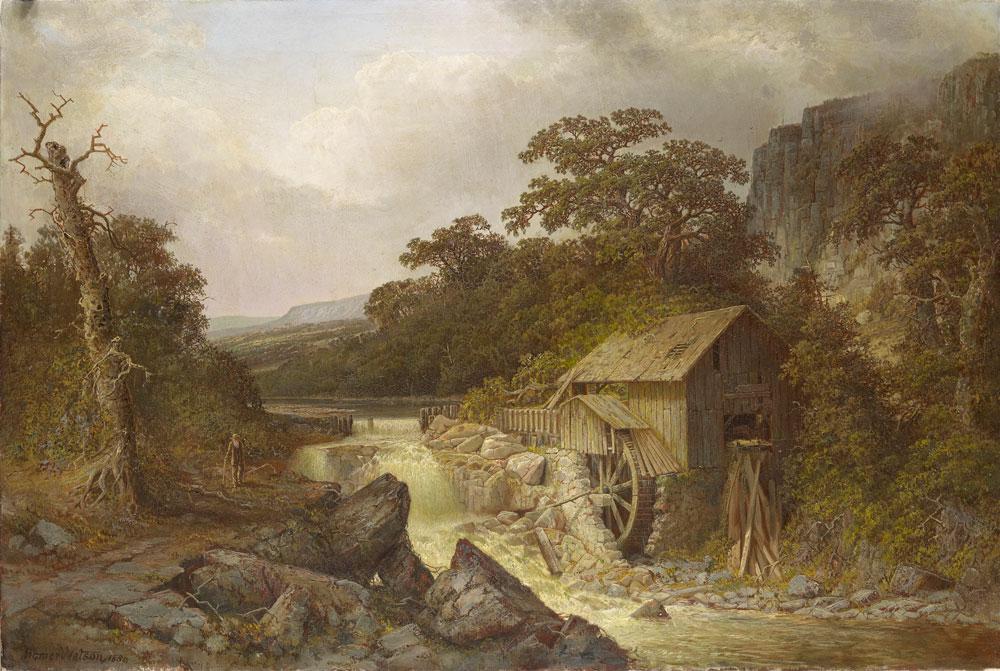
Watson's talent as a painter was recognized by a friend who initially advised him:
...to quit the nonsense of going in for art in a country like Canada. "Quit it and come into the office and become a businessman.”
Watson continues with the story:
...on nearing home [some weeks after he had submitted the painting [The Pioneer Mill] to the Canadian Academy exhibition] I saw this gentleman on the road in front of his establishment reading the Toronto Globe. Seeing me he advanced waving the paper and putting out his hand he exclaimed, “I take it all back. Go ahead and paint. Look here,” and there it was in flaming headlines in the Globe, “Country boy paints picture bought by Princess Louise.” So that was that...
Homer Watson was born in 1855 in Doon, Ontario (now Kitchener). He started to paint as a young child encouraged by his father and his aunt. He never received any formal art training, but acquired his skill and artistic sense through various artist mentors he sought as he developed his talent.

Watson was called "the Canadian Constable," and “the man who first saw Canada as Canada, rather than as dreamy blurred pastiches of European painting.” While he holds this noble acclamation, he has nonetheless been overshadowed by the more forceful Group of Seven artists.

The AGM’s exhibition showed us Watson’s southern Canadian landscapes, amidst its farms and homesteads, as civilized and vibrant, and as separate from America. He is the first nationalist Canadian painter, earlier even than the much touted Group of Seven painters.

But the exhibitors of Beyond the Pines had a subtle agenda, which was was to place Watson in the background of Canadian art as an artist who no longer represents contemporary Canada, and reflects only the past, colonial English heritage which they believe has little relevance in current Canadian art.

The much described regions of impenetrable wilderness and inhospitable glaciers is not the Canada that most Canadians know and live in, including Homer Watson and the Group of Seven. Their Canada of the late 19th and early 20th centuries was already a nation of defined European, and mostly British, communities with houses, gardens, farmland, and forests.

And that is the other narrative the AGM curators were presenting: the pre-colonial Canada of the aboriginal tribes.

The AGM’s website tells us:
First. New. Next.

The AGM provides platforms for exhibitions, collections and experimentation in contemporary culture with a recent focus on artists and cultural producers from Indigenous, newcomer and youth communities. Through a broad range of educational programs, artist projects and other forms of critical dialogue, the AGM seeks to transcend traditional disciplinary boundaries, foster community, and provide spaces where alternative modes of thought are supported and activated in tangible ways.
The one piece by Natives ("Native" being the commonly used word for Aboriginal) artists in Beyond the Pines is a film (later transferred to video) by Brian Jungen and Duane Linklater titled Modest Livelihood, who document their hunting expedition and challenge Canadian gun laws and restrictions.

Here is Canadian Firearms Act as it pertains to Native Canadians:
Under Canada's Firearms Act, everyone who possesses or acquires a firearm must have a firearms licence, and all restricted and prohibited firearms must be registered. While the Firearms Act applies to everyone in Canada, some provisions of the Act and of the Firearms Licences Regulations have been adapted for Aboriginal people who meet all three of the following criteria:
1.They must be a member of one of the Aboriginal Peoples of Canada (Indian, Inuit and Métis) or a beneficiary under a treaty referred to in section 35 of the Constitution Act, 1982.
2. They must be a member of an Aboriginal community.
3. They must engage in the traditional hunting practices of their community.
These adaptations facilitate the licensing process for Aboriginal people under unique circumstances while maintaining all the safety requirements of the Firearms Act.
We are hard pressed to believe that Brian Jungen and Duane Linklater are indeed hunting for their livelihood, in this age when hunting has become a sport and food for nourishment is abundant. But Jungen’s and Linklater’s purpose is to show us that they have a right to this land as had their aboriginal ancestors, with which the AGM curators fully agree.

A group of eight contemporary Canadian artists were also part of this exhibition. None made any explicit references to Watson or his era, rather focussing on the exhibition's general themes of the natural and the spiritual. But it was Jennifer Carvalho and Reinhard Reitzenstein who combined these natural and spiritual worlds most skillfully in their pieces.

Carvalho’s fir are impenetrable and dense, as though mysterious and macabre forces are hiding behind them. In Unexpected Connections, her trees spiral skyward to a grey zenith, reminiscent of Emily Carr’s west coast giant pines (Carvalho studied in Vancouver’s Emily Carr University of Art and Design), but without the hopeful sky blue of Carr’s heaven-reaching trees.

Reitzenstein reduces his pine sculptures to tiny spikes atop sinewy vines. In Thrust, the vine-like pine, rather than pull us upwards as the title would suggest, drags us down into the underworld of fungi, and we are forced to contemplate the dark and amorphous fungal netherworld of a place without God, without art and without beauty.

Reitzenstein may have obtained his training and perspective from the sculptural traditions of western art, but he has neglected the often hidden but important forces of religion and God present in most of non-modern western art. He desires, and creates with, beauty without the spiritual source of his sculptural discipline.

The AGM catalogue for Beyond the Pines informs us:
Contemporary Canadian artists looking at landscape must also find a way to access the ‘truth’ of a subject that is not only strongly represented in our national artistic history, but one that is both deeply political and personal. Placing contemporary work by emerging and established artists alongside that of Watson illustrates the universality of the quest to appreciate and capture the landscape in which we live.
Beyond the Pines was an ambitious project attempting to unite several themes of Canadian art. This was partly responsible for its failure: trying to be everything to everyone, from European-influenced landscape painting, to spirit-influenced Canadian art, to Native Canadians' grievances, and with an open ended question about contemporary Canadian identity, in which, of course the non-Western immigrant, the antithesis of Homer Watson's world, looms large.

But the deliberate ideological direction the curators took produced a collection of work which was not convincing in presenting its original idea of "moving forward" from the Watson narrative to a more inclusive multicultural art. Astute observers would instead realize that there was an undeclared intention of slowly and subtly removing the legacies of Homer Watson and his artistic heritage from the fore of Canadian fine art tradition to replace it with the contemporary landscape.

We were not told what this contemporary landscape could be other than a mishmash of disparate ideas and a desire for diversity that has become a cultish, spiritual quest oblivious of its fallacies. Whose diversity are we to take on? Will the Indian artist conform to the criteria of Chinese art? Will both accept, objectively and without prejudice, the artistic superiority of Homer Watson’s paintings? Would either attend, with curiosity and interest, the exhibitions of each other’s representative artists? And perhaps to settle this confusion, in December 2016 about a year after the Watson project, the AGM undertook another ambitious mandate, and led two full-day workshops titled: Collections through the Prism of Diversity, [Day 1, and Day 2].

We were informed that through these workshops:
The AGM is engaging in a forward thinking acquisition plan reflecting the cultural diversity of the city, region, as well as the historical diversity of Canada. Public art galleries and art museums are committed to acquiring works of art from culturally diverse and Indigenous communities, however this often requires considering how their acquisition plans are aligned with their missions and mandates.
There is a carefully guarded piece of information that is missing in the public announcements by the AGM. The museum was just approved to receive $325,000 for the 2017 fiscal year by the City of Mississauga's Art and Cultural Grant Program. This is a continuation of the prior seven years of six-digit grant money, starting with $271,000 in 2011, $316,000 in 2012, and $365,000 for the years thereafter upto and including 2017. This is an investment of $2412 million over a seven year period. [Grants and funding reports by the City of Mississauga for the following years: 2011, 2012, 2013, 2014, 2015, 2016, 2017,]

The other missing information was that if indeed there are enough high calibre non-Western artists (museum worthy) living in the Mississauga region who could benefit from such large grant and sponsorship monies.

The question begs to be answered with a no. If indeed there were such artists, then neither the exorbitant public money nor the earnestly planned workshops would have been necessary.

I say “earnest” a little tongue in cheek since for these cultural reformists, western art should not be (and cannot be) the criteria with which to judge multi-ethnic cultural participants. Each community member, each ethnic identity, each hyphenated Canadian, brings unique with him unique abilities and talents. He should be judged by those equality-based criteria rather than the elitist standards of western art.

And without those standards, there would be no Art Gallery of Mississauga and no exhibitions worthy of the public’s visits. And that is the conundrum in which these art and culture leaders find themselves, and the reason why they have to demand, fascistic fashion, that there be some way to allow such art and culture to enter the doors of the gallery.

These workshops had as their primary objective to attract the multicultural, non-Western, non-white, and Native population of Mississauga, a city which, from data from the 2011 census report was 53.74% non-white (described as "visible minority" by the census report). The non-white population can only have increased by the 2016 census, which is not yet available. Yet the 2011 census visible minority report is not reflected in the museum's attendance numbers, even when "ethnic" oriented programs were scheduled. Two billion dollars is a lot of money to invest in satisfying a community's cultural biases. Minority non-white cultures are not interested in attending museums even when the exhibitions represent their ethnic and cultural identities.

The bold, unique and truthful suggestions by these government-funded exploration committees would have been to propose that art galleries continue with their exhibition of western art and culture, partly to continue with the historical role of such arts organizations as purveyors of western art, and also, more importantly, to show the excellent treasures of western art, whether archival or historical like Homer Watson, or current and waiting to be discovered artists in our contemporary society who are true disciples of Canadian artists such as Homer Watson.

Tuesday, March 7, 2017

Let us be Ourselves: Part 2


Here is part one of my post.

--------------------------------

Amhara has a right to self defense
By Dr. Abel Joseph
.
Despite so many people, including some mindless Amharas denying the existence of Amhara people, we Amharas are the proud and dignified people, which have contributed so much to build Ethiopia as a nation.

Unfortunately, we had individuals like Waleligne mekonen who had betrayed their own people and characterized us as oppressive to appease their Eritrean mentors.

We have the drunkard Endrias Eshete, who humiliated the Amhara people by taking responsibility in which the Amhara people had nothing to do with it.

We have so many Amharas who are ashamed of to be called Amharas, and seeking other excuse to justify their house negro manner.

Sadly, those self hate Amharas do not have any notion about the mortal danger hovering over our head. Surprisingly, they prefer to ignore the danger and pretend as if everything is smooth and fine.

Even some of us are foolishly expecting others to defend Amhara, and instead of standing with our own people, we have chosen to adhere with others and embrace them as savors.

Of course, the Amhara haters love to see the self hate as well as the sycophant Amharas who are willing to betray their own people and serve them.

We have seen, some perfidious Amharas have been glorified by the Amharophobic for their betrayal act.

We have seen those mindless Amharas have been embraced as a love child by those who are wishing bad to Amhara people.

However, in spite of such betrayal act and bad wish, the people of Amhara remain as proud as before with unshakable integrity and valor.

There is no question that our people are in great danger, and those who are trying to eliminate us are working tirelessly with the help of self hate Amharas.

If we accept it or not, our current condition is as the same as the second world European Jews, and anti-Amhara tendency seems rampant in Ethiopia.

Even every loser tend to blame Amhara for his or his groups incompetency. We have been used as a scapegoat to every power-monger as well as unscrupulous individuals.

Nonetheless, we Amharas should understand the magnitude of danger we are in, and prepare to defend ourselves by any means necessary.

We need to humiliate those who have humiliated us.

We need to break the neck of those who have shed our blood.

Everyone of us should respond to the call, and ready to fight against those who are determine to eliminate us.

It is our own responsibility to fight back and preparing a stepping stone to the next generation.

We should not allowed our children to inherit poverty, humiliation, and defeat, instead we should leave behind something to have them proud of.

Being fooled by those who are naively expecting others to hand our freedom should end now, and we should start taking responsibility for our own freedom and survival.

we should stand together and firm in order to twist the arms of the Tigrian thugs who have been killing and robbing us.

Monday, March 6, 2017

The Left vs. Human Nature: "Let us all be ourselves"

I wrote the previous post "Let us all be ourselves" after I read the title and a couple of lines of this one below, written by Jim Kalb.

I alreadyknew what he was gong to say, and I was right.

--------------------------------------------------------------------------------------------------------------------------------


The Left vs. Human Nature
Jim Kalb
The Imaginative Conservative
Mar 3, 2015

The Left does not like the idea of human nature. It tells them they are not free to do what they want. From a factual perspective, it tells them people do not change much, so the way things were in the past is mostly how they will be in the future. From a moral perspective, it suggests a standard for what is good other than satisfying desire, since it tells people to act in a way that fulfills their nature, or at least is suited to it.

The Left does not like any of that and they have been very successful turning their dislike into accepted dogma. The result is that if you talk about human nature today you are not going to get anywhere. People will say you are stereotyping, you are denying Hope and Change, and you are presenting existing power relations as natural and unchangeable. You will have to prove every detail of every claim and the standard of proof will be infinitely high. Also, none of your arguments will stick—next time the matter comes up, you will have to go through every issue all over again at the same level of detail.

All of which seems odd. On the face of it every living thing has a nature of some kind. It has characteristic ways of acting, conditions it tries to bring about, and conditions that help it thrive. Why would that not be true of human beings? Is accepting human nature not basic to good sense in dealing with people? If the point looks obvious, why is it not generally accepted, or at least generally acceptable as something to consider?

As it is, people dismiss it without discussion. The result is that claims like “gender is a social construction” get taken seriously and, in fact, are basically treated as true. There are Midwestern public schools that tell teachers they should not use expressions like “boy” and “girl” because they are gendered. That is the new normal.

General acceptance of insane views can cause problems, so it is worth asking how we have ended up in this situation. The cause, I believe, is a tendency in modern ways of thinking to try to do too much with too little. The result is that people end up becoming irrational in the name of reason.

The Left is said to be progressive. That means that they apply modern thought to social affairs more single-mindedly than other people. That gives them a big rhetorical advantage. If you oppose them you are opposing the general movement of thought and once the modern world is thoroughly established, and everyone who matters has been subjected to mass higher education, you are opposing what everyone’s been trained to view as reason.

The modern thought I am talking about, which I think is the main tendency if you cut through a lot of fluff that ends up canceling itself out, tries to make knowledge rigorous and useful by concentrating on exact observation and immediate causal mechanism. It tries to use that knowledge to remake the world in accordance with whatever it is we want. That is what technology is about and it is what the functional part of the Left is about.

That general approach has been extremely effective in some settings. Obvious examples include modern natural science, modern industry, modern medicine, and modern warfare. So, everyone agrees that it works and makes sense.

There is not the same agreement as to other types of thought; for example philosophical thought of various kinds, religious thought, poetic thought, or thought based on tradition or informal good sense. The result is that reason has become identified with scientific thought, or at least what passes as such. Reason has to be common to all and the only kind of thought all accept is the kind associated with modern science, so that is what reason is understood to be.

That is a problem because people need answers to ultimate questions. That is a rational as well as emotional need. Part of what it is to be a rational actor is to act in accordance with a rational understanding of the situation you are in, and what makes most sense to do in that situation. If reason is modern scientific thought, and we want to be rational actors, then modern scientific thought has to give us that kind of understanding. It has to give us usable answers to questions about what actions, and therefore what goals, ultimately make sense. In other words, it has to tell us what the good is as well as how to bring it about.

The problem, of course, is that it cannot. Modern scientific thought is powerful because it limits itself. It does not claim to know everything and it will not give us an answer just because we need one. We do need to know what the good is, what the most reasonable goal of action is. “I feel like doing this” is enough for some people in some situations but it is not enough for everyone always. In particular, it is not enough in politics. Government has to be able to tell people that its demands are reasonable in a sense that is strong enough to justify compulsion and sacrifice, which is a very strong sense. With that in mind, it is not enough for government to say, “we are doing this because the guys running things feel like doing it.” In the end there has to be a believable argument why they should feel that way and why everyone else should too.

Modern progressive people need answers and they do not have a good way to get them, so they extract them any way they can from something that looks as much as possible like scientific thought.

For example, they make preferences, which are observable, substitute for the good. Instead of talking about what is good, they talk about satisfying preferences. That is what liberation means: People get what they choose. They make equality substitute for justice: All preferences are equally preferences, so they all have an equal claim to satisfaction. Put the two together and you get the progressive definition of the good society: It is the society that brings about maximum equal preference satisfaction.

They get very moralistic on the point. If you do not like their definition of the good society you are malicious, bigoted, greedy, and oppressive. They need the moralism because they do not have a reason why people should give up personal advantage for the sake of something else. They have a reason why the system in general should favor equality, but not why any of us should make the goals of the system our own. So they have to substitute abuse for reason.

The progressive definition of the good society has some important implications. It means you have to stop accepting general patterns, such as human nature, as a way of dealing with life. If satisfying preferences is the goal, going with the patterns that happen to exist is not the way to get there. If anything, those patterns get in the way of your freedom to get whatever it is you happen to want, so the progressive view is that you should suppress them or make them irrelevant.

That attitude is very much in line with modern technology. A traditional art or craft accepts the nature of its materials with all their special quirks and works with them. Modern technology would rather break down situations into their simplest components and apply a set routine that works equally well everywhere and gets you whatever goal you have specified. Traditional farming, medicine, and cooking, for example, took various aspects of living forms and their tendencies as a given and worked with them. Agribusiness, Big Pharma, and the food industry take a very different approach. The difference has a lot in common with the difference between politics as traditionally practiced and modern progressive politics. The latter is technocratic, so that its goals are defined abstractly by preference rigorously, rather than intuitively and with the aid of tradition and good sense.

Some of the odd features of political and social life today show how these general principles play out. People have traditionally believed in human nature. They have believed, for example, that men and women exist by nature, and mutual attraction and complementary qualities naturally lead them to come together, to have offspring, and form families. Both points, of course, are now denied. They have also thought that people are naturally social, and families are incomplete by themselves, so families come together to form larger communities.

When people began thinking about things somewhat philosophically, they noticed that man is rational, which means that he uses reason and general concepts to understand the world. An important part of that is understanding himself and what he does. For that reason, he has to have a conception of what he is—he is a man, a father, a husband, a citizen—that is somehow rooted in the nature of things, and his actions have to align with that conception. Otherwise he will not be satisfied with his life—it will not seem well founded and it will not seem to make sense as part of the general scheme of things. That is the source of the idea that human nature is a guide for life, so that our natural goal is to live in a way that realizes our good as beings of a certain kind.

If you accept that way of thinking, a lot of modern perplexities disappear. You can still debate the exact role of government, the details of masculinity and femininity, and the extent of family and paternal authority, but it does not make sense to claim that there is something radically problematic about all those things, that we should look at them as chains we have to break for the sake of the unconditioned freedom that constitutes human dignity.

The kind of modern thought I am talking about, which tends toward the technological, of course tells us something different. It tells us that man is a mechanical system that responds to stimuli. He forms preferences revealed in his actions, but those preferences are whatever they happen to be and do not have any relation to a nonexistent human essence or nature that tells us what to do because we are somehow supposed to fit into it.

Progressive politics is the application of this latter outlook to the organization of society. It proposes a system that maximizes equal fulfillment of preferences, consistent with coherence, efficiency, and stability. That means, to pick a current example, that physical sex differences and the biology of human reproduction, imply nothing about what anyone should do except in the narrowest practical sense; for example whether someone might need a pregnancy test. Apart from that kind of situation, natural functions and differences are just raw material to be dealt with and reconfigured in accordance with whatever individual preferences happen to be.

So people should be free to set up their sex lives however they want, and if they want to include something sex-related in their self-understanding, they should be free to do so as they wish. It is free to be you and me and if two men say they are married, they are married, and if Bradley Manning says he is a woman, he is a woman, and he has the same right anyone has to have his self-understanding accepted as valid. There is nothing natural or unnatural about it, it is all just something constructed.

All of this is becoming harder and harder to argue against in mainstream public life and the ratchet only turns one-way. Rejecting the trend is even considered a kind of violence, since it leads to a social environment at odds with Chelsea Manning’s new identity, and therefore constitutes an existential threat to her ability to exist as herself. In effect, it is a willful attempt to destroy what she is. In the interests of justice, tolerance, safety, and the conflict-free efficiency of the system as a whole, those who commit such acts, even if they claim their aggressions are “just words,” need to be muted and re-educated.

Nonetheless, it is obvious that the current situation is insane. Human nature exists, as we noted at the beginning, and we cannot deal with life in a sensible way without accepting that. So the question we face is how to overcome an outlook that categorically rejects the very concept and is deeply rooted in the way the people who dominate our political life understand the world.

These are very deep waters and there is not time to discuss the entire problem, but it seems to me there are two general approaches we might take to the situation. One sticks as closely as possible to the modern scientific outlook as the best overall guide to human life, so it treats human nature as fact but not principle; that is, it recognizes that human beings have natural tendencies that shape and limit what is possible for them, but does not let that fact tell us what we should do about those tendencies.

It seems to me that approach is insufficient because it does not change the Leftist goal. We still have the line of thought that tells you that the good society is a social machine that maximizes equal preference satisfaction in a stable and reliable way. What changes is that you have discovered that more radical measures will be needed to achieve that society. So you get a sort of Leftist version of human bio-diversity, whose natural outcome is left-wing transhumanism, in effect the creation of New Soviet Man through bio-engineering and total environmental control as the highest social goal. In other words, you get inhuman ideological tyranny taken to a whole new level.

The other way is to accept human nature as a principle, so that fulfilling our nature is understood as a fundamental guide to life. But that means accepting that nature is good and we can trust its guidance. You can find that view in Christianity and also in various classical views such as stoicism; you can also find it in the non-Western world, for example in Confucius and Mencius. You are not going to get it out of the modern scientific understanding of the world if you take that understanding as the ultimate explanation of what is real, rather than a partial explanation that results from accepting certain limits on the type of inquiry you will pursue.

To summarize, it seems that the problem people have with human nature today has to do with the current view of nature as pure blind fact. That view makes it morally impossible to treat nature as a substantive guide for how to live. The result, unless we ignore the facts and say human beings do not have a nature, is a choice between a technological approach leading to Left-wing transhumanism and a humanist approach based on a religious or philosophical outlook that sees moral principle as implicit in nature. The practical question, if you take the latter approach, is what outlook of that kind best fits the world we live in and how such an outlook can be embodied in a stable tradition sufficient to motivate the life of a society.

But those are big issues we are not going to resolve today.


Let us all be ourselves


Tamra Maryam (Small Miracles of the Blessed Virgin Mary)
Ethiopian, mid-18th century
64 leaves, 165 x 253 mm
Private Collection
(Righy: Saint George, Patron Saint of Ethiopia)

Here is an email from a correspondent:
Interesting article in the mainstream media critical of ETH [Ethiopian] government--I believe for the first time.
Who needs Trump when the Chinese are already there.

Link
My replay:
The article answers its own question:

"Why despite ever-increasing amounts of foreign support can't this nation of 100 million clever, enterprising people feed itself?"

with:

"Ethiopia is aflame with rebellions..."

It is the same old story. Rival ethnic, regional and international groups instigate unrest and rebellion. The government is focused on dampening down these rebels and unrest, and other national efforts and responsibilities like economic and agricultural development suffer as a consequence.

I've always said that Ethiopia should be divided into regional countries.

Let the Amhara, the Tigre, the Oromo etc. have their own regions. Let them do what they want with their new countries.