
About.......Contact.......Society.....................

Wednesday, May 22, 2013

The Daughter of Third World Immigrants: This Is Who Will Save America?


The butch-looking Anuradha Bhagwati was a former Captain and Company Commander in the Marine Corps. She served in the Marines from 1999-2004 (going one year beyond the minimum requirement of four years). She was honorably discharged from the Marines in 2004 and completed her graduate education, receiving and a Masters of Public Policy from the Kennedy School of Government focusing on international human rights policy. She already had a B.A. in English literature from Yale University, before entering the army. Bhagwati is also a 2010 Petra Fellow, which is an award given to:
...unsung individuals making distinctive contributions to the rights, autonomy and dignity of others...

Often at risk and without the safety net of personal privilege or institutional support, Petra Fellows fight poverty, discrimination, environmental degradation and violence. They work in prisons and police departments, factories and migrant worker camps, health clinics, housing projects, family farms and public schools—wherever people lack the resources, connections or clout to participate fully in American society. [Source: The Petra Foundation]
Bhagwati's special qualities that earned her the Petra Fellowship include being ignored or by-passed for her accomplishments. As the Petra Foundation, which finally and generously recognized her, informs us:
When Anu Bhagwati finished her first three-mile fitness run at Quantico ahead of all of the women and most of the men in her platoon, her drill instructor accused her of skipping a lap. When she stood up in a basic training class of 300 to inquire when submarines would be gender-integrated, she was loudly booed. And when she could no longer stop or stomach the sexual harassment being directed at female NCOs by her second-in-command, her formal complaint was not only disregarded but the offending lieutenant was promoted to command a gender-integrated unit. [Source: Petra Foundation]
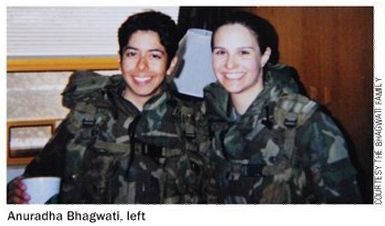
Bhagwati with a fellow (female) marine. Her colleague
could muster some femininity, even in the Marines,
unlike Bhagwati's androgynous, young boy, look.


After she left the Marines, Bhagwati co-founded Service Women's Action Network (SWAN) , and served as its first Executive Director.
Under Anu’s leadership, SWAN has spearheaded legislative reform and litigation to end military rape, sexual assault, sexual harassment, and domestic violence, and to eliminate all barriers to equal opportunity for service women. [Source: SWAN Executive Staff]
Bhagwati says about her time in the Marines:
I served for five years, with many gay and lesbian Marines, both enlisted and officer.

My best friend in the Marines was an incredible officer. She was also a lesbian. Because of this, she wasn’t allowed to live a normal life. While I could walk down the street holding the hand of my male partner, she could not do the same with her loved one, for fear of being outed.

Despite the enormous strain of living under the Don’t Ask Don’t Tell policy, my friend volunteered to serve for a year in Iraq, knowing that because she was lesbian, she wouldn’t be able to easily correspond with her partner back home. A couple of years after returning home from Iraq, she was discharged under the Don’t Ask Don’t Tell policy.

What happened to my friend was unfair, wrong and un-American.

Unfortunately, my friend’s story is all too common, especially as it concerns women in the military. While women make up only 15% of the entire armed forces, they make up almost 50% of last year’s Army and Air Force discharges under Don’t Ask Don’t Tell.

Race is another relevant factor in these discharges. African-American women are discharged under Don’t Ask Don’t Tell at three times the rate that they serve in the armed forces.

These statistics are not evidence that the military is upholding unit cohesion, good order and discipline, or any of the other convenient catch-phrases used by proponents of this archaic and useless policy. These statistics are, at the least, shocking, and at the worst, shameful.

Numbers like this originate from an ugly context, which we must discuss. Sexual harassment of women in uniform is pervasive. Lesbian-baiting is simply another insidious manifestation of sexual harassment. Many servicewomen risk two equally devastating prospects, as far as their professional careers are concerned: resist a serviceman’s advances and be labeled lesbian, or don’t resist, and get labeled promiscuous. Being labeled a lesbian, even by rumor, can prompt an investigation that ends in discharge. [Source: Service Women.org]
Baghwati has an interesting background. Her parents are academics, with professorships at Harvard and Columbia and at least two books between them. Her father, Jagdish Bhagwati, speaks highly of his daughter:
"...we are proud of her accomplishments, - particularly since they are based on social engagement that characterized our own parents almost 100 years ago, and are the jewel in the crown of the State of Gujarat from which we come, as did Mahatma Gandhi - but because it shows that none of what Anu has accomplished would have happened if she had not joined the Marines in the first place." [Source: The American Interest]
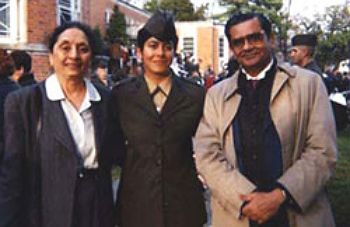
Bhagwati with her parents in her Marine uniform

Here, he's trying to understand his daughter's choices, and sympathizes with her "social conscience," that is also part of his (and his wife's) background.
"She is consumed by Human Rights work," Professor Bhagwati has said about Anuradha. When his 70th birthday was being celebrated, she could not make it to the event because of her political commitment in Palestine.

"She's our joy," her father said at his birthday celebration, the New York Sun reported in its account of the event. "And while I miss her tonight, I am delighted that it is in a good cause. After all, that is what counts."
One can also see where Bhagwati acquired her narcissism. Her parents give lavish praise and attention to their only daughter. Yet, as is characteristic of narcissists, one gets the feeling that Bhagwati resented their standards which she could never achieve, and her stint in the Marines was a way escape this family's high expectations. Even her post-Marine efforts with graduate work in Harvard and working on a novel, all seem to emulate these pleasant but demanding parents.

Here in this video, she says exactly that:
I had a very unique childhood. I mean, it was all about my parents. Obsessively so about the pressure of like getting into the top schools. And then I went to the top schools, and I was miserable. I just wanted to travel the world, go to war-torn areas and meet people and learn languages, and find out how people lived...I left grad school like mid-semester, and joined the marines [she completed a Masters in Public Policy after her discharge from the Marines].
Her parents seem to vacillate between leftist Third World positions and a capitalist Western lifestyle, which is often the behavior of committed, elitist ideologues: they want all the amenities of the West, but will promote ideologies that could destroy it (with them sheltered in safe havens). This can't have been a very stable environment for Bhagwati to grow up in.

Bhagwati père came to the US in 1969 to study economics at MIT. He is linked throughout his career with leftist institutions. He served:
...as an external advisor to the Director General of the World Trade Organization in 2001, as a special policy advisor on globalization to the United Nations in 2000, and as an economics policy advisor to the Director-General of the General Agreement on Tariffs and Trade from 1991 to 1993. From 1968 until 1980, Bhagwati was an economics professor at the Massachusetts Institute of Technology. Bhagwati currently serves on the Academic Advisory Board of Human Rights Watch (Asia) and on the board of scholars of the Centre for Civil Society. He is a Senior Fellow of the Council on Foreign Relations. [Source: Web India]
Her mother, Padma Desai, is linked with similar leftist ideological bodies. She served as:
...US Treasury’s Advisor to the Russian Finance Ministry (1995), [and] she is regarded as a leading scholar today on the Soviet Union and Russia. [Source: Celebrating Padma Desai, Columbia University]
There is a strange moment in Desai's life where she:
...won a scholarship to the US [from India] and never went back [to her first husband]. In the end, faced with his refusal to grant her a divorce, she converted to Christianity, because under the Indian law, religious incompatibility is a ground for divorce. The suggestion had actually come from him and she converted. She describes in moving detail how the forlorn ceremony took place on a rainy day in a small village in Gujarat. [Source: Random Truths and Common Threads, in The Hindu Business Line].
It is one thing to have leftist parents, another to have a first marriage in her mother's history, but how about her mother's conversion to another religion to facilitate her personal life?

After Desai gets her PhD from Harvard, she returns to India to teach at the Delhi School of Economics, and meets Jadish Bhagwati. They immigrate to America with a position for Bhagwati at MIT, but:
more importantly in order for Desai to make a clean break from her bad first marriage. [Source: Time Out India]
More on her mother's divorce, and her second marriage:
[T]he incredible legal entrapment of the Hindu Marriage Act of 1955...drove Desai to a phoney religious conversion - the only permissible grounds for a judicial separation, if her husband agreed. He did - after years of denying her a divorce - then recanted. Her Christian conversion was in vain. Eventually, in 1968, she followed Bhagwati to Boston, won a position at Harvard, and freed herself via a Mexican divorce before she could remarry...Eventually, she finds [a] life (and an exciting career) in America, with the ever charming and lovable Bhagwati, first at Harvard and then at Columbia. [Source: The Hindu]
Their daughter, Anuradha Bhagwati, was born in New York in 1976 (I calculated her birth date from this article, written in 2008, and which cites her age then as thirty-two). I find it important to know how soon after her parents immigrated to the US Bhagwati was born. She's had the typical, complicated life of a child of Third World of immigrants who arrived in the US after:
...the 1965 Immigration Act which opened U.S. immigration on an equal basis to every country in the world, rather than, as in the past, favoring our historic source nations of Europe. Of course many of the recent immigrants from non-European countries have fitted into America and made good contributions here. It is the unprecedented scale of this diverse immigration that is the problem. [Source: View From the Right"]
When Bhagwati's parents came to the US in the mid-sixties, multiculturalism was just becoming an accepted way of cultural life. By the time Bhagwati was born, it was a part of American life. I wouldn't be surprised if growing up, her life was full of reminders of the country her parents left behind, from the food, to the music, and the friends and relatives who frequented their home. So although she grew up in America, hers was a specific, ethnically restricted, America. I think this speaks of her behavior at the hearings, her victim stance, her repeated blame on racism for her discharge, and her particular singling out of white men leaders in the military as those who prevent non-whites (and of course women) from advancing in the military.

Here is a fascinating video of Bhagwati rambling on in free-style fashion about the evils of the military, misogynistic white men, fighting wars, and the hegemonic empire that is the United States. The video is titled: "Interview With a Reluctant Veteran: Anuradha Bhagwatl." I've transcribed it below from around the 15 minute point in the video to the end, to show the quality of her mind.
And when I see the usually white men who are providing the, I don't want to say, the state version, it's really how it seems at times [laughs while she says this], the state version of events and the state version of how you should operate in Iraq or how you should fix the military or improve and take care or support our troops, which is the biggest slogan of them all, you know, it feels very odd for me to have the same status, you know this veteran status. It feels very awkward. Because I wonder if they are having any intimate conversations with anyone about anything. I mean there are things that happen to every soldier's soul in that institution, regardless of where he or she comes from originally, political baggage, all of that. There's something that happens to their soul, and I'm not sure that enough of them examine what it is that happens. It's a very fragile thing, dealing with force and violence. You don't even have to physically hurt somebody, and you could have, you may have committed an act of violence upon them in what you bring to the table. And the society I don't think understand the ramifications of this, the violence. There is an indoctrination in any army that comes with the training. And any time that the nation perceives itself to be at risk of annihilation, well you know, or invasion, to use a smaller term, the existential issue of Israel, for instance, where you have so much more national ideology at play, and the basic indoctrination of the soldier, all politics aside, I mean that is how literally how Israelis are trained, so you think you're defending your individual family, you know, and societal existence, whether or not that's true. And you'll believe it, and you'll fight and kill, you know, to the end. You know, in a case like India I would imagine that was true at least on a partial scale, because of historic conflicts with neighbors to the north, right. But I don't know, I've talked to members of the military from South Asia, of various nations, there's something slightly more intellectual about their approach to, but I'm sure not everybody, but the few that I've talked to, about their role in the world. The thing that makes an American soldier stand out is his country's role in the world that bleeds into his ideology about where he thinks, who he thinks he is. Completely inflated sense of self. And it's unfortunate, right, because it prevents him from actually reaching out to people from other countries and cultures. It's a shame, in fact, it's a shame. Because it prevents him from being human, right. And so, yeah. I'm not saying, you known, that this is the American condition, and it couldn't ever happen. I think any hegemonic empire that this is the result, right. It's our turn, in the United States. [Source: Kran Film Collective]
This is someone who reached the rank of Captain in the American military. This is the type of soldier who is out in the fields, representing American soldiers. It is not an issue of women in the military anymore, it is an issue of Third World minded, anti-American, anti-military soldiers who are becoming a real detriment to America.

This is who represents America now.


The face of the victimized, feminized, Third World,
anti-American former soldier.


This is who will save America?
-------------------------------------------------------------------------------------------------------------------------------------------------------------

Posted By: Kidist P. Asrat
-------------------------------------------------------------------------------------------------------------------------------------------------------------

Saturday, May 18, 2013

Lilacs


Lilacs
[Photo by KPA]

-------------------------------------------------------------------------------------------------------------------------------------------------------------

Posted By: Kidist P. Asrat
-------------------------------------------------------------------------------------------------------------------------------------------------------------
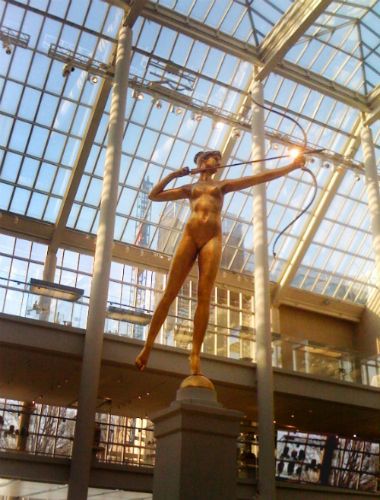
Diana and the American Renaissance Aesthetic


Diana, 1892–93;
This cast, 1928
Augustus Saint-Gaudens (American, 1848–1907)
Bronze, gilt
Metropolitan Museum of Art, New York


The Charles Engelhard Court
The American Wing
The Metropolitan Museum of Art, New York

-------------------------------------------------------------------------------------------------------------------------------------------------------------

Article Below:

Augustus Saint-Gaudens (1848-1907)
Diana of the Tower ca. 1899-1907
By: Thayer Tolles*
In: American dreams: American art to 1950 in the
Williams College Museum of Art

Hudson Hills Press, Oct 5 2001. Pp102-105

*Tolles is a graduate of Williams College (1987)
And Assistant Curator
Department of American Painting and Sculpture
The Metropolitan Museum of Art

For late-nineteenth-Beaux-Art sculptors a skillfully rendered nude was paramount demonstration of artistic competence. Rigorously schooled in Parisian academics, these artists drew and modeled sketches of the nude, aspiring to translate their talents into finished works with ideal themes. Of subjects inspired by classical mythology, Diana, goddess of the chase and the moon. was favored by sculptors from Jean Antoine Hondon to Jean-Alexandre-Joseph Falguiere, French-trained Americans such as Augustus Saint-Gaudens, Frederick William MacMonnies, and Olin Levi
Warner, were similarly drawn to her ideal feminine beauty. One reason for this popularity was that her understated attributes - bow, arrow, and crescent moon headpiece - so effectively asserted her identity that sculptors were able to give visual prominence to her nudity and thus showcase their prowess at modeling the human form. Although Diana was the only Saint-Gaudens sculpted during his illustrious career, it enjoyed instant renown and remained a cornerstone of his oeuvre.

The William College Museum of Art's graceful rendering of Diana drawing her bow is a reduction after a monumental weathervane that once surmounted the tower of New York's Madison Square Garden (an indoor sporting arena, auditorium, and concert hall completed in 1891). Saint-Gaudens created the figure as "purely a labor of love" at the request of his close friend Stanford White, the architect of this Spanish Renaissance-style structure inspired by the tower of the tower of Giralda in Seville. White - a partner in the noted firm McKim, Mead, and White -often collaborated with Saint-Gaudens to create decorative pedestals and frames; joint efforts such as the Farragut Monument (1877—80, Madison Square Park, New York) and Bessie Smith White (1884, The Metropolitan Museum of Art, New York) are exemplars of the American Renaissance Aesthetic.

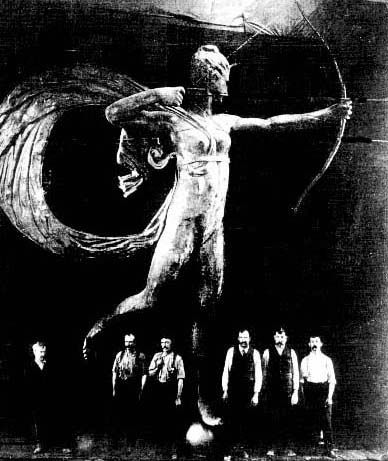
The initial seeds for Diana were sown in 1886 when Saint-Gaudens sculpted a portrait bust of his model and mistress Davida Johnson Clark (marble bust, Saint-Gaudens National Historic Site, Cornish, N.H.). This likeness later served as a study for the head of Diana, from which small figural studies were mechanically enlarged to an ambitious eighteen-foot-high figure by the W. H. Mullins manufacturing company in Salem, Ohio. When the statue of gilded copper sheets was hoisted atop the tower of Madison Square Garden in October 1891, it instantly became the point of greatest elevation in New York. With its clean lines and vivid silhouette, Diana gleamed in the light of day and was dramatically illuminated at night. However, her tenure atop the tower was short-lived; both architect and sculptor felt its scale was disproportionately large for its site. Furthermore, the immense weight - eighteen hundred pound - and awkward positioning of the left foot on the spherical base prevented the sculpture from revolving, thereby negating its function as a weathervane. Saint-Gaudens and White determined to create a smaller, lighter and more streamlined version at their own expense.


First weathervane version, bronze, photographed in the [Ohio] foundry,
Historic photograph collection of Saint-Gaudens National Historic Site


The first Diana (no longer extant) was removed in 1892 and sent to Chicago for display at the 1893 World's Columibian Exposition atop the Agricultural Building. Saint-Gaudens remodeled the figure, adjusting the hair, drapery and mounts as well as eliminating the crescent headpiece. When the slimmer, thirteen-foot figure was installed in November 1893, the critic Royal Cortissoz wrote appreciatively of the transformation: "The lithe goddess now has movement and elasticity as well as dignity; there is more strength in her limbs than there was, and there is more grace." Like the first Diana, the reworked figure featured a rudder of flying drapery to catch the wind. Unfortunately, when strong gales blew this piece off, the sculpture had to be permanently bolted into a stationary position. A famous New York landmark despite ongoing controversy over the issue of nudity, Diana remained resplendent on her perch until 1925, when Madison Square Garden was demolished. Seven years later, the New York Life Insurance Company, owners of the Garden site, gave the piece to the Philadelphia Museum of Art, where it is situated prominently at the top of a staircase.

By the time Saint-Gaudens modeled Diana for Madison Square Garden, he had revolutionized the field of American sculpture through his masterful handling of the bronze medium, his stirring monuments, and character-penetrating portrait reliefs. However, he, like other American sculptors, had been unable to encourage sustained interest for their bronze statuettes to the same degree artists enjoyed in France, for instance with the animal sculptures of Antoine-Louis Barye. Saint-Gaudens's replication of Diana as a statuette was a calculated attempt to bridge the gap between his large-scale images and smaller bronzes created for domestic display. During the 1890s and beyond, he successfully marketed multiple casts of three of his most attractive efforts: first Diana, then Robert Louis Stevenson and The Puritan. Ever concerned about maintaining control over the artistic process, he assured the individual aesthetic integrity of each cast by making occasional refinements, remodeling by hand rather than mechanically. He also experimented with the coloration of the patinas, which ranged from gold to green to brown. Copyrighted in January 1895, replicas of Diana were sold through Tiffany and Co. in New York, Doll and Richards in Boston, and by the sculptor himself.

When Saint-Gaudens reduced Diana, he made several changes from the original oversize figure. One, the removal of the billowing drapery. was the most significant compositional alteration; others, such as ongoing refinements to the hair, bow and base were more subtle, intended to improve the overall aesthetic. The earlier reductions, cast by Aubry Brothers in New York, are thirty-one inches high, and mounted on a half sphere (example in the collection of Chesterwood, National Trust for Historic Preservation, Mass.). Saint-Gaudens then produced a twenty-one-inch figure poised atop full orb on a low two-tiered base (example in the collection of the MetropolitanMuseum of Art). This "small" Diana was cast by Gruet in Paris, the artist's foundry of choice.

Although the figure is the same height at the "small" version, Williams College's Diana represents a third variation on the reduction theme. While Saint-Gaudens was in Paris in 1899, he remodeled the base so that the nude surmounts a sphere balanced atop a tripod adorned with winged griffins and classicizing scrolls and rosettes. This alteration is particularly pleasing since the elongated taper of the base complements the elegant sweeping lines of the nude.

Both French and American foundries produced this third version. The bronzes were in existence as early as 1899, and casting continued after Saint-Gaudens's death in 1907. For these reasons, as well as the sculptor's incomplete records, it is not possible to determine an exact production date for Williams's Diana. The raised letters on the base may be read as "Diana Op the Tower" rather than "Diana Of the Tower," but this does not necessarily imply a foundry error, but rather a less crisply cut inscription.

Among other casts featuring the tripod base are those in the collection of the Cleveland Museum of Art; Gilcrease Museum, Tulsa Oklahoma; the New York Historical Society; and the Virginia Museum of Fine Arts, Richmond. A cast at the National Gallery of Art, Washington D.C., differs in the treatment of the hairstyle, while one at the Smith College Museum of Arts, Northampton, Massachusetts, has a knob on the side of the base which when turned causes the figure to rotate as did the original large-scale version.

-------------------------------------------------------------------------------------------------------------------------------------------------------------

Posted By: Kidist P. Asrat
-------------------------------------------------------------------------------------------------------------------------------------------------------------

Friday, May 17, 2013

Shunga By Lucy Liu


Lucy Liu with Boxer Wladimir Klitschko in 2008,
with one of her paintings


I recently wrote about the Asian (American) actress Lucy Liu, and posted the photo above of her posing with one of her paintings.

I got a response to that posting from a reader:
That painting from the 2008 photo seems to sum it up better than I ever could.
I was debating whether to post that photograph or not, but it was pertinent to the discussion.

Liu is of Chinese background, but "Asian" is the term most Chinese/Korean/Japanese use when referring to their ethnic background, as does Liu.

Liu's painting exhibited at the Six Friedrich gallery for modern art in Munich is a Japanese style painting called Shunga. It is not surprising that she chose this style since it is one of the more famous "Asian" styles of painting, and I think it fits with her eroticization of the Asian female, at least in the film roles she has taken on.

Eroticism is a form of power. Rather than show us beauty, Liu shows us sex (or pornography, or "erotica" in more polite society). By putting these paintings aggressively before us, Liu is confronting us and our sense of decorum, partly saying she can do what she wants, and if we complain or find it repulsive, then we are criticizing her and her ethnicity, thus making us racist.

The only way to win back our dignity, and our civilization, is to call out these tactics by disgruntled non-whites, by showing the inferiority of their supposed superiority and by attacking back when they attack us.

Rather than let Liu and her ilk have their say (with art, fashion, literature, film, etc.) without criticism, we should hold them accountable for their words (and works), ask them to explain and substantiate their positions, and let our arguments be the best judge.

Below is the painting behind her in the above photo (there is nothing larger online, and I couldn't find a title for the piece).


Why couldn't Liu look toward Europe, or America, in other words, the West? Why is she running to the East?

It harks back to her victim-tainted statement where she said:
"I can’t say that there is no racism [in America toward Asians] - there’s definitely something there that’s not easy..."
Liu "channels" the Japanese Shunga and this cultural background despite it having no relation to her own ethnic history, simply to identify with her "Asianness." It is interesting that she uses eroticism (or porn, to be more blunt) to identify with her "Asianness." There are many more pastoral Japanese and Chinese paintings she could have used, or the aggressive ones of warriors, rather than to resort to Shunga.

But, this is her way of showing us the alternate to "the emotionless Asian girl," a label which seems to haunt her (and which she gave to herself), and which she has to disprove at any opportunity, from her string of boyfriends to her pornographic art.

Is this what we are creating? A whole generation of aggrieved non-whites, who will reject the West, its culture, art and eventually society, to build their own versions of their ethnicity and society?

I think so.
----------------------------------------------------------------------------------------------------------------------------------------------------

Posted By: Kidist P. Asrat
----------------------------------------------------------------------------------------------------------------------------------------------------

Response to: Women as Public Figures: Why it Doesn't Work


Diana West beint interviewed at the Presidential Speakers Series

Tiberge from GalliaWatch wrote a post on women as public figures here.

I was recently discussing the evil Angelina Jolie, and the horror she has inflicted on us, and most terribly, on a whole generation of young women who want to emulate her. I think Tiberge's comments on her are exactly right.

She agrees with my views on Diana West and Pamela Geller, who are Of course, not on the same level as Jolie, but who nonetheless inhabit the world of women as public figures.

On women in general, Tiberge wrote:
It's difficult to criticize a person's appearance. I feel uncomfortable doing it, so I keep it to a minimum. Lawrence Auster did it all the time, and sometimes I felt he went much too far, attributing an entire gamut of psychological traits to a person based on one photo.
I have to disagree. There are certainly many uncontrollable elements when one's photo is taken, but we still have control over a lot. We decide what to wear, how to pose, whether to smile or to scowl, how we groom ourselves (make-up, hairstyle), and we can even control with whom we have the photo taken. The ultimate decision is ours, unless we live in some kind of totalitarian gulag. If we don't like the photo, we can ask to have it removed from a public posting, and if that is not possible, write a statement that it wasn't our decision to have that (unflattering) photo taken in the first place.

So, if we as ordinary citizens can do all that, more important figures have more power over the dissemination of their image and to present the kind of image they want disseminated. And ultimately, their responsibility is also larger, and hence their damage potentially greater.

And writers also have some kind of duty to call them out on this. If these public figures claim to represent us, then they should represent us properly.
------------------------------------------------------------------------------------------------------------------------------------------------------------

Posted By: Kidist P. Asrat
------------------------------------------------------------------------------------------------------------------------------------------------------------

Women as Public Figures: Why it Doesn't Work


By Tiberge
writer at GalliaWatch

Pamela Geller is a self-infatuated egoist, even if she does some good. I'm often repelled by those who cannot resist showing off while they serve a worthy cause. This often creates dissent within the group serving the same cause, and does harm ultimately to the cause. An excellent example recently in France has been the outrageous behavior of Frigide Barjot (a.k.a. Virginie Merle) who has ostentatiously displayed sympathy for homosexuals to the point where she has accused the traditionalists and the Front National of being "fachos" and "extremists". She highjacked the cause of anti-gay marriage for her own self-serving ends. This has not gone unnoticed or uncriticized, and I believe she may have a lesser role to play now in the Manif Pour Tous. I have written about her and her movement here.

As for Diana West, I'm sorry she was not able to see herself more objectively. I like her, but she showed too much leg and the shoes were ugly as well (the shoes they wear today are beyond hideous). So she asked for it. I assume that a woman looks carefully at herself in a full-length mirror while preparing for a TV interview and perceives the dangers of a mini- skirt. But, the problem is that she doesn't see the problem, since she (like most women) want to be in vogue.

It's difficult to criticize a person's appearance. I feel uncomfortable doing it, so I keep it to a minimum. Lawrence Auster did it all the time, and sometimes I felt he went much too far, attributing an entire gamut of psychological traits to a person based on one photo. I would not do that, except perhaps in the case of a known criminal. In the case of Deneuve I was more critical of her thoughts that then ricocheted back onto her face revealing something not so beautiful. But that was a subjective criticism on my part - she was still beautiful in the plastic sense.

I presume you have heard about the monstrous Angelina Jolie. She has been a self-mutilating maniac from the beginning with her tattoos and drugs, etc... Now she is the martyr of the pink-ribbon girls. The medical profession and the so-called scientists will have their place in Hell. Here is an article I found of interest:

The thought that other impressionable women will imitate her is horrific.

--------------------------------------------------------------------------------------------------------------------------------
Posted BY: Kidist P. Asrat
--------------------------------------------------------------------------------------------------------------------------------

The Book of Judith


Ellen Frank
The Sword Page from “The Book of Judith,” 2012-2013
23.5 k moon gold, white gold, palladium leaf
and egg tempera on classic English vellum
(23 1/2" x 17")

O Lord God of my father Simeon, who gavest him a sword to execute
vengeance against strangers (The Book of Judith, 9:2)


-------------------------------------------------------------------------------------------------------------------------------------------------------------

The above image is from the Ellen Frank's Illuminated Arts project website. A Reclaiming Beauty reader sent me the link. According to the Ellen Frank Illuminated Arts Foundation's Mission Statement:
For centuries, societies far apart in culture and religion have had in common an exquisite art form: the Art of Illumination. Made with pictures, paint and precious metals, these cultures used illumination to create beautiful renderings of their most sacred documents. In archives and museums, a decorated Hebrew marriage contract (or ketubah), an embellished New Testament manuscript, and a dazzling Koran, bespeak the reverence and intensity of feelings expressed through this fine art.

The Ellen Frank Illumination Arts Foundation, a not-for-profit corporation, was formed in June 2004 to revitalize passion for and public awareness of the art of illumination, in part through education and training at the unique Illumination Atelier. Modeled after the Renaissance atelier (studio), the Illumination Atelier is the first of its kind in the United States.
About the Book of Judith, Ellen Frank writes:
The Book of Judith is a contemporary illuminated manuscript that tells the ancient, inspiring story of Judith, a woman of valor, who single handedly saves her small town from Assyrian military take-over and religious oppression. It chronicles the historic struggle for religious freedom in a contemporary voice while echoing the great illuminated manuscripts that flourished in the Middle Ages and the Renaissance.
Wikipedia says this about the Book of Judith:
The Book of Judith is a deuterocanonical book, included in the Septuagint and the Catholic and Eastern Orthodox Christian Old Testament of the Bible, but excluded by Jews and assigned by Protestants to the Apocrypha. The book contains numerous historical anachronisms, which is why many scholars now accept it as non-historical; it has been considered a parable or perhaps the first historical novel.

The name Judith (Hebrew: יְהוּדִית, Modern Yehudit Tiberian Yəhûḏîṯ ; "Praised" or "Jewess") is the feminine form of Judah.
Here is our first introduction to Judith, in Chapter 8 of The Book of Judith:
1 Now at that time Judith heard thereof, which was the daughter of Merari, the son of Ox, the son of Joseph, the son of Ozel, the son of Elcia, the son of Ananias, the son of Gedeon, the son of Raphaim, the son of Acitho, the son of Eliu, the son of Eliab, the son of Nathanael, the son of Samael, the son of Salasadal, the son of Israel.

2 And Manasses was her husband, of her tribe and kindred, who died in the barley harvest.

3 For as he stood overseeing them that bound sheaves in the field, the heat came upon his head, and he fell on his bed, and died in the city of Bethulia: and they buried him with his fathers in the field between Dothaim and Balamo.

4 So Judith was a widow in her house three years and four months.

5 And she made her a tent upon the top of her house, and put on sackcloth upon her loins and ware her widow's apparel.

6 And she fasted all the days of her widowhood, save the eves of the sabbaths, and the sabbaths, and the eves of the new moons, and the new moons and the feasts and solemn days of the house of Israel.

7 She was also of a goodly countenance, and very beautiful to behold: and her husband Manasses had left her gold, and silver, and menservants and maidservants, and cattle, and lands; and she remained upon them.

8 And there was none that gave her an ill word; ar she feared God greatly.

9 Now when she heard the evil words of the people against the governor, that they fainted for lack of water; for Judith had heard all the words that Ozias had spoken unto them, and that he had sworn to deliver the city unto the Assyrians after five days;

10 Then she sent her waitingwoman, that had the government of all things that she had, to call Ozias and Chabris and Charmis, the ancients of the city.

11 And they came unto her, and she said unto them, Hear me now, O ye governors of the inhabitants of Bethulia: for your words that ye have spoken before the people this day are not right, touching this oath which ye made and pronounced between God and you, and have promised to deliver the city to our enemies, unless within these days the Lord turn to help you.

12 And now who are ye that have tempted God this day, and stand instead of God among the children of men?

13 And now try the Lord Almighty, but ye shall never know any thing.

14 For ye cannot find the depth of the heart of man, neither can ye perceive the things that he thinketh: then how can ye search out God, that hath made all these things, and know his mind, or comprehend his purpose? Nay, my brethren, provoke not the Lord our God to anger.

15 For if he will not help us within these five days, he hath power to defend us when he will, even every day, or to destroy us before our enemies.

16 Do not bind the counsels of the Lord our God: for God is not as man, that he may be threatened; neither is he as the son of man, that he should be wavering.

17 Therefore let us wait for salvation of him, and call upon him to help us, and he will hear our voice, if it please him.

18 For there arose none in our age, neither is there any now in these days neither tribe, nor family, nor people, nor city among us, which worship gods made with hands, as hath been aforetime.

19 For the which cause our fathers were given to the sword, and for a spoil, and had a great fall before our enemies.

20 But we know none other god, therefore we trust that he will not dispise us, nor any of our nation.

21 For if we be taken so, all Judea shall lie waste, and our sanctuary shall be spoiled; and he will require the profanation thereof at our mouth.

22 And the slaughter of our brethren, and the captivity of the country, and the desolation of our inheritance, will he turn upon our heads among the Gentiles, wheresoever we shall be in bondage; and we shall be an offence and a reproach to all them that possess us.

23 For our servitude shall not be directed to favour: but the Lord our God shall turn it to dishonour.

24 Now therefore, O brethren, let us shew an example to our brethren, because their hearts depend upon us, and the sanctuary, and the house, and the altar, rest upon us.

25 Moreover let us give thanks to the Lord our God, which trieth us, even as he did our fathers.

26 Remember what things he did to Abraham, and how he tried Isaac, and what happened to Jacob in Mesopotamia of Syria, when he kept the sheep of Laban his mother's brother.

27 For he hath not tried us in the fire, as he did them, for the examination of their hearts, neither hath he taken vengeance on us: but the Lord doth scourge them that come near unto him, to admonish them.

28 Then said Ozias to her, All that thou hast spoken hast thou spoken with a good heart, and there is none that may gainsay thy words.

29 For this is not the first day wherein thy wisdom is manifested; but from the beginning of thy days all the people have known thy understanding, because the disposition of thine heart is good.

30 But the people were very thirsty, and compelled us to do unto them as we have spoken, and to bring an oath upon ourselves, which we will not break.

31 Therefore now pray thou for us, because thou art a godly woman, and the Lord will send us rain to fill our cisterns, and we shall faint no more.

32 Then said Judith unto them, Hear me, and I will do a thing, which shall go throughout all generations to the children of our nation.

33 Ye shall stand this night in the gate, and I will go forth with my waitingwoman: and within the days that ye have promised to deliver the city to our enemies the Lord will visit Israel by mine hand.

34 But enquire not ye of mine act: for I will not declare it unto you, till the things be finished that I do.

35 Then said Ozias and the princes unto her, Go in peace, and the Lord God be before thee, to take vengeance on our enemies.

36 So they returned from the tent, and went to their wards.


Botticelli, Alessandro (1444/45-1510)
The Return of Judith to Bethulia
Oil on Panel
Date Painted: 1472
31 x 24 cm
Galleria degli Uffizi, Florence


Judith returns to Bethulia carrying the sword she used to decapitate Holofernes's head, while her maidservant Abra carries his head.


Michelangelo Buonarroti (1475 - 1564)
Detail from: Judith carries away the head of Holofernes
Fresco
Date Painted: 1508-1512
Sistine Chapel

-------------------------------------------------------------------------------------------------------------------------------------------------------------
Posted By: Kidist P. Asrat
-------------------------------------------------------------------------------------------------------------------------------------------------------------