About.......Contact.......Society.....................
Showing posts with label Art. Show all posts

Friday, June 16, 2017

Culture Watch: Burning Down Western Culture

I have started a new topic I've titled "Culture Watch."


Nafiseh Emadmostofi
Do it Yourself: Coffins II, 81cm x 101cm
Oil on Canvass


Art is one of the first ways that we get indications of the directions a culture is taking. That is because it is hard to lie with art. Your authenticity is revealed firstly through your technical dexterity. And having invested so much time learning the techniques and processes, what you present becomes a labor of love. You do the very best that you can do.

And images are more primal than words. One can mask meanings and intentions with words, but pictures are more direct.

We have now in Canada (and specifically in Mississauga) artists who have gone through - so far - the exemplary schools that the region have to offer. Even in this era of postmodernism, there are first class traditional schools of painting and drawing available to anyone who wants to attend. Many are at very low cost or even free. Public secondary and post secondary school systems in Ontario have them in their curricula, with skilled art teachers on their staff.

Many times these artists are second generation immigrants who may have been born in Canada or came to the country as very young children. They maneuver through "Canadian" culture with expertise, speak fluent English, and often also their own languages.

They go through the usual rigorous screening systems, first for admissions into these post secondary schools and even secondary schools. For example The Etobcoke School of the Arts is highly selective in admitting its high school students.

Then, as they complete their studies, these artists start their rounds of galleries and museums to submit their works for exhibitions. Some venture out into the commercial world, but that comes much later.

The fascinating thing is the themes they chose to represent. Without fail (view work by students and alumni of Chinese or other ethnic backgrounds at the Ontario College of Art and Design here, or here at the University of Toronto ), their works reference their own cultures. Often there is a sense of alienation in their works. And where these works intersect with other cultures, and specifically with white, western culture, there is an amorphous sense of doom. This may be representative of the postmodern era of doom and gloom in art, but this doom and gloom is specifically Chinese, or Indian, or some other ethnic group's where the artists pull from their own cultural vocabularies to represent such worlds through their art.

Multiculturalism has really brought out their unique demons.

But there is another interesting layer. While each culture represents its imagery, in its own way, with unapologetic references to its "identity," whites are not allowed to do so. For if they do, then they are channeling into their "oppressor" history, their legacy of "racism" where they prevented the ancestors of these non-whites (some only as far back as 1/2 a generation ago) from participating and fully living in this land. Whites cannot be genuine artists because of the crimes that have been allocated to them. They will only make more of the same art, "alienating" and "oppressive."

What could be further from the truth!

But all these "ethnics" cannot be true artists either, for their inauthentic methods of "copying" their oppressors.

So where does that leave us in the world of art?

We get to watch the burning of the Western tradition, painted in the immaculate tradition of Western art.

Nafiseh Emadmostofi channels back to this tradition, having nothing else to emulate. Yet her deepest desire is to see it go up in flames, to vanish, so that she can once again return to her true, authentic self, her true authentic art.

The Art Gallery of Mississauga will exhibit Emadmostofi's works in the XIT-RM from June 29-August 27 2017 under the title Burning Desire. She will also participate in an "Artist Talk" on June 29, the opening night.

What is Emadmostofi's burning desire? I have answered that question above: "...her deepest desire is to see [this Western culture] go up in flames, to vanish, so that she can once again return to her true, authentic self, her true authentic art."

The gallery's communication describes Emadmostofi's work thus:
Nafiseh Emadmostofi’s bold figural paintings offer up representative and allegorical examinations of ideological conflict, and the power of art to inspire protest, incite censure, and yet also speak to a collective (and contested) desire to envision a better world.
And we get this "better world" after we get rid of the "old" and "corrupt" one.

There is nothing more exhilarating than utopian visions.

Thursday, June 15, 2017

The Perfect Coordination: Urban Decay Takes on Decadent Art


Vice-loving AND Cruelty-Free, Urban Decay's new store in Ontario

A cosmetics store called Urban Decay opened up recently at the slickly renovated Square One mall. I walked in yesterday to see all the decay. I wasn't disappointed.

Urban Decay has teamed up with "artist" Jean-Michel Basquiat to make the perfect co-ordination of imagery and makeup. In our era of anti-beauty, which is now reaching a nefarious satanic state (and where else does deliberate embrace of ugliness take us), Jean-Michel Basquiat's legacy becomes the perfect "artistic" expression for contemporary fashion and "beauty."

Here is what Urban Decay says about the UD/J-MB link-up:
We’ve been fans of Basquiat’s art since before the early days of UD; so when his estate approached us about a collaboration based on his artwork, we couldn’t wait to start creating. From the colors and shade names to the packaging, EVERYTHING in this collection evolved from Basquiat’s art. Like Urban Decay, Basquiat was an outsider who challenged the status quo and used color in nontraditional ways. From his informal graffiti work and the way he mixed mediums and colors to the way he spoke out against social injustice

Urban Decay Jean-Michel Basquiat Tenant Eyeshadow Palette: $39
Shades included:
- Studio (pale pink matte)
- 1960 (bright pink matte)
- Neo (rich aubergine w/micro-shimmer)
- Les (charcoal-black matte-satin)
- Graffiti (deep metallic green)
- Exu (bright green shimmer)
- Boom (bright teal matte)
- Untitled (rich deep blue matte)
OK, the "untitled" is funny.


Jean-Michel Basquiat
Self-Portrait, 1982
Media: acrylic, crayon
Dimensions: 239 x 193 cm
Private Collection
© The Estate of Jean-Michel Basquia


Art critics dare not expose the emperor as having on no clothes because they would be exposed as having on no clothes either. So we get endless repetitive art-talk admiration for truly ugly horrors.

And it takes someone who has no stake in the postmodern art horrors either financially or intellectually to expose the nakedness of these. One such is a blogger, short-lived and anonymous (probably has a real job to protect, where he doesn't earn even a tiny percentage required to pay for these multi-million dollar doodles) whose post I've posted in full below.

---------------------------------------------------------------------------------------------------------

I don't get it: Jean-Michel Basquiat
By: Daily soup
June 4, 2011
[make sure to read the comments]

I once dated this fine art major from the academy of art college. she was a bit introverted at times but tended to emerge from that shell with a bat outta hell fury when angered or passionate about an issue. So her and I are on the haight and we go into this poster shop. she stops and and asked me; do you know jean michel basquiat? asking me in a tone that seemed to indicate irrevocable damage to our relationship was at hand should I answer poorly. not wanting to be erroneously outed as a liar, I simply said no, I am not familiar with jean michel basquiat. surprised, she looked at me as if I had looked in the mirror and said: you know what? I hate you niggaz. In an ever so sexy low tone, she explained a short history of this painter and then she gentility grabbed my wrist and led me to a stack of posters.

I was expecting to see some undiscover 20th century new york answer to leonardo du vinci or vincent van gogh.Instead I get these.....


If star wars came out in Shakespeare's day, I would imagine this is what the darth vader of his day would look like.

AFTER MY EXPOSURE to these...umm...yeah...I asked her, oh wow! was he insane? At this point, my girl was clearly offended. she went on into a whole discussion about not "getting it" and how I shouldn't be in art school because I lack the vision to see beauty in the abstract and so forth and so on.

I retorted by asking her has she ever seen the paintings they found made from serial killers and mass murderers? well these would definitely fit in the lot for sure.This led to an intense yet low decibel trade off of passive aggressive quips.I swear even arguing with that girl was a strange venture down the rabbit hole.
A day later, I went back to that store alone and for almost 15 minutes (and after fighting off the strong compulsion to make the sign of the cross numerous times before those painting) I went from a strong silent and contemplative stone pillar stance to a loud and eruptive THIS SHIT IS GARBAGE! WHAT THE FUCK IS THE DEAL WITH THIS OVERRATED SPLASH OF SHOCKING AND DISTURBING VOMIT OF QUASI ARTISTIC INSANITY WORTH ONLY THE CANVAS IT WAS PAINTED ON!?

Surprised by that flood of seldom used vernacular and vocabulary, I stopped myself. Then was asked to leave the store, NO SWEAT, I've BEEN KICKED OUT OF BETTER PLACES THAN THIS. I guess word got back to my girlfriend because she broke up with me that evening.

Look, I'm not ashamed of the fact that I could stand in an art gallery scratching in perplexity. Wondering what one sees in abstract expressionism. I'm not insecure about my uncultured and unrefined nature. I'm proud of my blue collar, sports bar self.

yes I do miss the GF from time to time, although we aren't talking, we do past each other and say hi. But I still get pretty peeved when I realize that our relationship came to an end over JMB. It couldn't be a micheal angelo?

I guess our relationship was less fine art and more chicken scratch.

Thursday, June 1, 2017

Double Whammy Discrimination: Diversity at all Cost
Even if it Means Empty Museums


In our postmodern era I would be defended as a discriminatee.

My non-White, Third World background would automatically place me in the "victim" pigeonhole where my word against my white "antagonist" would preside, NO MATTER WHAT.

That is, until I start to defend this "white" monster and say he is the one being discriminated against.

Then the wrath, slow though it may come, is full on!

Especially if it is a white women who is regulating the discrimination channel.

This happened to me recently after I attended (and participated in) a lecture at the Art Gallery of Mississauga, where a group of artists were to discuss the works of Homer Watson, a late 19th early 20th century painter from southern Ontario.

I wrote about the exhibition and the panel discussion here: Homer Watson, Native Son. But I left out my questions to the panel.

As wrote in my post:
Last year, I attended a panel discussion on the exhibition Beyond the Pines: Homer Watson and the Contemporary Canadian Landscape at the Art Gallery Mississauga. I had visited the exhibition numerous times, going through Watson's work one by one, to study his technique, his evolution as an artist, his views, his concerns, and his Canada.

The exhibition also displayed works by contemporary Canadian artists to bring this pine "narrative" to the fore. Some were reasonably good, but none reached the overall skill and beauty of Watson's paintings.
I was gong to leave it at that, just a personal observation (not naive or untutored, since I have a solid background in the arts), hoping that I would gain some insight from these artists.

But I should have known better.

The catalogue the AGM produced for this exhibition prefaced with this objective:
Contemporary Canadian artists looking at landscape must also find a way to access the ‘truth’ of a subject that is not only strongly represented in our national artistic history, but one that is both deeply political and personal.
So the "truth" of a subject is now mandated to "represent" not just our nation "objectively" but has to incorporate political and personal views as well.

A tree is not a tree is not a tree, to paraphrase Gertrude Stein .

I asked Reinhard Reitzenstein, one of the panelists, who is a pretty good sculptor (and who is white), if he believes that Homer Watson's standards, and art, set an example for artist in general or if his English (Western) heritage is insignificant. This was of course not what I was asking, as Reitzenstein clearly understood. I was asking him if he thought that Watson's work was good, was superior.

Reitzenstein talked for a bit and finally admitted that he doesn't want to emulate the now archaic art of Watson. We are in the modern age after all!

So, irrespective of technical expertise, artistic beauty, or individual ingenuity, as long as an artist follows the archaic art of Watson, his work can not be deemed "good."

This is the tired discussion of art which has reached now such a comical zenith that works are exhibited in museums and galleries simply based on their mockery (and not simply rejection) of this western tradition. And many artists have become wealthy doing so.

But the public isn't with the program, which is why the Art Gallery of Mississauga has to go through loopholes to get people to visit its exhibitions, including set up committees and workshops to "study" this lack of museum attendance.

I received a "newsletter" email about a year after this exhibition from the AGM, one of the few I have received from them to invite me to participate in two workshops ttled: Collections Through The Prism of Diversity Series (here are day one and day two of the schedules):

But I was given about a week's notice for a two day workshop, where would have had to pay $250/day to attend. My first reading of the email, before I saw the dates, was to figure out ways could come up with the sum, including asking for a reduced fee. Soon after, I realized that I was put on the list as a "visible minority" participant.

Here is the email I sent the gallery:
I can only surmise from this late notification that the AGM is getting some kind of monetary benefit from this "email list" which it seems to use haphazardly to meet with its program mandates.

In my case, the mandate appears to be that of a minority female artist who can participate in the discussion on how to add more "diversity" into the art collections of the region.

Through your lack of appropriate notification, you indeed lost the participation of a minority female artist (myself) who would have made a unique and substantial contribution to this discussion.
And the reply I received from Mandy Slater the director:
The AGM prides itself on its high professional standards and its strong relational manner. We provide a safe and accountable space for our diverse staff, volunteers, artists and audience. All of this supports the democratic nature of the work we do at the AGM.


Moving forward, if you are able to visit the AGM in a congenial and supportive way I encourage you to do so. If at any point in the future, you visit the AGM and create an unsafe, critical and or threatening space, we will contact security who will request that you leave the premises. If you do not comply they will be entitled to further legal action under the Ontario Trespass to Property Act. I have cc’d senior Security Officers at the City of Mississauga on this and other incidents regarding inflammatory and false statements made by yourself.

The AGM prides itself on embracing diversity and inclusion as a core institutional value. We strive to create an accountable and inclusive space that supports like-minded individuals.
Diversity counts at all costs, even if it means getting the "diverse" complainant out the door!

The irony of the AGM's position of course doesn't occur to its staff: that they are discriminating against me (shutting down my "voice" ) in order that they might continue with their program is exactly what they are accusing the white inheritors of Homer Watson.

This time though, they have found a whole different story: An "ethnic minority" who supports a white tradition!

Multiculturalism and its Impact on Canadian Culture


The Muses Clio, Euterpe and Thalia (detail),
Eustache Le Sueur (1617-1655), French Baroque painter
This painting and its companion piece depicting Melpomene, Erato and Polyhymnia
were used to decorate the Cabinet of the Muses of the
Hotel Lambert in Paris
The Louvre, Paris

The muses are the goddesses of creative inspiration in poetry, song and other arts, they are the companions of Apollo. They were the daughters of Jupiter and the Titaness Mnemosyne (memory) who had lain together for nine consecutive nights. The muses were originally nymphs who presided over springs that had the power to give inspiration, especially Aganippe and Hippocrene on Mount Helicon and the Castilian spring on Mount Parnassus. The nine muses and their usual attributions are the following.

- Clio, the muse of history (book, scroll or tablet and stylus)
- Euterpe, the muse of music, lyric poetry (flute, trumpet or other instrument)
- Thalia, the muse of comedy, pastoral poetry (scroll, small viol, masks)
- Melpomene, the muse of tragedy (horn, tragic masks, sword or dagger, crown held in hand, sceptres lying at feet)
- Terpsichore, the muse of dancing and song (viol, lyre, or other stringed instrument, harp, crowned with flowers)
- Erato, the muse of lyric and love poetry (tambourine, lyre, swan, a putto at her feet)
- Urania, the muse of astronomy (globe and compasses, crowned with a circle of stars)
- Calliope, the muse of epic poetry (trumpet, tablet and stylus, books, holds laurel crow
- Polyhymnia (or Polymnia), the muse of heroic hymns (portative organ/, lute or other instrument)
[Source: Web Gallery of Art]
More on the muses hereMore on the muses here.

-------------------------------------------------------------------------------------

Multiculturalism and the War against White America
Speech at the American Renaissance Conference on May 29, 1994
By: Lawrence Auster

[Multiculturalism and its] Impact on American Life (Excerpt)

While the “delegitimizing” impact of unassimilable immigrants can be seen in many areas of American life, in no other field is it more obvious than in the arts. Cultural institutions in cities with large third-world populations are rapidly abandoning the Western high culture tradition in favor of third-world folk cultures. According to music critic Edward Rothstein writing in the New Republic, the new immigrants simply aren’t interested in Western music:

“[S]trikingly in a city like New York, [classical music culture] is largely a racially stratified culture as well: there are almost no black or immigrant faces (aside from Asians) to be seen in concert halls... My neighborhood arts organization, like many others around the country, has been unsuccessful in marketing Western art music to the new racial and international communities in the area. So instead they’ve begun presenting the folk musics of immigrant and black cultures.”

The same applies to the theater. “The reason that Broadway appeals less to New Yorkers these days,” writes theater critic Thomas Disch, “isn’t just that Broadway has changed: so have New Yorkers... [A] glance around the lobby at any Broadway show reveals who isn’t there: any of the city’s readily identifiable minorities — blacks, Hispanics, Asians ...”

Theatrical companies have tried to address the problem by introducing multiracial casts into Western plays, but have been disturbed to find that the audiences for such multiracial productions are still almost exclusively white. Evidently, third-worlders are simply not attracted to Western theater, even when it has lots of nonwhites in the cast. Since changing the cast doesn’t work, the only solution will be to give up the plays themselves. The irony is that these problems, are not seen as the result of nonwhites’ lack of interest in Western culture, and therefore as proof of their non-assimilability; rather, Western culture itself is blamed for not appealing to nonwhites.

Artistic images of American history are also coming under attack. Rush Limbaugh recently noted that the state of Oregon, after commissioning a beautiful bronze statue of a 19th century pioneer family, had rejected the completed statue because the image of a white pioneer family was considered “racist” and “noninclusive.” While Rush was unusually upset about this incident, it didn’t seem to occur to him that it had anything to do with demographic change — i.e., that it is our society’s increasingly nonwhite character that is making any “all-white” image seem unrepresentative and therefore illegitimate.

In 1993 there was an angry protest by black and Hispanic students at the University of Massachusetts who wanted the school to dump its official symbol, the Minuteman. The image of a “white man carrying a gun,” they charged, was racist. For the time being the school has resisted this demand. But for how long? As the university’s white population continues to decline, can we expect the Chinese and Pakistani students and administrators of the future to care enough about the image of the Minuteman to defend it against intimidating black and Hispanic protesters? Who will preserve the symbols of our Anglo-European national heritage after whites are gone?

Indeed, who will defend that heritage even now, while whites are still the majority? On Long Island this past Spring, a school production of Peter Pan was canceled at the last minute, after six weeks of rehearsals, because the town’s American Indian minority felt that the play’s portrayal of Indians (which, remember, is simply a childlike fantasy taking place in Never-Never Land) was insulting to them. So, to accommodate multiracial America, this classic play that we all remember with fondness from our childhood is to be proscribed. The most significant thing about the incident was that no one in the town, including the parents whose children had their play taken away from them, seriously protested this outrage.

In an even more horrifying example of white surrender, an elite private school in New England was considering hiring a well-known multicultural curriculum consultant when it was discovered that the consultant — a Caribbean-born black woman based in Toronto — had admitted in a published interview that her approach would make white children feel intimidated and guilty. After some discussion, the school’s board of trustees went ahead and hired her anyway.

These are examples of what is happening to our entire country and culture. As America becomes more and more nonwhite, everything we think of as the American culture and identity will be either censored, squeezed out or transformed into something else.

The response of establishment conservatives to these concerns is to say that such problems are created not by immigrants but by alienated white elites, as well as by the general moral decay of our society. “It is true that radical and liberal elites in education, government, and media appear to be doing everything they can to destroy whatever is left of traditional America, and they might well be doing so even if there were no immigrants at all.” But we must understand that even if there were no “cultural revolution” going on in this country, the kind of massive demographic change we are experiencing as a result of immigration would still be enough, by itself, to destabilize and ultimately destroy our culture.

Monday, May 29, 2017

Minimalist Art and the Vietnam Veteran’s Memorial: Reclaming Our Monuments


Minimalist Art and the Vietnam Veteran’s Memorial
Elaboration on the unpublished article
Article posted on Reclaiming Beauty Articles: June 7. 2011

War memorials are an integral part of civilizations and their histories. One just has to look at the resplendent and grandiose Arc de Triomphe standing tall, at the center of a star-shaped street structure in Paris, to see how it affects the city and the people around it. The more dignified Trafalgar Square holds its distinction with lions, fountains and Nelson on the pedestal, and its vast public esplanade.

War memorials have always been about honoring their dead. And it isn’t false honor, since the mere dedication of a sculpture or a square is indicative of some outstanding effort that was made, whether it be winning a battle, holding a front, or just staying the course for so long.

This is why the Vietnam Veterans Memorial is such a disappointment. History is slowly exposing the real costs and gains behind that war, including the ultimate winners and losers. And the balance lies more on the American side. Yet, the Vietnam Veterans Memorial is all about expiation and loss.

on a college project for a funerary design when she submitted her winning entry,

There was fierce opposition to the memorial from the start, where statesmen, veterans and the general public demanded that a more heroic symbol be built. One of the most poignant outrages was that nowhere on the monument is the word Vietnam carved, as though the place never existed, and the soldiers fought a non-existent war.

This controversy precipitated the erection of another monument. Sculptor Frederick Hart, whose base-reliefs adorn the great Washington National Cathedral, constructed a three-man composition which he called The Three Soldiers, clearly Vietnam soldiers standing in their combat gear and rifles. Lin was displeased by this new addition, and demanded that it be placed as far away from her contribution as possible. And no flag to render her area like a golf course, she declared. A flagpole was nonetheless placed near the The Three Soldiers with the fitting inscription: “This flag represents the services rendered to our country by the veterans of the Vietnam War.”


What eventually happened was that the memorial garnered popularity as a focus for grief. Even Lin acknowledges her subtle coercion when she says: “I actually feel like I controlled it a little too much… I knew that one's first immediate reaction… could very well be that you were going to cry.” Her design was to create a repository for unappeasable mourning, and in the end, that is what became of the granite wall.

Lin continues in the art world with sporadic contributions as an abstract, minimalist sculptor, and architect of a few lackluster buildings. She was one of the jury for the 911 memorial competition, and a strong promoter for the design that won. Once again, the winning design was a commemoration to insatiable grief as symbolized by two 30-feet deep holes at the spots where the towers stood. The contending design was more serene and spiritual, evoking enveloping clouds and sparkling lights. It is still hard for Lin to leave the black wall of death. Her original idea describing the wall: “I had a general idea that I wanted to describe a journey...a journey that would make you experience death…” holds to this day.


Maya Lin's collaboration with fashion designer Phillip Lim, in 2016.
The event took place in a pier warehouse-e where Lin's mounds of dirt fit well with Lim's postmodern androgyny

“I needed a raw, large venue to create this work...the Pier was the first place we saw, and the scale and rawness of the space was perfect,” Ms. Lin told the Observer.
But, there is a light at the end of the tunnel, or the wall, as the case may be. More recent memorials are giving credence to their lost heroes. The Korean War Veterans Memorial, unveiled in 1995, is a triangular field of 19 stone soldiers with a clear dedication to the veterans. And the National World War II Memorial, which opened in 2004, also includes a wall with symbolic stars representing the fallen soldiers.

Frederick Hart, on meeting Lin, confidently told her, “My statue is going to improve your memorial.“ Time has already proven him correct. The collection of photographs at the veteran-ran The Wall USA website emphasizes the Three Soldiers statue more than the wall, and uses the granite wall many times as a backdrop to reflect this.

The original memorial celebrated its 25th anniversary this November, and it already looks quite different from its initial granite wall concept. Lin’s minimalist abstraction, which only succeeded in making the wall an empty repository for grief, is slowly being improved by more concrete and tangible elements. A Women’s Memorial was added, and a new plaque commemorating the veterans who died after the war lies near the Three Soldiers. There is not much to be proud about war, but there is pride and honor due to the soldiers who fight in them.


Iwo Jima Memorial, Arlington Virgina

Tuesday, May 16, 2017

Homer Watson: Native Son


On the Grand River at Doon, c. 1880
Homer Watson, Canadian, 1855 - 1936
Oil on canvas
24 x 36 in
Purchased 1952
National Gallery of Canada (no. 5900)


Last year, I attended a panel discussion on the exhibition Beyond the Pines: Homer Watson and the Contemporary Canadian Landscape at the Art Gallery Mississauga. I had visited the exhibition numerous times, going through Watson's work one by one, to study his technique, his evolution as an artist, his views, his concerns, and his Canada.

The exhibition also displayed works by contemporary Canadian artists to bring this pine "narrative" to the fore. Some were reasonably good, but none reached the overall skill and beauty of Watson's paintings.

Watson's talent as a painter was recognized by a friend who initially advised him:
...to quit the nonsense of going in for art in a country like Canada. "Quit it and come into the office and become a businessman.”
Watson continues with the story:
...on nearing home [some weeks after he had submitted the painting [The Pioneer Mill] to the Canadian Academy exhibition] I saw this gentleman on the road in front of his establishment reading the Toronto Globe. Seeing me he advanced waving the paper and putting out his hand he exclaimed, “I take it all back. Go ahead and paint. Look here,” and there it was in flaming headlines in the Globe, “Country boy paints picture bought by Princess Louise.” So that was that...
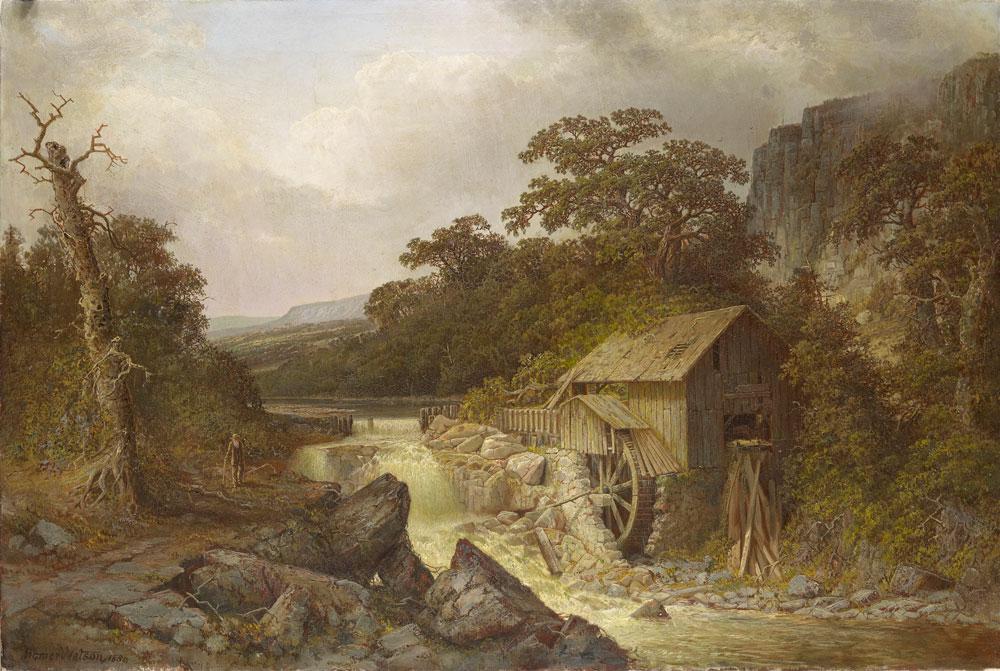
Homer Watson was born in 1855 in Doon, Ontario (now Kitchener). He started to paint as a young child encouraged by his father and his aunt. He never received any formal art training, but acquired his skill and artistic sense through various artist mentors he sought as he developed his talent.

Watson was called "the Canadian Constable," and “the man who first saw Canada as Canada, rather than as dreamy blurred pastiches of European painting.” While he holds this noble acclamation, he has nonetheless been overshadowed by the more forceful Group of Seven artists.

The AGM’s exhibition showed us Watson’s southern Canadian landscapes, amidst its farms and homesteads, as civilized and vibrant, and as separate from America. He is the first nationalist Canadian painter, earlier even than the much touted Group of Seven painters.

But the exhibitors of Beyond the Pines had a subtle agenda, which was was to place Watson in the background of Canadian art as an artist who no longer represents contemporary Canada, and reflects only the past, colonial English heritage which they believe has little relevance in current Canadian art.

The much described regions of impenetrable wilderness and inhospitable glaciers is not the Canada that most Canadians know and live in, including Homer Watson and the Group of Seven. Their Canada of the late 19th and early 20th centuries was already a nation of defined European, and mostly British, communities with houses, gardens, farmland, and forests.

And that is the other narrative the AGM curators were presenting: the pre-colonial Canada of the aboriginal tribes.

The AGM’s website tells us:
First. New. Next.

The AGM provides platforms for exhibitions, collections and experimentation in contemporary culture with a recent focus on artists and cultural producers from Indigenous, newcomer and youth communities. Through a broad range of educational programs, artist projects and other forms of critical dialogue, the AGM seeks to transcend traditional disciplinary boundaries, foster community, and provide spaces where alternative modes of thought are supported and activated in tangible ways.
The one piece by Natives ("Native" being the commonly used word for Aboriginal) artists in Beyond the Pines is a film (later transferred to video) by Brian Jungen and Duane Linklater titled Modest Livelihood, who document their hunting expedition and challenge Canadian gun laws and restrictions.

Here is Canadian Firearms Act as it pertains to Native Canadians:
Under Canada's Firearms Act, everyone who possesses or acquires a firearm must have a firearms licence, and all restricted and prohibited firearms must be registered. While the Firearms Act applies to everyone in Canada, some provisions of the Act and of the Firearms Licences Regulations have been adapted for Aboriginal people who meet all three of the following criteria:
1.They must be a member of one of the Aboriginal Peoples of Canada (Indian, Inuit and Métis) or a beneficiary under a treaty referred to in section 35 of the Constitution Act, 1982.
2. They must be a member of an Aboriginal community.
3. They must engage in the traditional hunting practices of their community.
These adaptations facilitate the licensing process for Aboriginal people under unique circumstances while maintaining all the safety requirements of the Firearms Act.
We are hard pressed to believe that Brian Jungen and Duane Linklater are indeed hunting for their livelihood, in this age when hunting has become a sport and food for nourishment is abundant. But Jungen’s and Linklater’s purpose is to show us that they have a right to this land as had their aboriginal ancestors, with which the AGM curators fully agree.

A group of eight contemporary Canadian artists were also part of this exhibition. None made any explicit references to Watson or his era, rather focussing on the exhibition's general themes of the natural and the spiritual. But it was Jennifer Carvalho and Reinhard Reitzenstein who combined these natural and spiritual worlds most skillfully in their pieces.

Carvalho’s fir are impenetrable and dense, as though mysterious and macabre forces are hiding behind them. In Unexpected Connections, her trees spiral skyward to a grey zenith, reminiscent of Emily Carr’s west coast giant pines (Carvalho studied in Vancouver’s Emily Carr University of Art and Design), but without the hopeful sky blue of Carr’s heaven-reaching trees.

Reitzenstein reduces his pine sculptures to tiny spikes atop sinewy vines. In Thrust, the vine-like pine, rather than pull us upwards as the title would suggest, drags us down into the underworld of fungi, and we are forced to contemplate the dark and amorphous fungal netherworld of a place without God, without art and without beauty.

Reitzenstein may have obtained his training and perspective from the sculptural traditions of western art, but he has neglected the often hidden but important forces of religion and God present in most of non-modern western art. He desires, and creates with, beauty without the spiritual source of his sculptural discipline.

The AGM catalogue for Beyond the Pines informs us:
Contemporary Canadian artists looking at landscape must also find a way to access the ‘truth’ of a subject that is not only strongly represented in our national artistic history, but one that is both deeply political and personal. Placing contemporary work by emerging and established artists alongside that of Watson illustrates the universality of the quest to appreciate and capture the landscape in which we live.
Beyond the Pines was an ambitious project attempting to unite several themes of Canadian art. This was partly responsible for its failure: trying to be everything to everyone, from European-influenced landscape painting, to spirit-influenced Canadian art, to Native Canadians' grievances, and with an open ended question about contemporary Canadian identity, in which, of course the non-Western immigrant, the antithesis of Homer Watson's world, looms large.

But the deliberate ideological direction the curators took produced a collection of work which was not convincing in presenting its original idea of "moving forward" from the Watson narrative to a more inclusive multicultural art. Astute observers would instead realize that there was an undeclared intention of slowly and subtly removing the legacies of Homer Watson and his artistic heritage from the fore of Canadian fine art tradition to replace it with the contemporary landscape.

We were not told what this contemporary landscape could be other than a mishmash of disparate ideas and a desire for diversity that has become a cultish, spiritual quest oblivious of its fallacies. Whose diversity are we to take on? Will the Indian artist conform to the criteria of Chinese art? Will both accept, objectively and without prejudice, the artistic superiority of Homer Watson’s paintings? Would either attend, with curiosity and interest, the exhibitions of each other’s representative artists? And perhaps to settle this confusion, in December 2016 about a year after the Watson project, the AGM undertook another ambitious mandate, and led two full-day workshops titled: Collections through the Prism of Diversity, [Day 1, and Day 2].

We were informed that through these workshops:
The AGM is engaging in a forward thinking acquisition plan reflecting the cultural diversity of the city, region, as well as the historical diversity of Canada. Public art galleries and art museums are committed to acquiring works of art from culturally diverse and Indigenous communities, however this often requires considering how their acquisition plans are aligned with their missions and mandates.
There is a carefully guarded piece of information that is missing in the public announcements by the AGM. The museum was just approved to receive $325,000 for the 2017 fiscal year by the City of Mississauga's Art and Cultural Grant Program. This is a continuation of the prior seven years of six-digit grant money, starting with $271,000 in 2011, $316,000 in 2012, and $365,000 for the years thereafter upto and including 2017. This is an investment of $2412 million over a seven year period. [Grants and funding reports by the City of Mississauga for the following years: 2011, 2012, 2013, 2014, 2015, 2016, 2017,]

The other missing information was that if indeed there are enough high calibre non-Western artists (museum worthy) living in the Mississauga region who could benefit from such large grant and sponsorship monies.

The question begs to be answered with a no. If indeed there were such artists, then neither the exorbitant public money nor the earnestly planned workshops would have been necessary.

I say “earnest” a little tongue in cheek since for these cultural reformists, western art should not be (and cannot be) the criteria with which to judge multi-ethnic cultural participants. Each community member, each ethnic identity, each hyphenated Canadian, brings unique with him unique abilities and talents. He should be judged by those equality-based criteria rather than the elitist standards of western art.

And without those standards, there would be no Art Gallery of Mississauga and no exhibitions worthy of the public’s visits. And that is the conundrum in which these art and culture leaders find themselves, and the reason why they have to demand, fascistic fashion, that there be some way to allow such art and culture to enter the doors of the gallery.

These workshops had as their primary objective to attract the multicultural, non-Western, non-white, and Native population of Mississauga, a city which, from data from the 2011 census report was 53.74% non-white (described as "visible minority" by the census report). The non-white population can only have increased by the 2016 census, which is not yet available. Yet the 2011 census visible minority report is not reflected in the museum's attendance numbers, even when "ethnic" oriented programs were scheduled. Two billion dollars is a lot of money to invest in satisfying a community's cultural biases. Minority non-white cultures are not interested in attending museums even when the exhibitions represent their ethnic and cultural identities.

The bold, unique and truthful suggestions by these government-funded exploration committees would have been to propose that art galleries continue with their exhibition of western art and culture, partly to continue with the historical role of such arts organizations as purveyors of western art, and also, more importantly, to show the excellent treasures of western art, whether archival or historical like Homer Watson, or current and waiting to be discovered artists in our contemporary society who are true disciples of Canadian artists such as Homer Watson.

Monday, May 1, 2017

The Art and Craft of Restoring Paintings


Lucius O’Brien (1832-1899)
Doon, Ontario, 1891
Watercolour on paper
Gift of Helen and Arch Brown, 1995
Permanent Collection at the MacLaren Art Centre, Barrie, Ontario

"Suppose that instead of Exhibiting Canadian art, Canadian artists should help to represent Canada by such portrayal as they can give of the picturesque aspects of her scenery & life. (…) Pictures and drawings of Canadian life and scenery would have in this connection, an interest due to the subject & would materially help to make the country known and understood."

-O’Brien’s letter, Tupper papers quoted in Reid, D., (1990). Lucius R. O’Brien Visions of Victorian Canada, p.63

Text from the MacLaren Art Center website:
When Lucius O’Brien painted Doon, Ontario, 124 years ago in 1891, he could not have anticipated the ways in which light, fluctuations of temperature and humidity, atmospheric pollutants and a backing board of unpurified woodpulp would deteriorate this intimate work over time. Nineteenth century watercolours are notoriously delicate, and this one was no different. Stained and yellowing, paint loss in key areas of the image and mounted poorly, Doon, Ontario and eight other works by O’Brien require major work from a specialist conservator to stabilize them for exhibition and to preserve them for future generations. In the summer of 2014, MacLaren curators selected Doon to be the first of O’Brien’s work for treatment. Over the course of several weeks, Jayne Woods removed the acidic backing board, dry cleaned the surface and stabilized the work for exhibition.

The conserved image of Doon, Ontario is printed on our gift cards and journals, and your purchase of this stationery directly supports our special fund for conserving and framing the remaining eight images we hold by O’Brien in our Permanent Collection. These watercolours will be exhibited in our summer 2017 exhibition of works by Lucius O’Brien, Beloved, which forms a key part of our Canada’s 150th anniversary celebrations.

Lucius O’Brien was born in 1832, in nearby Shanty Bay. A significant Canadian painter in the Victorian era, he was the founding president of the Royal Canadian Academy of Artists. Best known for his travels throughout Canada, documented in the monumental Picturesque Canada (1882-1884), O’Brien was a seminal figure in the early Canadian arts movement. A treasured regional figure, many of the works in our collection were donated either by family members or local collectors, including his grandniece Norah (Simmelhag) Wishart, Helen and Arch Brown and John D. Holden. Lucius O’Brien died in Toronto in 1899.

To view before and after photos of the conservation of Doon, Ontario, select images on the right hand side of this page (images at the MacLaren Art Center website here).

Sunday, April 16, 2017

Happy Easter


The Resurrection of Christ
Raphael
1499-1502
Oil on panel


-----------------------------------------------------------------------------------------
John 11:25-26
25 ...I am the resurrection, and the life:
he that believeth in me, though he were dead, yet shall he live:
26 And whosoever liveth and believeth in me shall never die...

[First posted on Movement for the Reclamation of Western Beauty (then simply Reclaiming Beauty)
on April 5 , 2015]

Saturday, April 15, 2017

"Who Will Wipe This Blood Off Us?"


Prophet, 1912
Emil Nolde
Woodcut


From Camera Lucida, April 19th 2011:
There is a timely discussion going on at the View From the Right (VFR). The topic on Rand and conservatism weaves through race, Athena and Zeus, Christianity, American Protestantism, the nature of individuality, heroes, the objective good, God, and ends with this comment by Lawrence Auster quoting Nietzsche's madman from The Gay Science:
The madman jumped into their midst and pierced them with his eyes. "Whither is God?" he cried; "I will tell you. We have killed him--you and I. All of us are his murderers....

"How shall we comfort ourselves, the murderers of all murderers? What was holiest and mightiest of all that the world has yet owned has bled to death under our knives: who will wipe this blood off us?... Is not the greatness of this deed too great for us? Must we ourselves not become gods simply to appear worthy of it?"
At her Camera Lucida blog, Kidist Paulos Asrat quotes that passage and adds:
Nietzsche’s ambiguous, ambivalent relationship with the God he perceives as greater than anything he can conceive of, yet deigns to have him killed to supplant him, is surely part of our Easter story.
I like that. Just as Jesus was crucified, dead, and buried, then rose into eternal life, the nihilistic modern world has (in its distorted imagination) killed and buried God. But God still lives.
The conversation at VFR continues here.

Saturday, April 1, 2017

Bust of the Christ Child


[Photo by KPA]
Antonio Rossellino
(Italian, 1427–1478)
Bust of the Christ Child, ca. 1460–70
(On wooden base over column. The halo on His head is modern.)

Marble, with nineteenth-century metal halo
With base, 18 7/8 inches x 11 inches x 15 3/8 inches
Purchased by Pierpont Morgan, 1906
More information here

Thursday, March 23, 2017

The Particularities of Heaven


Multicultural Gothic
From the Painting American Gothic
Illustration By: Kagan Mcleod After Grant Wood


I met with a group in New York which holds monthly meetings but which I can attend only periodically. Despite my low attendance record, I am on the mailing list for announcements on upcoming meetings and also for the topics to be discussed at these meetings.

I will post later on the discussion and responses. But here was one question about heaven which I found intriguing and insightful. (It wasn't so far off topic since the discussion dealt with Western civilization, and a large part of the strength of Western civilization was Christianity and belief in God which of course includes the afterlife and heaven.)

"What language is spoken in heaven? What are the flower and plants in heaven?"

Simple but profound questions, which refer to the multicultural utopia that is now being designed in Western countries, but with little success. People still group around their cultures. Even if they don't "speak" their ethnic languages, they still "think" and behave within those cultural and ethnic contexts.

One fascinating thing is as the numbers of ethnic groups increase both through immigration and birth, the younger generations start to congregate together.They all speak English fluently, and with less fluency their parents' languages. These Chinese, Korean, Indian, Somali, Ethiopian etc. youth groups create their own variations of "ethnic" English adding words from their ancestral languages, making their own distinct "language," or perhaps a better word than language is their own idiom. They also have subtle but distinct accents so astute observers can distinguish a Chinese ancestral influence from a Korean, or an Ethiopian from a Somali.

So multicultural utopia is a myth. Eventually, at a critical number, people capitulate towards their own particularities.

Sunday, February 26, 2017

Cross of the Materialists


"Pattern Migration is an exceptional opportunity to connect with our community partners through the Art Gallery ofMississauga. Together, we have created programming that will enhance our guests’ shopping experience, and introduce them to up-and-coming and internationally acclaimed artists."

-Toni Holley, Marketing Director
Oxford Properties
Group, Square One Shopping Centre

[Photo By: [KPA]
-----------------------------------------------------------------------------------------------------------------------------

While inhabitants of western society are busy out shopping, they are oblivious of the anti-Christ that is funneling its way into their lives.

I took the photo above in Mississauga's Square One Shopping Centre's Holt Renfrew department store about six months ago in the section which is referred to as the Luxury Wing.

Right in front of the store's entrance, in the corridor, the Art Gallery of Mississauga teamed up with Square One to display art as part of its satellite exhibition program. On display are a series of photo-manipulated prints from the AGM's 2016 Pattern Migration exhibition, which was going on at the AGM at the same time. The AGM exhibit was from July 14 - September 11, 2016, while the display at Square One is still going on.

The images are:
...digital photo collages [which Mazinani creates] using her own photographs and found images...her Persian Architecture series was created from photographs of the intricate tilework in mosques in Iran. The AGM has invited Mazinani to create a new artwork inspired by this exhibition in partnership with the communities of Mississauga! To do this she will photograph patterned ceramic objects provided by the community, and create a new collage from the images.
Sanaz Mazinani, carefully and intelligently, presents to us her grand Persian imagery, acculturating us to her world of Islam. The AGM curators are not wedded to Islam. They present us with a smorgasbord of religious/spiritual art, even occasionally Christian ones.

Their intention really is to show us the wonderfully diverse population that now lives in Mississauga, and to help us museum-goers appreciate their backgrounds and origins. The curators' generosity knows no bounds, except when it comes to Christian art and Canadian culture. Do they think that other cultures and religions will so readily step aside, in the same spirit of generosity?


From Sanaz Mazinani's Works on Paper collection

Related article: Islams Missionary Women
By: Kidist Paulos Asrat
Published: ChronWatch, 10/02/08


Pattern Migrations' curator Kendra Ainsworth,
who now holds the title of Curator of Contemporary Art,
photographed here with the artist Sanaz Mazinani
at the exhibition's opening reception on July 14, 2016

The work on display in the background is
Mazinani’s “Golestan Palace Tiles”
from her Persian Architecture series


--------------------------------------------------------------------------------------------------------------------------------

Pattern Migrations exhibition at the Art Gallery of Mississauga


Left wall:
Diyan Achjadi
Java Toile, 2015
Toner print on Tyvek


------------------

Floor:
Soheila Esfahani
The Immigrants, 2016
Hand-built and found porcelain


------------------

Back and right walls:


Images left to right:
Golestan Palace Tiles, Tehran, Iran (1865/2014)
Archival Pigment Print (ed. 1 of 3)
Printed in 2016

Iwan of Imamzadeh Mahruq at the tomb of Omar Khayyam
Neyshapour, Iran, 17th c./2013
Archival Pigment Print (ed. 1 of 3)

Masjed-Jame mosaic, Isfahan, Iran, 841/2016
Archival Pigment Print (ed. 1 of 3)
Printed in 2016


--------------------------------------------------------------------------------------------------------------------------------


[Photo By: [KPA]


Tuesday, January 10, 2017

Canadian Patterns

He shall have dominion also from sea unto sea, and from the river unto the ends of the earth.
- Psalm 72:8


Skater


Toronto Gables


Lake Huron


Trillium


Lake Ontario


Fir Trees: On the Road to Ottawa


Niagara Falls


Lake Ontario: Winter and Summer

-------------------------------------------------------------

All works by KPA

Saturday, December 17, 2016

I wrote in my last post A Basic Guide to Liberalism and Conservatism, Part I: From the Orthosphere:
I have made a major decision in the way I am to approach recent events. And as my last few posts show, I am getting a shower of support! Is this a sign from God :).
Well here's another one from The Federalist:

-----------------------------------------------------------------------------------------------------------------------

What Life Is Like For Artists In The Time Of Trump
By: Maureen Mullarkey
Donald Trump’s victory has affected even the artists’ listserv I belong to. A December 3 broadcast touted an ‘action plan’ to stop Trump.

“I am an artist, you know. It’s my right to tell you what to think. I’m chosen. You’re not.” That is the nutshell version of a long-standing effort to wrest art away from bourgeois aesthetic concerns and onto political ones. This tug is at work in every branch of the arts. But for economy’s sake, I will keep to the words art and artist as shorthand for the range of disciplines.

Today’s arts culture—the segment of it that appeals to museum curators, faculty hiring committees, and awards panels—mimics the intellectual fray of the 1960s, itself an imitation of contests begun in the 1910s and ‘20s. From the 1909 Futurist Manifesto, through assorted utopian declarations of the 1960s, on to the hectoring of Mike Pence by the cast of “Hamiliton,” artists have been on a steady, determined march toward ideological preachment.


“The truth of art,” wrote Herbert Marcuse, “lies in its power to break the monopoly of established reality to define what is real.” What is taken as real by graduates of university art departments are the biases that flatter the university’s view of itself as a progressive institution. Coloring that view is the old myth of the artist’s divine spark, a tradition fuelling the mystique of an avant garde.

It is a heady brew. It repudiates inherited models of aesthetic worth, dismissing hard-won mastery as technical hokum. At the same time, it seduces art majors—novel creatures, historically—to see themselves as an intellectual class commissioned to awaken audiences from acceptance of the status quo. The ultimate aim of the contemporary artist’s training is not facility, not ease with one’s métier, but the political or social message. Since there is no end to things to be anguished about, Hope ‘n’ Change can last forever.

I Thought Artists Were Against Censorship

Right now, the art-and-culture bubble is iridescent with gloom. Election Day was an alarm to mobilize combatants in the culture war to lift the yoke of our oppression. Here in my inbox is a “Dear Colleague” letter from the board of the U.S. chapter of the International Association of Art Critics (AICA), a nongovernmental organization founded in 1950 by the newly formed United Nations:
We’re getting in touch to let you know it is time to renew your membership. But first we’d like to say how deeply troubled and saddened we are by the responses of hatred that we’ve been seeing and hearing about following the results of our presidential election. One of AICA’s founding principles was a statement against censorship. As art critics and writers, we are committed to contribute to mutual understanding of visual aesthetics across cultural boundaries, and to defend impartially freedom of expression and thought and oppose arbitrary censorship. We can’t know what 2017 will be like, but with your renewed membership, AICA-USA will work to redouble our commitment to these values as we head into uncertain times.
Who is doing the hating? Perhaps the board missed Matt Welch’s column in Reason last March: “During her October 2015 testimony in front of the House Select Committee on Benghazi, she [Hillary Clinton] issued the remarkable claim that the murdered cartoonists of the French satirical newspaper Charlie Hebdo ‘sparked’ their own assassinations by drawing caricatures of Mohammed—the free expression equivalent of blaming rape victims for wearing short skirts.”

Someone forgot to tell the board of directors that their preferred candidate thought there ought to be a law, with federal penalties attached, against controversial entertainment—including movies that criticize a politician named Hillary Clinton. This same board stood proud when AICA held its annual international congress this past October at the Museo de Belle Artes in Havana, where freedom of thought and expression are non-issues.

The eminent College Art Association (CAA) encourages attendance at its 2017 Annual Conference with this: “Given the political climate in the United States right now, CAA knows it is of utmost importance to address issues at the intersections of race and contemporary art, colonialism in art history, and the Black Lives Matter movement at the 2017 Annual Conference.”

Conference highlights include a discussion on “Public Art in the Era of Black Lives Matter;” “Picturing Social Movements from Emancipation to Black Lives Matter,” a panel titled “Post-Black and Liquid Blackness” in contemporary African American art; and a talk by Evie Terrano, PhD, an art historian whose topics include challenging the authority of the Confederate flag.

Brushes Aside! We Have Politics to Do

Trump’s victory has affected even the artists’ listserv I belong to. The list began as a handy way to circulate useful information among visual artists in and around New York City. It affirms Picasso’s contention that only critics natter about form and content. When artists get together, they just want to talk about “where to buy cheap turpentine.”

Postings usually keep to methods and materials, the cookery of things. (“If your umbers are drying too quickly, try a little clove oil.”) Subscribers help each other out with the vital questions: Who has the name of a low-cost art mover? What are they paying studio models these days? Can anyone recommend a plumber?

But since Election Day, politics has been gaining ground. This is every cultural worker’s hour to repudiate formalist hocus pocus and encourage solidarity in the arts in service to the noble cause of building . . . no, not communism. Just left-leaning liberalism epitomized by the First Woman not-yet-President.

A December 3 broadcast touted an “action plan” to stop Trump. Remember, he still has not been elected. That happens in the Electoral College on December 19. There were only 16 days left.

Innocuous ornaments like the easel-picture could wait. Better to sign and distribute an Electoral College petition to make Hillary president. Initiate individual contact with specific electors. Keep this Change.org petition in the public’s consciousness by contacting TV stations, reporters, and bloggers. Organize and direct grassroots action; man phone banks; write letters. Promote protests in state capitals on December 19.

A fabric artist—whose hand-stitched work eyeballs the worldwide immigrant crisis, gun violence, health care, and marriage equality—stepped forward to offer her own efforts to the new cause:
Because of the election of Donald Trump I am planning on periodically posting information of events that are in reaction to Trump’s presidency. These events could be demonstrations, teach ins, lectures, study groups, art exhibits, calls for art, readings and performances. If you know of any events that you would like to share on this list and if you would like to receive this list please contact me at . . . .
Westbeth, an affordable housing complex for artists on the former site of Bell Laboratories, jumped into the ring to promote “Write Now: A Participatory Installation” assembled to address a world suddenly “in upheaval” by giving artists and visitors to Westbeth Gallery an opportunity to address their feelings. Participants receive Post-It notes in four different colors. They can use as many notes as needed to express their pensées. They can draw, collage, paint, write, or sculpt on them before sticking them on gallery walls.

In addition, participants are encouraged to donate to four recommended charities. The character of Westbeth’s policy preferences is clear in their selected endorsements: Planned Parenthood; the Ali Forney Center for gay and transgender teens; God’s Love We Deliver, a service for HIV/AIDS patients; Cabrini Immigrant Services, a boon companion to illegal aliens seeking social services.

You’re Fueling Trump Again, People

Dark times are upon us. Now more than ever, artists are needed to save us from the snare and the pit. An excerpt from one painter’s lengthy morning-after listserv reflection illustrates the current sense of mission:
I have a responsibility to engage in our communities. In fact, I must admit I feel artists might even bear more responsibility than the general public, as we have special gifts to offer. . . . We offer personal strengths unique to us as artists. I’ve noticed that the anti-fracking community is composed of an inordinate number of artists, and often wondered why. My sense is that because artists are well-educated, more able than most to think ‘outside the box,’ accustomed to taking chances in their art and risks in their lives, artists are among the first to recognize a societal problem, and among the first to search for solutions. . . . Artists perform every type of role imaginable, and have been critical to any of the successes we’ve had. . . .
Now it is time for each of us to act in whatever way feels right to us as individuals and as artists, but definitely to act.
Here is a pitch-perfect sample of the elitist self-regard that contributed to Trump’s victory. The writer, a painter, takes for granted his own rectitude. He also assumes his audience is equally offended by an election that went against the grain of worthier preferences. Worthiness, you see, is a natural result of intellectual superiority. It comes with those special gifts and unique strengths unavailable to lesser sorts.

It never occurs to the arts community that it has no more political insight or civic savvy than its neighbors. Like the “anti-fracking community,” the fraternity might have less. Its image of itself as occupying a privileged place in the moral universe is a distorting lens through which self-congratulation looks easily like discernment.

Your ‘Education’ Consists of Indoctrination

Stay for a moment with that term better educated. There is humor in that. Since the post-World War II era, when art training began to shift in earnest from the atelier to the campus, artists have breathed the same infantilizing culture that infects academia.

Consider the University of Delaware’s current pitch for its master of fine arts program. Second-year MFA students are invited to a 9-day frolic dubbed “Barefeet and Birthday Suits: MFA in Berlin.” Tuition is free for this “unique international experience partially funded by private charitable donations.” (Any wonder why millennials went for Bernie Sanders?)

Imagine a program for medical or law students hawked in terms more suggestive of a nudist colony than professional expertise. But then, expertise is an outmoded concept in an area of activity to which the word discipline is hard to apply. Painters, sculptors, and gifted craftsmen still exist. But they are outnumbered by contemporary artists adrift in a sea of undifferentiated “practices,” a portmanteau word for holding whatever posture an MFA drops into it.

By their Post-It notes you will know them.

-----------------------------------------------------------------------------------------------------------------------

Maureen Mullarkey is an artist who writes on art and culture. She keeps the weblog Studio Matters. Follow her on Twitter, @mmletters.

Photo Photo by Maxwell Leung for CAA
Photo William Murphy / Flickr

Tuesday, July 14, 2015

Infused With Beauty


The last time went to the Fraunces Tavern Museum website (only about a week ago), I didn't notice this new acquisition:
Fraunces Tavern Museum is proud to announce the most recent acquisition, a terra cotta bust of George Washington. This bust is a 19th century draped a l ‘antique unsigned copy of the original bust made by Jean-Antoine Houdon in 1785.
I've written about this bust here and here. And, Larry Auster, whose admiration of the bust I shared, wrote about the bust, and made a post here on my commentary on the sculpture.

I wrote in the commentary Auster/Asrat: Interaction on Beauty:
Although Larry Auster didn't directly write about beauty, his work is infused with the desire to bring beauty back into our world.

One of the most memorable posts he did on art (and beauty) was his reaction to a bust of George Washington. The image of the bust he has posted is huge and takes up the whole screen, so that we, like him, can have as close a look at it as possible. [the rest of my post is here]
So, it is a nice surprise that a museum is bringing this piece into its collections.
------------------------------------------------------------------------------------------
Posted By: Kidist P. Asrat

Thursday, June 18, 2015

George Washington: The World Historical Figure in the Quintessentially American Tradition


George Washington, 1780
Charles Willson Peale (American, 1741–1827)
Oil on canvas; 95 x 61 3/4 in.
Metropolitan Museum of Art, New York

Part of what makes his live story so gripping is that he shaped himself into the world-historical figure he became, in the quintessentially American tradition of men who spring, as F. Scott Fitzgerald famously wrote, from their own Platonic conception of themselves. But his self-conception was extraordinary: it began as a worthy ideal and evolved into a magnificent one. In his fiercely ambitious youth, he sought to win acclaim for his for his heroism and savoir faire. In his maturity, he strove to be, in his own conscience even more than in the eyes of others, virtuous, public-spirited, and (although his ethic wouldn't allow him to claim the word (noble). He did hope, however, that posterity would recognize and honor the purity of his motives; and Americans, who owe him so much, do him but justice in understanding not only what he did for them but also what greatness of soul he achieved to do it.

From: The Founding Fathers at Home (p. 94)
By: Myron Magnet
.
----------------------------------------------------------------------

Thursday, April 23, 2015

Hurried Views

I had another whirlwind of a trip to Philadelphia (and New York) last week. I finally arrived at my destination in Philadelphia after a couple of incidents. This seems to be a regular occurence on my trips. The last time involved a Greyhound bus which took me to the wrong destination (see here, where I ended up in Cleveland on my way to Steubenville Ohio). And this time it was a Canada goose.

We got stuck in Mount Cobb, Pennsylvania after a north-migrating (returning to Canada, actually) Canada goose smashed into the windshield on the driver's side. We were ceremoniously escorted to the nearest Burger King, and about three hours later, a replacement bus took us to our final destination of Port Authority.

But the trip was a wonderful respite, and I wasn't going to let a couple of incidents spoil it. I managed to pack in, with the help of my friends, quite a schedule.

We visited Larry's grave in the beautiful St. Peter and St. Paul Cemetery in Springfield Pennsylvania, to commemorate the second year of his death. The statue behind me is St. Paul's. And I am standing under the oak tree, which I write about here.


Below, I've posted the various photographs I took over these five days.

On the Road through Ontario, New York State and Pennsylvania (and New Jersey for a bit)


At Buffalo


That is a small lake in the background, I tried to find out its name, but it was too small to find on my google map.


I finally could see the New York skyline in New Jersey. It was dark, and I would reach the city's bus terminal about an hour later. I would travel to Philadelphia the next morning.

-----------------------------------------------------------------------------------------

Pennsylvania

Longwood Conservatory, in Kennett Square, Pennsylvania


Glory-of-the-snow flowers blooming in a field at Longwood Gardens


Glory-of-the-snow are "one of the first harbingers of spring," according to this site. We were just about to leave the cold (and long, this year) winter and the snow as I got to Philadelphia, and this field of flowers showed us that spring is ahead.


Star Magnolia tree in bloom


Pierre Dupont Conservatory

DuPont built his home above the conservatory, and could see the plants from his bedroom window!

-----------------------------------------------------------------------------------------

Homes near the area where I stayed, a couple of hours from Phildelphia


-----------------------------------------------------------------------------------------

New York for a day


Marble floor at the New York Public Library


Portrait of James Lenox, founder of the Lenox Library of the NYPL

I should have got just a close-up of the portrait, but here is one in black and white of I think the same one.


View from the main entrance at the New York Public Library, with 41st Street


Plaque with Yeats Poem in the Library Way, on 41st Street between 5th and Park


Atlas at the Rockefeller

The reflection in the glass in the background is of Saint Patrick's Cathedral. It seems an apt metaphor for the seizure of the pagan, Roman god of by Christians.

I was so busy trying to get the Atlas image, that I didn't even notice the reflection.

As some kind of penance - inadverantly - I went to Saint Patrick's and lit a candle.


Lions at the Rockefeller Plaza" "Arms of England"
Frieze by Lee Lawrie

The 50th entrance to the British Empire building features three walking lions looking out towards the viewer from the building. Below is a row of red Tudor roses. [From this site]


Saint Francis of Assisi with birds at the Rockefeller Plaza
Frieze by Lee Lawrie


More on Lew Lawrie here.

All the Rockefeller friezes are here.


Manhattan Building

I took this somewhere mid-town (between 47th and 59th streets) on Madison or Fifth. I should have written down the street.


Plaza Hotel entrance


Pomona Statue and fountain by the Grand Army Plaza, next to the Plaza Hotel and by Central Park

-----------------------------------------------------------------------------------------


Saint Patrick's Cathedral Stained Glass, with Mary

I asked a docent in the cathedral if he could show me any stained glass with Mary, since I didn't have much time.

I lit a candle under the stained glass as I left. The stained glass is near the door (it is the second one in at the right entry), and there are candles right underneath it.

Here is another where in my rush I neglected to take one of the full glass, and instead, I took the bottom half, where the intricate lace-like design caught my attention.


Saint Patrick's Stained Glass

Here is a photo of the full stained glass.

Several sites write that Henry Ely made the stained glass, which they title "Three Baptisms." But they don't reference that information. It is strangely hard to find information on the stained glass online, but here is something in Google Books, under the title: New York City: Vol 1, New York City Guide (page 345):
Forty-five of the seventy stained glass windows are from the studios of Nicholas Lorin at Chartres, and Henry Ely at Nantes. Rich in tone, some dark some of pastel lightness - and combined with elaborate tracery, they glow in the sunshine, but unfortunately, much of the detail in them is too delicate to be legible at a distance. They become simply patterns of red, yellow, green, blue and purple against the framework of the stone walls which, in the dusky night, takes on a tone of deepest gray.
-----------------------------------------------------------------------------------------
Posted By: Kidist P. Asrat