About.......Contact.......Society.....................
Showing posts with label Etiquette. Show all posts

Saturday, June 15, 2013

The Aesthetics of Foxhunting


John Ward Dunsmore (1856-1945)
The First Gentleman of Virginia: George Washington at the Hunt (c. 1777)
Frances Tavern Museum, New York City

Information on the painting is on page 20 of:
Images of America: Woodbrook Hunt Club
Joy Keniston-Longrie
Arcadia Publishing, 2009

-------------------------------------------------------------------------------------------------------------------------------------------------------------

Jessica Fletcher, the astute observer of human (and it seems, animal) behavior in Murder, She Wrote is on a Virginia estate solving the problem of the murdered estate owner Denton Langley in the episode It's a Dog's Life. The wealthy Langley leaves his estate to his dog Teddy, causing a lot of disappointment amongst his relatives, including the one who murdered him in the hopes of getting the spoils of his death. Teddy gets called a murderer (of his beloved master) by these greedy relatives, in order to disown him of the inheritance, and to claim it for themselves. It is up to Jessica to show that Teddy in as innocent as, well, a dog.

Here is the synopsis of the episode.

What was interesting was the foxhunt that took place during the program. Jessica usually carries out her special art of investigative activity in a charming Massachussets coastal town called Cabot's Cove. For this one, she travels to Virginia to visit a friend at Langley's estate. Foxhunting is apparently still practiced in the United States.

Jessica joins the crowd in her own charming version of a foxhunt attire:


Standard attire is:
[D]uring the formal hunt season (usually around late October to late March in the northern hemisphere)...hunt members [wear] 'colours'. This attire usually consists of the traditional red coats worn by huntsmen, masters, former masters, whippers-in (regardless of sex), other hunt staff members and male members who have been invited to wear colours as a mark of honour. Since the Hunting Act in England and Wales, only Masters and Hunt Servants tend to wear red coats or the hunt livery whilst out hunting. Gentleman subscribers tend to wear black coats, with or without hunt buttons. Ladies generally wear coloured collars on their black or navy coats. These help them stand out from the rest of the field.
Teddy, the dog is probably an American Foxhound, which was bred by George Washington, although he looks a little too small to be an American Foxhound (here are dimensions for the American Foxhound and here for the English Foxhound), since he was easily carried around by the various protagonists of the murderous show.


Teddy

Is this the face of a sleuth? Actually, it is the face of an intelligent and observant woman, with a sense of humor


Jessica Fletcher, who would rather be writing
her books than solving murders.

-------------------------------------------------------------------------------------------------------------------------------------------------------------
Posted By: Kidist P. Asrat
-------------------------------------------------------------------------------------------------------------------------------------------------------------

Wednesday, May 15, 2013

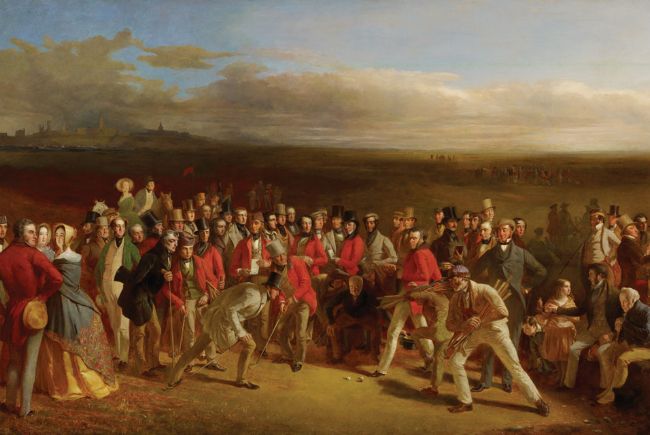
The World's Most Beautiful Golf Courses


The Golfers
By: Charles Lees (1800-1880)
Painted 1847
Oil on Canvas
National Galleries of Scotland, Edinburgh


From the National Galleries of Scotland, Edinburgh:
This large painting shows a match being played on the Old Course at the Royal and Ancient Golf Club, St Andrews. The centre of everybody's attention is a decisive moment in a match between Sir David Baird and Sir Ralph Anstruther against Major Hugh Lyon Playfair and John Campbell of Glen Saddel. Lee carefully composed this complex scene, which includes over fifty individual portraits, using photographs of some of the golfers to help him.
------------------------------------------------------------------------------------------------------------------------------------------------------------

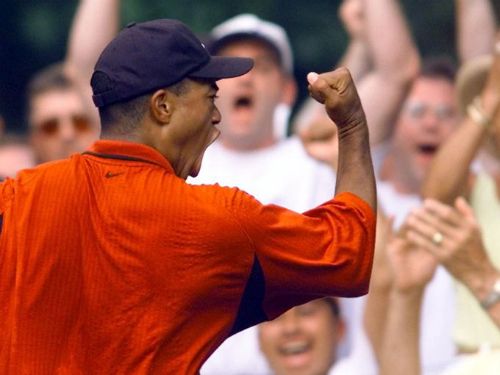
Tiger Woods was trying to make a come-back at The Players Championship at Sawgrass, Florida. While watching some of the news footage, I realized what how beautiful golf courses are. There is a refined cultivation of the elements - sea, woods, and of course hilly meadows (or lawns), which the golfers and spectators enjoy. It is still a wonder that Woods has stayed so long in the sport. He cannot enjoy it much. He is into showdowns and public scenes. This last tournament was no exception.


Tiger Woods at The Players Championship in Ponte Vedra Beach, Florida

Does Woods even enjoy the intricacies of golf? Or is it just some testosterone inducing walloping of a ball with a stick? Golf is the gentleman's game par excellence. A quiet, unperturbed demeanor is part of it [See article below: Etiquette of Golf - A Gentleman’s Game].

At the same time, golf's aesthetics go beyond the style of the game. The surrounding course is as important as the game itself. Elaborate landscapes are designed from grass, trees, water and rock, to create miles of terrain.

All sport is grueling and competitive, but it also needs an element of beauty, like the smooth and strong strokes of the racket by a tennis player, or the leap of a save of a goal keeper in soccer. Even football can be beautiful, as I wrote here (although we would be hard pressed to find that now). Golf is no less competitive, and requires as well-prepared an athlete as any. But there must be something that lifts the spirit of athletes when they participate surrounded by environments of superior aesthetic design.

Below are photos of golf courses from the Pebble Beach, California resorts:


Del Monte Golf Course


Pebble Beach Golf Course


Spyglass Hill Golf Course


Spanish Bay Golf Course

------------------------------------------------------------------------------------------------------------------------------------------------------------
Etiquette of Golf - A Gentleman’s Game
Tom Swanston
January 11, 2013
A Perfect Gentleman

Throughout its history, golf has retained a few basic tenets. Without referees, golf requires players to be self-governing. Even the top professionals govern themselves unless they need advice on a ruling, in which case they can call for a marshal or rules official.

The rules of golf are inextricably linked to the game’s etiquette. Each player must show consideration for the game, the course, and other players. Those who do not abide by these unwritten rules, often find themselves shunned and unable to find a game, with no other golfers willing to play with them. Being brandished as a cheat can tarnish a player’s reputation for his entire career.

Goldfinger, the infamous Bond villain, is the perfect example of a man who knows and understands the rules and etiquette of golf, but is willing to bend and break these in any way that will help him to win. Winning by any and all means is the antithesis of what it means to be a true golfer.

Let’s take a closer look at the infamous Bond scene, filmed at Stoke Park Golf Club (named Stoke Poges at the time of filming). Bond makes the first faux pas when he stands too close to Goldfinger as he is putting. He compounds this by asking Goldfinger a question as he is about to make the putt. Players should be given ample room to make their shot and their fellow players should remain quiet before and throughout the stroke. But Goldfinger returns the favour on the next tee, by asking Bond a question just as he reaches the top of his back swing.

When Goldfinger loses his ball in the rough he blatantly breaks the rules by placing another ball down and pretending he has found the first one.

A rule of golf is that the ball furthest from the hole should be played first. On the next green Goldfinger is due to putt (being further from the hole), but Bond politely asks if he would like him to mark or play his own ball. This is because the ball nearer the hole can be a distraction, or even directly in the way, for the player further from the hole. This is the sort of situation where the players can agree to break the rules in favour of being gentlemanly toward one another.

On the next tee, Goldfinger strides up to play his shot, but Bond’s caddy exclaims: “It’s your honour, sir!” The player who won the previous hole should play first on the next hole i.e. it is his ‘honour’. Goldfinger is playing out of turn. However, the rules state that there is no automatic penalty for playing out of turn, unless the opposing player wishes to impose one, in which case he can ask the other player to replay the shot. Bond choses not to do this. This is a classic example of how the rules and etiquette merge, and it is left to the discretion of the players to implement as they see fit.

The rules of golf, as stipulated by the Royal & Ancient Golf Society and the US Golf Association, are fairly hefty tomes, and only appointed rules officials need know them all by heart. However, one of the joys of the game is that, if you play it in a gentlemanly manner you are more than likely to abide by the rules.

Professional golfer Brian Davis gained international favour when he had the chance to win the Verizon Heritage at Hilton Head Island, South Carolina, but on the final hole he called a penalty on himself for a rules infringement that no one else saw and could only be seen by the cameras with an extreme close-up replayed in slow motion.

As top golfer Phil Mickleson so eloquently put it: “The object of golf is not just to win. It is to play like a Gentleman, and win.”
------------------------------------------------------------------------------------------------------------------------------------------------------------
Posted By: Kidist P. Asrat
------------------------------------------------------------------------------------------------------------------------------------------------------------

Wednesday, May 8, 2013

Dionysus' Fury


Vista Point Pinot Grigio, which my local
restaurant sells for $6.5/glass (half price on Tuesdays)


I describe the red California wine Vista Point Cabernet Sauvignon here, where I also discuss Dionysus, the God of Wine.

Vista Point wineries in southern California also have a white wine. Their Vista Point Pinot Grigio is: "Light, crisp & refreshing with citrus & apple notes & pleasant acidity."

When I had it, I could taste the light and crisp notes, but there was some substance to the wine. Many inexpensive whites tend to have an insipid, watery taste, or an acrid aftertaste. This is actually pretty perfect. I think it is the apple that gives it substance. It tastes like a green apple, perhaps a Granny Smith.

I took my C. S. Lewis Mere Christianity along. I will write a short report in my next post on my reading. Lewis is surprisingly original, and generously optimistic in his book.

I asked the waitress to give me the name of the wine (they just wrote it as "Vista Point White" in the menu). She brought the bottle to show me. Later, while I was busy reading and writing notes, she showed up with a bottle of red wine and another glass. "I wanted to have you taste our new red," she says.

How am I supposed to "taste" another wine while I have one already before me? This is the crassness of our current civilization. First, this waitress showed no respect for me, interrupting me while I was occupied. Second she brings another wine, mostly as a sales gimmick. Third, the level of her voice was so high, that I actually jumped when she spoke. Fourth, she is from another culture (she looks Chinese, although she speaks with a fluent English and with no accent). Her lack of understanding of wine, wine culture, and table etiquette arises from this alien culture of which she is a part. I doubt she is really interested in wine (or the food in the restaurant, for that matter), because they don't relate to her background and how she lives (and plans to live) her life in Canada. Multiculturalism, rather than bring people together, has actually pulled them apart, with each culture living in its own cocoon, and ignoring or even maligning the historical white culture.

I just waived my hand to say no, and for her to leave. I could feel the fury of Dionysus, who I felt was protecting me during this unpleasant interlude. The manager of the restaurant, a Scots/Irish (I asked him if his name was English, and he adamantly told me that it was Scots/Irish), is pleasant to me after I emailed him and the restaurant's head office about these unschooled waitresses. It's not making much of a difference. Now, I simply ask for the Caucasian waitresses, who are calmer and more attentive. I don't think that is simply a matter of training, but of culture as well.

For background on multiculturalism, see Lawrence Auster's book Path to National Suicide [pdf file].

And his 2004 article at Frontpage Magazine : How Multiculturalism Took Over America.

-------------------------------------------------------------------------------------------------------------------------------------------------------------
Posted By: Kidist P. Asrat
-------------------------------------------------------------------------------------------------------------------------------------------------------------

Wednesday, May 1, 2013

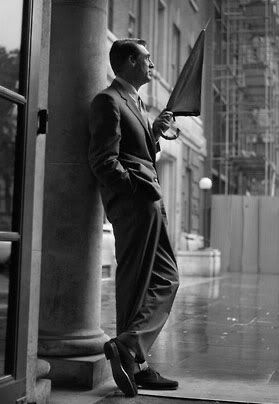
Cary Grant On Style


Cary Grant
Photo by Harry Benson
1957


Cary Grant On Style
Gentlemen's Quarterly, Winter 1967/68
[Reprinted in the April 2013 issue of GQ]
By Cary Grant

I'm often asked for advice or an opinion about clothes, and I always try to answer the best I can, but I'm not inclined to regard myself as an authority on the subject. Many times during my years in films, some well-meaning group has selected me as best-dressed man of the year, but I've never understood why. The odd distinction surprises me: first, because I don't consider myself especially well dressed, and, secondly, I've never, as far as I can compare the efforts of others with my own, gone to any special trouble to acquire clothes that could be regarded as noticeably fashionable or up-to-date.

Some of my suits are ten to twenty years old, many of them ready-made and reasonably priced. Those that were custom-tailored were made by many different tailors in many different cities: London, Hong Kong, New York and Los Angeles. I believe that American ready-made clothes are the best ready-made clothes in the world: that the well-dressed American man makes a better appearance than the well-dressed man of any other country.

No, it isn't only money that determines how well a man dresses—it's personal taste. Because of the demands of my work, I've purchased dozens of suits over the years and they all have one attribute in common: they are in the middle of fashion. By that I mean they're not self-consciously fashionable or far out, nor are they overly conservative or dated. In other words, the lapels are neither too wide nor too narrow, the trousers neither too tight nor too loose, the coats neither too short nor too long. I've worn clothes of extreme style, but only in order to dress appropriately for the type of character I played in particular films. Otherwise, simplicity, to me, has always been the essence of good taste.

I believe men's clothes—like women's—should attract attention to the best lines of a man's figure and distract from the worst. In all cases, the most reliable style is in the middle of the road—a thoughtful sensible position in any human behavior. Except perhaps on the freeway—but, even then, the middle lane, providing of course, it's on your side of the road, usually gets you where you're going more easily, comfortably, and less disturbingly. And so it should be with clothes. They should be undisturbing, easy and comfortable.

There are many established stores or haberdasheries in each city, and probably in your neighborhood. Look at the suits in the windows. See how they compare with those worn by men whose taste you respect and admire. Think about the practical, functional and long-wearing qualities as they apply to your particular job or social activities. It's better to consider carefully before buying than to regret your purchases for months afterwards. Study the cut, the price.

And here, by the way, is a tip. If the sleeves seem disproportionately wider than customary, it indicates a very deep armhole. Don't contemplate buying if you are of average or slim size—you'll get a well-fitting back but an extremely loose-fitting front and sleeves that tend to ride up if you lift your arms. A deep armhole is popular with many manufacturers because each coat fits a wider range of customers.

How much on should pay depends on how much one has to spend. I'm reminded of a piece of advice my father gave me regarding shoes: it has stood me in good stead whenever my own finances were low. He said it's better to buy one good pair of shoes than four cheap ones. One pair made of fine leather could outlast four inferior pairs, and, if well cared for, would continue to proclaim your good judgment and taste no matter how old they become. The same applies to suits, so permit me to suggest you buy the best you can afford even though it means buying less. Rather like the stock market: it is usually more sensible to buy just one share of blue chip than 150 shares of a one-dollar stock.

What should one buy? Well, if a man's budget restricts him to only one suit, then I would choose something unobtrusive. A dark blue, almost black, of lightweight cloth, serviceable for both day and evening wear. I suggest lightweight because nowadays most restaurants, offices, shops and theaters are well heated during fall and winter. I found that so even, surprisingly, in Moscow. With such modern indoor comfort, one need only be concerned with cold weather while out-of-doors.

Which brings us to overcoats. I've learned to wear overcoats that button up to the neck yet still appear neat when left open. It mystifies me that some men wear heavy single-breasted and even double-breasted, overcoats to protect themselves from cold, yet expose the most vulnerable part of their chests with V-neck openings. By wearing an overcoat that buttons to the neck, there is no need for a scarf.

The topcoat I use for traveling can be worn spring or fall. It's black and therefore not only less apt to show dirt and travel stains, but usable for both day and formal wear. It's made of a gabardine-type waterproof material, with slash side pockets that enable one to reach through easily for change, or to carry a book, or something similar, protected from the rain. There is also a detachable lining that buttons inside for very wintery days. An all-purpose coat.

What about a second suit? Well, I think a grey worsted or flannel would be most serviceable. Not too light in color, not too dark. And, this time, of medium weight but not more than what is known as ten-ounce cloth. It might be advantageous to purchase an extra pair of trousers for wearing separately with a sweater or a sport shirt. A grey flannel suit, with or without extra trousers, together with a sport coat could, at a pinch, be sufficient for a weekend in the country.

A sport coat ought to be easy-fitting, its pattern neither loud nor flashy. If you're unsure which plaid or check to choose, then one of those dark blue, single-breasted blazers that have been worn by all classes in England for years, and have since become popular here, is acceptable for most casual wear.

Except, of course, on very hot days. During summer I've taken to wearing light beige, washable poplin suits. They're inexpensive and, if kept crisp and clean, acceptable almost anywhere at any time, even in the evening. Also, the coat can be worn with grey flannels at the seashore or in the country, and the trousers used separately with a sport shirt and moccasins, or a pair of those heavy-soled white canvas shoes that are popular with young college men.

Poplin or seersucker suits are the mark of no special social class or income group, but are worn by all. And, providing he is well-mannered, a young man wearing such a suit can confidently approach the other fellow's girl, secure in knowing that his way of dress is no deterrent.

A cardigan coat sweater of lightweight wool and conservative color is a useful investment. It can be worn without a coat on many occasions, and has the advantage of being easily slipped on without those arm-raising contortions and the need to re-comb your hair.

How do I feel about ties? If I had only one to choose, then I think a black foulard, not too wide nor too narrow, is best, as it's acceptable with most clothes. An expensive tie is not a luxury—the wrinkles fall out quicker and the knot will hold better. Personally, I wear ties of small, conservative pattern and color.

Shoes? I've already mentioned that good shoes look better and last longer. If a man must limit himself to only one pair of shoes for city wear, then they should be black. If two, then a brown pair of darkest chocolate color are useful with almost all suits and, if he has no moccasins, even with grey flannels. The moccasin type of shoe is, to me, almost essential and especially convenient when traveling, since they can be easily slipped off in the airplane or car.

If your pocket handkerchief is monogrammed, don't wear it carefully folded to show the monogram peeking above your breast-pocket. That's somehow ostentatious.

Shirts should usually be white for the evening, but, in the city's grime, it's practical and permissible to wear a light blue or conservatively striped shirt during the day. The type of collar should suit the contours of the neck and face. As a younger man, I tried wearing a flared, too-high collar that, although modish amongst those I regarded as the sophisticates of that day, looked ridiculous on my 17 1/2- inch neck. Luckily, after the embarrassment of viewing myself from almost every angle on screen, that mistake was soon rectified. Button-cuffed shirts are simplest to manage, but if you wear cuff links, as I do, don't, I beg you, wear those huge examples of badly designed, cheap modern jewelry. They, too, are not only ostentatious, but heavy and a menace to the enamel on your car and your girl friend's eye.

Learn to dispense with accessories that don't perform a necessary function. I use belts, for example, only with blue jeans, which I wear when riding, and content myself with side loops, that can be tightened at the waistband, on business suits.

A tip about trousers. Trouser cuffs seem to me unnecessary, and are apt to catch lint and dust. However, whether you prefer cuffs or not, ask the tailor to sew a strip of cloth of the same material, or a tape of similar color, on the inside at the bottom of the trouser leg where it rubs the heel of the shoe. It will keep your trouser-bottoms from fraying.

Do I have any special do's and don't's about clothes? I can't think of and rules about clothes, since there really aren't any, but I suggest you buy trees to conform to the shape of your shoes, and keep your coats on curved hangers.

Take care of your clothes, keep them clean and in good repair. I suggest you avoid using heavily scented cologne or soaps. When I meet a man I like him to smell like a man, or not to smell at all; certainly he shouldn't smell like a woman. Do see that your socks stay up. Nothing can spoil an otherwise well-groomed effect like sagging socks. Don't stuff your pockets with heavy articles and bulging wallets filled with seldom-used cards. They ruin not only the neatness of your appearance but the actual tailoring of your suit.

Don't be a snob about the way you dress. Snobbery is only a point in time. Be tolerant and helpful to the other fellow—he is yourself yesterday.

Don't overbuy. When you contemplate an article, judge whether or not it harmonizes with items you already own. Again, avoid exaggeration of current fashions. It's best to be inconspicuous. But inconspicuous does not mean dull. Extreme dullness can be conspicuous in itself. Just do the best you can.

Come to think of it, who knows how anything becomes bad or good taste? Who decides a standard of esthetics? If it's the majority, then how is it the minority are the ones considered well dressed? Everything is only exactly what it is. If a man wears the kind of clothes that please him, then, providing they're clean and don't shock society, morals, and little children, what is the difference as long as that man is happy?

Any other thoughts on clothes?

Yes. Somewhere I read that Harvard's Professor Archibald MacLeish was asked by a student about to graduate into our highly competitive world what advice he could give him. Professor MacLeish's answer was, "Wear your Sunday suit every day." The inference, of course, being that the suit would give the young man such confidence in seeking positions that he would eventually own many Sunday suits, for any and all days.

Splendid advice even by itself, but it's probable that the professor meant not only his Sunday or best suit, but also his Sunday or best smile, disposition, and behavior—knowing that each begets the other. So wear, not only your clothes, but yourself, well, with confidence. Confidence, too, is in the middle of the road, being neither aggressiveness nor timidity. Pride of new knowledge—including knowledge of clothes—continually adds to self-confidence.

-------------------------------------------------------------------------------------------------------------------------------------------------------------
Posted By: Kidist P. Asrat
-------------------------------------------------------------------------------------------------------------------------------------------------------------

The Aggression Behind Scruffy Jeans

The article below is a compilation of several posts from Camera Lucida (see links below). It will probably go in the "Beauty in Masculinity" chapter of Reclaiming Beauty.

- The Sexy Escape
- The Barbarization of Contemporary Young, White Men
- The Curse of the Vera Wang Wedding Dress
- The Arrogant Aggression of Scruffy Jeans
- The Aggressive Sloth of Young, White Men
- Busy Chelsea, Married Lady
- More Thoughts on Chelsea's Wedding

------------------------------------------------------------------------------------------------------------------------------------------------------------


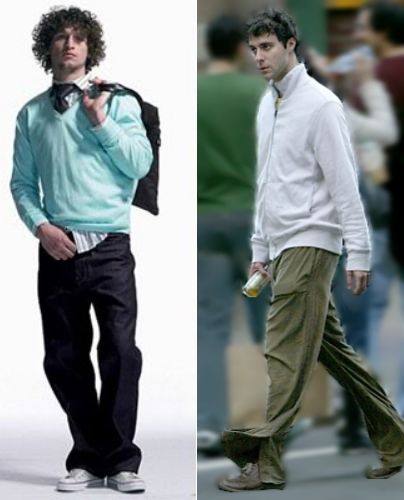
Fig. 1
Left: Model for a jeans ad
Right: Marc Mezvinsky


This must be the only civilization in the history of our planet where men define their masculinity by wearing scruffy clothes [Fig. 1]. It looks, at first, quick glance, as though men are abandoning style, but they're not.

There is a very particular look to the scruffy jeans ensemble: the un-tucked shirt; the "just so" length of the pants, which fold over sneakers and scrape the floor; those sneakers which are never dirty, but have a clean, almost brand new look; a clean sweater with the shirt hanging out from underneath; a loosely tied tie; a tote bag, or some "man" purse; some kind of twisted thread bracelet, or a copper or silver bangle, and a ring on one ear or some body piercing; disheveled, over-grown hair; and a day-old beard, although clean-shaven is also acceptable. The clothes look clean and washed, and if they have a few rips or tears, that is part of the style.

The slouch is the uniform posture from which these young men assess their surroundings, pretending to look nonthreatening, whereas they are observing closely to make the necessary moves to maintain their stakeout.

This look is not at all spontaneous and nonchalant. The men sporting this look, usually in their early to late twenties, appear to have spent some time putting it together, although with practice it probably doesn't take them too long.

I started observing their expressions and behaviors, and I began noticing a self-centered narcissism. For example, they are unlikely to cede the sidewalk to me, and expect me to walk a half a circle around them to avoid collision. Although these days, I just stop in my tracks and wait for them to make the adjustments. If they are with women, they walk very fast, oblivious to the extra fast pace the women have to maintain to keep up with them, although I think it's more that they're uncaring than not noticing.


Fig. 2
Buffalo Jeans Advertisement


Advertisements also expose the narcissism of these young men. In the jeans ad [Fig. 2], the young man looks arrogantly confident. His ensemble is baggy jeans and a long, disheveled shirt, un-tucked, and worn over some undershirt. He looks aggressive, and possessive. Who would want that kind of a guy around? But in this world of gender equality, there is still male swagger, and female demureness. In this "girl power" era of ours, young women actually seem to find this obnoxious-looking male attractive.


Fig. 3
Man in Bowler Hat


The man in the suit, bowler hat and cane [Fig. 3] is also aware of style and clothing. But he isn't using his style and his appearance as some kind of war against the world, but as a way to fit in the world, and to make it look civilized. At the same time, he is giving clear codes through this bold and well-defined attire that other men should aspire to a similar presence.

The twenty-first century young man, on the other hand, is as much concerned with aesthetics as he is with power and aggression.


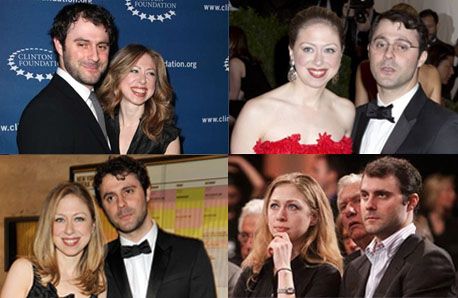
Fig. 4
Marc Mezvinsky's expression vacillates between the insipid,
characterless look that is so common in young men these days,
but seems to change into the hard glint of a narcissist without warning.


Chelsea Clinton's husband fits this appearance perfectly. Marc Mezvinsky at times looks like the insipid male that is so common these days, but then flashes without warning a hard glint of narcissistic aggression [Fig. 4]. Despite his scruffy look in Fig. 1, Mezvinsky's pants are clean and trendy cargo pants, and his sweat shirt is a spotless white. And no sneakers for him as he pushes his way forward with a growl.


Fig. 5
Chelsea and Mark: A Match Made in Hell?


Mezvinsky regularly pulls out his bow tie and white shirt in public appearances. Like all narcissists, he knows he has to win over his audience, and his wife, since extreme behavior will alienate them, and he cannot allow anything to jolt his prestigious and affluent lifestyle. He also manages to put on a subdued expression [Fig. 5]. Chelsea Clinton often has a bewildered, and intimidated look in her eyes, albeit with a glint of her own narcissistic ambitions (it has been reported that she is waiting to have her first child in order to pursue a "career"). It must be hard to keep up with her husband.

------------------------------------------------------------------------------------------------------------------------------------------------------------
Posted By: Kidist P. Asrat
------------------------------------------------------------------------------------------------------------------------------------------------------------

Monday, March 11, 2013

An Etiquette Guide by a Future President


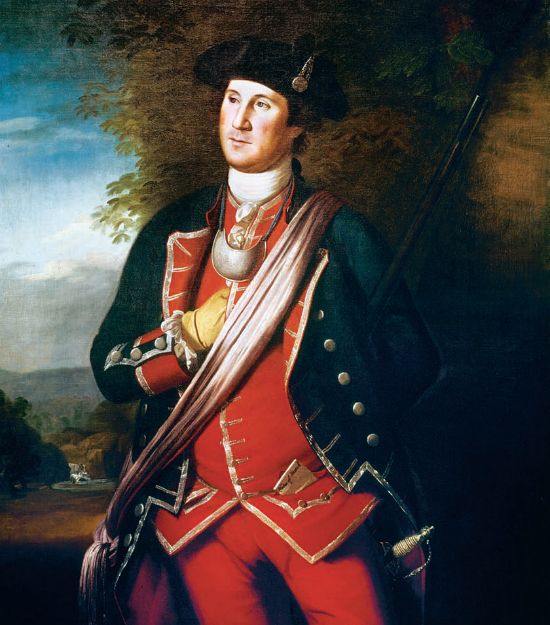
Portrait of George Washington (1732- 1799)
Date Painted: 1772
Artist: Charles Willson Peale (1741 – 1827)
Oil on canvas
The earliest authenticated portrait of George Washington shows him wearing his colonel's uniform of the Virginia Regiment from the French and Indian War. The portrait was painted about 12 years after Washington's service in that war, and several years before he would reenter military service in the American Revolution [Source].
-------------------------------------------------------------------------------------------------------------------------------------------------------------
I'm finding notes I wrote down, and haven't yet transcribed, of various items on view at the Morgan Library (here is my last post on the Morgan, which also includes a photograph I took of the ceiling).

Here is what I scribbled from the label I found below a manuscript of George Washington at the Morgan:
Washington requests "some additional aids." Letter to Elbridge Gerry, 25 Dec. 1777
With a bit of a search (I should have written better notes) I found the full, transcribed letter here, from the manuscript The Writings of George Washington from the Original Manuscript Sources, 1745-1799. John C. Fitzpatrick, Editor. (To find the letter, type in "additional aids" in your server's search/find box at the manuscript website - without quotations marks.)

Here is the letter:
Valley Forge, December 25, 1777

Dear Sir: Notwithstanding my last Letters to Congress were very explicit, and expressive of the wants of this Army, the necessity of arranging many matters in it, and making the necessary appointments without a moments loss of time, yet, when I consider the advanced Season, and consult my past experience of delay, I am induced to take the liberty of claiming your particular attention to this business; hoping thereby, that the method suggested by you, of having a Comee. of Congress, or from the board of War, sent to Camp to consult with me, or a Comee. of my appointing (for it would be impossible for me to give that close attention which the nature of the thing would require) on the best regulations, arrangements, and Plans for the next Campaign will be approved.

If this method should be adopted by Congress, I would feign hope that the powers of their Comee. might not be confined to particular matters, but generl. and extensive; Congress reservg. to themselves the right of approving or disapproving the proceedings. Our whole Military system might then be considered, and such alterations as should be found necessary and beneficial, and that circumstances would admit of, be adopted.

If this Comee. should happen to be composed of Members from the board of War, they could fix many matters at the sametime with Genl. Knox in the Ordnance department, which requires as close attention and dispatch; as any thing whatever; in short I can foresee many great advantages which would result from it, without one possible evil.

I shall be obliged to you for recollecting what I mentioned respecting some additional Aids; I find, especially at times; the multiplicity of writing, and other business too great for those I have. Congress may be assured I do not want to run the public to any unnecessary expence on this Acct. and that I shall be as sparing as possible in my appointments under the Indulgence they may give. I am, etc.

P.S. If Congress mean to adopt the half pay establishment. &c. much good would result from anouncing it soon; that all Officers who should be retaind, under the New regulations, may know at once what they have to trust to; this would, probably, begin the desired reformation in the Army whereas, under uncertainty and doubt, things at best, will jog on as usual.
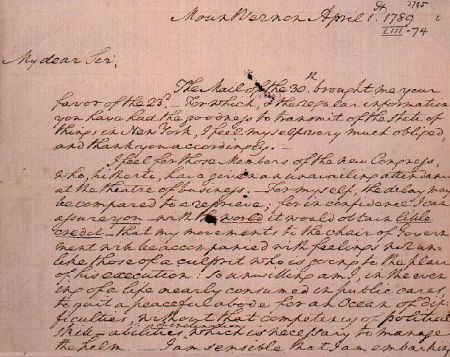
I've tried to find the image of the manuscript to show Washington's handwriting (rather than the transcribed, typed form above). I was intrigued by the manuscripts at the Morgan, which showed me the personality behind the important figures. I found Washington's writing neat and meticulous, but with a certain flair. I liked the script style. I was surprised by (and disliked) Brahms' script in his music manuscripts which I describe in my notes as "drama - also in manuscript" - as in drama in music, and drama in musical manuscript.

Here is part of a letter that Washington wrote (not the manuscript of the letter I describe above - this letter can be found here - small pdf file):


George Washington (1732–1799)
Autograph letter to Henry Knox, April 1, 1789 (detail)
Gilder Lehrman Collection, on deposit
Morgan Library


And below is Brahm's music manuscript:


Brahms, Johannes, 1833-1897
Score, p. [3] (3 of 4)
Lieder und Gesänge, op. 59
Dämmrung senkte sich von oben
Autograph manuscript, 1871?
Morgan Library


Below is a recording of the song "Dämmrung senkte sich von oben" (upto the 3:38 point in the youtube recording, another song follows it - "Mein Wundes Herz")


Dämmrung senkte sich von oben (starts at the 0:26:22 point, ends at 0:30:14)
Angelika Kirchschlager, mezzo-soprano
Graham Johnson, piano


Dämmrung senkte sich von oben

Dämmrung senkte sich von oben,
Schon ist alle Nähe fern;
Doch zuerst emporgehoben
Holden Lichts der Abendstern!
Alles schwankt ins Ungewisse,
Nebel schleichen in die Höh’,
Schwarzvertiefte Finsternisse
Widerspiegelnd ruht der See.
Nun am östlichen Bereiche
Ahn’ ich Mondenglanz und -glut,
Schlanker Weiden Haargezweige
Scherzen auf der nächsten Flut.
Durch bewegter Schatten Spiele
Zittert Lunas Zauberschein,
Und durchs Auge schleicht die Kühle
Sänftigend ins Herz hinein.
Dusk has fallen from on high

Dusk has fallen from on high,
All that was near now is distant;
But there the evening star appears
Shining with its lovely light!
All becomes an uncertain blur,
The mists creep up the sky;
Ever blacker depths of darkness
Are mirrored in the silent lake.
Now in the eastern reaches
I sense the moon’s light and glow,
The branching hair of slender willows
Frolics on the nearby water.
Through the play of moving shadows,
The moon’s magic light quivers down,
And coolness steals through the eye
Soothingly into the heart.

-------------------------------------------------------------------------------------------------------------------------------------------------------------
While searching for the manuscript I mention above, I found this document on "Rules of Civility." It was a copy that Washington made from a 16th century French etiquette manual as part of a classroom exercise at age sixteen or so of Rules of Civility (and Decent Behavior in Company and Conversation) (seen notes below). This document, and the exercise, must have influenced his adult, and presidential, years. We underestimate the importance of memorization and rote learning (there are many lines of Shakespeare I still remember after those arduous memorization tests I had to take in high school). As Washington meticulously (that is his character, after all) copied those lines on civility and decent behavior, he must have had them engraved in the back of his head, later to be useful when he was running a country, and a very new one at that. The American people are lucky in their first leader, that he was wise, humble and decisive. His education surely had a part to play in his leadership.

From his meticulous script, I would think he also found daily etiquette as an important aspect of civility, and that he had a regard for morality.

I've posted below rules 54-67 of the young George Washington's Rules of Civility (and Decent Behavior in Company and Conversation), along with an introduction on these rules.

Here is the background behind these Rules:
Washington's concern for morality can be dated back at least to a list of “Rules of Civility and Decent Behavior” that he copied into his school writing book when he was 16. Most of these 110 rules, which have been traced to a late-16th century French etiquette manual, concern manners in both speech ("Mock not nor jest at anything of importance") and deed ("When in company, put not your hands to any part of the body not usually discovered"). But several address also the habits of the mind ("Be not hasty to believe flying reports to the disparagement of any"). The last rule reads: "Labor to keep alive in your breast the little spark of celestial fire called conscience." Conscience here refers to man's innate grasp of, or ability to reason about, moral right and wrong. When the American Founders would later declare independence from Great Britain in 1776, it was by virtue of this "spark of celestial fire" that they would establish the principles of human equality, unalienable rights, and government by consent as the foundations of American constitutional government.[Source: PBS.org]
Below are the rules 34-67:
George Washington's Rules of Civility (and Decent Behaviour in Company and Conversation)
[Source: The Papers of George Washington]
No 54-67

These maxims originated in the late sixteenth century in France and were popularly circulated during Washington's time. Washington wrote out a copy of the 110 Rules in his school book when he was about sixteen-years old.

This exercise, now regarded as a formative influence in the development of his character, included guidelines for behavior in pleasant company, appropriate actions in formal situations, and general courtesies, such as: "Superfluous Complements and all Affectation of Ceremonie are to be avoided, yet where due they are not to be Neglected" (no. 25); "Think before you Speak" (no. 73); and "Rince not your Mouth in the Presence of Others" (no. 101).
-----------------------------------------------------------------------------------------------------------------------------------------

54th Play not the Peacock, looking every where about you, to See if you be well Deck't, if your Shoes fit well if your Stokings sit neatly, and Cloths handsomely.

55th Eat not in the Streets, nor in the House, out of Season.

56th Associate yourself with Men of good Quality if you Esteem your own Reputation; for 'tis better to be alone than in bad Company.

57th In walking up and Down in a House, only with One in Compan[y] if he be Greater than yourself, at the first give him the Right hand and Stop not till he does and be not the first that turns, and when you do turn let it be with your face towards him, if he be a Man of Great Quality, walk not with him Cheek by Joul but Somewhat behind him; but yet in Such a Manner that he may easily Speak to you.

58th Let your Conversation be without Malice or Envy, for 'tis a Sig[n o]f a Tractable and Commendable Nature: And in all Causes of Passion [ad]mit Reason to Govern.

59th Never express anything unbecoming, nor Act agst the Rules Mora[l] before your inferiours.

60th Be not immodest in urging your Freinds to Discover a Secret.

61st Utter not base and frivilous things amongst grave and Learn'd Men nor very Difficult Questians or Subjects, among the Ignorant or things hard to be believed, Stuff not your Discourse with Sentences amongst your Betters nor Equals.

62nd Speak not of doleful Things in a Time of Mirth or at the Table; Speak not of Melancholy Things as Death and Wounds, and if others Mention them Change if you can the Discourse tell not your Dreams, but to your intimate Friend.

63rd A Man ought not to value himself of his Atchievements, or rare Qualities of wit; much less of his riches Virtue or Kindred.
-------------------------------------------------------------------------------------------------------------------------------------------------------------
Posted By: Kidist P. Asrat