
I wrote the followng response to the comment on the article 150 Year Old Canada Experiencing Highest Levels of Immigration Ever , by Ricardo Duchesne on the website Council of European Canadians (I've also posted the article here):
-------------------------------------
Jakob Scheffer • 20 hours ago
We should not use free-standing figures, but put them in perspective. In a link you gave, it is revealed that the total net cost of non-Western immigrants in Denmark is 33 billion kroner. That is 6.6 billion CAD, or about 1,200 CAD per capita. Better is to see what this 33 billion kroner is as a percentage of Danish GDP expressed in kroner. Denmark's GDP is about 2 trillion kroner, so those 33 billion kroner are 1.65% of Danish GDP. That is not a very high percentage.
A Swedish economist said it best when he stated that immigration has not brought any net economic benefits to Sweden, but that it hasn't been an economic calamity either. The problem of course is that it will become a calamity if it continues undiminished.
Regards. JS
-------------------------------------
Kidist Paulos Asrat Jakob Scheffer • 16 minutes ago
It is people like you who make wonderful pro and con pronouncements sitting from, no doubt, a comfortable perch, who haven't the God-given human (and humane) common sense to extrapolate on the consequences. These immigrants are not stupid. They know they cannot kill the goose which lays the golden eggs. Instead they cleverly cull and accumulate what they would need when THEIR time comes.
Of course they can do this because the structures are sound and solid and whites still continue to make the big and important societal (science, art, technology, medicine, community, etc. etc.) contributions.
But go to certain locations, both in the US and in Canada, and you will see what happens, and much sooner than you think.
Immigration has been sugar-coated by elitist intellectual language for so long now that these elitist intellectuals actually BELIEVE what they say.
Have some grit and take a stand. I challenge you.
Kidist Paulos Asrat
-------------------------------------
MoxNix Kidist Paulos Asrat • 8 hours ago
"They know they cannot kill the goose which lays the golden eggs."
Could've fooled me.
-------------------------------------
Kidist Paulos Asrat MoxNix • 5 hours ago
LOL. I meant to say that the intelligent ones know that. But eventually they have to destroy (are destroying) in order to set up their worlds.
By the way, Steve Paikin of The Agenda has a fascinating program this evening on diversity and multiculturalism. It will be on his website by the end of the day. Please watch.
The language of multiculturalism has entered fully into our language. It is astonishing.
Showing posts with label Immigrants. Show all posts
Showing posts with label Immigrants. Show all posts
Thursday, June 29, 2017
150 Year Old Canada Experiencing Highest Levels of Immigration Ever
by Ricardo Duchesne

The dishonest Canadian establishment wants us to believe that the incredibly high levels of immigration we have been experiencing since the early 1990s, ranging from 225-000 to 320,000 immigrants per year, are not historically unprecedented but part of a normal pattern in our "nation of immigrants." Century Initiative says:
Historically, Canada has successfully supported very high levels of immigration. In 1913, 400,000 immigrants arrived in Canada, representing over 5.2% of the population at the time.On the surface this may seem like an honest statistic. Stats Canada is even more emphatic that "record numbers of immigrants were admitted in the early 1900s...The highest number ever recorded was in 1913, when more than 400,000 immigrants arrived."
Ethnic Composition of Immigrants Today Is Fundamentally Different
Over the 400 years before Confederation, there were only "two quite limited periods" of substantial arrivals of immigrants: from 1783 to 1812, and from 1830 to 1850. In these two periods, the immigrants were "overwhelmingly of British origin." [...] Between 1896 and 1914, Canada experienced high immigration levels with more than 3 million arriving within this period. However, the ethnic composition of the nation remained 84 percent of British and French origin, while the European component rose to 9 percent. Between 1900 and 1915, the high mark in "Asian immigration" before the 1960s, 50,000 immigrants of Japanese, East Indian and Chinese descent arrived, but this number comprised less than 2 percent of the total immigration flow. In contrast, in 1914, there were nearly 400,000 Germans in Canada, the largest ethnic group apart from the British (which includes the Irish and Scots) and French.Facing these facts, the personnel of Century Initiative, and the academic establishment which has an inherent incapacity for critical thinking, would likely reply that their point has nothing to do with race but with the numbers of immigrants, as well as how "successfully" Canada integrated these high numbers in the past.
But this is a simplistic reply. For it matters a lot that the Canada that accepted high numbers in the early 1900s was a Canada determined to maintain the Anglo-European character of the nation. Ninety percent of the immigrants who came to Canada before 1961 were from Britain. In stark contrast, the top three sources countries for immigration in the last 10 years have been China, India, and the Philippines.
It is rather lazy to extrapolate that our current majority non-Western immigrants are bound to be "successfully" integrated because the Anglo-European immigrants before 1961 were so integrated. There is abundant research showing that Europeans are more individualistic in their values, whereas non-Europeans are more collectivist. Due to complex historical reasons, Whites have a greater inclination to value the individuality and rights of each person, whereas Asians, and non-Whites generally, have a stronger inclination to think in terms of the interests of their ethnic in-group members.
Here are some links to studies corroborating the individualist values of Europeans versus the collectivist values of non-Europeans:
- Individualism vs. Collectivism in Different Cultures: A Cross-cultural Study
- Collectivist Value Orientations Among Four Ethnic Groups: Collectivism in the New Zealand Context(PDF)
- Understanding the Individualism—Collectivism Cleavage and its Effects: Lessons from Cultural Psychology (PDF)
- http://web.uri.edu/iaics/files/07-Catherine-Konsky-Mariko-Eguchi-Janet-Blue-Suraj-Kapoor.pdf (PDF)
- http://gsappweb.rutgers.edu/cstudents/readings/Summer/Summer/Kelly_Diversity/Coon%202001%20individualism%20and%20collectivism.pdf (PDF)
History is also showing that the ever more diversified nations of the West are now experiencing continuous terrorist attracts, massive welfare expenditures for immigrants, and systematic raping of White girls by members of collectivist cultures.
Historically Highest Number of Immigrants Since Early 1990s

In contrast, only for the singular years of 1907, 1908, and 1911 to 1914, that is a mere 4 years, did the number of immigrants to Canada stood above 200,000, whereas since the early 1990s, the number has remained at an average of approximately 235,000 new immigrants per year. We have everything reason to mistrust the "experts" who tell us with a smug attitude that Canada had higher levels in the early 1900s. Let them know that during the last 25 years or so we have been experiencing the highest levels of immigration.
The Century Initiative plan to bring 450,000 per year until the end of this century has no parallels whatsoever in the history of any nation since the origins of humans. It is a malicious act of deception, therefore, to justify current immigration levels by referring to the "historically" high levels of immigration of the early 1900s.
Immigration numbers today are fast destroying the ethnic and cultural identity of the founding peoples of Canada. The prediction is that by the end of this century White Canadians will constituted only 20 percent of the population inside a nation controlled by 80 percent non-Whites lusting to eliminate what they will happily identify as the "White trash" leftovers.
If you don't want your children to live in this impending dystopia, support CEC.
Research the anti-Canadian Century Initiative.
Small Town Delicacies and Canada's 150 Birthday

Canada 150th and Port Stanley's Shawarma
The Chordekars via Israel and India
CTV News had yesterday a "Canada 150 success story" (150 years of Canada's confederation) about a family that came from Tel Aviv to Port Stanley, a town on the shores of Lake Eerie. They are touted as immigrants who shunned the big city lights of Toronto and got themselves to a smaller town instead. Well they were in Toronto for several years before they made it to Port Stanley, so they are not the Third-World-Country-to-Small-Town-Canada type at all. Their move is really not much different from immigrants who slowly move their way out of congested cities to other more pleasant locations, which they once again exit to other more secluded, pleasant small towns.
Below is the television story:
So, they opened up a "shwarma" place in this pretty town. Not some fancy French restaurant, or a lively Irish pub, or a menu-rich American Diner.
No. It's just another meat-wrapped-in-a-pita place. That is, a Middle Eastern fast-food joint.
And modesty runs shallow as they talk about opening another place:
The Chordekars are working on plans to expand their business and hire locals to work at their restaurantsays the eulogizing CTV reporter.
Of course all this money comes from government subsidized new business (and immigrant business) start-up funds, which means the ordinary Canadian tax payer is invested in yet another corner shop "venture" whether he wants to or not.
They appear to be professional re-locators. They stress their Tel Aviv connection (they lived there eight years ago) but they originally came from India (Mumbai, as Bombay is now called). They give no concrete reason for why they left India or Israel. The Israeli relocation seems more for financial reasons than personal safety, as does their move to Canada. The CTV news narrator says cryptically:
Living in Tel Aviv, Mumbai before that, the family longed for a country where safety wasn't a concern. Canada promised good education and opportunity. Eight years ago they moved...They met in Israel where:
Gabriel had experience in the Hotel industry in Eilat, a resort city on the Red Sea with hotels and beaches packed with thousands of tourists from around the world, where Gabriel and Doris Chordekar met and married in Israel before emigrating to Canada.I believe that the ultimate goal for both of them has always been to get to North America (Canada, the United States, it's all the same). Like most Third World immigrants, they will have a plethora of connections on both sides of the border which they will use constantly - for travel for business an even for future re-locations.
Here is a 2017 reprt which describes their business thus:
Shebaz’s Shawarma & Falafel is owned and operated by Gabriel and Doris Chordekar. Gabriel and Doris had previously resided in the Greater Toronto Area and settled in Port Stanley in 2012. They arrived in Port Stanley armed with a master’s degree in business, training in Middle Eastern Cuisine, and a passion for customer service. It was not long before they decided to follow their dream and open a Middle Eastern themed take-out restaurant. The local community quickly embraced this venture and continues to support the business. The Elgin Business Resource Centre and the County of Elgin Economic Development team are proud to have supported these entrepreneurs through the planning and launch phases of their business. Not only have the Chordekars enhanced the culinary landscape of Port Stanley but their young family has been a great addition to the community.Well they made it.
If you listen to them talking, it is clear that they are not destitute refugees who might have genuine reasons for running across the globe. They clearly come from some kind reasonably secure segment of their native society where, among other things, they have learned to speak good English and procured an MBA between them.

William Road in Port Stanley:
From left to right:
- Shebaz Shwarma and Falafel "[has] delicious Middle Eastern flavours awaiting you, just minutes away from the main beach."
- Succs On The Beach "is all about showcasing succulents in natural and/or reclaimed vessels, put together with skill and love."
- Sushi Punk "is a hip new sushi/noodle bar & coffee house located in Port Stanley. There's a lounge for you to kick back in with a latte, bubble tea or smoothie and dig the vibes." (Sushi Punk is more an "eclectic" place run by what looks like a former punkrocker-type who is now into food, coffee and antiques). No Japanese there.
-----------------------------------------------------------------------
Sushi Punk

Emily Sheeler from Sushi Punk
From an ad for a cooking (sushi) presentation at Pepper Tree Spice Co.,this past May.
NEW! SUSHI WORKSHOPSheeler is clearly an expert. But she doesn't just stop there. Her vintage furniture bring some history into this shopping block, and "Canada 150" would do well to visit her collections.
Thurs. May. 18th , 6:00 pm - 8:00 pm, $60
We are positively thrilled to have Sushi Punk join us in Port and we want to share! Welcome Emily Sheerer from Sushi Punk to our kitchen as she leads you in this fun sushi workshop. Prepare to roll up your sleeves and learn the secret to making perfect Sushi Rice, Futomaki (Sushi rolls with multiple fillings, seaweed on the outside),
Uramaki (Inside out sushi rolls, seaweed on the outside), Nigiri (individual hand formed sushi pieces) and finally Chirashi, scattered sushi. In addition you will all be taking home your own Sushi making tool kit ($20 Value). Vegetarian & Vegan options are a cinch to create once you have the basics.
-----------------------------------------------------------------------
Succs on the Beach

Elgin County Tourism:
[Succs on the Beach]...is a magical nature filled Artisan Gift Shop, abundant with locally handmade crafts and an array of beautiful Succulent arrangements.-----------------------------------------------------------------------
Wednesday, June 28, 2017
"Stay Classy, Toronto"
This is a re-post from Steve Paikin's TVO program The Agenda from June 7, 2013.
------------------------------------------------------------------------------------------------------------

"Stay Classy, Toronto"
Steve Paikin hosting the program The Agenda
Video can be viewed here
TVO's Steve Paikin has another one of his stellar programs. The June 7 program was on the urban/inner suburbs differences. The term inner suburbs is used for low-income neighborhoods within urban areas, which are usually located in the peripheries of the urban areas, and closer to urban areas than suburban ones. The urban and inner suburb areas rarely meet, mingle or use the same services. The inner suburbs are usually populated by government-dependent, poor, often unemployed or under-employed groups. The majority of the inner suburb population is of immigrant origin. Urban communities are wealthier than the inner urban groups. They are mostly white.
This new "class" division that is occurring in Toronto, and apparently in other Canadian cities from the information in the video above, has been acerbated by the high level of immigrants that Toronto has been accepting over the last thirty years. It is clearly a class issue, but it is primarily an immigration issue, which is turning into a racial issue.
The discussion below barely touches on immigration, and if the panelists do bring it up, it is a word buried amidst a forest of others, or it is alluded to. For example, the inner urban areas such as Scarborough and North York which have the highest population of poor, social assistance-dependent groups are the areas with dense immigrant groups, from Third World countries.
Paikin tries to bring this out in the open, and asks for solutions to the problem. But each time, the panelists blame the problem on evil politicians who don't dish out enough money to improve these conditions by providing the necessary social infrastructures, or social assistance funds.
In the end, all Paikin could do was to thank the panelists. I think his problem is that partly he is a nice guy, and partly he has to toe the line to keep his job at the leftist TVO. But, at least he brought the panel together, and gave us plenty of information to think about. I would think that he would be called a "white wine-sipping elite" by these two women, and by others. He lives a few blocks away from the TVO station, in an elite neighborhood called Forest Hill. How long before he takes insult?
This will be the phenomenon of the upcoming decades. People with values, abilities, religions and cultural and social structures very different from the original Canada (which is still being maintained by the "white wine-sipping elites" as they are now being disparagingly labeled) are populating the country. The net effect will be a society more inferior than the one that existed before they arrived (how can we expect more, since the societies they left were of inferior standards, which they will be replicating here thanks to the leniency of multiculturalism?). There will be other dangerous elements to contend with, one of which is the Muslim aggression which will precipitate Jihadist/terrorist behavior, and make the country less safe for all its inhabitants.
Below is a transcript of the video from between the 25 - 36 minutes point, where the immigration issue, in conjunction with poverty (clearly referring to the poor immigrants that are populating these inner subarbs) is subtly explored.
This is not wishful thinking, or a myopic view of the situation. I think she really believes this. What could be better than to have a city full of vibrancy? Toronto, and its "white wine-sipping elites," and all those other whites, can only gain from a city full of "ethnics" with charming accents, exotic restaurants, colorful holidays, and wise and wonderful ways.
Yet, when we go to the areas most densely populated by these "ethnics" all we see are deteriorating restaurants and dull, colorless houses. So much for vibrancy. Even those areas where reasonably well-to-do (these days they are "Asians" - i.e. Chinese, Koreans and Filipinos, and the South Asians - i.e. Indians and Pakistani) immigrants reside, we find generally inferior homes, with no landscaping or maintenance of the surroundings. Dull and lusterless places.
Stinz of course, being the "white wine sipping elite," lives in the affluent Forest Hill, where she has her ward, where she also resides. There are no photos of her home, but she has posted some scenery of beautiful houses surrounded by lush greenery.
Steve Paikin was kind and generous towards her. He should have simply demolished her illogical ramblings with devastating logic. He could have set a precedent for other journalists.

Left: A home in a woody cul-de-sac in Stinz's affluent Forest Hill ward
Middle: A housing complex in Scarborough's West Hill
Right: A detached pre-fabricated house with a bare lawn in West Hill Scarborough
-----------------------------------------------------------------------------------------------------------------------------------------------------
Posted By: Kidist P. Asrat
-----------------------------------------------------------------------------------------------------------------------------------------------------
------------------------------------------------------------------------------------------------------------
"Stay Classy, Toronto"
Steve Paikin hosting the program The Agenda
Video can be viewed here
TVO's Steve Paikin has another one of his stellar programs. The June 7 program was on the urban/inner suburbs differences. The term inner suburbs is used for low-income neighborhoods within urban areas, which are usually located in the peripheries of the urban areas, and closer to urban areas than suburban ones. The urban and inner suburb areas rarely meet, mingle or use the same services. The inner suburbs are usually populated by government-dependent, poor, often unemployed or under-employed groups. The majority of the inner suburb population is of immigrant origin. Urban communities are wealthier than the inner urban groups. They are mostly white.
This new "class" division that is occurring in Toronto, and apparently in other Canadian cities from the information in the video above, has been acerbated by the high level of immigrants that Toronto has been accepting over the last thirty years. It is clearly a class issue, but it is primarily an immigration issue, which is turning into a racial issue.
The discussion below barely touches on immigration, and if the panelists do bring it up, it is a word buried amidst a forest of others, or it is alluded to. For example, the inner urban areas such as Scarborough and North York which have the highest population of poor, social assistance-dependent groups are the areas with dense immigrant groups, from Third World countries.
Paikin tries to bring this out in the open, and asks for solutions to the problem. But each time, the panelists blame the problem on evil politicians who don't dish out enough money to improve these conditions by providing the necessary social infrastructures, or social assistance funds.
In the end, all Paikin could do was to thank the panelists. I think his problem is that partly he is a nice guy, and partly he has to toe the line to keep his job at the leftist TVO. But, at least he brought the panel together, and gave us plenty of information to think about. I would think that he would be called a "white wine-sipping elite" by these two women, and by others. He lives a few blocks away from the TVO station, in an elite neighborhood called Forest Hill. How long before he takes insult?
This will be the phenomenon of the upcoming decades. People with values, abilities, religions and cultural and social structures very different from the original Canada (which is still being maintained by the "white wine-sipping elites" as they are now being disparagingly labeled) are populating the country. The net effect will be a society more inferior than the one that existed before they arrived (how can we expect more, since the societies they left were of inferior standards, which they will be replicating here thanks to the leniency of multiculturalism?). There will be other dangerous elements to contend with, one of which is the Muslim aggression which will precipitate Jihadist/terrorist behavior, and make the country less safe for all its inhabitants.
Below is a transcript of the video from between the 25 - 36 minutes point, where the immigration issue, in conjunction with poverty (clearly referring to the poor immigrants that are populating these inner subarbs) is subtly explored.
Karen StintzStintz says: "But in terms of a city that works, as to a city that works, absolutely I think that we work."
Chair, Toronto Transit Commission:
25:38 - 26:24
There's no question Toronto is growing and that's presenting challenges. But I think it's also important to recognize the reason we're growing and the rate that we are is because we are the largest city in Canada, because we have a diverse population, because Toronto is home to many people. And people who come to Toronto and chose it, I don;t think they're choosing North York, Scarborough or Etobicoke. They're choosing the city of Toronto. And when we think about the fastest growing city, I think about the fastest growing city I think we're now fourth in North America, we're hosting the Pan Am Games. We've got so many attributes that big cities can brag about, we've an arts community, the medical community, the universities that are now connected by mass transit. There's so many things we have going for us by virtue of the fact that we're such a big city, but we just have to consider ourselves that big city.
Steve Paikin
Host of The Agenda:
26:35 - 26:40
They used to call Toronto (thirty years ago] the city that works. And I don't hear people saying that as much anymore. Does the city still work given how big and clunky it is?
Stintz:
26:41 - 27:13
Yeah! Every day 1.7 million people use the TTC [Toronto Transit]. There's pressures on our system no question. But with the budget that we have, we provide a lot of services, from water to roads to sewers to snow clearing to snow plowing to leaf collection to parks and rec[reations], camps, the zoo. You know, there's the question that are we doing too much. I think that's a legitimate question. Are we doing the core things that we should be doing as well as we could be doing, I think those are legitimate question that the public has of us. But in terms of a city that works, as to a city that works, absolutely I think that we work.
Paikin:
28:10 - 28:30
But again I keep hearing this, that the values of the people who live in the Old City of Toronto the legacy city of Toronto, and the values of city of Toronto, Old Toronto, and the values of the people who live in the inner suburbs, Etobicoke, Scarborough, North York, East York, York, as they then were called, are different. And it's too hard to shoe-horn everybody into one shoe nowadays. That's what you hear.
Paikin:
30:40 - 30:45
The needs and desires of those living in Scarborough and Etobicoke are really different from those living downtown [Toronto]
Paikin:
31:30 - 31:46
What you would hear was...The people in the inner city, they get the subway because they are the white wine-sipping elites, and you folks living in Scarborough, you know, a street car is good enough for you. You're not entitled to a subway. I mean that kind of class warfare was played out on a daily basis when the city debated that, right?
Stintz:
32:50 - 33:00
There's lots of messages that resonate with people who again are not well-served by transit, who are feeling that they're paying more because they tend to be in the outer areas of the city because they're economically disadvantaged...
Paikin:
33:08 - 33:15
To the extent that those cleavages existed, do you think they are much worse now that Mayor Ford has been mayor for the last, almost, three years?
Stintz:
36:31 - 36:35
I don't think we're divided as the current administration would like us to believe.
This is not wishful thinking, or a myopic view of the situation. I think she really believes this. What could be better than to have a city full of vibrancy? Toronto, and its "white wine-sipping elites," and all those other whites, can only gain from a city full of "ethnics" with charming accents, exotic restaurants, colorful holidays, and wise and wonderful ways.
Yet, when we go to the areas most densely populated by these "ethnics" all we see are deteriorating restaurants and dull, colorless houses. So much for vibrancy. Even those areas where reasonably well-to-do (these days they are "Asians" - i.e. Chinese, Koreans and Filipinos, and the South Asians - i.e. Indians and Pakistani) immigrants reside, we find generally inferior homes, with no landscaping or maintenance of the surroundings. Dull and lusterless places.
Stinz of course, being the "white wine sipping elite," lives in the affluent Forest Hill, where she has her ward, where she also resides. There are no photos of her home, but she has posted some scenery of beautiful houses surrounded by lush greenery.
Steve Paikin was kind and generous towards her. He should have simply demolished her illogical ramblings with devastating logic. He could have set a precedent for other journalists.
Left: A home in a woody cul-de-sac in Stinz's affluent Forest Hill ward
Middle: A housing complex in Scarborough's West Hill
Right: A detached pre-fabricated house with a bare lawn in West Hill Scarborough
-----------------------------------------------------------------------------------------------------------------------------------------------------
Posted By: Kidist P. Asrat
-----------------------------------------------------------------------------------------------------------------------------------------------------
Tuesday, May 16, 2017
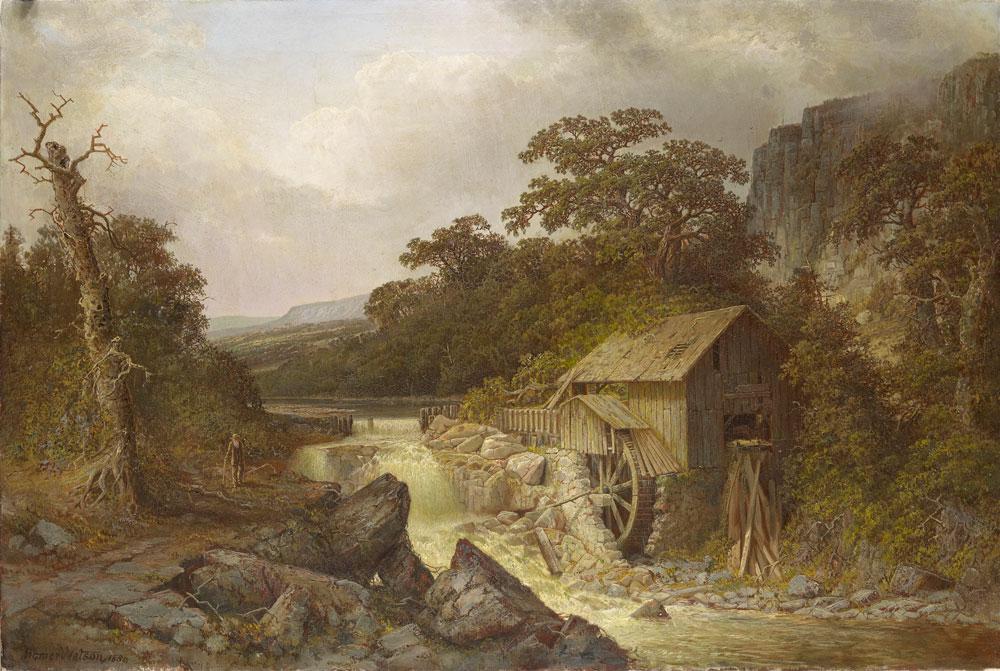
Homer Watson: Native Son

On the Grand River at Doon, c. 1880
Homer Watson, Canadian, 1855 - 1936
Oil on canvas
24 x 36 in
Purchased 1952
National Gallery of Canada (no. 5900)
Last year, I attended a panel discussion on the exhibition Beyond the Pines: Homer Watson and the Contemporary Canadian Landscape at the Art Gallery Mississauga. I had visited the exhibition numerous times, going through Watson's work one by one, to study his technique, his evolution as an artist, his views, his concerns, and his Canada.
The exhibition also displayed works by contemporary Canadian artists to bring this pine "narrative" to the fore. Some were reasonably good, but none reached the overall skill and beauty of Watson's paintings.
Watson's talent as a painter was recognized by a friend who initially advised him:
...to quit the nonsense of going in for art in a country like Canada. "Quit it and come into the office and become a businessman.”Watson continues with the story:
...on nearing home [some weeks after he had submitted the painting [The Pioneer Mill] to the Canadian Academy exhibition] I saw this gentleman on the road in front of his establishment reading the Toronto Globe. Seeing me he advanced waving the paper and putting out his hand he exclaimed, “I take it all back. Go ahead and paint. Look here,” and there it was in flaming headlines in the Globe, “Country boy paints picture bought by Princess Louise.” So that was that...Homer Watson was born in 1855 in Doon, Ontario (now Kitchener). He started to paint as a young child encouraged by his father and his aunt. He never received any formal art training, but acquired his skill and artistic sense through various artist mentors he sought as he developed his talent.
Watson was called "the Canadian Constable," and “the man who first saw Canada as Canada, rather than as dreamy blurred pastiches of European painting.” While he holds this noble acclamation, he has nonetheless been overshadowed by the more forceful Group of Seven artists.
The AGM’s exhibition showed us Watson’s southern Canadian landscapes, amidst its farms and homesteads, as civilized and vibrant, and as separate from America. He is the first nationalist Canadian painter, earlier even than the much touted Group of Seven painters.
But the exhibitors of Beyond the Pines had a subtle agenda, which was was to place Watson in the background of Canadian art as an artist who no longer represents contemporary Canada, and reflects only the past, colonial English heritage which they believe has little relevance in current Canadian art.
The much described regions of impenetrable wilderness and inhospitable glaciers is not the Canada that most Canadians know and live in, including Homer Watson and the Group of Seven. Their Canada of the late 19th and early 20th centuries was already a nation of defined European, and mostly British, communities with houses, gardens, farmland, and forests.
And that is the other narrative the AGM curators were presenting: the pre-colonial Canada of the aboriginal tribes.
The AGM’s website tells us:
First. New. Next.The one piece by Natives ("Native" being the commonly used word for Aboriginal) artists in Beyond the Pines is a film (later transferred to video) by Brian Jungen and Duane Linklater titled Modest Livelihood, who document their hunting expedition and challenge Canadian gun laws and restrictions.
The AGM provides platforms for exhibitions, collections and experimentation in contemporary culture with a recent focus on artists and cultural producers from Indigenous, newcomer and youth communities. Through a broad range of educational programs, artist projects and other forms of critical dialogue, the AGM seeks to transcend traditional disciplinary boundaries, foster community, and provide spaces where alternative modes of thought are supported and activated in tangible ways.
Here is Canadian Firearms Act as it pertains to Native Canadians:
Under Canada's Firearms Act, everyone who possesses or acquires a firearm must have a firearms licence, and all restricted and prohibited firearms must be registered. While the Firearms Act applies to everyone in Canada, some provisions of the Act and of the Firearms Licences Regulations have been adapted for Aboriginal people who meet all three of the following criteria:We are hard pressed to believe that Brian Jungen and Duane Linklater are indeed hunting for their livelihood, in this age when hunting has become a sport and food for nourishment is abundant. But Jungen’s and Linklater’s purpose is to show us that they have a right to this land as had their aboriginal ancestors, with which the AGM curators fully agree.
1.They must be a member of one of the Aboriginal Peoples of Canada (Indian, Inuit and Métis) or a beneficiary under a treaty referred to in section 35 of the Constitution Act, 1982.These adaptations facilitate the licensing process for Aboriginal people under unique circumstances while maintaining all the safety requirements of the Firearms Act.
2. They must be a member of an Aboriginal community.
3. They must engage in the traditional hunting practices of their community.
A group of eight contemporary Canadian artists were also part of this exhibition. None made any explicit references to Watson or his era, rather focussing on the exhibition's general themes of the natural and the spiritual. But it was Jennifer Carvalho and Reinhard Reitzenstein who combined these natural and spiritual worlds most skillfully in their pieces.
Carvalho’s fir are impenetrable and dense, as though mysterious and macabre forces are hiding behind them. In Unexpected Connections, her trees spiral skyward to a grey zenith, reminiscent of Emily Carr’s west coast giant pines (Carvalho studied in Vancouver’s Emily Carr University of Art and Design), but without the hopeful sky blue of Carr’s heaven-reaching trees.
Reitzenstein reduces his pine sculptures to tiny spikes atop sinewy vines. In Thrust, the vine-like pine, rather than pull us upwards as the title would suggest, drags us down into the underworld of fungi, and we are forced to contemplate the dark and amorphous fungal netherworld of a place without God, without art and without beauty.
Reitzenstein may have obtained his training and perspective from the sculptural traditions of western art, but he has neglected the often hidden but important forces of religion and God present in most of non-modern western art. He desires, and creates with, beauty without the spiritual source of his sculptural discipline.
The AGM catalogue for Beyond the Pines informs us:
Contemporary Canadian artists looking at landscape must also find a way to access the ‘truth’ of a subject that is not only strongly represented in our national artistic history, but one that is both deeply political and personal. Placing contemporary work by emerging and established artists alongside that of Watson illustrates the universality of the quest to appreciate and capture the landscape in which we live.Beyond the Pines was an ambitious project attempting to unite several themes of Canadian art. This was partly responsible for its failure: trying to be everything to everyone, from European-influenced landscape painting, to spirit-influenced Canadian art, to Native Canadians' grievances, and with an open ended question about contemporary Canadian identity, in which, of course the non-Western immigrant, the antithesis of Homer Watson's world, looms large.
But the deliberate ideological direction the curators took produced a collection of work which was not convincing in presenting its original idea of "moving forward" from the Watson narrative to a more inclusive multicultural art. Astute observers would instead realize that there was an undeclared intention of slowly and subtly removing the legacies of Homer Watson and his artistic heritage from the fore of Canadian fine art tradition to replace it with the contemporary landscape.
We were not told what this contemporary landscape could be other than a mishmash of disparate ideas and a desire for diversity that has become a cultish, spiritual quest oblivious of its fallacies. Whose diversity are we to take on? Will the Indian artist conform to the criteria of Chinese art? Will both accept, objectively and without prejudice, the artistic superiority of Homer Watson’s paintings? Would either attend, with curiosity and interest, the exhibitions of each other’s representative artists? And perhaps to settle this confusion, in December 2016 about a year after the Watson project, the AGM undertook another ambitious mandate, and led two full-day workshops titled: Collections through the Prism of Diversity, [Day 1, and Day 2].
We were informed that through these workshops:
The AGM is engaging in a forward thinking acquisition plan reflecting the cultural diversity of the city, region, as well as the historical diversity of Canada. Public art galleries and art museums are committed to acquiring works of art from culturally diverse and Indigenous communities, however this often requires considering how their acquisition plans are aligned with their missions and mandates.There is a carefully guarded piece of information that is missing in the public announcements by the AGM. The museum was just approved to receive $325,000 for the 2017 fiscal year by the City of Mississauga's Art and Cultural Grant Program. This is a continuation of the prior seven years of six-digit grant money, starting with $271,000 in 2011, $316,000 in 2012, and $365,000 for the years thereafter upto and including 2017. This is an investment of $2412 million over a seven year period. [Grants and funding reports by the City of Mississauga for the following years: 2011, 2012, 2013, 2014, 2015, 2016, 2017,]
The other missing information was that if indeed there are enough high calibre non-Western artists (museum worthy) living in the Mississauga region who could benefit from such large grant and sponsorship monies.
The question begs to be answered with a no. If indeed there were such artists, then neither the exorbitant public money nor the earnestly planned workshops would have been necessary.
I say “earnest” a little tongue in cheek since for these cultural reformists, western art should not be (and cannot be) the criteria with which to judge multi-ethnic cultural participants. Each community member, each ethnic identity, each hyphenated Canadian, brings unique with him unique abilities and talents. He should be judged by those equality-based criteria rather than the elitist standards of western art.
And without those standards, there would be no Art Gallery of Mississauga and no exhibitions worthy of the public’s visits. And that is the conundrum in which these art and culture leaders find themselves, and the reason why they have to demand, fascistic fashion, that there be some way to allow such art and culture to enter the doors of the gallery.
These workshops had as their primary objective to attract the multicultural, non-Western, non-white, and Native population of Mississauga, a city which, from data from the 2011 census report was 53.74% non-white (described as "visible minority" by the census report). The non-white population can only have increased by the 2016 census, which is not yet available. Yet the 2011 census visible minority report is not reflected in the museum's attendance numbers, even when "ethnic" oriented programs were scheduled. Two billion dollars is a lot of money to invest in satisfying a community's cultural biases. Minority non-white cultures are not interested in attending museums even when the exhibitions represent their ethnic and cultural identities.
The bold, unique and truthful suggestions by these government-funded exploration committees would have been to propose that art galleries continue with their exhibition of western art and culture, partly to continue with the historical role of such arts organizations as purveyors of western art, and also, more importantly, to show the excellent treasures of western art, whether archival or historical like Homer Watson, or current and waiting to be discovered artists in our contemporary society who are true disciples of Canadian artists such as Homer Watson.
Wednesday, May 3, 2017
Chinese House Flipping in Canada
In this post:
- Quote from Globe and Mail's September 12, 2016 article
-Vancouver real estate developer seeks to set record straight
- Real estate board is the landlord of exposed real estate speculator’s company
- In the housing market, foreign buyers are given a different set of rules

Documents shown to The Globe and Mail reveal that one-time developer Kenny Gu
buys and flips homes in deals that are financed with investor money from
China and mortgages issued to those investors by Canadian banks.
Photo: Ben Nelms for The Globe and Mail
---------------------------------------------------------------------------------------------------------------------
From a September 12, 2016 article (posted below) in the Globe and Mail,
The Globe and Mail
Vancouver real estate developer seeks to set record straight
By: Kathy Tomlinson
September 20, 2016
Business Vancouver
Real estate board is the landlord of exposed real estate speculator’s company
By: Bob Mackin
September. 12, 2016
In the housing market, foreign buyers are given a different set of rules
The Globe and Mail
By: Gary Mason
September 14, 2016
- Quote from Globe and Mail's September 12, 2016 article
-Vancouver real estate developer seeks to set record straight
- Real estate board is the landlord of exposed real estate speculator’s company
- In the housing market, foreign buyers are given a different set of rules
Documents shown to The Globe and Mail reveal that one-time developer Kenny Gu
buys and flips homes in deals that are financed with investor money from
China and mortgages issued to those investors by Canadian banks.
Photo: Ben Nelms for The Globe and Mail
---------------------------------------------------------------------------------------------------------------------
From a September 12, 2016 article (posted below) in the Globe and Mail,
Mr. Gu came to Canada in 2009 under Ottawa’s now-defunct immigrant-investor program, which gave permanent residency to applicants who agreed to lend a significant amount of money to the federal government. He started out here as a developer, but the documents show that his business evolved to buying homes – using other people’s money– and then flipping them. His deals are financed with investor money from China and mortgages issued to those investors by Canadian banks.Back to top
The papers that Mr. Lazos [a former employee of Mr. Gu] provided The Globe paint a fascinating picture, revealing a network of players – local and foreign – who are parking money in Canadian real estate. They also show how loopholes and lax oversight make it easy for the speculators to play the system – and profit tax-free – by obscuring their ownership and earnings, all the while treating the properties as commodities, not homes.
The Globe and Mail
Vancouver real estate developer seeks to set record straight
By: Kathy Tomlinson
September 20, 2016
Kenny Gu (also known as Jung Gang Ju) sat down with The Globe for an exclusive interview because he said he wanted to clear his name after allegations of possible fraud and tax evasion in connection with flips of residential properties. “I want to show you I am a good guy. I am not that kind of guy,” Mr. Gu said. “My family is here. My children are here. They will live in this country forever. For a long time. So, I don’t want them to see or to look at me as if I break the law or don’t want to pay the taxes to the country.”Back to top
Mr. Gu said he came forward after his ex-employee Demetre Lazos persuaded him it was the right thing to do. The Globe investigation was based on a large cache of documents from Mr. Gu’s operation supplied by Mr. Lazos. The paperwork showed millions of dollars have flowed through Mr. Gu’s personal and corporate bank accounts in recent years, while he claimed personal income of $45,865 on his 2015 tax return. Mr. Gu initially did not respond to The Globe’s requests for interviews. Mr. Lazos said he met with CRA officials in Vancouver on Tuesday to show them the same documentation.
Mr. Gu has now provided The Globe with more details on his finances. He said if anything reported on his taxes was incorrect, it was unintentional, because his books are handled by professionals he hires. He said he is also prepared to meet with the tax agency to set things straight.
“I am open. I don’t fight. Any time, I will meet with them,” Mr. Gu said. “Because I don’t want to do anything to break the law here or to avoid the tax, so everything I am giving to the accountant and the lawyer and they help me to do these things. Maybe they do something not so good. But from my side, I don’t know.”
According to Mr. Gu’s documents, companies that he owns designed, built or renovated 32 Vancouver-area properties since 2011. In addition, he and several clients also flipped five homes in the past two years for $4-million more than they paid as prices in Vancouver skyrocketed. Mr. Gu’s family now lives in one of those houses in West Vancouver. His wife bought it for more than $2-million, with no mortgage. The family’s vehicles include a BMW and a Mercedes.
Mr. Gu explained that lifestyle is possible even though his reported income is low partly because he and his wife brought about $3-million into Canada from China after they came to Vancouver under the immigrant investor program in 2009.
First, he said, he started a prefab construction business and lent money to it, but it failed. Mr. Gu explained that after his companies began making money in real estate in 2014, some of those profits went to his family, tax-free, to repay the loan. His documents show Mr. Gu’s wife, Min Tang, also made $1.17-million in gross profit buying and selling six more residential properties since 2010. Mr. Gu said the family lived in three of those homes, so the sales were classified tax-free under the principal residence exemption.
However, he indicated his tax bill is about to go way up.
“This year, I will have big income. Big income,” Mr. Gu said. “Which I will report to the taxes.”
Financial statements provided to The Globe by Mr. Lazos show Mr. Gu’s companies recorded deficits until early 2015. However, new CRA notices of assessment from Mr. Gu show two of his companies now owe almost $42,000 in taxes on newly reported income. Those notices are dated four days before The Globe’s initial story was published. “The documents you had are only part of the reality,” he explained.
As The Globe first reported, Mr. Gu said his real estate deals were financed with money from China, provided by investor clients. “They trust me. That is why we do business together. They invest the money. I invest my knowledge and the work. Then after we finish the project, we share the profit.”
Mr. Gu said he understands why Canadians are upset about real estate speculation driving up home prices. He said he would rather develop properties than flip them, but that he sold recently because the gains were huge and development costs and delays were prohibitive. He said he would also like prices to stabilize because his business would suffer “terribly” from a crash.
“The policies from government need to be careful,” Mr. Gu said. “I want the business to keep going – a long business. Not just the price go very high and then go down.”
---------------------------
Read the rest here
Business Vancouver
Real estate board is the landlord of exposed real estate speculator’s company
By: Bob Mackin
September. 12, 2016
Back to top
The Gukan Construction office in the complex at Spruce Street and West 8th Avenue where the Real Estate Board of Greater Vancouver is located | Photos: Bob Mackin
A real estate speculator who was alleged in a national media report to have used loopholes to avoid paying taxes is a tenant of the association for the region’s real estate agents, BIV has learned.
Provincial company records show Jun Gang “Kenny” Gu is the only director and officer of 2013-incorporated Gukan Construction Ltd. Gukan is located in the same complex at Spruce Street and West 8th Avenue in Vancouver as the headquarters of the Real Estate Board of Greater Vancouver, the trade group for more than 13,000 real estate agents.
REBGV president Dan Morrison said he had never heard of Gu before the weekend. Morrison said that Gukan had already given notice to end its tenancy by the end of September.
“We do a due diligence process where we do a credit check and make sure that they’re a legitimate company and that seemed to be the case here,” Morrison said.
The Globe and Mail reported September 10 that Gu, a former government employee from China, had come to Canada under the federal immigrant investor scheme in 2009.
A former executive who worked for Gu provided documents showing Gu sold several houses that he had never lived in, but still claimed the principal residence tax exemption. The Globe story did not mention the names of Gu’s companies.
Finance Minister Mike de Jong issued a statement on September 10 that called on Canada Revenue Agency to “diligently enforce the law.” NDP critic David Eby said de Jong and the BC Liberal government had failed to hire enough auditors to battle tax evasion and fraud in the Lower Mainland real estate industry.
“When we hear allegations that somebody might be operating outside of the law, obviously it’s very concerning to us and it ought to be investigated,” Morrison said.
Gu is also the only officer and director listed for Royal Columbia Development Corp. and was one of the nine founding directors of the Chinese Construction and Renovation Association of Canada in 2014. The CCRAC’s Chinese-only website says that Gu was elected a vice-president and is on the membership committee.
Gukan and Royal Columbia were both named as defendants in an August 19, 2015-filed B.C. Supreme Court lawsuit by Mingfei Zhao, who is purported to be a retired billionaire developer from Beijing.
Zhao bought the 1913-built, Rosemary heritage mansion at 3689 Selkirk Street in Shaughnessy for $11.01 million in 2014 and hired Gukan and RCDC to work on the exterior wood and stucco. Zhao’s statement of claim alleged the quality of work done and materials supplied “fell below” standards and were not in accordance with heritage conservation standards or civic requirements. Zhao sued Gu’s companies for breach of contract and negligence, seeking $120,500 plus GST and general and special damages.
Gukan and RCDC denied the allegations and filed a counterclaim against Zhao on September 25, 2015, seeking $39,375 in unpaid bills. The statement of defence blamed Zhao for the breach of contract when work was halted in February 2015. The mansion was assessed at $13.5 million in 2015.
None of the allegations has been proven in court, and the Court Services Online database does not show any hearing dates.



/Art_Gallery_of_Mississauga_BeyondThePines_(4).jpg)

In the housing market, foreign buyers are given a different set of rules
The Globe and Mail
By: Gary Mason
September 14, 2016
It has long been suspected that Canadian banks were playing a less-than-honorable role in the foreign investment rush taking place in the country’s real estate market. Now, questions about precisely how they have been helping fuel the obscene rise in house prices in places such as Vancouver and Toronto have been partly answered.Back to top
It would appear the Big Five banks (and likely others) have been doing this by giving foreign clients preferential treatment when it comes to qualifying for loans – a level of banking bias the likes of which Canadians have never witnessed.
A Globe and Mail investigation into Canadian real estate practices revealed on Wednesday that banks use a different set of loan requirements for foreigners than they do for those who work and pay taxes in this country. So, if you are from mainland China, for instance, and have no credit history in Canada but are looking to buy a place in Vancouver, you can likely borrow large sums of money from a Canadian bank without having to verify your income – this would include foreign students attending university here.
Related: Canadian banks’ mortgage guidelines favour foreign home buyers
According to internal documents obtained by The Globe, loans officers at Bank of Nova Scotia, for instance, have been told they do not need to verify the incomes of new immigrants if they have a loan down payment of 35 per cent. For foreigners, the no-verification threshold jumps to 50 per cent. At the Bank of Montreal, it’s 35 per cent for both; the bank also requires that foreign clients have the equivalent of 12 mortgage payments on hand at the time the loan is issued.
So much is wrong about what is taking place one hardly knows where to begin. But let’s start with the now-evident role the banks have been playing in the vicious, inflationary upward spiral in house prices. Although a federal regulator has warned all of the banks that income verification for foreign clients has been lacking, the practice continues. As long as one bank is doing it, they all will – especially if there is no punitive price to pay beyond a mild reproach. Meantime, there are ample data to underscore the role of foreign purchasers on the price surge in markets such as Metro Vancouver and Toronto.
At the same time, economists for most of the big banks have been warning about the economic perils represented by a potential housing bubble, and the corollary debt bomb it could set off. Yet they never mention the role their institutions are playing in creating these dangers.
There is also the not-so-little matter of what this lack of income verification could facilitate: money laundering. If foreign clients do not have to document and prove the source of their income, it opens the door to those looking for a haven for ill-gotten gains. Real estate is the perfect vehicle in which to invest illicit funds. And it would seem our banks are more than happy to accommodate people with this intent.
What the recent mayhem in the real estate market has confirmed is that many people take Canadians for dupes. Look at the shady practices (such as shadow flipping) that were taking place before they were uncovered by The Globe: Realtors and others using the most unscrupulous means possible to take advantage of unsuspecting buyers, right under the nose of government and regulatory bodies.
On the weekend, The Globe revealed that a network of house speculators was flipping homes for profit and dodging taxes in the process. The person who blew the whistle told The Globe he had earlier approached the Canada Revenue Agency and the police and got nowhere. This is what passes for consumer protection in this country.
But it is the banks’ role in all this that is especially infuriating. It was not the foreign clients they now seem to prefer who helped them become what they are today. It was families in big cities and small right across this country. It was parents opening accounts for their kids, who would later open ones for their own children. It was plumbers and electricians, school teachers and nurses. These are the people who helped make five, once small Canadian banks into global players.
Well, it would seem gratitude does not go as far as it once did. Today, when Canadians walk into a bank to negotiate a mortgage, they will wonder if someone in the next room is operating by a different set of rules. And if so, why?