

For better or ....
Screenshot of post at Hall of Macademia.

This massive circular temple-like monument located along Riverside Drive at 89th Street commemorates Union Army soldiers and sailors who served in the Civil War. This monument, one of the few in a city park that the New York Landmark Commission designated a landmark, was designed by architects Charles (1860–1944) and Arthur Stoughton (1867–1955), who won a competition with this ancient Greek design.
The marble monument, with its pyramidal roof and 12 Corinthian columns, is based on the Choragic Monument of Lysicrates in Athens. It was commissioned by the State of New York, and dedicated on Memorial Day in 1902. Sculptor Paul E. Duboy carved the ornamental features on the monument. The pillars list the New York volunteer regiments that served during the battle as well as Union generals and the battles in which they led troops. For years the monument was the terminus of New York City’s annual Memorial Day parade.
In 1961 the City spent more than $1 million to fix the monument’s marble façade, which had deteriorated, and portions of the monument were replaced with more durable granite. [Source: NYC Architecture]

Russia's President Vladimir Putin chairs a session of the State Council Presidium in Voronezh, August 5, 2014. Putin has ordered his government to prepare retaliatory measures against the latest round of Western sanctions, Russian news agencies reported on Tuesday.Obama's photo caption from ABC News says:
President Barack Obama gestures in the James Brady Press Briefing Room of the White House in Washington, Aug. 28, 2014. Evan Vucci/AP PhotoI think it is more than a "summer suit." Obama is saying that he is still on vacation, no matter the world's situation.
You have the whole world watching, you have a week, two weeks of anticipation of what the United States is going to do and then for him to walk out – I'm not trying to be trivial here – but in a light suit, light tan suit, saying that first he wants to talk about what most Americans care about, and he said that's the vision of the second-quarter numbers on the economy.
This is a week after Jim Foley was beheaded, and he's trying to act like, you know, real Americans care about the economy, not about ISIS and not about terrorism. And then he goes on to say that he has no strategy!
Now you know, listen, you and I know that it is easy to mis-speak [inaudible]...you can say the wrong things. What this showed was, you know, you know there's always a few issues you're not overly familiar with, and you can find yourself saying the wrong thing or saying it in the wrong way. That's the way it struck me is that this is not, that foreign policy is not a major issue to him. It's something he has to talk about, he's not crazy about it, and he'd much rather talk about some social engineering or healthcare or whatever. And he doesn't even know how to..For a guy that's so articulate, he does not know how to express himself on this issue. He's not the --thoughest radar screen, he really isn't.
It was just a terrible performance by a commander-in-chief.
Forget that our allies are watching, forget that the American people are watching. ISIS is watching.
If you were the head of ISIS, if you were [ISIS leader Abu Bakr al-] Baghdadi, or if you were any of the ISIS, anyone in the ISIS leadership, would you come away from yesterday afraid of the United States?" he asked. "Would you be afraid that the United States is going to use all its power to crush ISIS?
Or would you think, here's a person who's going to go out and do a few fundraisers over the Labor Day weekend? [More of the interview at Newsmax.com]

-------------------------------------------------------------------------------------------------------------------------------------------------------------A Chinese J-11 fighter jet is seen flying near a U.S. Navy P-8 PoseidonChinese interceptions of U.S. military planes could intensify due to submarine base
about 215 km (135 miles) east of China's Hainan Island in this U.S. Department
of Defense handout photo taken August 19, 2014."We didn't give [the Americans] enough pressure (before)," Zhang* said... "A knife at the throat is the only deterrence. From now on, we must fly even closer to U.S. surveillance aircraft."----------------------------------------
* Zhang is Rear Admiral Zhang Zhaozhong from the National Defense University in Beijing
Source, text and image: Reuters

1) Siding with Mexico against Arizona.Hawkins doesn't follow the logic of his thoughts, to continue writing that un-American activities necessitate investigation by the House of Un-American Activities, not some list in a newspaper.
2) All the bowing to foreign leaders (I wrote on this several years ago).
3) Criticizing America abroad.

The President of the United States at a public press conference with JihadistsThe second phrase, which sounds like "ze aba yem," is the Afghani language Pashto for "I am your father," which Brendahl does translate:
in the White House Rose Garden, where Brendahl's father
used many Islamic phrases including: Bismillah al Rahman al Raheem
"I am your father, Bowe."Below is the video, and Brendahl's father speaks the words above between the 4:00 and 5:00 minutes point, and he continues to speak for another twenty seconds or so.
O Lord, save the Queen;I tried very hard to be in this prayerful spirit for Obama, but I cannot.
O Lord our heavenly Father,
high and mighty, King of kings, Lord of lords, the only Ruler of princes,
who dost from thy throne behold all the dwellers upon earth;
most heartily we beseech thee with thy favour
to behold our most gracious Sovereign Lady, Queen Elizabeth;
and so replenish her with the grace of thy Holy Spirit,
that she may alway incline to thy will, and walk in thy way:
endue her plenteously with heavenly gifts;
grant her in health and wealth long to live;
strengthen her that she may vanquish and overcome all her enemies;
and finally, after this life, she may attain everlasting joy and felicity;
through Jesus Christ our Lord.
Amen.

Mr. Auster,I commented on this interaction, again at VFR, which I wrote on June 19, 2012:
I admire your fairness and generosity towards all types of people. Those who may have called you racist are using the term erroneously. Racial pride does not equal racist.
I had noticed your staunch support for Hirsi Ali, when I could see months before that she had no intention to really help the Netherlands, but was focused on her own status as female, Muslim (and I suppose black too).
Malkin seems also intent on vociferously asserting herself. I always find that such passionate self-justification (maybe to feel a part of the rest) is a symptom of insecurity and dare I say, inferiority.
Perhaps all these non-white women need to do is to have a certain humility. To agree and accept the fact that America was founded by other white nations. That a Philippino or a West African population could never have created what the British did.
And if that becomes too difficult, then stay away from public life, rather than eventually become hypocrites.
Although, one final thing that I may add. Race is war in a sense. Each one wants supremacy over the other. Rice may very well envision a land full of powerful blacks, and Malkin may lapse at times into a vision of a world of powerful browns.
Well, we certainly are headed for interesting times!
It was fun to go through your search engine to find my first emails to you. I used my initials KPA then, and I think I identified myself as being from Canada since the beginning.Larry added the article I had written for VFR, Christian Tolerence, Islamic Jihad:
From what I can find, my first email to you was on May 9, 2006. The thread was on how nonwhites, even the “conservative” ones, push for the advancement of nonwhites at the expense of whites, as well as on Hirsi Ali, Islam, Western culture, gender, and what I thought were race “wars.” Quite a post! And I declared myself your ally!
My second comment, in the entry, “The enemy is not jihad,” deals with more pressing and tangible material, namely: Islam’s incursions into Western society, from cultural strongholds to actual preparations for jihad. This was in September 2006. I am surprised that I understood (I think) the problem so well so far back, when few people were talking or writing about the reality of Islam.
It is interesting that Laura Wood, in her first email to you, was also concerned about religion (or the loss of Christianity).
It seems that spiritual and religious matters are at the forefront of the West’s problems, and the decline of religion makes it easier to dismantle the civilization.
Also see the article Kidist wrote for VFR in 2007 (when she still was ID’d as “KPA”), in which she told how the Christian kingdom of Ethiopia’s tolerance toward its Muslim minority in the 16th century enabled the Muslims to launch a jihad.








In a 2006 post at Gates Of Vienna, Baron Bodissey described the Battle of Vienna on September 11, 1683, when the Christian army under Jan Sobieski, the King of Poland, ended the Muslim siege of the city.A commentator at her site writes:
It is good to be reminded of what should have been Christendom’s conclusive triumph over Islam, in the persons of the Ottoman besiegers of Vienna in 1683I think we are at a more difficult juncture than ever before. The Christian spirituality of the world, and especially the Western world, has diminished. Are we ever going to get those armies which march forward with the cross at their helm?
[...]
So while we should lament that, through our moral weakness, Vienna was not the last word in the struggle between Islam and the West, we can draw hope from its example that the West can endure if we can only summon the will to prevail.
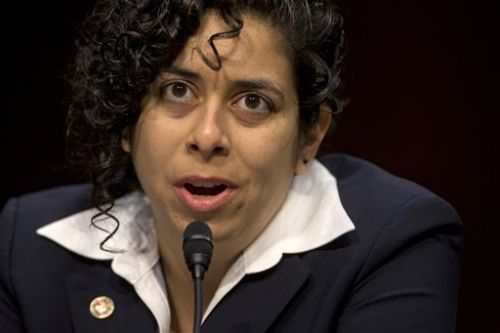
...unsung individuals making distinctive contributions to the rights, autonomy and dignity of others...Bhagwati's special qualities that earned her the Petra Fellowship include being ignored or by-passed for her accomplishments. As the Petra Foundation, which finally and generously recognized her, informs us:
Often at risk and without the safety net of personal privilege or institutional support, Petra Fellows fight poverty, discrimination, environmental degradation and violence. They work in prisons and police departments, factories and migrant worker camps, health clinics, housing projects, family farms and public schools—wherever people lack the resources, connections or clout to participate fully in American society. [Source: The Petra Foundation]
When Anu Bhagwati finished her first three-mile fitness run at Quantico ahead of all of the women and most of the men in her platoon, her drill instructor accused her of skipping a lap. When she stood up in a basic training class of 300 to inquire when submarines would be gender-integrated, she was loudly booed. And when she could no longer stop or stomach the sexual harassment being directed at female NCOs by her second-in-command, her formal complaint was not only disregarded but the offending lieutenant was promoted to command a gender-integrated unit. [Source: Petra Foundation]
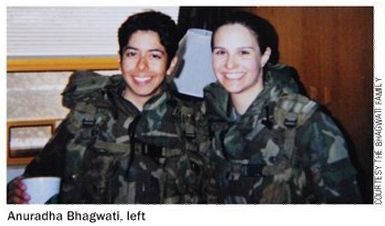
Under Anu’s leadership, SWAN has spearheaded legislative reform and litigation to end military rape, sexual assault, sexual harassment, and domestic violence, and to eliminate all barriers to equal opportunity for service women. [Source: SWAN Executive Staff]Bhagwati says about her time in the Marines:
I served for five years, with many gay and lesbian Marines, both enlisted and officer.Baghwati has an interesting background. Her parents are academics, with professorships at Harvard and Columbia and at least two books between them. Her father, Jagdish Bhagwati, speaks highly of his daughter:
My best friend in the Marines was an incredible officer. She was also a lesbian. Because of this, she wasn’t allowed to live a normal life. While I could walk down the street holding the hand of my male partner, she could not do the same with her loved one, for fear of being outed.
Despite the enormous strain of living under the Don’t Ask Don’t Tell policy, my friend volunteered to serve for a year in Iraq, knowing that because she was lesbian, she wouldn’t be able to easily correspond with her partner back home. A couple of years after returning home from Iraq, she was discharged under the Don’t Ask Don’t Tell policy.
What happened to my friend was unfair, wrong and un-American.
Unfortunately, my friend’s story is all too common, especially as it concerns women in the military. While women make up only 15% of the entire armed forces, they make up almost 50% of last year’s Army and Air Force discharges under Don’t Ask Don’t Tell.
Race is another relevant factor in these discharges. African-American women are discharged under Don’t Ask Don’t Tell at three times the rate that they serve in the armed forces.
These statistics are not evidence that the military is upholding unit cohesion, good order and discipline, or any of the other convenient catch-phrases used by proponents of this archaic and useless policy. These statistics are, at the least, shocking, and at the worst, shameful.
Numbers like this originate from an ugly context, which we must discuss. Sexual harassment of women in uniform is pervasive. Lesbian-baiting is simply another insidious manifestation of sexual harassment. Many servicewomen risk two equally devastating prospects, as far as their professional careers are concerned: resist a serviceman’s advances and be labeled lesbian, or don’t resist, and get labeled promiscuous. Being labeled a lesbian, even by rumor, can prompt an investigation that ends in discharge. [Source: Service Women.org]
"...we are proud of her accomplishments, - particularly since they are based on social engagement that characterized our own parents almost 100 years ago, and are the jewel in the crown of the State of Gujarat from which we come, as did Mahatma Gandhi - but because it shows that none of what Anu has accomplished would have happened if she had not joined the Marines in the first place." [Source: The American Interest]
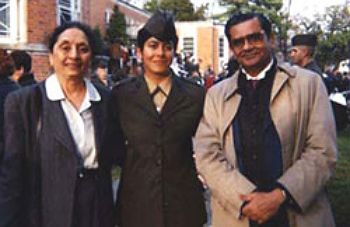
"She is consumed by Human Rights work," Professor Bhagwati has said about Anuradha. When his 70th birthday was being celebrated, she could not make it to the event because of her political commitment in Palestine.One can also see where Bhagwati acquired her narcissism. Her parents give lavish praise and attention to their only daughter. Yet, as is characteristic of narcissists, one gets the feeling that Bhagwati resented their standards which she could never achieve, and her stint in the Marines was a way escape this family's high expectations. Even her post-Marine efforts with graduate work in Harvard and working on a novel, all seem to emulate these pleasant but demanding parents.
"She's our joy," her father said at his birthday celebration, the New York Sun reported in its account of the event. "And while I miss her tonight, I am delighted that it is in a good cause. After all, that is what counts."
I had a very unique childhood. I mean, it was all about my parents. Obsessively so about the pressure of like getting into the top schools. And then I went to the top schools, and I was miserable. I just wanted to travel the world, go to war-torn areas and meet people and learn languages, and find out how people lived...I left grad school like mid-semester, and joined the marines [she completed a Masters in Public Policy after her discharge from the Marines].Her parents seem to vacillate between leftist Third World positions and a capitalist Western lifestyle, which is often the behavior of committed, elitist ideologues: they want all the amenities of the West, but will promote ideologies that could destroy it (with them sheltered in safe havens). This can't have been a very stable environment for Bhagwati to grow up in.
...as an external advisor to the Director General of the World Trade Organization in 2001, as a special policy advisor on globalization to the United Nations in 2000, and as an economics policy advisor to the Director-General of the General Agreement on Tariffs and Trade from 1991 to 1993. From 1968 until 1980, Bhagwati was an economics professor at the Massachusetts Institute of Technology. Bhagwati currently serves on the Academic Advisory Board of Human Rights Watch (Asia) and on the board of scholars of the Centre for Civil Society. He is a Senior Fellow of the Council on Foreign Relations. [Source: Web India]Her mother, Padma Desai, is linked with similar leftist ideological bodies. She served as:
...US Treasury’s Advisor to the Russian Finance Ministry (1995), [and] she is regarded as a leading scholar today on the Soviet Union and Russia. [Source: Celebrating Padma Desai, Columbia University]There is a strange moment in Desai's life where she:
...won a scholarship to the US [from India] and never went back [to her first husband]. In the end, faced with his refusal to grant her a divorce, she converted to Christianity, because under the Indian law, religious incompatibility is a ground for divorce. The suggestion had actually come from him and she converted. She describes in moving detail how the forlorn ceremony took place on a rainy day in a small village in Gujarat. [Source: Random Truths and Common Threads, in The Hindu Business Line].It is one thing to have leftist parents, another to have a first marriage in her mother's history, but how about her mother's conversion to another religion to facilitate her personal life?
more importantly in order for Desai to make a clean break from her bad first marriage. [Source: Time Out India]More on her mother's divorce, and her second marriage:
[T]he incredible legal entrapment of the Hindu Marriage Act of 1955...drove Desai to a phoney religious conversion - the only permissible grounds for a judicial separation, if her husband agreed. He did - after years of denying her a divorce - then recanted. Her Christian conversion was in vain. Eventually, in 1968, she followed Bhagwati to Boston, won a position at Harvard, and freed herself via a Mexican divorce before she could remarry...Eventually, she finds [a] life (and an exciting career) in America, with the ever charming and lovable Bhagwati, first at Harvard and then at Columbia. [Source: The Hindu]Their daughter, Anuradha Bhagwati, was born in New York in 1976 (I calculated her birth date from this article, written in 2008, and which cites her age then as thirty-two). I find it important to know how soon after her parents immigrated to the US Bhagwati was born. She's had the typical, complicated life of a child of Third World of immigrants who arrived in the US after:
...the 1965 Immigration Act which opened U.S. immigration on an equal basis to every country in the world, rather than, as in the past, favoring our historic source nations of Europe. Of course many of the recent immigrants from non-European countries have fitted into America and made good contributions here. It is the unprecedented scale of this diverse immigration that is the problem. [Source: View From the Right"]When Bhagwati's parents came to the US in the mid-sixties, multiculturalism was just becoming an accepted way of cultural life. By the time Bhagwati was born, it was a part of American life. I wouldn't be surprised if growing up, her life was full of reminders of the country her parents left behind, from the food, to the music, and the friends and relatives who frequented their home. So although she grew up in America, hers was a specific, ethnically restricted, America. I think this speaks of her behavior at the hearings, her victim stance, her repeated blame on racism for her discharge, and her particular singling out of white men leaders in the military as those who prevent non-whites (and of course women) from advancing in the military.
And when I see the usually white men who are providing the, I don't want to say, the state version, it's really how it seems at times [laughs while she says this], the state version of events and the state version of how you should operate in Iraq or how you should fix the military or improve and take care or support our troops, which is the biggest slogan of them all, you know, it feels very odd for me to have the same status, you know this veteran status. It feels very awkward. Because I wonder if they are having any intimate conversations with anyone about anything. I mean there are things that happen to every soldier's soul in that institution, regardless of where he or she comes from originally, political baggage, all of that. There's something that happens to their soul, and I'm not sure that enough of them examine what it is that happens. It's a very fragile thing, dealing with force and violence. You don't even have to physically hurt somebody, and you could have, you may have committed an act of violence upon them in what you bring to the table. And the society I don't think understand the ramifications of this, the violence. There is an indoctrination in any army that comes with the training. And any time that the nation perceives itself to be at risk of annihilation, well you know, or invasion, to use a smaller term, the existential issue of Israel, for instance, where you have so much more national ideology at play, and the basic indoctrination of the soldier, all politics aside, I mean that is how literally how Israelis are trained, so you think you're defending your individual family, you know, and societal existence, whether or not that's true. And you'll believe it, and you'll fight and kill, you know, to the end. You know, in a case like India I would imagine that was true at least on a partial scale, because of historic conflicts with neighbors to the north, right. But I don't know, I've talked to members of the military from South Asia, of various nations, there's something slightly more intellectual about their approach to, but I'm sure not everybody, but the few that I've talked to, about their role in the world. The thing that makes an American soldier stand out is his country's role in the world that bleeds into his ideology about where he thinks, who he thinks he is. Completely inflated sense of self. And it's unfortunate, right, because it prevents him from actually reaching out to people from other countries and cultures. It's a shame, in fact, it's a shame. Because it prevents him from being human, right. And so, yeah. I'm not saying, you known, that this is the American condition, and it couldn't ever happen. I think any hegemonic empire that this is the result, right. It's our turn, in the United States. [Source: Kran Film Collective]This is someone who reached the rank of Captain in the American military. This is the type of soldier who is out in the fields, representing American soldiers. It is not an issue of women in the military anymore, it is an issue of Third World minded, anti-American, anti-military soldiers who are becoming a real detriment to America.

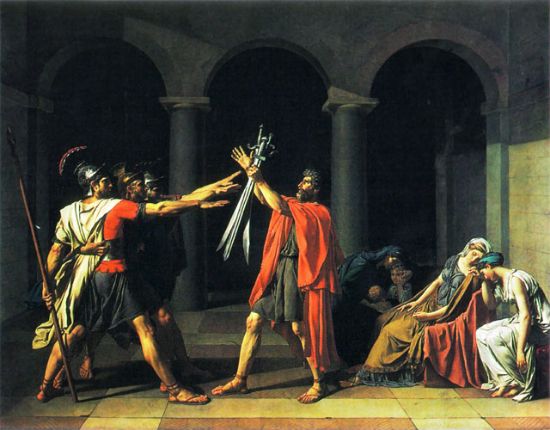
Perhaps the most surprising thing is that the Kubrick film isn't complete fiction, but offers some historical truth. The truth is that Spartacus really was a slave and a gladiator in Capua, Italy, and he really did lead a revolt. As the movie shows, it started in the kitchen of the gladiatorial barracks with the men using basic kitchen utensils to fight the guards and break out. And it's even true that Spartacus had a ladylove as he did in the movie. But there are some real differences as well. The movie Spartacus was born a slave and was the son and grandson of slaves, but the real Spartacus was born free. He came from Thrace, roughly equivalent with today's Bulgaria. And far from being a lifelong opponent of Rome, he started out as an allied soldier in the Roman army. He fought for Rome. His fate, ending up as a slave and gladiator, was quite unexpected and quite unjust. The Romans themselves admitted that Spartacus was forced to become a gladiator even though he was innocent. (The historian is Barry Strauss, and here is his link at Cornell University)The other was My Life in Ruins, a silly film with Nia Vardalos (who was in the mildly funny and somewhat successful film My Big Fat Greek Wedding). My Life in Ruins is about a Greek-American academic (Vardalos - highly unlikely as an NYU professor) who goes to Greece as a tour guide (much more likely) to share her erudition with annoying tourists.
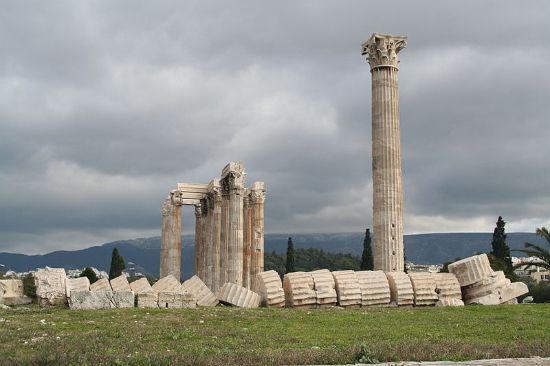
The Temple of Zeus was burnt by order of [the Byzantine Emperor] Theodosius II in AD 426. Badly damaged by the fire, it was finally thrown down by the earthquakes of AD 551 and 552. Excavations at the temple began by the French in 1829, and were completed by the German School. Parts of the sculptural decoration have been restored and are now on display in the Olympia Archaeological Museum, while the metopes removed by the French expedition of 1829 are in the Louvre. Conservation and cleaning of the monument are currently in progress. [Source]And more information below:
Since the 1870s, the excavation and preservation of Ancient Olympia has been the responsibility of the German Archaeological Institute at Athens. The first major excavation of Olympia began in 1875, funded by the German government. [Archaeologists] excavated the central part of the sanctuary including the Temple of Zeus, Temple of Hera, Metroon, Bouleuterion, Philipeion, Echo Stoa, Treasuries and Palaestra. Important finds included sculptures from the Temple of Zeus, the Nike of Paeonius, the Hermes of Praxiteles and many bronzes. In total 14,000 objects were recorded. The finds were displayed in a museum on the site.
Excavation was continued in a more limited way...between 1908 and 1929 but a new systematic excavation was begun in 1936 on the occasion of the 1936 Summer Olympics in Berlin under... [The] excavation focus was on the area to the south of the stadium, the South stoa, bath complex and gymnasion.
Between 1952 and 1966, [archaeologists] excavated Pheidias' workshop, the Leonidaion and the north wall of the stadium. They also excavated the southeast section of the sanctuary and out of approximately 140 debris pits found many bronze and ceramic objects along with terracotta roof tiles.
[E]xcavations between 1972 and 1984 reveal[ed] important dating evidence for the stadium, graves, and the location of the Prytaneion. From 1984 to 1996...the focus shifted to the earlier history of the sanctuary with excavation of the Prytaneion and Pelopion.[Source: 1000 years of the Olympic Games: Treasures of Ancient Greece - pdf file]
