I've posted on a film of a book that I recently re-read titled: Starting Out in the Evening.
Here's what I wrote:
Starting out in the Evening is a quiet, graceful film about Leonard Schiller, a New York writer who is working on what could be his final book, and Heather, a young, aggressive graduate student who disrupts his life to do research for her master's thesis on him. Leonard is initially taken in by this bold young woman, and reluctantly agrees to her regular visits to interview him. He admires her persistent and intelligent personality. But he refuses to answer personal questions, saying that explaining his books and the ideas behind them is sufficient.
Starting Out in the Evening is a book about the importance of writing, and the importance of conveying ideas through writing. Schiller, the protagonist, is a writer who tries to distance the personality of the author as far away from the content of the writing as possible. He is not writing a confessional book, nor really a book about personal perceptions. His quest is a quiet and determined one to bring literature to the forefront of writing.
Here is a paragraph from the book:
The thought crossed his mind that if greatness had eluded him as a writer, perhaps this was why: because he'd never wanted to make a scene. Subtlety and indirection are important tools, but you can't scale the highest peaks with these tools alone. [P. 174]
Writing is like a weapon. It critiques, and often criticizes, the culture it is in. It is not a "stream of consciousness" of the artist's confessions, and who really cares about the author's "personal stories" unless you're a one-in-a-million writer like Dickens or Shakespeare? Even when available, the personal stories of writers tell us very little about the literary aspects of the book. Just because we know that Hemingway liked to watch bull fights doesn't give us any further insight into Hemingway's fascination in brute force. He could have equally watched contemporary football games and written similar books on "sports and force."
Schiller is right. Subtlety and indirection can help some parts of writing, but at the end of the day, the writer has to bite the bullet and write the real story. He has to find other tools to scale the highest peaks. I think you can do that with truth. And often truth is difficult to write, and difficult to accept. And it can lead to serious repercussions, from loss of a career to loss of life, for the writer. ------------------------------------------------------------------------------------------------------------------------------------------------------------- Posted By: Kidist P. Asrat -------------------------------------------------------------------------------------------------------------------------------------------------------------
I came across David Bentley Hart’s The Beauty of the Infinite: The Aesthetics of Christian Truth (via Thomas F. Bertonneau's post "What are you reading" at the Orthosphere, where he linked to The University Bookman, a book review site in which he participates).
I went searching for the book in various bookstores. From what I understand, it is out of print, or out of stock. In any case, it is available on Amazon.com ($26 for a used book, from the original price of $40!).
I searched for online versions, and there is an almost complete Google Books version. There is a page missing every few pages, but until I get a hold of a hard copy, I will suffer through that.
This will be a great book to review as I work on my own modest contribution to beauty. One of the sections in my book Reclaiming Beauty is titled: Beauty in the Worship of God. I'm approaching this from the "human" angle, that one of the ways we worship God is through our creation of beauty, of which art plays a large part. But there is also the beauty in the perfect, or perfectible, logic of science. And beauty in the elegance in even the clumsiest of sports (wrestling or even boxing). The true worship of God includes our creation of beauty, as well as our appreciation, recognition and inclusion of beauty.
But Bentley's book has given me a different perspective, although I would have reached it at some point in my research and writing.
From Part 2 of the table of contents of The Beauty of the Infinite: The Aesthetics of Christian Truth (see the list of contents below), Bentley introduces us to the concept of beauty that comes from God, who is a God who would rather win us over through beauty, with "shared regard, delight, fellowship, feasting, and joy." I will venture to say that God created the world to fill it with beauty, to share this world with us, and to bring us closer to Him. We should delight in beauty, as He does, if only to show our appreciation as the chosen partakers of beauty.
I quote Pope Benedict XVI in my chapter Seek and Ye Shall Find (which I've reproduced here as one of a few select chapters to introduce my ideas):
Beauty, whether that of the natural universe or that expressed in art, precisely because it opens up and broadens the horizons of human awareness, pointing us beyond ourselves, bringing us face to face with the abyss of Infinity, can become a path towards the transcendent, towards the ultimate Mystery, towards God. [Meeting with Artists. Address of His Holiness Benedict XVI. Sistine Chapel. November 29, 2009. ]
1. The Christian understanding of beauty emerges not only naturally, but necessarily, from the Christian understanding of God as a perichoresis of love, a dynamic coinherence of the three divine persons, whose life is eternally one of shared regard, delight, fellowship, feasting, and joy i. Divine Apatheia ii. Divine Fellowship iii. Divine Joy
2. The Christian understanding of difference and distance is shaped by the doctrine of the Trinity, where theology finds that the true form of difference is peace, of distance beauty i. Divine Difference ii. Divine Perfection
3. In the Christian God, the infinite is seen to be beautiful and so capable of being traversed by way of the beautiful i. Desire's Flight ii. Changeless Beauty iii. The Mirror of the Infinite iv. Infinite Peace
4. The infinite is beautiful because God is Trinity; and because all being belongs to God's infinity, a Christian ontology appears and properly belongs within a theological aesthetics i. God and Being ii. God beyond Being iii. Analogia Entis
II. Creation
1. God's gracious action in creation belongs from the first to that delight, pleasure, and regard that the Trinity enjoys from eternity, as an outward and unnecessary expression of that love; and thus creation must be received before all else as gift and as beauty i Analogia Delectationis ii. The Gift iii. Desire's Power
2. As God is Trinity, in whom all difference is possessed as perfect peace and unity, the divine life might be described as infinite music, and creation too might be described as a music whose intervals, transitions, and phrases are embraced within God's eternal, triune polyphony i. The Divine Theme p. 275 ii. Divine Counterpoint p. 282
3. As God utters himself eternally in his Word, and possesses all the fullness of address and response, and as creation belongs to God's utterance of himself (as a further articulation, at an analogical remove, of the abundant "eloquence" of divine love), creation may be grasped by theology as language i. Divine Expression ii. Divine Rhetoric iii. Analogia Verbi
III. Salvation
1. Salvation occurs by way of recapitulation, the restoration of the human image in Christ, the eternal image of the Father after whom humanity was created in the beginning; thus salvation consists in the recovery of a concrete form, and in the restoration of an original beauty i. The Form of Distance ii. Christ the Sign iii. "What Is Truth?" iv. The Practice of the Form
2. In Christ, totality's economy of violence is overcome by the infinity of God's peace, inasmuch as one order of sacrifice is overcome by another: sacrifice as the immolation of the beautiful is displaced by a sacrifice whose offering is one of infinite beauty i. The Economy of Violence ii. A Gift Exceeding Every Debt iii. The Consolations of Tragedy, the Terrors of Easter
IV. Eschaton
Christian eschatology affirms the goodness of created difference, reveals divine truth to be inseparable from beauty, and exposes the totality as false and marked with a damnable finitude i. Time's Surface, Eternity's Light ii. The Last Adam
Persuasion, the Tyranny of Twilight, and the Language of Peace
I. The War of Persuasions II. The Violence of Hermeneutics III. The Optics of the Market IV. The Gift of Martyrs ------------------------------------------------------------------------------------------------------------------------------------------------------------- Posted By: Kidist P. Asrat -------------------------------------------------------------------------------------------------------------------------------------------------------------
Robert Spencer interview by The Arena's Michael Coren on May 2, 2013
Robert Spencer is a regular guest on Michael Coren's The Arena. He was on last night to discuss his new book, the Boston bombings and other Islam-related news.
But, I've said before that it is not enough to go on this disorganized, arms-outstretched mode of dealing with Islam in the West. And sure enough, during the interview, Spencer defends "dialogue" between Christians and Muslims, although he does makes some kind of disclaimer that Muslims are not interested in dialogue, but in subjugation of non-Muslims.
Michael Coren gives him a lead with:
Those people who say well all religions produce extremism. It's not the religion, it's the people who misinterpret it. You make in an extremely informed way the argument that no I'm sorry, I'm sorry, these religions are very, very different.
Spencer replies:
And people who engage in dialogue - that's what this book is about - between Christians and Muslims should be informed. I'm not saying that there should be no dialogue, but they should be aware of the contempt in which Christianity is portrayed in the Koran, and how that then informs their dialogue [I couldn't decipher this last word].
As I wrote about Pamela Geller, and her confusions and contradictions, Spencer, who would like nothing else than a "dialogue" with Muslims realizes that they have a deep-seated contempt for him, nonetheless revels in the same kind of wishful thinking as Geller, and would actually venture out to meet these people who have this deep contempt for him as mandated by their holy book.
What kind of lunatic is that!
I found the list of chapters in Spencer's new book (at this source - pdf file).
They are:
1. Time for an `Ecumenical Jihad'?
2. Three Great Abrahamic Faiths?
3. The same God?
4. The Same Jesus?
5. Are We All Muslims Now?
6. A Common Desire for Justice?
7. A Shared Sexual Ethic?
8. An Honest Desire for Dialogue?
Epilogue
Appendix
The (first) striking think about these chapters is that every single one of them ends with a question mark. Which of course leads to the second (more important) striking thing where Spencer looks like he's trying to join these two religions, despite his agreement with Michael Coren that the two religions are "very, very different"
One senses that he really wants "a shared ethic" and that Christians and Muslims worship the same God, and that we are all Muslims (as in we are all black, or all poor, or all women, which is a way of raising up who one perceives to be a "victim" and equalizing him.
In his confused way, he must realize that it is Christians like him who have "an honest desire for dialogue" and not the hard-headed, Koran-mandated Muslims. But, there is no harm in wishful thinking, or is there?
Of course there is. It is a recipe for dhimmitude at its best, and annihilation at its worst.
The prominent spokesmen against Islamic incursions into the West these days are Pamela Geller and Robert Spencer. Other spokesmen like Sam Solomon, Bat Ye'or, are keeping a low profile. I think their silence is their realization that more books, and more conferences, and more speeches in a synagogues are not going to going to improve anything. At least I hope that is what their silence means, and that it is coupled with founding a new strategy.
How many more books can we read, and how many more dramatic presentations can we participate in, before the Islamic message becomes clear?
We know enough already, and if not, as I've said, there is a myriad of available information that we can tap into. I think it is time to retreat, to consolidate this information, to form concrete, organized and effective measures to fight against Islam's incursions.
This Amazon.com reviewer has read and reviewed the book. I don't know who William Garrison Jr. is, but his notes make for an interesting read.
Chapter 1. Time for an `Ecumenical Jihad'?
Mr. Spencer counters the 1996 book "Ecumenical Jihad", in which its author Peter Kreeft heralded: "The age of religious wars is ending". Mr. Spencer notes that today's on-going lethal Islamic jihad attacks against Christians from Nigeria eastward to Pakistan. Mr. Spencer claims "this religious bigotry, hatred, and violence are legitimized by holy writ: The Qur'an and other Islamic texts and teachings" (p. 19) - he proceeds to cite chapter [sura] and verse [aya]. And exemplifies how hundreds of thousands of Christians have and are fleeing Islamist-dominated Middle Eastern countries. Mr. Spencer quotes the Muslim sources commanding death for those apostates [murtadd] who convert to Christianity. Subtopics: `A tradition of persecution', `The silence of human rights groups', & `Saladin: myth versus reality'.
Chapter 2. Three Great Abrahamic Faiths?
Mr. Spencer explains that while the Bible identifies the "10 Commandments" that were revealed to Moses [Musa], none is stated in the Qur'an. Pertaining to the Jewish Exodus, the Qur'an informs us that Sabbath-breaking Jews were transformed into "Jew-apes" [gird] - a concept that does not appear in the Bible (p. 43). The author details the differences between how the Bible reveals the "original sin" of Adam & Eve, whereas the Qur'an rejects this concept. Mr. Spencer states how Muslims believe that the original Islam-oriented Bible was "corrupted" by Jews & Christians to lead people away from `the Straight Path' [al-sirat ul-mustaqim] of Islam.
Chapter 3. The same God?
Herein Mr. Spencer questions why the Second Vatican Council concluded that the Judeo-Christian "God" is the same as the Muslim "Allah" (p. 54). He reviews why Muslims do not believe that Jesus was the son of God, why they deny the Trinity, and why "Allah is not a `Father'". He notes that Pope Benedict XIV, in 1754 "reaffirmed an earlier prohibition of Albanian Catholics giving their `Turkish or Mohammedan names' in baptism" (p. 57). Mr. Spencer proceeds to explain how Muslims view Allah, and discusses some Islamic views regarding `free will' versus Allah's powers (pp. 69-76).
Chapter 4. The Same Jesus?
We read that Muslims respect Jesus [Isa] because he is mentioned as a prophet in the Qur'an. Mr. Spencer reviews the issue "then why aren't Muslims Christians?" and how Gnostics may have influenced Muhammed to proclaim that Jesus was not actually crucified (p. 87). Mr. Spencer details various inconsistencies that he perceives are within the Qur'an. More importantly, the author explains how Muslims perceive that at the "End of Days" [qiyama] the true Islam-oriented Jesus [Isa] will return to save mankind from Christianity by destroying it! (p. 100).
Chapter 5. Are We All Muslims Now?
Mr. Spencer argues that "Islam treats Christianity as a perversion of the original teaching of Jesus.... This robs Christianity of any legitimate manifestation; to Islam, all Christians are essentially apostate Muslims" (p. 103). Pertaining to the prophet Abraham [Ibrahim], the Qur'an stipulates: "Abraham in truth was not a Jew, neither a Christian; but he was a Muslim..." (Q3:67), in fact, the Quran rules that all of the prophets [nabiyyun] mentioned in the Bible were all Muslims.
Chapter 6. A Common Desire for Justice?
In this chapter Mr. Spencer disputes Westerners who "think the Islamic world has something to teach today's decadent West. Yet although it is obvious that Christians should learn `the absoluteness of the moral laws and of the demand to be just and charitable,' it is far less clear that Muslims have these laws to teach, or believe them themselves" (p. 116). The author lists numerous examples of whereby the Muslim Prophet Muhammed (al- insane al-kamil) himself engaged in either various violent military campaigns or personal crimes against those who disbelieved him.
Chapter 7. A Shared Sexual Ethic?
While finding some commonality regarding sexual ethics between Christians and Muslims, Mr. Spencer opined: "... and there are other apparent moral similarities between the two religions, [but] the Muslim understanding of marriage and sexual morality differs so greatly from Christian understanding that it renders those similarities void of meaning.... What's more, Islamic morality allows for practices that Catholicism abhors, including contraception, child marriage, polygamy, female genital mutilation, and even sexual slavery of non-believing women." (p. 139).
Chapter 8. An Honest Desire for Dialogue?
In this section Mr. Spencer discusses various attempts to bring about "discussion" between the faiths, let alone "assimilation" of Christianity and Islam, and explains why the two cannot be married.
Epilogue
A transcript of the Nov. 2010 kind, erudite and spirited debate (more of a polite discussion) between the author and Mr. Peter Kreeft regarding whether or not peaceful coexistence is possible between Muslims and Westerners.
Appendix
Lists "Some Fundamental Differences Between Islam and Christianity" regarding (1) The nature of God, (2) Jesus, (3) e revelation, & (4) the Moral Law.
Alas, no attribution is given to the book-jacket's designer; again, I am impressed with its cover depicting an old curved dagger [khanjar] with Muhammed's name engraved three times upon it. ------------------------------------------------------------------------------------------------------------------------------------------------------------ Posted By: Kidist P. Asrat ------------------------------------------------------------------------------------------------------------------------------------------------------------
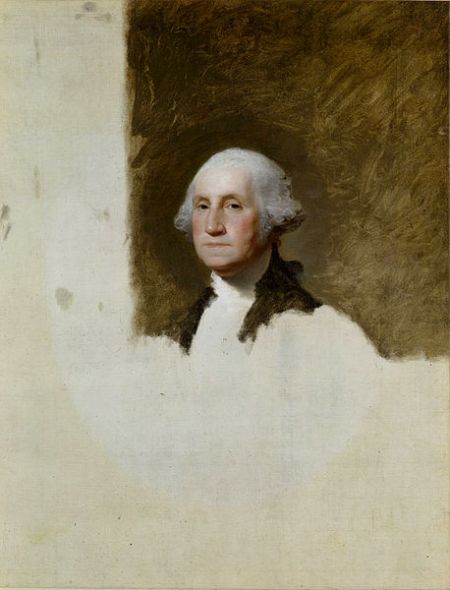
Gilbert Stuart (1755–1828) George Washington: The Athenaeum Portrait 1796 Oil on canvas 48 x 37 in Jointly owned by the National Portrait Gallery, Smithsonian Institution, Washington and the Museum of Fine Arts, Boston
I will put it in one of the following Reclaiming Beauty chapters: Beauty Truth and Goodness, Beauty in Art, or Beauty in Culture and Society under Myths and Legends, with the same title: The Truth That Follows George Washington.
George Washington's prolific portraitist, Gilbert Stuart, painted approximately seventy-five portraits of the President, but used three portraits as references for all the rest (1). The Athenaeum Portrait is Stuart's most reproduced portrait, and is so called after the Boston Athenaeum which originally bought it. Stuart never finished this portrait. It was Washington's second sitting with Stuart, and perhaps Stuart didn't yet know how to appease the irritable Washington, who might have thought portrait painting a frivolous affair, and didn't like the long sittings. By the time Stuart painted his third portrait, he know that he could appease the accomplished equestrian through discussions about horses. The other two portraits are the Vaughan Portrait, where Washington is facing to his left, and the Landsdowne Portrait of Washington in full-length. The portraits are named after the owners. In the Athenaeum, Washington is facing to his right.
The Athenaeum Portrait provides an extraordinary vision of the President. Despite its unfinished state, Stuart manages to convey a strong vision of Washington emerging as though from some primordial matter, like a force entering our world. It was as though Washington were completely formed, somewhere behind the canvass, and Stuart was simply pulling him out with his brush and paint tools.
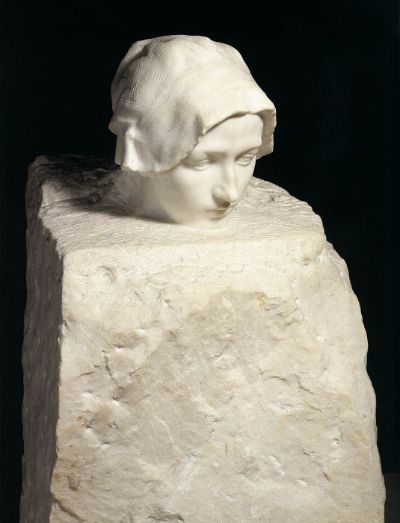
The French sculptor Rodin said that he could see the forms within the stones he chose for his sculptures, and all he he did was to entice them out of their hiding. He also left unfinished works, perhaps finding these forces to strong, and too alive, to contend with (2).
Auguste Rodin (1840-1917) Thought 1886-89 Marble Height 74 cm Musée d'Orsay, Paris
In 1886 Rodin began modeling a portrait of Camille Claudel in traditional costume. When his assistant Victor Peter, executing the work in marble, reached the collar, Rodin made him stop: the head emerging from the block offered the contrast, as in Michelangelo, of a finished section imprisoned in the rough-hewn stone. This triumph of sculpture was exhibited as it was at the Salon in 1895, entitled Head. Only later did it receive its Symbolist title of Thought Emerging from Matter, then simply Thought (3).
Perhaps Stuart, like Rodin, was aiming for something bigger than he could handle. But, it is a calm Washington that emerges in the Athenaeum Portrait, exuding a steady temperament and ready to enter our world and to put it right. It is the unfinished nature of the painting which conveys this, and Stuart may be a greater artist than I give him credit for. This portrait is probably as much about Stuart's perseverance and patience as it is about Washington's character.
The Smithsonian's National Portrait Gallery in Washington D.C. explains Stuart's technique for the Athenaeum Portrait (4):
The strikingly fresh aspect of this life portrait of Washington comes from Stuart's application of subtly varied skin tones in separate, unblended touches of the brush. His technique is visible even in the shaded areas under the chin, where Stuart alternated darker and lighter flesh tones to indicate shadow and reflected light. The president's white-powdered hair and blue eyes stand out in contrast.
And the biographical notes on Stuart at the National Gallery of Art biography say this (5):
[Stuart] used it [the Athenaeum Portrait] throughout his career to make approximately seventy-five replicas, and the image - carefully built up with contrasting flesh tones - is one of Stuart’s most accomplished portraits.
Stuart spent time on Washington's face, once again supporting my idea that the process exhausted his artistic energy. He used this completed (or detailed) visage as his reference for his many other completed paintings of Washington, since perhaps using a painting reproduction was an easier reference than Washington himself.
Pictures don't lie, at least I don't think they do. And they often succinctly tell us truths which can easily be camouflaged by clever words or clever techniques. Despite Stuart's difficulties, he gave us one of the best portraits of Washington, depicting both his strength and his wisdom.
Another artist, the French sculptor Jean-Antoine Houdon, produced a life-like bust of Washington, which is now at the Morgan Library in New York (6). Houdon made a cast of Washington's face, and returned to France to complete his work. Washington had to remain behind the drying mask with his eyes closed, and Houdon had to use his creative powers to bring to bring life back into Washington's eyes. Like his countryman Rodin, he let the sculpture breath its own life in to the bust, and like Stuart, he gave Washington the calm, confident strength. As described in Ron Chernow's Washington: A Life (7):
The conscientious Houdon...asked if he could shadow Washington on his daily rounds and study his face and movements in social interactions. During the next two weeks he even attended a funeral with Washington and took part in the wedding of George Augustine Washington and Fanny Bassett. It reveals a good deal about Houdon’s genius that the most expressive moment for him came when Washington flared up indignantly as he haggled over a pair of horses; always a tough bargainer, Washington thought the other trader was asking too much. During this sudden flash of anger, Houdon thought he spied the inner steel in Washington’s nature.
Chernow continues with Houdin's paring down the bust to "essential truths about Washington":
Methodical in his own habits, Washington was naturally fascinated by the systematic effort that Houdon poured into each step of the artistic process. On October 6 the Frenchman began working on a terra-cotta bust that was likely a preliminary step in creating the full-length sculpture.
...To the extent possible, Houdon dispensed with artistic conventions and pared down the bust to essential truths about Washington, making him life-size and lifelike. The sculpted face is strong and commanding, and the skin smooth, without the crags time later carved into the cheeks. As Washington turns his head, his shrewdly appraising eyes seem to scan the far horizon. Washington’s expression is forceful, his determination evident in his narrow gaze, matched by the muscular strength of his shoulders. Because his hair isn’t fluffed out at the sides, the bust accentuates the hard, lean strength of his face. Houdon captured both the aggressive and the cautious sides of Washington, held in perfect equipoise.
Lawrence Auster wrote about Washington in a similar fashion (8):
We are so accustomed to the Gilbert Stuart portraits, painted in Washington’s sixties when he was already showing premature signs of age (though his firmness of character was not diminished), that it can be a shock to see a more vital Washington. Here is a marvelously life-like image of the then 53-year-old Washington rarely seen by Americans, one of the heads sculpted by Jean Antoine Houdon from the life mask he cast when he visited Mount Vernon in 1785, now at the Museum of the Louvre in Paris. Houdon told a friend he was in awe of "the majesty and grandeur of Washington’s form and features." One has the same awe at Houdon’s genius; it is to be doubted that any photograph could make us feel that we are as close to the living man as he really was.
High Park Cherry Tree Photograph by: Kidist P. Asrat ca. 1997
And Truth was never far behind Washington. A famous legend which followed him throughout his life recounts his awakening to truth when confronted by his father (9):
Never did the wise Ulysses take more pains with his beloved Telemachus, than did Mr. Washington with George, to inspire him with an early love of truth. "Truth, George"' (said he) "is the loveliest quality of youth. I would ride fifty miles, my son, to see the little boy whose heart is so honest, and his lips so pure, that we may depend on every word he says. O how lovely does such a child appear in the eyes of every body! His parents doat on him; his relations glory in him; they are constantly praising him to their children, whom they beg to imitate him. They are often sending for him, to visit them; and receive him, when he comes, with as much joy as if he were a little angel, come to set pretty examples to their children."
But George Washington had told a lie, when he was six years old (10):
When George," said [an excellent lady], "was about six years old, he was made the wealthy master of a hatchet! of which, like most little boys, he was immoderately fond, and was constantly going about chopping every thing that came in his way. One day, in the garden, where he often amused himself hacking his mother's pea-sticks, he unluckily tried the edge of his hatchet on the body of a beautiful young English cherry-tree, which he barked so terribly, that I don't believe the tree ever got the better of it. The next morning the old gentleman [Washington's father] finding out what had befallen his tree, which, by the by, was a great favourite, came into the house, and with much warmth asked for the mischievous author, declaring at the same time, that he would not have taken five guineas for his tree. Nobody could tell him any thing about it. Presently George and his hatchet made their appearance. George, said his father, do you know who killed that beautiful little cherry-tree yonder in the garden? This was a tough question; and George staggered under it for a moment; but quickly recovered himself: and looking at his father, with the sweet face of youth brightened with the inexpressible charm of all-conquering truth, he bravely cried out, "I can't tell a lie, Pa; you know I can't tell a lie. I did cut it with my hatchet."--Run to my arms, you dearest boy, cried his father in transports, run to my arms; glad am I, George, that you killed my tree; for you have paid me for it a thousand fold. Such an act of heroism in my son, is more worth than a thousand trees, though blossomed with silver, and their fruits of purest gold.
The story is of course not only of telling the truth, but of telling the truth after one had told a lie. To recant, to accept one's guilt, and to rectify the error is what George Washington did, and why his father so whole-heartedly forgave him. And why we still hold this legend dear, which gives us the essential truth about George Washington.
It is a great legend to have for a nation's founding leader.
References: 1. Gilbert Stuart: Philadelphia (1794-1803). Notes on the National Gallery Art Exhibition, March 27-July 31, 2005. http://www.nga.gov/exhibitions/2005/stuart/philadelphia.shtm
2. Thought (Portrait of Camille Claudel). Web Gallery of Art http://www.wga.hu/html_m/r/rodin/3busts/claudel.html
3. Ibid
4. Gilbert Stuart. George Washington: The Athenaeum portrait. The Smithsonian National Portrait Gallery, Washington D.C. http://www.npg.si.edu/cexh/stuart/athen1.htm
5. Gilbert Stuart: Philadelphia (1794-1803). Notes on the National Gallery Art Exhibition, March 27-July 31, 2005. http://www.nga.gov/exhibitions/2005/stuart/philadelphia.shtm
6. Gilbert Stuart George Washington Life Mask: Morgan Library, New York. http://www.themorgan.org/exhibitions/gwlifemask.asp
7. Chernow, Ron (2010). Washington: A Life. p. 511. Penguin USA.
8. Auster, Lawrence. (February 20, 2004). Washington's Birthday. View From the Right. http://www.amnation.com/vfr/archives/002212.html
9. Mason Locke Weems (1809). The Fable of George Washington and the Cherry Tree In: The Life of Washington. M.E. Sharpe. 1996 Armonk NY
10. Ibid
------------------------------------------------------------------------------------------------------------------------------------------------------------- Posted By: Kidist P. Asrat
"When a whole people is trained either to the passive acceptance of or the eager participation in lies, it is the human soul that suffers first, and suffers worst. It is this that makes the constant seeking out and explication of the animating principles of contemporary liberalism absolutely vital." Sage McLaughlin, From The Price of Progress is Truth
“It is not merely true that the age which has settled least what is progress is this ‘progressive’ age. It is, moreover, true that the people who have settled least what is progress are the most ‘progressive’ people in it.” GK Chesterton, Heretics
“We have mixed up two different things, two opposite things. Progress should mean that we are always changing the world to suit [a] vision. Progress does mean (just now) that we are always changing the vision…” GK Chesterton, Orthodoxy
The advanced liberalism of our age combines a remarkable zeal for what is called Progress with a rejection of any standards superseding Man’s desires. I intend to use the words liberal and progressive in a somewhat sloppy way in this post, because for all practical purposes the liberalism of the mid-20th Century has been replaced in America by the Progressivism to which it owes its original existence, and in fact that “regress in Progress” was in my view necessary. It was necessary not only because the problems which liberals attempted to solve could never be solved by their preferred means and were therefore bound to be judged, at some point, to be insufficient half-measures; but also necessary because of what Jim Kalb identifies in his book The Tyranny of Liberalism as the absence of any internal or intrinsic limiting principle to political liberalism.
It is often said that the problem with progressives is that they don’t clearly know toward what they are progressing, and in the case of most flesh-and-blood liberals, this is certainly true. But it would be a mistake—indeed, it is a mistake often made on the right—to leave it at that and to suggest by our silence that the problem with Progressivism simply is a lack of vision. In this respect the quotes I’ve cited by Chesterton leave out something crucially important, which is that liberalism does advance according to a discernible logic and a working set of core assumptions. Thus it would be more appropriate to say that the vision is left largely unstated—and must be, because the whole rhetorical appeal of liberalism is that it promises the end of any external constraints on the human will—but that the workings of Progress move toward a definite goal or end state is observably true.
Because liberals are so often opaque and even confused about the end state toward which they supposedly would like to progress—in fact they are in my experience extremely hostile to any pressure you might place on them to articulate that state, and frequently will become agitated and put out if pressed on the topic—it has largely been left to conservative commentators like Jim Kalb to work out what precisely is the end goal of political liberalism. This frequently entails a process of working backwards from the end goals of liberalism in such a way as to explain the policy choices we see them pushing everywhere, and to explain such phenomena as political correctness, by which we mean the unspoken assent by every member of polite society to a set of unquestionable assumptions, without stating explicitly what those assumptions are but sensing, without being told, when he might be coming close to transgressing them.
Some say the problem is one of ordinary honesty. That is, liberals generally know what they really want, but are unwilling to tell us frankly what it might be. In the concrete case of particular political figures, academics, or public intellectuals, this is certainly true. But the problem reduces to one of active deception in only a limited number of cases, and in my opinion the most powerful force corralling the liberal masses into line is the mundane influence of social and political partisanship. Stated simply, liberalism advances in the practical political realm in spite of its evident radicalism because people on the political left are flatly unwilling ever to admit that the policy being pushed by Political Figure X is as radical as it appears to be, or even that it is a liberal policy per se, insisting instead that it is merely an extension of universally agreed-upon and obvious values.
Thus while it would have been impossible during the campaign season of 2008 to convince Candy that President Obama intended to force Catholic hospitals to provide free abortifacient coverage to its employees, Candy would nonetheless defend to her dying breath the notion that nothing could be more fair, sensible, and obviously in keeping with the demands of justice than the HHS mandate once it had been proposed by her man, though she was perfectly unaware of the urgent necessity of the policy only a week before the it was made public. The point is that Candy can intuit that the policy is an extension of liberal principles identified by Kalb, such as the free and equal satisfaction of desires; all that is wanting is for some liberal politician or academic, in whom she has some political or social investment, to announce his intention to impose that extension into law. What would have been denounced as the raving fantasies of the Paranoid Style only a day before, becomes an obvious requirement of justice merely by its being advanced as a real policy proposal. This dynamic is possible only because advanced liberalism has a rationale to which people feel constrained to offer general consent, even though they have no idea why.
One normally encounters this timely shift in attitude hand-in-hand with a downright gasp-inducing lack of self-awareness, as was on display in EJ Dionne’s astounding claim that it was the (solidly Democratic and generally Obama-adoring) US Catholic Bishops who were acting out of partisanship when they moved to oppose the administration’s new rule. That Dionne was carrying water for a liberal Democrat administration, and that he was doing so in direct contradiction to his supposed Catholic identity, seems rather obvious to any fair-minded observer. In Dionne’s case we may speculate without knowing for certain that as a member of the liberal opinion-shaping class, a perverse sense of professional obligation is at work here; but even for your common man on the street it is probably the case that something like party identification or the demands of one’s social circle exerts an extremely strong pressure to conform to every new liberal demand. Why their wills yield so reflexively to this pressure can be explained simply by considering the new policy as an extension of core liberal principles which, having no intrinsic limit whatsoever, are taken to be right and necessary even if they were completely unimaginable a week before.
Liberals often object with great heat and umbrage that there are of course rational limits which adhere naturally to liberalism’s predations. We just haven’t reached them yet, we are assured, and any rank injustice to which we might point is the work of overzealous enlisted men in the field, so to speak. But other evidence, besides the incremental acquiescence of its adherents, for the lack of any internal controlling mechanism abounds. An all-embracing, atmospheric inexactitude with respect to goals is often presented as a virtue in itself (as in the Johnson campaign’s 1964 statement that, “I just want to tell you this—we’re in favor of a lot of things and we’re against mighty few”). At other times, the goals are stated in facially ludicrous terms, betraying a basic intolerance of any rational or externally-imposed constraints (as in the call by FDR’s National Public Resources Board in 1943 for the official recognition of “rest, recreation, and adventure” as an individual right to be supplied, somehow, by the federal bureaucracy). A quick perusal of the daily news shows that after running short on formal political inequalities to remedy, liberalism prowls ever-more avariciously for ever-tinier and ever-more trivial dragons to slay, until practically anything, from a child’s drawing to the convenience of male posture in the bathroom, becomes a political concern requiring the liberal state to swing heroically in on the chandelier. It is my contention that were liberalism based on true principles, this would not be the problem that it is; at a minimum, it would not lead to amoral absurdities and irrational inquisitions that leave the shame-faced liberal with no basis for objection except to plead that, of course, one mustn’t go too far.
But how, we may ask, can one go too far in the direction of “progress?” Of course he can’t, leaving us with the reasonable suspicion that it is the liberal program itself, and not merely its overzealous application, that is the problem. It is liberalism, not “political correctness gone too far” that is implicated. And because, as a matter of common experience, whatever is thought “too far” one week might be considered “not nearly far enough” in the next, we also have the lived reality that such unprincipled protestations cannot possibly last, and will soon be abandoned, at first with a regretful sigh that “That’s the way the world is now,” but soon with indignation and bafflement that any other state of affairs ever could have obtained in civilized society.
One of the worst affects all this has is on the intellectual probity of the common person, who constantly must either assent to things he does not believe, or adjust his belief to the requirements of the current state of Progress. This must have a wearying and entropic affect on the spirit, not least on the person attempting to live and think otherwise to the current state of liberal orthodoxy. Caught in a discussion with a basically agreeable and seemingly rational liberal on some newly-harvested fruit of liberal insanity, trying to remind him of all the indignant protestations that “Of course, the right is always fear-mongering—nobody seriously would contemplate forcing Americans to recognize a homosexual union as a marriage, much less punish him for refusing to do so,” the traditionalist can feel real sympathy with Winston Smith, as he lay in the dungeon of the Ministry of Love, attempting to convince O’Brien that what they both knew to be true only a moment ago still was true:
'It exists!' he cried.
'No,' said O'Brien.
He stepped across the room. There was a memory hole in the opposite wall. O'Brien lifted the grating. Unseen, the frail slip of paper was whirling away on the current of warm air; it was vanishing in a flash of flame. O'Brien turned away from the wall.
'Ashes,' he said. 'Not even identifiable ashes. Dust. It does not exist. It never existed.'
'But it did exist! It does exist! It exists in memory. I remember it. You remember it.'
'I do not remember it,' said O'Brien.
Winston's heart sank. That was doublethink. He had a feeling of deadly helplessness. If he could have been certain that O'Brien was lying, it would not have seemed to matter. But it was perfectly possible that O'Brien had really forgotten the photograph.
And so it goes. The devoted liberal really does not remember the time when he believed Ted Kennedy’s protestations that the 1965 Immigration Act would never upset America’s ethnic composition (more fear-mongering by the practitioner of the Paranoid Style, naturally), and he most certainly does not remember his own warm relief at hearing that America would go on just as it had been. It is possible for me to imagine that my young liberal friend from the office really does not remember his angry insistence that I was being "paranoid," only a year before his open embrace of the very thing I was warning him against. It is also possible to imagine that a combination of partisanship and an unconscious knowledge of the social costs of deviation from the liberal program induces him to pretend that he does believe some new and absurd thing, while knowing that he does so because he is a craven.
Whatever the case, it is evident that a principal casualty of this constant, bewildering shifting of goal posts is not just the demoralization of principled conservatives. More importantly we may observe a diminishment in the capacity or even the desire for intellectual honesty, and an active preference for obvious lies, which results (for example) in the constant, maddening insistence by liberals that they do not wish to make American into a European Social Democracy, while assiduously advocating exactly that (particularly in the academy, where such advocacy is often perfectly explicit). When a whole people is trained either to the passive acceptance of or the eager participation in lies, it is the human soul that suffers first, and suffers worst. It is this that makes the constant seeking out and explication of the animating principles of contemporary liberalism absolutely vital. ------------------------------------------------------------------------------------------------------------------------------------------------------------- Posted By: Kidist P. Asrat
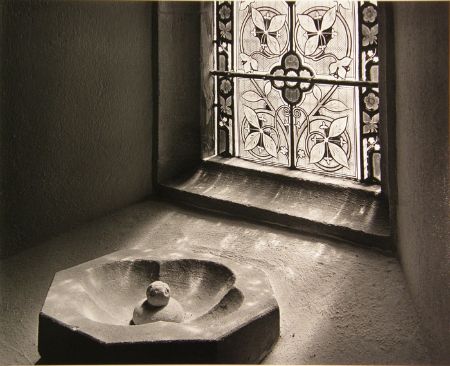
Howard Bond (b. 1931) Window, Pylle, England, 1982 Black and white photograph (gelatin silver) Brauer Museum of Art
I was just reading Solzhenitsyn, from a little volume of collected essays Larry [Auster] had given me, and in his address to the Nobel Committee on receiving their prize he said this about beauty:
Dostoevsky once let drop an enigmatic remark: ‘Beauty will save the world.’ What is this? For a long time it seemed to me simply a phrase. How could this be possible? When in the bloodthirsty process of history did beauty ever save anyone, and from what? Granted, it ennobled, it elevated—but whom did it ever save?
There is, however, a particular feature in the very essence of beauty—a characteristic trait of art itself: the persuasiveness of a true work of art is completely irrefutable; it prevails even over a resisting heart*. A political speech, an aggressive piece of journalism, a program for the organization of society, a philosophical system, can all be constructed—with apparent smoothness and harmony—on an error or a lie […] But a true work of art carries its verification within itself […] works which have drawn on the truth and which have presented it to us in concentrated and vibrant form seize us, attract us to themselves powerfully, and no one ever—even centuries later—will step forth to deny them.
So perhaps the old trinity of Truth, Goodness, and Beauty is not simply the decorous and antiquated formula it seemed to us at the time of our self-confident materialistic youth. It the tops of these three trees do converge, as thinkers used to claim, and if the all too obvious and the overly straight sprouts of truth and goodness have been crushed, cut down, or not permitted to grow, then perhaps the whimsical, unpredictable, and ever surprising shoots of Beauty will force their way through and soar up to that very spot, thereby fulfilling the task of all three. (*Larry marked this passage in the book)
In searching the web for Solzhenitsyn's quote (so I didn't have to type it from my paperback) I found it, and some additional commentary on the topic that you may find of interest:
----------------------------------------------------------------------------------------------------------------------------------------------------- By: Dean Ericson