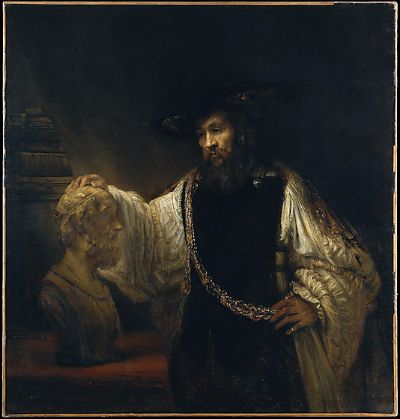
 Aristotle with a Bust of Homer
Rembrandt van Rijn, Dutch, 1606–1669
1653
Oil on canvas
56 1/2 x 53 3/4 in Metropolitan Museum of Art-----------------------------------------------------------------------------------------------------------------------------------------------------
The Tyranny of Artistic ModernismMark Anthony Signorelli and
Nikos A. SalingarosNew English Review, August 2012
[Note: I went to Mark Anthony Signorelli's website and found
this as his main page. This is the same image I used at a
post on aesthetics. I've re-posted the image above].
We who live in the Western world at the present time continue to suffer under the reign of a great tyranny — the tyranny of artistic modernism. The modernist aesthetic, which dominates our age, takes a variety of forms in the respective arts — in architecture, a lack of scale and ornamentation combined with the overwhelming deployment of materials like glass, steel, and brutalist concrete; in the plastic arts, a rejection of natural forms mixed with an unmistakable tendency towards the repulsive or meretricious; in literature, non-linear narrative, esoteric imagery, and an almost perfect lack of poetic form and diction. Yet common now to the practice of all these arts are certain primal impulses which may be said to form the core of the modernist aesthetic — a hostility and defiance towards all traditional standards of excellence, discovered over millennia of craftsmanship and reflection; a notion of the artist’s freedom as absolute, and entirely divorced from the ends of his art; and, as Roger Scruton has so clearly demonstrated, a refusal to apply the category of beauty to either the creation or the estimation of artwork. Standing behind this aesthetic is an ideology supported by nearly the entire institutional structure of the Western world — the universities, the publishing houses, the galleries, the journals, the prize committees, the zoning boards. Books that evince a fidelity to modernist principles are the ones that get published. Buildings that conform to the brutal codes of modernism and its derivatives are the ones that get built. Whatever creative efforts spring from other sources of inspiration other than modernist aggression are invariably ignored and dismissed as something antiquated or reactionary. This is the great totalitarian system of our times — the dictatorship of modernism.
Of course, the reign of modernism has been with us for over a century, and its domination has developed over a long period of time. At this point, it has been around long enough to propagate its own rules and standards as it institutionalized its strategy for survival and dominance. It has been around long enough to establish its own canon of “classics.” In short, it has by now developed into its own distinct tradition. Because contemporary artistic production — whether in the field of literature, architecture, music, or the plastic arts — is so obviously inferior to what has been produced before, proponents of modernism generally aver that modernism per se belongs to the early part of the twentieth century, that the creative world has since moved beyond modernism into a “post-modernist” phase, then beyond even that, and thus any criticism of contemporary art is irrelevant to the period of “high modernism.” But this clever strategy pretends to miss the fact that the vast majority of developments since modernism retain its essential negation of complex order. Any evolution of types and forms that has occurred since the period of “high modernism” have applied merely on a superficial level, but the essential ideological core of artistic practice remains the same. The modernists’ tradition of negation still rules over us.
In one respect, this seems like a remarkable development, since arguably the dominant impetus behind the advent of modernism was the rejection of tradition. Whether heard in Ezra Pound’s admonition to “make it new,” or the credo of the Bauhaus to “start from zero,” the desire to break free from what the modernists regarded as the confining strictures of the West’s artistic legacy was obviously an overriding goal and motive of the movement. In a manner too obviously analogous to the totalitarian political regimes of the twentieth century, the modernists endeavored to create an art that would be entirely free of any indebtedness to the past, best captured in the noxious appeal of Alfred Jarry to “destroy the ruins.” That such a virulently “anti-traditional” movement has coagulated into its own tradition must appear paradoxical.
In fact, though, the transformation of modernism into its own discrete tradition can hardly be surprising to anyone who has reflected upon the nature of artistic production. Practical rationality dictates that all artistic creation is law-like, entailing as it does the selection of certain means to achieve certain ends. Artistic traditions emerge over time when any number of artists, under common influences, employ generally similar means to achieve generally shared ends, and thus, consciously or unconsciously, create their artifacts according to the same laws. It is thus impossible for the work of any like-minded artists, working in sympathy with one another, not to develop into a tradition, marked by allegiance to its own laws. If the rules inherent in one tradition are abandoned or proscribed, another set of rules will replace it. Thus we find that the modernists, in breaking all the rules of harmonious composition, in turn generated a set of rigid rules that are simply the opposite of the rules they replaced, rules that guarantee that complex coherence is permanently denied. They began as wild revolutionists, and have ended in our own time as the most stolid conventionalists, and only someone entirely ignorant of art and human nature would have guessed things would turn out any differently.
We see, for example, that contemporary prize-winning architects slavishly copy the same industrial aesthetic originally approved by the Bauhaus, whose members were working for the German industry to sell the industrial products of that time: steel, plate glass, and concrete. Those buildings perform terribly in all climates and are dysfunctional for most human activities inside and in their immediate external vicinity, yet so-called “starchitects” continue to emulate the rules embodied in those failed examples. Alleged artists like Damien Hirst and Cindy Sherman still recycle basically the same pranks first played on the public by Marcel Duchamp and the Dadaists almost a century ago. Poets like Geoffrey Hill and John Ashberry continue to cultivate the same arcane diction, comprised of disjointed syntax and esoteric reference, which was employed by purported “high modernists” like Pound and Wallace Stevens. In every case, whether they acknowledge it or not — whether they realize it or not — the most notable creators in our times repeatedly display their fidelity to the rules imposed by modernist ideology.
As soon as we inquire into the nature of these rules, we discover that they are opposed in almost every way to the principles of artistic creation prevailing in the world prior to the end of the nineteenth century. Of course, no one would suggest that prior to the era of modernism, artists all adhered to one monolithic tradition, or that there are not important and irreconcilable differences between, say, the tradition of Gothic cathedral architecture and the tradition of Islamic sacred architecture, or between the neo-classicism of a Pope and the Romanticism of a Wordsworth. Nonetheless, one can identify certain very deep underlying similarities among these traditions, which are not common to modernism — which in fact are antithetical to modernism — and thus we may correctly distinguish between pre-modern traditions and the modernist tradition. Whereas earlier traditions of artistic creation embraced symmetry within complexity, modernism has embraced extreme simplicity, dislocation, and imbalance. Whereas earlier traditions sought to bring pleasure to an audience — “to teach and delight,” as Horace’s famous dictum would have it — modern art attempts to “nauseate” or “brutalize” an audience (the terms are from Jacques Barzun’s The Use and Abuse of Art). Whereas pre-modern architecture employed scale and ornament, modern architecture aggressively promotes gigantisms and barrenness. Whereas classical literature was grounded in regular grammar and public imagery, modern literature routinely resorts to distortions of syntax and esotericism.
The tradition of modernism is thus at enmity with the classical and vernacular traditions of art-making at the most fundamental level. And those evolved from the human effort to grasp and engage with the natural environment. Any artist who believes his work can display loyalty to both traditions is fooling himself. Any playwright who believes he can write on the principles implicit in the work of both Sophocles and Beckett, any architect convinced he can design according to the principles underlying the work of both Palladio and Le Corbusier, is in the grips of a delusion, because the work of the latter artists came into the world to be a rejection and negation of the work of the former. An artist must settle a thousand stylistic questions in the course of his labor, but to any artist working in our times, the first and most pregnant question which must be answered before a line can be written or a stone can be laid is this: will I respect and celebrate the life-affirming aspects of human nature (as traditional artists do), or will I reject and condemn human nature, and celebrate its most destructive traits (as modernists and their derivatives do)?
How an artist chooses to answer this question will depend crucially on what sort of conception he entertains of how human beings are connected to life and the cosmos. Artistic styles, and the traditions which perpetuate them, do not emerge from an abyss, but rather grow out of the deep philosophical convictions of their practitioners. There is such a thing as consistency between one’s beliefs and one’s artistic techniques. The artist in our time will therefore need to ask himself what understanding of humankind manifests itself in the parallel strands of classical and vernacular traditions, versus what understanding of humankind manifests itself in the modernist tradition, and which of these understandings best matches his own. He will discover that the prevalence of complex forms among pre-modern artworks bespeaks a conception of liberty bound to a conception of essence — a deep, even unconscious, belief that the limits and strictures of artistic form do not constitute a deprivation of the artist’s freedom, but rather the preconditions for any creative activity at all. Traditional societies produced artifacts and shaped their environment in a way to give maximal sensory and emotional pleasure within the constraints of materials and utility. This action was therapeutic, a means of emotional nourishment akin to and just as necessary as physical nourishment. The order and proportion inhering in these forms demonstrates their creators’ conviction that their work was to be presented to rational creatures, to creatures capable of recognizing order, and moreover, irresistibly attracted to order, according to the ineffable but universal phenomenon of beauty. The constant pursuit of beauty in classical art evinces the similarly profound conviction that the human soul is a thing capable of edification, of being drawn more constantly and more thoroughly towards harmony, and that the making of art is unrivaled in its capacity to further such edification.
To the contrary, modern art betrays a pursuit not of harmony, but of domination — domination of nature, of language, of one’s fellow man. The level of stylistic violence implicit in modernist architecture is extraordinary: overhangs without obvious supports, leaning buildings, extremely sharp edges sticking out to threaten us, glass floors over heights leading to vertigo, tilted interior walls also leading to vertigo and nausea. Look at the horizontal windows of modernist buildings that violate the vertical axis defined by gravity, or the “brutalist” exposed concrete in dangerously rough surfaces — a violence against the tactile environment, often falsely excused as being “honest” rather than a sadistic architectural expression. The “milder” forms of this violence are represented in minimalist environments devoid of all signs of life: totally blank walls, windowless façades, curtain glass walls, buildings as cubes of glass, buildings as cubes of smooth concrete, etc. Indeed, the subtlety that earlier attempted to camouflage this intrinsic violence has finally been abandoned, and buildings are now built as if blown apart, dismembered, and their forms melted. Consider also the jarring disjunctions of meaning and sense in modernist poetic lines like Hart Crane’s “Again the traffic lights that skim thy swift / Unfractioned idiom, immaculate sigh of stars, / Beading thy path--condense eternity” or Geoffrey Hill’s “Vehemencies minus the ripe arraignment / Clapper this art taken to heart the fiction / What are those harsh cryings astrew the marshes / Weep not to hear them.” Such passages constitute an assault on the normal conventions of linguistic usage and discursive thought, which is why Jacques Maritain claimed that the poetry of his age “endeavors to get free from the intelligible or logical sense itself,” that it represented “a process of liberation from conceptual, logical, discursive reason.” Or consider the deformations of the human form in painters from Picasso onwards, or worse, the displays of body parts with or without fresh blood, excrement, anything that is disgusting and revolting to our physiological systems, all of which, as Ortega y Gasset claimed, “betray a real loathing of living forms or forms of living beings.” Through this stylistic violence, modernism pursues not an edification of man’s rational nature, but rather an exaltation of his unqualified will. And behind it all is nothing but despair, betrayed by the total absence of beauty, which signifies these artists’ complete inability to imagine any reality transcending the calamitous ugliness of the modern world.
We can see then that modern art embodies and manifests all the worst features of modern thought — the despair, the irrationality, the hostility to tradition, the confusion of scientia with techne, or wisdom with power, the misunderstanding of freedom as liberation from essence rather than perfection of essence. In short, artistic modernism is the nihilism of our epoch made incarnate. The modern world did give us a vastly improved understanding of our environment coupled with enormous power over it. We became drunk with that power and abused it abominably, yet modern science increasingly reveals the superiority of evolved solutions for furthering human civilization in a healthy and sustainable manner, compared to arbitrary artistic whims. We have equated this power with the modernist agenda, and, terrified of losing our dominance over nature, continue to subjugate creative endeavor to ideology.
Because the practices of modern art emerge from this false conception of human nature, its productions are typically repellent to human nature. The ordinary response to modern art is not attraction, but nausea or revulsion. This is why the vast institutional structure supporting modernism is necessary, to forcefully maintain the perpetuation of forms of art which, if left to the tastes of people in general, would die off in a day. Only the absolute dominance of the institutions could ever convince the population that a lopsided building or paint splattered across a canvas should qualify as a masterpiece. The public is normally revolted by such artistic violence, which is why its propagandists call out constantly and hysterically for more “education,” by which they mean brainwashing, intended to bully ordinary people into accepting these perversions. Indeed, the modernists’ almost complete take-over of the schools has been the single most important factor in the triumph of their style; witness the architecture schools, where only a handful of programs in the entire world dare to teach design on traditional principles. Modernism’s project of domination, control, and destruction has naturally attracted persons who crave power, and who master all the techniques for achieving power and dominance over others. It should be no wonder, therefore, that a dominant elite producing and promoting an art of hatred controls the market today. A “new normal” has been imposed, according to which the most unnatural — or rather, anti-natural — of styles has been exalted. What is worse, the classical styles have been represented as aberrant; the pursuit of beauty or harmony has become the gravest crime an artist could commit. Poets who attempt to write in structured form are attacked as “fascists.” Architects who employ the design vocabulary of pre-modern traditions are dismissed as “reactionaries.” The propaganda machine of modernism has been so successful that we now witness the complete inversion of artistic standards.
And what now drives the construction of such anti-art and anti-architecture more than anything else is simply the lust for financial gain. Success in the corporate commercial sector has come to depend upon the ability to find ever more shocking expressions. Contemporary art is no longer about art, and has not been for decades. Instead, we have a vast corporate media machine that produces “objects,” often repulsive ones, as play-pieces in a financial game of manipulative speculation. The commercial value of these objects is artificially inflated via cycles of promotion and sales, and then the end-owner enjoys a tax write off by donating the object to a museum. The paid mercenaries who play this sordid game are then pushed upon the public as great figures, worthy of our admiration and emulation. This is how the farce of modernism ends, with the anti-bourgeois rebel revealed to be a money-grubbing little fraud. As with all unscrupulous money-making schemes, the people who engage profitably from selling such art and design to the public are habitual practitioners of deception: the global advertising industry is a vast and willing participant in this game. And throughout the corporate and academic structures supporting this system, otherwise decent people lead a life of continual lying, in order to achieve a level of economic comfort. Conservatives who continue to lament the decline of our cultural standards in one breath while expressing unqualified loyalty to the “free-market” in the next ought to give serious consideration to how much of the decadent cultural detritus surrounding us has been ushered into the world out of the profit-motive.
When the authentic nature of artistic modernism is thus laid bare, we have no doubt that young artists of good intentions will readily reject it in favor of the natural and timeless traditions of artistic creation. Not that we ought to return to the past, but to use the accumulated wisdom of discovered knowledge to finally move forward. The stakes could not be higher. This is not about aesthetics but civilization itself. We are watching the increasingly rapid dissolution of civil society on all sides of us — the failure of our schools, a breakdown of the family, the degradation of language, the abandonment of polite manners, the rape of the environment, and the replacement of a stable economy with a torrent of dangerous speculation. We do not give sufficient consideration to how far the depravity of contemporary art may be implicated in this catastrophic decline. Nothing is so important to the spiritual and mental flourishing of a people as its art. The stories they tell, the buildings they inhabit, the public spaces in which they gather, the songs they sing, the fashioned images they gaze upon — these things shape their souls more permanently and effectively than anything else. We live in a time when the art all around us accustoms men to, and insinuates into their souls, the most erroneous and degrading ideas imaginable about themselves and their world. A humane society can hardly be expected to grow out of such an adverse cultural environment.
The prerequisite, then, for restoring sanity to our civilization is an unqualified rejection of artistic modernism. Consequently, the first duty for every true artist at this moment of history is an act of spiritual fidelity to the timeless traditions of art-making, and an uncompromising, unmitigated hatred towards the dictatorship of modernism. Every true artist should come to his work now with something of the spirit of a liberator fighting an entrenched tyranny. Just as important for the long term is that people now intimidated by the regime’s hegemony do their part through passive resistance, a Gandhian refusal to participate in and be manipulated by the corrupt system, and a willingness to mistrust “experts” who have for years promoted creations that disdain life and human sensibilities. Every true artist will have engraved in his heart and mind the powerful words of Schiller, “But how is the artist to protect himself against the corruption of the age that besets him on all sides? By disdaining its opinion.” Buoyed by this disdain for the professors and the critics, the “starchitects” and the laureates, who have done so much to wreck the various arts which they pretend to practice and promote, the true artist will turn his gaze away from the disastrous wasteland those individuals have wrought, and return again to the permanent sources of all genuine inspiration — the beauty pulsating throughout the natural world, the capacity for excellence inhering in the human soul, the faint and sporadic glimpses we have of a purposefulness behind the observable chaos of life. From such springs the great traditions of artistic creation were once nourished; from such springs alone will a renovated culture emerge once more in our times.
-----------------------------------------------------------------------------------------------------------------------------------------------------
Posted By: Kidist P. Asrat