About.......Contact.......Society.....................

Saturday, December 14, 2013

Flora

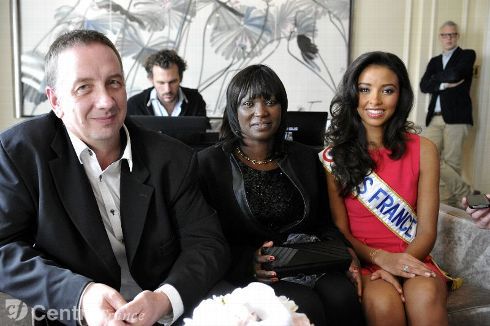
I went through my post on the new Miss France, Flora Coquerel, to review the photograph I posted of her with her African cousins.


I made a small error (well, big in the context of the analysis I later make), but I think I missed it because of the re-writes I did of the post to get to the core meaning of the words and images.

Flora says:
...je pense que beaucoup de personnes peuvent se retrouver en moi.
I translated "se retrouver" and "en" as:
...I think that many people can identify themselves with me.
Later on, in an analysis of this statement, using the correct pronoun for "en" and a different, but more precise phrase for "se retrouver," I wrote:
"find themselves in me"
I think finding oneself is an existential quest. There is only one self to find. Whereas to identify oneself is a fluid, changing, and less traumatic quest. One's identity can be linked to a family, to a gender, to a culture, to a country, to a region, and so on. If my family's link is not solid, then I always have my cultural links. If that is not enough, there is always my country, and so on.

Flora instinctively realizes that there are many like her in France, and although she may not be able to articulate this, in the West as well, who are "finding themselves." Her example, and her candid declaration, may help those others, lost and searching, who cannot feel comfortable with the France they grew up in, but who can still fight to reach the pinnacle she has reached. She is truly "Miss France," but for the disenfranchised, as she has pronounced in her unsophisticated, but sincere, language.

And later on, as she gains more confidence, and without doubt becomes more political, she will try to forge a new "France" where the metisses, the neglected offspring of Africa and Europe, can win more than decorative titles. Why not from Miss France to Madame La Presidente?

Flora's quest is serious and deep. She may have won Miss France, but who is she, really?

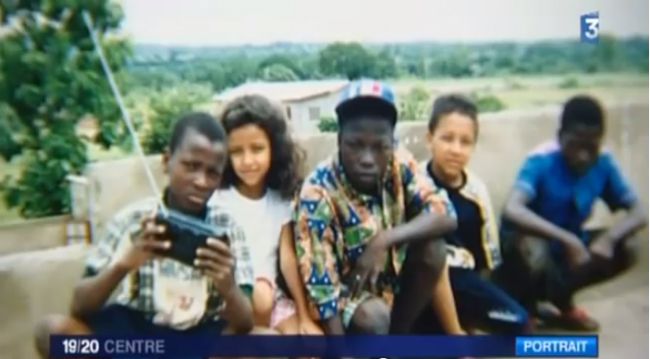
Back to the photographs. Flora's parents took her to Benin as a young girl, and from my understanding, took her there regularly. Her mother is very dark-skinned (and I think attractive with her high cheek bones and very dark, ebony skin), so it is not surprising that these cousins also have this blue-black skin color.

Flora seems at ease in the photograph, and is even leaning slightly on the cousin to her right, in a kind of loving gesture. These are family, after all.

But look at the scowls of the boys. And look at how the one on her right is pushing into her, squeezing her between him and the other cousin. It is as though she is to be protected by them, but that she also belongs to them. This beautiful, light-skinned, half-white cousin of theirs is like a trophy. Even the cousin at the far right is vigilant, forming a bodyguard of boys around the girls. I would think the other girl is also a cousin, and she looks like another mettise, although perhaps not as favored as the French Flora. I have to speculate that this other metisse cousin has a difficult life in Benin. Metisse may be good coming from France, but black Africans would most certainly not tolerate such a different looking "relative" in their midst, and would treat her as an alien. That could be the reason for her slightly dejected, and vigilant - in her own way - look. She does look like Flora, but isn't as pretty. And that could be another reason these dark African boys flocked around Flora in their protective/aggressive manner.

Flora is not at all frightened. Her father (whom I assume is taking the photograph) is there after all.

I wonder if Flora were left alone with these boys and the other metisse girl for an extended period the protectiveness of the boys would turn to violence? I think the metisse girl would be an accomplice with the black boys, since she has to deal with them when Flora is gone. She is not Flora's ally. For these black boys (and metisse African girl), Flora is the pretty French cousin who comes from that far-off white world which they see on television and which the whole world admires. She is a trophy, and an enemy. To have her in their midst, and to claim her, would give them prestige. And no-one in their community would denounce them.

This is the volatile world in which Flora lives, as she happily and innocently claims her trophy in the name of her metissage.

-------------------------------------------------------------------------------------------------------------------------------------------------------------
Posted By: Kidist P. Asrat
-------------------------------------------------------------------------------------------------------------------------------------------------------------

Thursday, December 12, 2013

Truth Doesn't Mix With Subtlety


I've posted on a film of a book that I recently re-read titled: Starting Out in the Evening.

Here's what I wrote:
Starting out in the Evening is a quiet, graceful film about Leonard Schiller, a New York writer who is working on what could be his final book, and Heather, a young, aggressive graduate student who disrupts his life to do research for her master's thesis on him. Leonard is initially taken in by this bold young woman, and reluctantly agrees to her regular visits to interview him. He admires her persistent and intelligent personality. But he refuses to answer personal questions, saying that explaining his books and the ideas behind them is sufficient.
Starting Out in the Evening is a book about the importance of writing, and the importance of conveying ideas through writing. Schiller, the protagonist, is a writer who tries to distance the personality of the author as far away from the content of the writing as possible. He is not writing a confessional book, nor really a book about personal perceptions. His quest is a quiet and determined one to bring literature to the forefront of writing.

Here is a paragraph from the book:
The thought crossed his mind that if greatness had eluded him as a writer, perhaps this was why: because he'd never wanted to make a scene. Subtlety and indirection are important tools, but you can't scale the highest peaks with these tools alone. [P. 174]
Writing is like a weapon. It critiques, and often criticizes, the culture it is in. It is not a "stream of consciousness" of the artist's confessions, and who really cares about the author's "personal stories" unless you're a one-in-a-million writer like Dickens or Shakespeare? Even when available, the personal stories of writers tell us very little about the literary aspects of the book. Just because we know that Hemingway liked to watch bull fights doesn't give us any further insight into Hemingway's fascination in brute force. He could have equally watched contemporary football games and written similar books on "sports and force."

Schiller is right. Subtlety and indirection can help some parts of writing, but at the end of the day, the writer has to bite the bullet and write the real story. He has to find other tools to scale the highest peaks. I think you can do that with truth. And often truth is difficult to write, and difficult to accept. And it can lead to serious repercussions, from loss of a career to loss of life, for the writer.
-------------------------------------------------------------------------------------------------------------------------------------------------------------
Posted By: Kidist P. Asrat
-------------------------------------------------------------------------------------------------------------------------------------------------------------

Wednesday, December 11, 2013

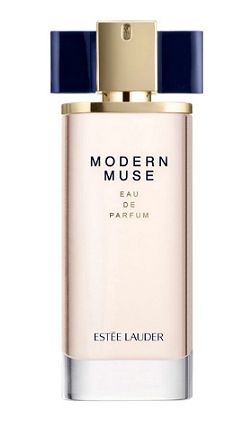
Modern Muse: A Jasminy-Musky-Vanilla Grand Finale


What is a modern muse?

Estee Lauder created the new perfume Modern Muse inspired by:
...the complexity of a modern woman, with the same dynamic contrasts as her life and her personality. Her creative energy and magnetic femininity are captured by its multi-faceted, sparkling floralcy. Her sleek style, strength and sensuality by its sleek woods.
She asks:
"Who is a Modern Muse?"
And answers:
A chic new vision of today's woman.

She's confident and independent, soft and strong, feminine yet dynamic.

Stylish and original, she inspires everyone she meets--without saying a word.
It looks like the modern muse is everything.

Irrespective of this "dual" definition, Modern Muse is a soft and flowery perfume. It has none of the "strength" and "dynamism" that Lauder describes.

And I think it is a good thing.

Here are the notes for Modern Muse:

Top Notes: Mandarine Orange
Middle Notes: Lily, Honeysuckle, Jasmine, Tuberose, "Flower Petals"
Base Notes: Patchouli, Amber, Musk, Vanilla, "Woody Notes"

The perfume is lovely. It does start off a little strong. Could it be the tuberose middle note? I've never liked tuberose in perfumes as it gives them a harsh scent. Or the citrusy orange top note? Citrus notes are my least favorite. But fortunately this doesn't stay long, and a delicate flowery scent - possibly the lily or honeysuckle - takes over for a while. Then we're left with a jasminy-musky-vanilla finale.

I think it can work both for a day and a night perfume. I think it is best as a winter/fall perfume, and is a little too strong for spring and summer. It is just strong enough to give a "dressed-up" feel for an evening, but light enough to wear on a winter's coat.

The bottle is also well-designed, in a modernist sort of way. The long, rectangular bottle resembles the tall modern skyscrapers (very masculine), but the dark bow on top gives it that feminine touch (women shopping in big city department stores?). I like the contrast of the very pale pink of the bottle, which is not the color of the liquid, but rather the enameled bottle, with the stiff navy blue bow. This is not a bottle that men would be attracted to.

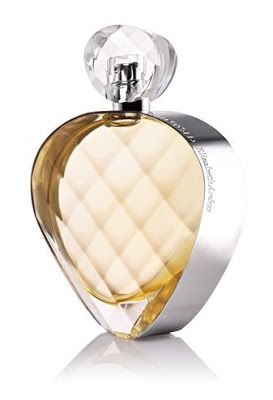
The nice shop girl at Sephora's gave me a sample, although I went looking for Elizabeth Arden's "Untold," which is being advertized in magazines and on TV commercials. Again, it is the "multi-faceted modern woman" who is being featured in Arden's new perfume. But the jeweled facets of the bottle more creatively allude to this modern woman. The notes for Untold, though, are very similar to Modern Muse, although Untold doesn't have the vanilla and jasmine base notes which soften it and make it very feminine.


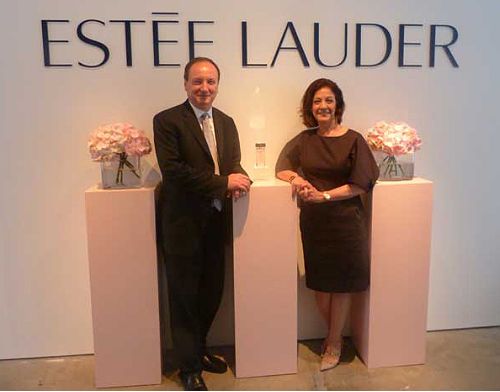
I thought perhaps the perfume designers were the same for Modern Muse and Untold. But it is Karyn Khoury (who sounds like she has Lebanese origins) for Modern Muse, who worked as an assistant to Estee Lauder for thirty-five years, and the French Clement Gavarry, with several generations of perfumers in his family, for Untold.

I will do a review of Untold in the near future.

Karen Khoury, Senior Vice President at Estee Lauder says about creating Modern Muse:
We built Modern Muse by carefully selecting every ingredient to reflect the personality, style and distinctive femininity of today’s woman.

The “dual-impression” creative approach offers each woman the opportunity to connect with the fragrance in her own way. Some will focus on the sparkling floral elements of the fragrance, while others will view the warm, rich woodiness as the defining facet.
The "we" in Khoury's team consists of the French Master Perfumer Harry Fremont:
Parfumer; born in Cannes, France, graduated from the ISIPCA or "Institute Superieur de la Parfumerie" located in Versailles in 1981, he received two consecutive awards for his olfactive creation by the prestigious "Societe Technique Des Parfumeurs de France" in both 1984 and 1985. In 1987, joined the Firmenich International Fragrance Center in New York after spending three years at the Corporate Headquarters in Geneva; has created fragrances in partnership with Ralph Lauren Fragrances, Calvin Klein Cosmetics, Intimate Beauty, Bath & Body Works, Cacharel, Nino Cerruti, Valentino and Lancome


Harry Fremont and Karyn Khoury showcasing Modern Muse

--------------------------------------------------------------------------------------------------------------------------------------------
Posted By: Kidist P. Asrat

Tuesday, December 10, 2013

"Je pense que mon métissage est une force"


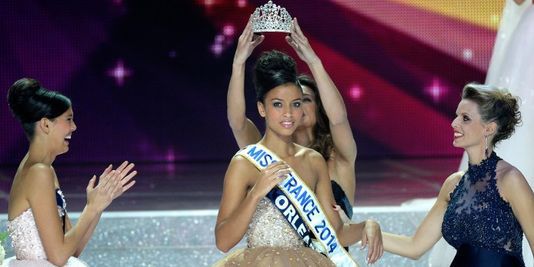
Miss France 2014 being crowned

We think that through our multicultural mind-set, other cultures will follow our (pious) example.

Well, people don't want to change.

The new Miss France is a metisse: the offspring of a black mother and a white father.

I've tried to find a current definition (and translation) of "metissage" but have decided to keep the word in its French. Tiberge from Gallia Watch has come to the same conclusion, and explains her decision here. She writes:
Here is my rendition of his words. It is far from perfect, because his grammar seems a bit off at times. Except for two places, I have retained the French word "métissage" (crossbreeding), and it's various verbal and adjectival forms, since "crossbreeding", "racial mixing" and other similar terms don't always convey the right meaning. "Crossbreeding" sounds too scientific, as when farmers crossbreed crops. "Miscegenation" is too technical and refers to marriage. "Mongrelization" and "bastardization" are too graphic. It looks as if "métissage" will join "laïcité" and "communautarisme" as French words that are so troublesome, it's better to just leave them.
This Metisse Miss France says:
"I think that my metissage is a strength."

Which is a variation on "Diversity Our Strength."

She says about her "metissage":
Je pense que mon métissage est une force. Ca montre que la France d’aujourd’hui est une France mélangée où il y a toutes les cultures. Et je pense que beaucoup de personnes peuvent se retrouver en moi, que ce soit les Français de souche ou les Français d’origines diverses.
--------------------------------------
I think my miscegenation is a strength. It shows that today's France is a mixed France, which has all cultures. And I think that many people can identify themselves in me, whether they are "les Français de souche" or those french from diverse origins .
Some notes on the translation:
- "find themselves in me" implies a deep, even ancestral identification rather than through skin color or looks.
- "Les Français de souche" is a difficult phrase to translate, and Tiberge has given a brief definition here, where she writes: "[I]n French the word "souche" means "root", a "Français de souche" being, therefore, an ethnic Frenchman."
- Rather than say "French of diverse cultures" Miss France goes one step back and says French of diverse origins, as though these are not French people - i.e. les Français de souche - but other peoples of the world. But more specifically, she means French of diverse origins who come from non-European countries.

Miss France is pretty. I thought she was Arab when I first saw her photo, and that her "metissage" was white and Arab. But, here are her parents:


Miss France's parents

Her father is from Orleans, the heartland of France, in the beautiful Loire Valley, in whose town center stands a statue of Joan of Arc.

Her mother is from the west African country Benin.


Statue of Joan of Arc in the city square of Orleans


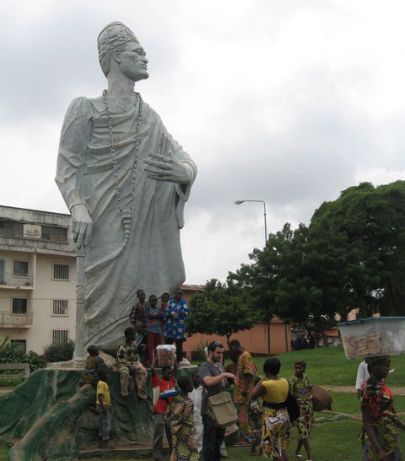
Statue of King Toffa in Porto Novo, Benin

She looks nothing like either of them. How does she identify with her parents? Children often resemble at least one of their parents, and if they have siblings, the resemblances would be distributed amongst the two parents. They can say "I come from that family," which of course leads to the bigger identification of "I come from that culture," and eventually "I come from that country."

Although Miss France's mother speaks fluent French, she has a slight accent. French is the official language of Benin, which also has a plethora of indigenous languages. Most African countries which were colonized by the British or the French use these European languages as their official ones, but also speak one or more other native language.

I wonder how Flora reacted to her mother's accent growing up? Young children are very discerning of differences. This must have accentuated her mother's "otherness" to her even more. Her father, like her, speaks French like a Frenchman.

Miss France has to invent an identity for her amorphous and difficult-to-identify mixed-parentage of such different racial and national backgrounds. Even countries where metissage is common in the core identity of the country, like Brazil, for example, the strong and confident groups are not the metisse, but those who claim a particular racial group, like blacks or whites. In Canada, there is a racial group called Metisse, but they have never forged alliances either with the "Natives Canadians," i.e. those with Indian ancestry, or with whites. Their cultural and political, and even personal, strength is minimal.

I don't know how strong metissage will prove in France. I don't think it is a strength, as Flora says above. Whites may be having a hard time identifying their whiteness with strength, but there is a group which is not at all shy of doing so, and it is growing in strength and in numbers: Muslims. And this group doesn't tolerate any kind of metissage, either in racial or religious terms. It jealously guards its religious, and cultural, identity. And it eventually seeks to put everyone within its own religious identity, possibly with hierarchical categorizations of Arab Muslims at the top and with white and black Muslims at the bottom of the ladder. The religious superiority of Islam is mandated through their religious book, the Koran. Muslims show this repeatedly throughout history in whatever country they have amassed numbers any strength. Why should France be any different? Where would the black and white metisse like Flora fall under this categorization?

Here is Flora's more specific association with her African roots:
"Je suis franco-béninoise. Je mets en avant mes deux origines. Mes parents ont une association au Bénin, qui vient en aide aux enfants et s'occupe du forage. Au cours de mon année, je souhaite soutenir l'insertion des femmes dans le travail et l'alphabétisation", a-t-elle expliqué après son sacre.
Below is my translation:
I am Franco-Beninese. I give equal importance to both my backgrounds. My parents have an association in Benin, which helps children and drills wells. During my reign, I hope to provide work and literacy for women [in the Benin project, I presume].
In the Wikipedia definition of Beninese (the English translation for Béninois) such a person is:
From Benin, or of Beninese descent.
Flora thus identifies with the culture (or racio-culture) as well as the nationality of Benin.

Her metissage does not place her white and black backgrounds on an equal level: she is more black than white. Her diversity does not put all cultures on an equal footing: she is more Béninoise than Française.

Whenever a mixed-race child with one parent who is white and the other Asian, African or Hispanic, is asked to chose his identity, he will always identify with the non-white parent. This seems to be the rule of racial identity.

This of course also leads to identification with the non-white parent's cultural and national background, even as this mixed-race child lives, and benefits from, the culture, civilization and accomplishments of whites.

I will try to refine this and coin a definition (or definitions) in the manner of: First Law of non-whites' racial and cultural identification.


Flora in Benin as a small girl, visiting her cousins, as Mr. Coquerel informs us in this video.
Her parents kept her in direct contact with her mother's country from an early age.


-------------------------------------------------------------------------------------------------------------------------------------------------------------
Posted By: Kidist P. Asrat
-------------------------------------------------------------------------------------------------------------------------------------------------------------

Sunday, December 8, 2013

A Very Rockefeller Christmas


One minute the tree is dark.

The next minute, it's twinkling with a thousand lights.


The Christmas tree on Rockefeller Center is lit. The Tree Lighting Ceremony took place last week some time, but I missed it for some reason, and watched a recast of the show on ABC last night.

I won't go into the parade of contemporary pop stars who came on singing their renditions of Christmas songs and carols. Suffice to say that many sang their songs flat - although they all made a show of adjusting their ear-pieces, as though it was a technical fault rather than their inadequacies.

But I will mention these two who gave great performances: Jewel and Kelly Clarkson.

Jewel discarded her slightly whiny "country" voice at least for this show, and came on as a chanteuse. I was surprised at her deeper voice, and how effectively she used it. She sang a classic, Chestnuts Roasting on an Open Fire.

Kelly Clarkson came on with gusto and energy, and sang Chuck Berry's Run, Run Rudolph. Her take was more rock, and the rock-and-roll kind of rock, with its feet-stomping, dance rhythms.

Then, there is the magical lighting of the tree. One minute it's dark, the next it's sparkling with thousands of lights (45,000 multi-colored LED lights, to be exact. And on top of the 12-ton tree is a 9 1/2-foot-wide Swarovski crystal star).


Jewel the Chanteuse
Chestnuts Roasting on an Open Fire


Kelly Clarkson the Rockeuse
Run, Run Rudolph

-------------------------------------------------------------------------------------------------------------------------------------------------------------
Posted BY: Kidist P. Asrat
-------------------------------------------------------------------------------------------------------------------------------------------------------------

Friday, December 6, 2013

A Parasitic Marriage and the Decline in Happiness


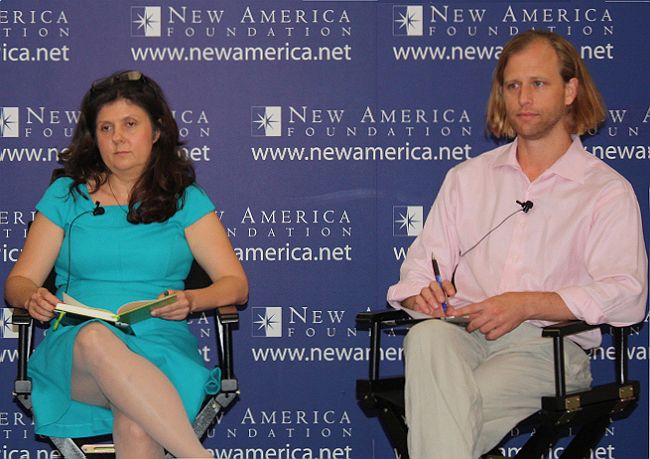
Betsey Stevenson and Justin Wolfers on a panel at New America Foundation conference in 2013.
Their panel was titled: Home Economics: How the Changing Economy Shapes Decisions
to Marry - or Not Marry.
(Scroll down to the bottom for the video.)

Stevenson has a Rottweiler's expression, as though she's ready to swat someone (Wolfers?).
I don't blame her. Who wouldn't swat Wolfers, with his meek and subservient demeanor.


-------------------------------------------------------------------------------------------------------------------------------------------------------------

I posted a couple of days ago images of unhappy, and aggressive, young girls who were part of a toy campaign to have them play with toys made for boys. The girls, despite their initial interest in these toys, ultimately wanted "girl" toys.

I found this comment I made at Lawrence Auster's Veiw From the Right in 2010 while looking through my emails. The comment was posted in a discussion titled: The Factory Of Liberal Society Keeps Churning Out Its Quota Of Dead Young White Women.
A long and complex 2009 study on women's happiness shows that women lose ground to men (are unhappier than men), and older women are less happy than younger women. And "[Twelfth grade] girls have lost ground [in happiness] both absolutely and relative to boys."
Twelfth grade girls, given a list of items and asked "How important is each of the following to your life? report a large number of these items with increasing importance, compared to boys. The list includes things like: "Having a good marriage and family life" to "Discovering new ways to experience things." It could well include "Running in marathons."
Twelfth grade girls in this study are overwhelmed with the expectations they adopt, and are more anxious and insecure (i.e. unhappy) in general than boys.

Although they seem happier than their mothers or grandmothers, their decline in happiness is predictable, if taken by their mothers' responses.

This study's results, coupled with the trust and innocence of teenage girls (not discussed/measured in the study), makes their "proud and sovereign" appearance not what it seems to be. And women's apparent pride and sovereignty in general. Although one would think by this study that teenager girls are more confident and happier (proud and sovereign) than their older relatives. Another one of those instances where facts debunk wishful thinking.

Here is the full pdf file of the study: The Paradox of Declining Female Happiness. By Betsey Stevenson and Justin Wolfers.
Critics of this study show that the numbers are insignificant, but in a scientific study context, they are statistically significant: i.e., the data mean something.

Wolfer and Stevenson try to explain this declining female happiness, although I think another study which targeted the portion of women who responded with "yes, my happiness is declining" and asked them variations on "why are you unhappy" would be an important follow-up study.

This follow-up study never occurred, but Stevenson and Wolfers continue with another equally fascinating topic about the relationship of men and women in a household where both hold careers. They don't quite present it like that, but I have analyzed it in that context.

Below is a transcript of some sections of the conference Home Economics: How the Changing Economy Shapes Decisions
to Marry—or Not Marry
, presented by Betsey Stevenson and Justin Wolfer in 2013. Here is the full video. They haven't come up with any explanation for this decline in
Stevenson: In our household...I do all the bills and all the taxes, and manage all the money.
Wolfers: And I have no idea how much money I have...
[Belly laugh from Stevenson]
Stevenson: And Justin deals with all the bills and all the technology. I can barely turn on...Every time I go on the treadmill I go "how does this TV turn on again?"
Of course, like all female feminists, Stevenson wants the best of both worlds. She can act all "girlie" and confused when it comes to technology (really, how hard is it to figure out house-hold appliances and home exercise machines?), but no toddler or infant will get in the way of her career ("We have a three-year-old and an eight-month-old" announces Stevenson). And she can get her "career" too.

This must be a parasitic relationship. Wolfers and Stevenson must benefit from the double income. I wonder how much of the household chores Wolfers really does? Stevenson implies that modern domestic work is relatively easy, with all the gadgets. But someone still has to cook the dinner and clean the bathroom, albeit with fortified and quick-acting detergents. And there are the children. I assume it is her who takes care of these by maneuvering a large supply of nannies and day-cares. I assume also that she makes the meals, or at least prepares the food in advance and stores it in color-coded tupperware for her husband to defrost and serve when she's out on her after-hour missions. Then she might even take an extra hour after work to buy that new perfume, or the pair of shoes she saw recently in some fashion magazine. Or take a "girl's night out" for a drink of wine with other career women at an expensive downtown bar one day a week. And of course there will be the hair stylist, the cosmetician, the manicures and pedicures, the spa. Her ragged look in the conference photo above should not fool us. And all this costing her several thousand over the course of the year.

I wonder what "gadgets" Wolfers gets for his suffering? A boat for the summer? A "man cave" in the basement, replete with an HDTV, a surround sound music system, and a state-of-the-art Laz-Y-Boy?



This article informs us that Wolfers' hobby is "running."
If You Run the Numbers, It's a Good Time:

I'm not just an economist, I'm also a runner, training for the Marine Corps Marathon.

Runners World magazine recently argued that marathon running is an incredibly cheap sport. All you need is a pair of shoes, and you're off and running. But they're wrong.

You see, they were emphasizing the out-of-pocket cost, which is small. But the foundation of all economics is something called opportunity cost. It says that the true cost of something is the alternative you have to give up.

So each hour that I spend running is an hour that I don't spend hanging out, working, or sleeping. How do I choose? Following economic theory, I keep doing an activity only as long as it yields greater benefits than the alternative.

And as I spend my hours slugging out the miles, I'm forced to confront my choices. Instead of sweating it out on the trails, I could take on extra teaching and earn a few extra bucks. And so going running costs me good money.

The same logic applies to you. Each hour you spend on your hobby is an hour you don't spend working harder to get a promotion, studying for a degree, or shopping around for the cheapest groceries.

By my calculations my 16-week training program comes at an opportunity cost of several thousand dollars. A quicker runner would have a smaller opportunity cost. It's only because I'm both slow and an economist that I fret that the world's cheapest sport is actually incredibly expensive.

But to an economist, the choice is still a no-brainer. We think you should only do what you love, and pay for it by doing what you are good at.

By sticking to economics, I make time for running. Rather than spend hundreds of dollars worth of time cleaning my house each Sunday, I hire a cleaner, who does a better job, at a better price.

When a friend asks me to help them move, I write them a check to pay professional movers instead. It's just more efficient.

And while it can be hard to forgo extra income for a long run, it is even harder to justify wasting that time on Facebook. And with the time that saves, I'm pulling on my shoes to head out for another run.
Running doesn't cost much money, except for the initial investment in a $200 pair of sneakers (I can't see Wolfers going for $50 running shoes) and a monthly gym membership fee of $75, which will set him back $1,000 for the year (he just couldn't share that treadmill with his wife).

But Wolfers clearly understands that the cost for his running is not necessarily monetary, but the time he cannot (does not, will not) spend with his wife and family. Perhaps his running is a ruse to avoid spending time with them, in that chaotic house where he will be shouldered with the chore of the evening.

The goal of women is marriage, however much they deny it. I doubt that Wolfers would want marriage with Stevenson, as is the nature of men unsure of their women, especially emasculating ones like Stevenson. Marriage, with its life-binding promises, with the burden placed higher on males, is something to be avoided with women like Stevenson.

In the meantime, Wolfers gets to work in a career and have a extra money around from his wife's income. Although, Stevenson is clearly the more advanced, career-wise (here is the Wikipedia profile for Stevenson, and here is Wolfers'). At some point, Wolfers who will have to deal with a discontented wife, making more "family" demands on him to come home earlier, take the kids skating or soccer, help with the dishes. And why not the cooking too?


Baby Duty

He surely gets what he deserves. But, since he won't see it like that, at some point he will have to contend with a wife who files for divorce, or a separation. Perhaps she might even suspect him of/catch him cheating.

I thought Stevenson's corpulence and sloppiness (in the top photo) was because of a pregnancy. But, she's eight months past her second child's birth at that point. She just seems overwhelmed with "How does this treadmill work" and "How do I continue with my fast-paced career which won't sync with my breast-feeding and nappy-changing schedule?" I suspect she has a plethora of nannies to feed her expressed breast milk to her infant, and might even bring her baby to her office on "light" days to show what a mom she is. I think all this adds to her her frazzled look of overwhelmedness, which I think is really guilt, buried deep at leaving her children, and husband, behind for a career. And she looks far older than Wolfers, although he is only a year younger. She looks like she could be his mother.



Above is a photo of Stevenson that is profiled in articles as far back as 2008. She has on make-up, and looks pretty. She must resemble the younger woman Wolfers met as a graduate student in Harvard, when they were both twenty-somethings (Stevenson graduated from Wellesley College in 1993, and I would estimate at twenty-three, and from Harvard in 2001, when she must have turned thirty). In her most recent photo (see the top of the blog for one taken in 2013), she looks like she's simply aged. Two toddler children, a full-time career, and a live-in "partner" don't make for an easy life.

Wolfers is no better, with his longish hair, chopped off as though to deny he grooms it carefully (this is a carefully styled hairstyle to look nonchalent and "radical"). Although he looks like he's regressed back to some college era age in his most recent photos.

But, he has a fanatical look which come through when he's discussing the evils done to mankind before Obama came to save it in this video at a Brookings Institue conference taken in 2013. He is a true Obama disciple. His views seem as though he's supporting "rich kids'" ability to transfer to non-paying public pre-schools. But then he faults their move by saying that the "poor kids" would be crowded out by these rich kids, who's greedy parents would rather have the option of sending their children to the non-paying public schools.


Image from the video at a 2013 Brookings Institute conference

Odd logic, these lefties. Surely a rich parent wouldn't want his children to receive mediocre education, as well as the plethora of dangers the child could face in a government subsidized poor school? Surely he will do his best to give quality care, on all counts, for his children and family, and that would include quality day-care, even at a cost?

Wolfers' reverse logic is of course that rich kids could also be crowded out of pre-schools by poor kids entering these schools through various subsidies. But these rich kids would then be forced to enter the free public pre-schools due to overcrowding by poor kids in their own rich schools, in turn crowding out those poor kids left behind without subsidies to enter rich schools. I knew there was a catch when he started "supporting" rich kids. I had to listen to his video, and read a couple of posts, before I could surmise the above [these links might be helphul: a and b).

He must have learned his tactics for arguments from Obama, his mentor.

Such are the convoluted personalities of the liberal elite, who live their public lives advocating for the poor, yet everything they do in their personal lives depends on a large stash of income.

Stevenson and Wolfers have two children, a daughter who is about four, and a son who is about one. It will be interesting to see how the "rear" these children, and if they will have found solutions to increasing the happiness quotient of girls. And what woudl they do if their doaughter wanted a full-own, wedding-dress including, church wedding (miracles do happen.) Would they attend, or would they refuse the invitation out of principle? Or if their son, as a macho teenager laughed at his father's dishwashing ways?

As I wrote above, there are many sequels to this research waiting to be written.

-------------------------------------------------------------------------------------------------------------------------------------------------------------
Posted By: Kidist P. Asrat
-------------------------------------------------------------------------------------------------------------------------------------------------------------

Monday, December 2, 2013

Mutli-Culti Girl Riveters Building Amunition?


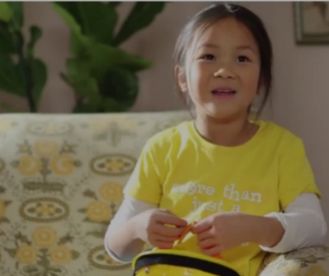
Laura Wood, at The Thinking Housewife has posted the above image, which was sent by one of her correspondents. It is a crew of multi-culti future girl engineers. On closer inspection, what these girls are really interested in are the pinkness of their toy kitchen cabinets. The full interaction about girls (and women) in men-oriented fields like engineering, is discussed at the site.

What I'm interested in is the expressions of these little girls.

I kind of like the black girl's "come and get me if you want trouble" expression, in the group photo I posted above. I think black girls, and low-income black girls in particular, are at the bottom of the totem pole of American life. I think they have it tough. Being on welfare, as many are, is a mind-numbing life. And as the statistics show, they are single mothers on welfare: i.e their men have abandoned them. So I think this aggressive stance is a form of self-protection, even against those men who may show up for whatever opportunistic reason. Does that translate into the tough job of a construction worker though? I doubt it. Manouevering welfare to bring up a baby is very different from wheeling huge machinery around and planning the construction of a building.

But, then look at the black girl when she smiles. What a pretty face, in a strong and chiseled way, she has. Her behavior seems spontaneous and genuine. She really is smiling. And is happy to smile. I suspect that when she gets mad, it is with equal genuineness.

Next, the Asian girl. She seems the most out of place. She cannot act "tough" following the black girl's lead, and instead looks self-conscious, doing an uncomfortable parody of "tough." What happens when a rough, aggressive working man questions her authority? No smile, or half smile, will work.

And she smiles (or half-smiles) as though she doesn't know how to read the cues for "it is o.k. to smile now." Danger seems to be around the corner.

The white girl has mimicked the black girl the closest. She does look serious and angry. I suspect she could wreck her own little havoc if she had to.

But then her expression later in the video loses that boldness. Not only has she lost her boldness, she seems to be asking, pleading, for help from some higher power. Can she not act tough on her own? Does she need the guidance of her black mentor (or some other mentor - probably a male)? Her toughness seems to fall apart pretty easily.

These girls may be wearing construction helmets, but they show us that they just want to be happy, pretty girls, surrounded by pinks and lavenders. Each in her own way, seems to buckle into being the kind of girl she knows how to be.

In terms of running the world, I would give the white girl a longer piece of the rope. And I would prefer the honesty of the black girl (think if Mammy in Gone with the Wind, who loved and took care of Tara and taught her right from wrong) to the hard-drives of an Asian girl (think of the Tiger Mom, who cannot seem to push - force - even her own children to the level she expects them to reach).

Now, the next experiment would be how this multi-culti assortment of female engineers would really fare in the real world. Would the black woman listen to the Asian? Would the white woman diplomatically lead the group? Would the firm build any bridges while making money? So far, the evidence is negative.


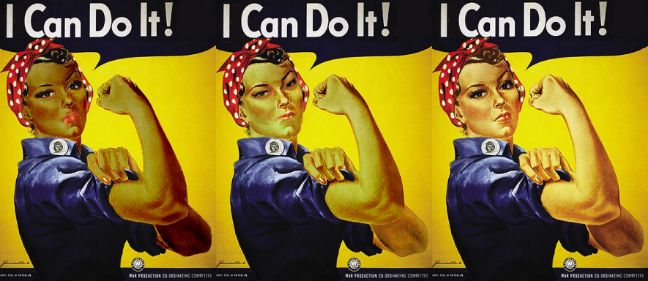
Rosie the Riveter: I Can Do It!

I got the title for this post from Rosie the Riveter. She was the iconic image for women working in factories building war machinery towards the war effort during WWII. The "We Can Do It!" Rosie the Riveter poster was created by J. Howard Miller for the War Production Coordinating Committee of the Westinghouse Company, in 1942.

I used Rosie's image and changed it to look like a black and an Asian woman to parody "inclusive" feminism that contemporary feminists advocate.


But, the reality is that even feminism cannot unite the different races of women. Even if the language is a war against a "common" enemy: Men.

Rosie (and the Rosies) went back to their domestic domains once the men came back from the war fronts.

And all little girls want are pretty, soft toys in pinks and lavenders.


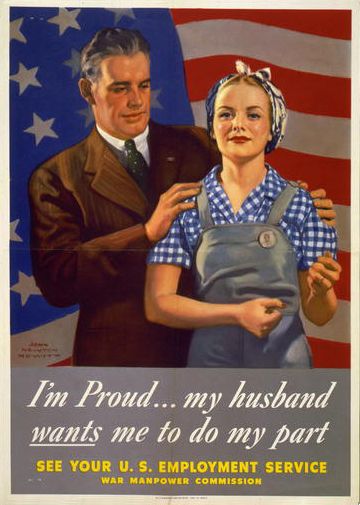
Title: I'm proud ... my husband wants me to do my part
See your U.S. Employment Service / / John Newton Howitt.
Creator(s): Howitt, John Newton, 1885-1958, artist
Related Names:
United States. War Manpower Commission , funder/sponsor
United States. Office of War Information , funder/sponsor
Date Created/Published: [Washington, D.C.] : U.S. Government Printing Office, 1944.
Medium: 1 photomechanical print (poster) : halftone, color.
Summary: Husband, in suit, and wife in working clothes, standing in front of U.S. flag.
Repository: Library of Congress Prints and Photographs Division Washington, D.C.

------------------------------------------------------------------------------------------------------------------------------------------------------------

Posted By: Kidist P. Asrat
------------------------------------------------------------------------------------------------------------------------------------------------------------