About.......Contact.......Society.....................

Saturday, November 30, 2013

Jewel Reigns

Last year a beautiful American Foxhound named Jewel won the Hound category in the National Dog Show.

This year, she went one up and won both the Hound, and the final coveted Best in Show prize.


Yes, she is smiling

Dogs are interesting creatures. They do things with such seriousness, and above all, with such eagerness to please their masters. Some act a little cocky, even in front their masters, but their are quickly reined in by an adroit and commanding voice. Jewel was a little disobedient in last year's competition, and that is why the judges feel she may have lost the grand title, although she did win the 2012 Best in Hound trophy. It looks like she was a little spooked by the foreign environment, with all the noise and the crowd. But, the judges were quick to add that at the moment of the hunt, the American Foxhound focuses in on putting his attention on the chase and capture. That is probably the same spirit that led Jewel to win the coveted dog prize this year.

And this year, she seemed perfect. She was happy to show what she knew, and she did so with some flourish. Probably the familiarity with the place helped, as well as a few other competitions and prizes she took along the way. And a dog's natural proclivity for play (at whatever age) also adds to Jewel's, and other dogs', charms.


The foxhound was President Washington's favorite dog. As I wrote here (quoting from the America Kennel Club):
George Washington, the father of our nation, is also the father of American Foxhounds. In 1770, Washington imported a number of hounds from England and in 1785, he received a number of French foxhounds from the Marquis de Lafayette. These hounds, carefully bred and maintained by Washington, are the founders of today’s American Foxhound. More than 30 hounds were listed in Washington’s journals, including "Drunkard," "Tipler," and "Tipsy."


First Gentleman of Virginia, 1909
John Ward Dunsmore
Fraunces Tavern Museum


Jewel: A Winning Spirit


Roger the Pekingese, who won Best in Toy [Dog] category.
How can this creature compete with the likes of Jewel?


There is a hierarchy of royalty. American President George Washington vs. Chinese Dowager Empress Tzu Hsi

The Pekingese is a spoiled lap dog: The American Foxhound is a working dog. Although the Amercian Foxhound became famous for fox hunts, it was also used for chasing coyote and deer.


Jewel, with her Best in Show 2013 Trophy

--------------------------------------------------------------------------------------------------------------------------------------------------------------
Posted By: Kidist P. Asrat
--------------------------------------------------------------------------------------------------------------------------------------------------------------

Thursday, November 28, 2013

Happy Thanksgiving


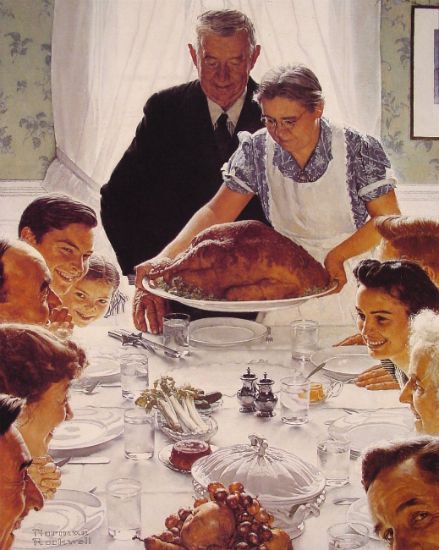
Norman Rockwell (1894-1978)
Freedom from Want
Oil on canvas
1943
45.67" x 35.43"
Norman Rockwell Museum, Stockbridge, Massachussetts


Here's how I analyzed the painting in a post in 2005:
Freedom from Want. By Norman Rockwell, 1943

1. The grandfather is the center, both pictorially and actually - there is no ambiguity about that.

2. The picture is designed in the classic pyramidal fashion, with the important figures at the top of the pyramid (grandfather and grandmother) and the rest of family widening out to the base.

3. ...Rockwell has brought nature into to the family, with the turkey, fruits and vegetables all laid out on the table. Rockwell's Nature is really abundant.

4. All the food follows the central and important axis, with the grandfather at the top.

5. Although we are indoors, there is a sense of space and light. The elongated perspective of the table with its white tablecloth connects with the white curtains on the window, which in turn promises to take us out into the sunny mid-day exterior.

6. Finally, this family seems to be fully enjoying the moment. And even the one person looking at us is doing so with a sense of fun and mischief...
-------------------------------------------------------------------------------------------------------------------------------------------------------------
Posted By: Kidist P. Asrat
-------------------------------------------------------------------------------------------------------------------------------------------------------------

Monday, November 25, 2013

Chutzpah!


-------------------------------------------------------------------------------------------------------------------------------------------------------------
Posted By: Kidist P. Asrat
-------------------------------------------------------------------------------------------------------------------------------------------------------------

Sunday, November 24, 2013

A Bout de Souffle

Jean-Luc Godard is one of my least favorite of the New Wave French film directors. I think his films are cruel and violent.

But, Godard's first feature-length film, Breathless, or A Bout de Souffle, has a charm and wit about it, despite its intermittent violence. Godard's films are about corruption. It is charmingly displayed as in Breathless, or is violently, cruelly and sadistically shown in his later films.

I think Breathless' charm has to do with Jean Seberg's character Patricia Franchini, the American (Girl) in Paris. Seberg had a volatile personal life. Her early life was also clouded by the suicide of her brother. It is not surprising that she was attracted to Godard, and to Breathless. Like all astute people, and those alert to people's sufferings and weaknesses, Godard must have sensed Seberg's sadness, and emotional instability. Her whimsical, fresh looks is perfect for Breathless, and it is her very charm and (initial) innocence that underscores the violence of Breathless. The ending, with its deaths and betrayal, contrasts with the light and fresh beginning. Patricia comes out unharmed, at least physically. But, we sense in the final scenes that she has been damaged, standing lost and alone, unlike the confident and resourceful girl we saw at the beginning. Godard, and Belmondo's character Michel Poiccard, have corrupted her.


Final scenes of Breathless


Patricia in the streets of Paris selling the New York Herald Tribune,
at one of her first encounters with Poiccard.


Here is a detailed write-up on the film by an obvious fan. As well as describing the film, it references its influences, both American gangster movies and a continuation of the French New Wave movement.
-------------------------------------------------------------------------------------------------------------------------------------------------------------
Posted By: Kidist P. Asrat
-------------------------------------------------------------------------------------------------------------------------------------------------------------

Friday, November 22, 2013

Share Joy with a Starbucks Holiday Coffee

The gradual move away from Christmas is subtle and clever.

Starbucks has a new "holiday" logo out, which seems to be celebrating Christmas. But it doesn't quite do that.

The main, written message of the logo, instead of saying "share the joy" of Christ's birth, simply tells us to "share joy." What could this joy mean? One million things. Something different for each person. The unified joy that we are to feel around the Christmas season has splintered into the joy each of us feels for whatever reason.

That is one way Starbucks is shifting us away from Christams.

Another way it is relaying its message of a Christmas Holiday without Christmas is through the design of its products, which either distort Christmas symbols, or leave them out all together.

Here is the Starbucks paper cup for this "holiday season":



1. What looks like a star on the left cup could just be a sparkly tree decoration shaped in a flower design.

2. The triangular star shapes in the octagons (dispersed around the cup) are too uniform, and there are two of each star ray, making a total of eight. The rays are all the same length.

The star that shines in many renditions of Christmas paintings and illustrations has four rays. And the top and bottom rays are longer, with the bottom the longest. This elongated bottom ray connects the star to the earth, to show the spot where Jesus' manger lay. This star is often called "The Star of Bethlehem."



Elihu Vedder (American, 1836–1923)
Star of Bethlehem, 1879–80
Oil on canvas: 36 3/16 x 44 3/4 in
Milwaukee Art Museum

The frantic holiday scene I’ve described is starkly in contrast to the peaceful one we find in Star of Bethlehem created by American painter Elihu Vedder in 1879-80. This painting, currently housed in Milwaukee Art Museum storage, depicts a serene moment in the muted, golden desert. Three figures on camels overlook the path before them, while three shepherd/guides ahead and three behind also survey what lies ahead. Color can be seen in the distance in the green of trees. Above them the sky contrasts what is seen below with a bright light that illuminates the sky. There is a sense of anticipation created by figures that can be seen in the clouds, standing there, backs slightly hunched as they look down upon the earth. [Source: The Milwaukee Art Museum]
Here's Rembrandt's (or what is attributed to be a pupil of his) Adoration of the Shepherds, where Jesus is bathed in what is most likely the light from the Star of Bethlehem.
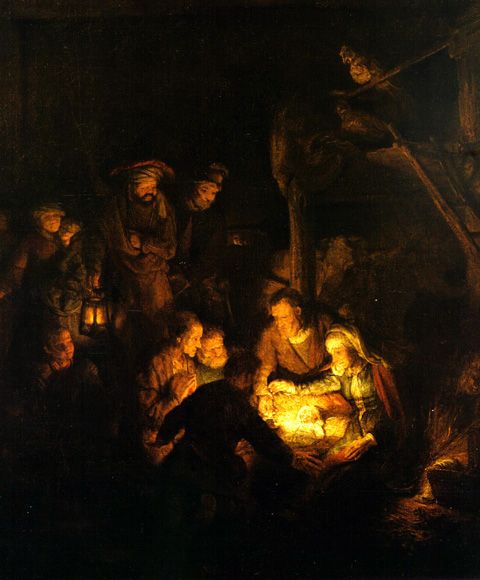

Pupil of Rembrandt, 1606–1669
‘The Adoration of the Shepherds’, 1646
Oil on canvas


Painters and art of various centuries and cultures show the importance of the star as a guiding light, and especially its pointed direction toward the earth to indicate where the infant Jesus lay.

Even popular illustrations, often for cards and hanging pictures, depict the bottom ray of the star pointing downwards. In the image below, the star shows the three kings where the manger lies.


3. Back to the Starbucks cup. The illustrations on the cup are sloppy. They look like they're preliminary sketches, rather than decorations ready for display. Especially irritating is the cone-shaped decoration, which is drawn as an amorphous blob.




4. The leaf at the bottom of the smaller cup is not that of a pine tree, nor does it look like a holly, the traditional leaf for most Christmas decorations.



It is a coffee plant leaf, and the nut-like shape, a coffee bean. Starbucks' marketing strategy, is to commemorate this "holiday" season through coffee rather than through Christmas.

The Starbucks Christmas cup is all about the coffee and very little about Christmas.

5. Shapes are scattered around the cups, as though to fill in gaps. What are the spikey triangular shapes - rays from a star? And the white dots - snow flakes? Why not have sketch of snow flakes, with some of the beautiful shapes?



6. The homes we see on the package illustration could be homes on any product cover. They have no Christmas distinction: there is no Christmas tree near the homes; there are no decorations around the houses; there is no angel or star above.



Below is a promotional image from the Starbucks website, showing the homes and their surroundings. There is no Christmas tree. The odd, leafless trees are dotted with what could be lights, but it could just be any kind of graphic embellishment. The homes have what look like lights framing the roofs, but it isn't enough to indicate Christmas lights. And the diamond-shaped objects in the sky could be stars, but there is no unique, distinct Star of Bethlehem to show that this is a Christmas scene, and not just any winter scene.

And we are invited to "create wonder," as though we have supernatural powers. What kind of wonder do we create? Again, whatever strikes our fancy, creators that we are. Like the message "Share Joy," what we create, and the joy that we share, are not related to the Christmas story, but rather, our very own individual fancies.



And finally, here is the description of the Christmas Blend mixture, from the Starbucks website:
A time to create wonder. An invitation to share joy.

Three decades ago, we created something wonderful - a coffee special enough for your celebrations big and small. Christmas Blend brings bright, lively Latin American coffees together with smooth, mellow Indonesian coffees, including rare aged beans from Sumatra. The aged coffee dramatically balances the overall flavor to create luscious, sweet, spice notes. Crafting this coffee embodies the best of everything we do - sourcing, roasting, blending, exploring, perfecting and sharing. It’s one of our most cherished traditions - made for you to savor season after season.
Of course, coffee is a Third World export. But, the description above tells us that it is part of Starbucks' "sourcing" strategy.

Dictionary.com defines "sourcing" as:
...the buying of components of a product from an outside supplier, often one located abroad
And Starbucks tells us how it does this "ethically":
Ethical Sourcing
We've always believed in buying and serving the best coffee possible.

And it's our goal for all of our coffee to be grown under the highest standards of quality, using ethical trading and responsible growing practices. We think it's a better cup of coffee that also helps create a better future for farmers and a more stable climate for the planet.
With the help of Conservation International, we’ve developed ethical sourcing guidelines that help us purchase coffee that is responsibly grown and ethically traded.

We’re working directly with farmers to develop responsible growing methods and investing in their communities to ensure a sustainable supply of quality coffee.
This sounds too much like the "Banana Republics" that developed through vast farmlands being allocated for big business plantations, while local farmers had to do with inferior land.

In this Starbucks produced video, Carlos Mario (no last name), who is clearly an intermediary between Starbucks (the corporation) and the local Costa Rican farmer, talks about the farmer and coffee production. This Third World company man says:
We are helping farmers, teaching them how to improve production, improve the quality, and reduce the use of pesticides. We are taking care of the environment and the pretty country that we have. Helping farmers is really good, and I feel really proud of that. I think Starbucks is working with agronomists because they know that if they don't care about the environment, they will not have good quality coffee in the future."
All Hail King Coffee!

Below is Toik Wolf, the cup's designer saying "All Hail King Coffee."

I found his quotes after I wrote my design break-down above. Wolf is saying almost to the word what I've written about the cup design. Of course, he thinks it is a Good Thing, while my analysis is a lament. This shows further that the deconstruction of Christmas is systematic and deliberate by the likes of Wolf and Starbucks, and not some random aesthetic project:

On The Design Process
Toki Wolf, Creative Director, In-store Promotions:
One of our early idea explorations was treating our core product, coffee, in its agricultural form and seeing if we could apply that in a beautiful way for the holidays. See if it can be meaningful in the holiday timeframe. So, there’s this image, a quick sketch of a coffee plant with coffee cherries coming out of the red cup. We were literally thinking, “If coffee is at the heart of what we do, can that be the foundation where the exploration comes from?” Even in that little sketch form, we thought we might be onto something. We kept going back to it, even after moving on from it and exploring different illustration style. We always went back to the drawing with the red cup below it. It was the basis of the elements that ended up on the red cups and the coffee bags for this year.

So, the idea was to take these coffee cherries and use them as a holiday element – like holly berries. The coffee flower that you see on the cups comes across, as maybe a snowflake, maybe a poinsettia. We start to see these interpretations. Even in the origin patterns, they kind of look like snow in an abstract form. They start to have a holiday feel to them. Once we realized that we could make this work visually in a way that was both authentically Starbucks and authentically holiday, we went for it, and extracted it all the way across all of our holiday elements. We started with the way it can be interpreted, creating the story around it. Going back to that original sketch, it feels like this beautiful holiday moment is coming out of the red cup, literally coming from the coffee. We ended up keeping the element in the swoop. We call it a “story swoop” or “story arch” that kind of flow around the packaging. So, you’ll see that across all of our holiday design elements, including the cups and the coffee packaging.

[...]

This holiday is the next step of the visual journey we’ve been on with the brand. Beginning with the new coffee packaging. We wanted the coffee to be at the center. We wanted it to look like the leader and to elevate above the noise in the coffee category. We wanted to create something that felt right for coffee but was unique and own-able to Starbucks. By doing so, we created this new visual vocabulary around coffee that looks traditional, and looks like it’s rooted in heritage, but yet it’s fresh and new. We haven’t done anything exactly like it - nor has there been anything like it in the category. You’re right. This holiday feels like a natural extension of that [the coffee packaging redesign]. It keeps that momentum going.
I like coffee, and I especially like Starbucks' blends. There is no doubt that its the "King of Coffee." I wish its leader would just say that they're in the business of making great coffee, and that they work in Third World countries. Let those countries make the necessary steps to help the farmers, while Starbucks provides the coffee for us through a true market and competitive manner.

And, I wish Starbucks wouldn't tell us to "Share Joy," or to "Create Wonder" if it cannot come right out with "Share the Joy of Christmas." I would rather just have a warm cup of coffee without being pulled into a false sense of the Christmas holiday. It is just coffee, after all.
-------------------------------------------------------------------------------------------------------------------------------------------------------------
Posted By: Kidist P. Asrat
-------------------------------------------------------------------------------------------------------------------------------------------------------------


Thursday, November 21, 2013

Living on Canaan's Side

Living on Canaan's Side, Egypt behind
Crossed over Jordan wide, gladness to find


The book cover image for On Canaan's Side

I've tried looking for the subject of this photograph. She is identified as: Woman: Topical Press Agency, Getty Images in the book's jacket. When I do a google image search for her, I get and audio book cover (below). The woman is clearly the same one as on the book cover, but the shot is taken from a different angle. I would think she is somewhat well-known, perhaps a 1920s actress. I will keep tracking down her identity, although for now I've come up only with blanks.


Audio Book Cover for Canaan's Side

--------------------------------------------------------------------

I went to Chapters Indigo looking for a calendar, and I found instead a novel. Rather than go to the regular fiction section, I often go straight to the "bargain books" tables to see their collection. The books are randomly placed on the tables (well, it seems random to me, but I'm sure the store has its own method), so it requires a little bit of patience, and some time, to glean through the titles to find one that might interest me. Once I've found something I like, I then ask a clerk what he thinks about the book. Mostly, though, I go to the store's computer and look up the author to read what critics have written.

I think this time I got lucky. I found a book titled Canaan's Side, by Sebastian Barry published in 2011. I liked the religious allusion, and the cover's black and white photograph of a woman from the 1920s. Behind her, there is a skyline of Chicago. The book was on sale for CAN $6.99 reduced from $30. A great bargain at 75% off.

The reviews in the back are by award-winning, and best-selling, authors I've never heard of. Colm Toibin, winner of the Coasta Novel Award Brooklyn, writes:
On Canaan's Side is written with vast sympathy and tenderness. Sebastian Barry's handling of voice and cadence is masterly. His fictional universe is filled with life, quiet truth and exquisite intimacy; it is also fully alert to the power and irony of history. In evoking Lilly Bere, he has created a most memorable character.
Helen Simonson, author of the New York Times bestseller Major Pettigrew's Last Stand praises the book with:
Somewhere on the second page of this book, your heart will break, and you will devour every glimmering image and poetic line as if the sheer act of reading might alter the course of Lilly Bere's haunting tale. A story of love and loss, as Irish as the white heather and as big-hearted as America itself.
And Joseph O'Neill, Pen/Faulkner winner for Netherland says the book is:
A marvel of empathy and tact.
These three reviewers wrote novels which are a little too multicultural for me, but that is to be expected of contemporary novels, set in contemporary times.

Barry, though, set his novel, or rather starts his novel, at the turn of the twentieth century, with the protagonist Lilly Bere leaving Ireland for America.

I cannot imagine any of the three critics' books described as: "A story of love and loss as Pakistani as the jasmine flower, and as big-hearted as America itself." Or: "A story of love and loss as Trinidadian as the wild poinsettia, and as big-hearted as America itself." Or even: "A story of love and loss as Italian as the Lily, and as big-hearted as America itself." I am being facetious, but somehow we relate more to the white heather's Irishness than we do to the poinsettia's Trinidadianess.

Barry has also written two books short-listed for the Man Booker Prize: The Secret Scripture published in 2008, about the protagonist's "...chronicle not only of her deep emotions, but also of a turbulent era in her nation’s history, from the upheavals of the Irish civil war to the German bombing of Belfast during World War II," and A Long Long Way published in 2005, about Ireland's participation in the First World War.

The Secret Scripture will be made into a film for next year.

--------------------------------------------------------------------
I'm Living on Canaan's Side

Music composed by: Mathilda Durham (1815-1901)
From: The South­ern Har­mo­ny and Mu­sic­al Com­pan­ion
Compiled by: Wiliam Walker (1809-1875)

On Jordan’s stormy banks I stand,
And cast a wishful eye
To Canaan’s fair and happy land,
Where my possessions lie.

(Refrain)
I am bound for the promised land,
I am bound for the promised land;
Oh who will come and go with me?
I am bound for the promised land.


O the transporting, rapturous scene,
That rises to my sight!
Sweet fields arrayed in living green,
And rivers of delight!

Refrain

There generous fruits that never fail,
On trees immortal grow;
There rocks and hills, and brooks and vales,
With milk and honey flow.

Refrain

O’er all those wide extended plains
Shines one eternal day;
There God the Son forever reigns,
And scatters night away.

Refrain

No chilling winds or poisonous breath
Can reach that healthful shore;
Sickness and sorrow, pain and death,
Are felt and feared no more.

Refrain

When I shall reach that happy place,
I’ll be forever blest,
For I shall see my Father’s face,
And in His bosom rest.

Refrain

Filled with delight my raptured soul
Would here no longer stay;
Though Jordan’s waves around me roll,
Fearless I’d launch away.

Refrain
------------------------------------------------------------------------------------------------------------------------------------------------------------

Posted By: Kidist P. Asrat

Wednesday, November 20, 2013

Henry Chao: Remember that Name


I wrote about a high-level Asian in the Obamacare design in Todd Park: Remember That Name. I said:
[I]t is much later on that we hear that Obamacare's "main architect" is an Asian - Todd Park. And his involvement in Obamacare and dishonesty about it is far greater than any of these three representatives [Health and Human Services Secretary Kathleen Sebelius, Head of the Centers for Medicare and Medicaid Services Marilyn Tavenner, and White House Press Secretary Jay Carney].
Well, we're learning now that there is another high level official who is an Asian: Henry Chao.

Fox News reports today that:
...Henry Chao, Deputy Chief Information Officer at the Centers for Medicare and Medicaid Services, testified at a House subcommittee on Energy and Commerce hearing that the site will be “greatly improved” by the end of the month -- not fixed.

Chao said Tuesday [November 19, 2013] that up to 40 percent of the technical systems supporting the federal health insurance marketplaces have not yet been built, including a system to issue payments to insurance companies, The Washington Post reported.

[...]

At Tuesday's hearing by a subcommittee of the House Energy and Oversight Committee, Chao, who is widely seen as the operational official most knowledgeable about ObamaCare's online system, said he never saw the McKinsey report.(Read more at Foxnews.com: Sebelius says ObamaCare website will remain a work in progress after key deadline
Here's a video from S-Span with Chao testifying yesterday at The House Oversight and Investigations Subcommittee of the House Energy and Commerce Committee, with questions presented by Rep. Cory Gardner.


-------------------------------------------------------------------------------------------------------------------------------------------------------------

Posted By: Kidist P. Asrat
-------------------------------------------------------------------------------------------------------------------------------------------------------------